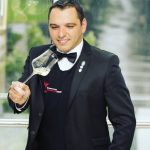
– Tasting wine is a pleasure, but creating something you enjoy brings far greater satisfaction.
When Csaba Malatinszky says this, there is no rhetoric in the sentence, no desire to impress. It comes from the experience of a man who has known wine from both sides of the glass. As a sommelier, he learned to interpret it; as a winemaker, he learned to create it. Between those two roles lies a decision that changed the course of his life.
He was Hungary’s first professional sommelier, at a time when the profession did not yet carry the weight it had in France or Italy. At Budapest’s Gundel restaurant, wine was more than a drink: it was part of a culture. There he learned how it worked: how tannins interact with fat, how acidity structures flavour, how balance is a matter of harmony rather than compromise.
Over time, however, he realised that he remained an interpreter of someone else’s vision. He explained other people’s decisions and interpreted their terroir, but created nothing himself. Quietly and persistently, that began to trouble him. At some point, he felt that talking about great wines was no longer enough-he wanted to take responsibility for a wine of his own.
Today, he speaks about marketing with a certain detachment. Since 2004, he has taken part in neither competitions nor festivals, and spends almost nothing on promotion. He understands it; he simply considers it unnecessary.
– I feel no need to embellish my wine story – he says matter-of-factly.
He chooses conversation over campaigns. If he sees someone drinking his wine in a restaurant, he will approach, introduce himself and ask what they think. He will explain the vintage, the vineyard, the choice of barrel-and watch their reaction.
– Those are the only reactions that interest me.
In a world where wines are often sold before they have matured, he chooses to take his time. In an industry that loves medals and scores, he chooses quiet. And in that quiet, he feels no sense of something missing, only peace.
Steven Spurrier and Jancis Robinson have spoken about him, while Caroline Gilby has said that he “lives, breathes and dreams wine” and that “Cabernet Franc runs through his veins”. Yet Malatinszky does not rely on other people’s words. He accepts praise without turning it into a selling point.
What he is building is consistency: the foundation for everything that follows, from his family history to Méthode Malatinszky, from Cabernet Franc to Magyar.
Before he became a winemaker, before Bordeaux and Cabernet Franc, there was a quiet fact in his family history that could not be changed.

CsabaCsaba Malatinszky comes from the Hungarian noble Malatini family, whose roots can be traced to the fourteenth century. The family’s wine history dates back to the seventeenth century, when his ancestors owned the Malatinszky Kúria estate, with thirty hectares of vineyards north of Lake Balaton. It represented more than land. It was continuity: a cellar, accumulated knowledge, the memory of vintages.
After the Second World War, everything was nationalised. The estate was never returned.
In many families, such a story would have remained a footnote. For Malatinszky, it became a foundation. What shaped him was growing up with an awareness of something that might have been his, but never was.
– My parents were never able to recover the Kúria – he says matter-of-factly. – So I had to start from scratch.
Starting from scratch means having nothing to fall back on: no cellar built by a grandfather, no routines passed down through generations, no reassuring tradition. All you have is a name-and the responsibility to give it substance.
That is precisely why his approach to wine is so systematic and controlled. He could not afford to let time do the work for him. Every decision had to be considered, every vineyard carefully chosen, every barrel tested.
Losing the Kúria made him disciplined rather than nostalgic. He set about building his own version of continuity.
That awareness also explains his reluctance to embrace spectacle. He had no need to prove his noble origins, but felt an obligation to make his surname carry weight through the quality of his wines.
In a world where generations of tradition are often used as a selling point, Malatinszky was a paradox: an heir without an inheritance. He had to create his own Kúria.
From that obligation came ambition-quiet and deeply rooted-the desire for wine bearing his name to prove that continuity can be real even when it has not been inherited.
When Csaba Malatinszky became Hungary’s first professional sommelier, it was both a personal ambition and a pioneering act. At Gundel, wine had its place in the culture, but the role of the sommelier was only beginning to gain recognition. Malatinszky approached it with almost ascetic dedication.
He worked with precision. He was interested in structure as much as flavour: how tannin makes itself felt on the palate, how acidity prolongs aromatic expression, how texture determines balance. He was analytical and disciplined, approaching wine almost as an engineer might. And he became exceptionally good at it.
Yet beneath his professional success, a restlessness was growing.

A sommelier is always an interpreter. He explains someone else’s decision, defends someone else’s philosophy, interprets someone else’s terroir. He can understand and recommend, but does not decide how a wine will be made.
– I worked with wine, but always from the outside – he later admitted.
At some point, he realised that this was no longer enough.
It was a gradual process. Every tasting of a great wine began to raise a question: how would I make it? Every analysis of structure became an inner debate. The security and standing he enjoyed at Gundel were no longer sufficient.
He wanted to experience the responsibility of a harvest, the uncertainty of fermentation, the weight of a decision about a barrel whose consequences would be measured in years.
A sommelier’s work reaches its culmination at the moment of service. A winemaker has to live with the consequences of his decisions.
That difference began to draw him in.
When he left Gundel, he embarked on the venture out of necessity. He moved from interpretation to authorship, from commentary to decision-making. That transition lends weight to everything he would later build.
If Gundel was a school of analysis, Bordeaux was a school of responsibility.
When Csaba Malatinszky arrived in the Médoc, what impressed him was the seriousness of the work. In the cellars of Château Pichon-Longueville, Château Lynch-Bages and Château Cos d’Estournel, he observed a process that left no room for improvisation: every decision was measured, every component of the cuvée carefully considered. Wine was being built for decades.
– The Médoc prepared me for everything I would later do – he said years afterwards.
In Bordeaux, he understood that great wine results from a succession of conscious decisions, and that terroir brings an obligation.
Equally importantly, he understood what he did not want. He had no wish to copy a style or make a Hungarian version of Bordeaux. What interested him were the principles: discipline, patience and faith in structure. He therefore chose the Bordeaux varieties, convinced that they could express terroir with the greatest precision.
In Cabernet Franc, he recognised something special: aromatic lift, complexity without harshness, the ability to convey both the soil and the winemaker’s personality. Bordeaux gave him a benchmark and a set of criteria, but his identity had to be found elsewhere-in Hungary, in Villány, on his own soil.
He returned from the Médoc with a standard of seriousness. From that moment, making a merely good wine no longer interested him. He wanted to make wine that could stand alongside the greats, without an inferiority complex and without pandering.
His return from Bordeaux was no triumphal homecoming. He brought no capital and had neither a vineyard nor a cellar of his own. What he brought was a standard-and the conviction that he could make great red wines in Hungary.

U BIn Budapest, he opened the first specialist wine shop, La Boutique des Vins. It was an extension of his philosophy: a place where wine was treated as culture. Yet retail was a stepping stone.
The real breakthrough came when he met József Bock in Villány, one of the key figures in Hungarian winemaking. Their partnership gave him access to what he lacked: grapes and a cellar. His first wine range, Le Sommelier, was born.
He invested in one hundred new oak barrels. At the time, small barriques were not yet widely accepted in Hungary, and the move seemed ambitious, even risky.
– I was obsessed with the Médoc and believed I could make the best red wines in the world – he said without irony.
That belief was his driving force.
The first vintages were both experiments and an education. Theory collided with the reality of the vineyard: rain, temperature, fermentation with a logic of its own. He learned how to adapt a plan to nature and make decisions as events unfolded.
During this period, Hungary began to regard him as a pioneer of barrique ageing. Yet he soon began questioning his own enthusiasm for small barrels. He realised how dominant wood could become, how easy it was to make a wine that smelled of oak, and how much harder to make one that spoke of the soil.
When he established his own winery in 1997, he made an important decision: he switched to larger barrels of 500 and 1,000 litres. He wanted micro-oxygenation without an aggressive oak signature. When using Hungarian oak, he waited years before bringing it into the cellar. Wood had to provide architecture, not perfume.
During those years, his clear hierarchy of wines also began to take shape: Le Sommelier, Noblesse and Kúria. These represented different levels of ambition as well as different market segments.
But the most important decision was still to come-and it centred on one variety.
When he launched his own winery, the first variety he planted was Cabernet Sauvignon. It was a logical choice: structure, power, reputation. Then, in 2000, almost by chance, he obtained a few grafted Cabernet Franc vines. It was an experiment rather than a strategic plan.
The vineyard was less than ideal, but the harvest was exceptional.
– I felt that this was it.
That simple sentence marked a turning point. In Cabernet Franc, he found what he had been seeking: aromatic lift, depth without heaviness, a structure that was powerful yet supple. The variety could express both the soil and the winemaker’s personality.
He began considering where it could speak most clearly. He found his answer on the western slopes of Villány, towards Siklós, at the Kövesföld site, where stony soil provides drainage and encourages concentration. There, Cabernet Franc acquired a precision and energy he had not found elsewhere.
He maintained that Villány was the only place in the world where Cabernet Franc was nobler than Cabernet Sauvignon. It was a conclusion drawn from experience. Vintage after vintage, Franc showed consistency, longevity and balance.
In time, people began calling him the “king of Cabernet Franc”. He never wore the title theatrically, but accepted it as confirmation that his intuition had been right.

In his hands, Cabernet Franc becomes a medium through which he brings together reason and emotion, discipline and instinct.
It was with this variety that he began developing what would make him recognisable beyond Hungary.
Malatinszky’s perfectionism is rooted in having started from scratch. Without an established tradition to support him, he had to create his own standard.
In 1997, when he founded his winery in Villány, he became the first in the region to introduce controlled fermentation for red wines. Temperature, maceration time, contact with the skins: he left nothing to chance. The cellar was a place of quiet, order and precision.
In time, he also moved to organic production. It was a logical continuation of his thinking: if you want terroir to speak, you have to preserve it. The soil is a co-author of the wine.
His technical thinking culminated in 2015, when he developed Méthode Malatinszky. The method involves fermentation in hermetically sealed oak barrels, creating a controlled microenvironment and a different pattern of tannin development. The aim is integration.
In the glass, that means a structure that is powerful yet harmonious, density without heaviness, tension without aggression. The tannins develop gradually and become integrated with the rest of the wine rather than dominating it.
The method’s innovation earned him the SIAL Grand Prize in Paris and Shanghai in 2018. Yet the award did not change his relationship with publicity. He neither returned to competitions nor stepped up promotion. The method had been created to resolve a problem he sensed in the texture of his wines.
In his Cabernet Franc wines, Méthode Malatinszky finds its fullest expression. Mass becomes elegance; power gains proportion.
His control is deeply personal-a way of taking full responsibility for everything that leaves the cellar.
When Malatinszky speaks about his wines, he distinguishes them by levels of ambition as well as labels. Le Sommelier, Noblesse and Kúria are three stages of the same idea.
Le Sommelier carries the memory of his beginnings. These wines are more open and approachable, more at home at the table. They reveal his precision as a sommelier: clarity of structure, balance and drinkability.
Noblesse goes a step further. In this range, he seeks deeper concentration and greater control. In some vintages, the Noblesse Cabernet Franc displays an almost Bordeaux-like architecture while retaining the warmth of southern Hungary. The tannins are powerful but finely integrated; the oak supports rather than leads.
Kúria is the pinnacle. The name carries historical weight, yet the wines look forward. They distil his philosophy: monumental yet precise, powerful yet balanced. In the finest vintages, Kúria Cabernet Franc shows the ability to age for decades. We saw this for ourselves at his masterclass in Osijek, where the fifteen-year-old Kúria Cabernet Franc was the most impressive wine.
Annual production varies, but quantity has never been the goal. He has pursued complexity.
Alongside Cabernet Franc, he also produces a Chardonnay that many consider among Hungary’s finest: mineral, precise, with a tension reminiscent of Burgundy yet firmly rooted in Villány. There is also Pinot Bleu, an unusual blend of Pinot Noir and Blaufränkisch, born of curiosity rather than calculation.
International recognition followed, but did not change his direction. He neither softened the structure of his wines to make them “easier to understand” nor increased production to meet demand.
The three ranges show an evolution, but the signature remains the same: power without aggression, structure without brutality, ambition without theatrics.
Then comes a wine that gathers that philosophy into a single name.
Magyar.
By the time Villány Cabernet Franc had established its reputation, Kúria had proved its worth and Méthode Malatinszky had received international recognition, Malatinszky could have stayed on safe ground. He had a style, a market and validation. Yet reputation had never been his ultimate goal. Beneath the technical excellence remained a question of identity-the same question that began with the loss of the Kúria and the awareness that he would have to build continuity himself.
That is how Magyar came into being.
Magyar carries the symbolic weight of the country whose name it bears. It contains no nostalgia or attempt to revive the past. It is a contemporary, rigorously constructed wine, with the added dimension of a personal statement. If Kúria symbolises family history, Magyar symbolises personal responsibility. Here, Cabernet Franc becomes a bearer of identity, a medium through which the discipline learned in Bordeaux meets Hungarian soil.
Looking back, Malatinszky’s story reads as the gradual construction of his own standard. He inherited neither cellar nor vineyard, had no archive of vintages and no reassuring tradition. He had a name and the determination to give it substance. His wines therefore represent something built afresh. Continuity had to be established through work, discipline and the acceptance of responsibility. His rejection of marketing and competitions expresses confidence in what he does. His wines stand as proof that identity can be built even when it has not been inherited.