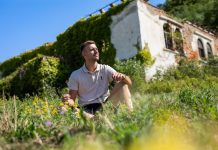
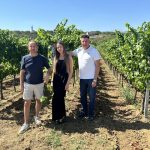
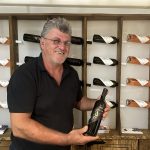
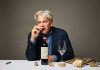
Vinski vrh Tomislava Bolfana, golemo imanje na čak 30 hektara površine, na kojem je posađeno više od 100 tisuća loza, jedna je velika bajka. A Tomislav Bolfan, ponajveći zagorski vinar, koji je u vinski posao ušao 2006. godine s namjerom dokazati „da je i u Zagorju moguće Tomislav Bolfan’s Vinski Vrh, a vast estate covering no fewer than 30 hectares, with more than a hundred thousand vines planted on it, is one great fairy tale. And Tomislav Bolfan, one of Zagorje’s foremost winemakers, who entered the wine business in 2006 determined to prove ‘that top-quality wine can be made in Zagorje too’, is anything but a fairy-tale character – he is a good-hearted man whom, with a smile, we shall try to ‘conjure into being’ before drifting off to sleep.
Tomislav is a fantastic storyteller, an enthusiast with tremendous energy and the power to draw everyone around him into his story, a dreamer and a sincere believer – both in the teachings of Jesus Christ and in the vision he is bringing to life at Vinski Vrh.
Although, looking back over the fifteen or so years since we met at his winery, Tomislav Bolfan’s story has undergone a few changes along the way.
The rooms at Vinski Vrh are still called Daran, Vit, Luba, Ejra and Zlatousta, but Tomislav says that ‘fairies no longer inhabit Vinski Vrh’.
– No, I’m no longer the Tomislav Bolfan you met back then. I don’t spend time with fairies any more.
– All right, but who, then, will do what Daran, the elf you were particularly fond of, could do: make a sword that never rusts, a shield that breaks every weapon that strikes it without suffering any damage itself, and sandals in which a soldier’s feet never hurt and he never grows tired from long marches?
– The fairies are still there, and the rooms at Vinski Vrh are still named after them, but their story has somehow slipped into the background. Perhaps that isn’t so important now, but a person spends their life searching for their God, or at least most of us seek answers to why we are here, what the meaning is of a world now hurtling towards the Third World War. I joined the Catholic Church in 2016, read the Bible four times and realised that it contains the absolute truth. Until then, I had some other God, something like energy in the air, in the universe. I went through all sorts of things, visited India, China…
– What prompted you to join the Catholic Church?
– I still suffer from severe insomnia. Five or six times a night, I’m woken by sharp stabbing pains in my heart and head, a feeling of fire in my head, jerking in my arms and legs… It feels as though a tractor is driving over my chest, crushing me… I’ve experienced all sorts of things. After going through conventional medicine, I went to India and had massages from Ayurvedic therapists. You look everywhere for help, and everyone tells me:
– You’re healthy!
– There was simply nowhere else to turn but to enter the Church. At first, everything in the Church seemed strange to me, but now it’s been eight years since I began going to Holy Mass every day. I read the Bible daily and have realised that the instructions Jesus Christ gave us are the only ones that can save this world.
– He called himself the light of the world, the only truth, the way and the life. And when I look back over my sixty years, I truly see no other light but Jesus.
– We can list all sorts of people – Plato, Aristotle, various philosophers and Stoics – but none of them has the words of eternal life except Jesus. Once you realise that is the truth, you stop looking any further. That is how, over these eight years, I have come to full health.
– Every friend my age has some problem – a stomach ulcer, cholesterol, headaches, haemorrhoids, surgery on the colon or prostate. I had problems with my kidneys, liver, cholesterol, stomach… But none of that troubles me any more. All those former ailments have been gone for eight years. I can no longer find any problem in my body!

Kad je Tomislav svojedobno kupio Vinski vrh, imao je problem s kožnom bolešću – lichen ruber planus, vrlo sličnom psorijazi. When Tomislav bought Vinski Vrh, he was suffering from a skin condition – lichen ruber planus, very similar to psoriasis. Conventional medicine, he says, could do nothing to help, so Tomislav decided to deal with it in his own way. And, he assures me, he succeeded.
– I changed my diet, read a lot of books… Somewhere along the way, I became a kind of nutritionist and a lover of raw food. These days, I eat about 80 per cent of my food raw, although I do sometimes ‘sin’ with a little fish – but even that appeals to me less and less. You realise that the way we live today is quite distorted by all those television advertisements showering us with untruths.
– Are you still devouring garlic? I’ll never forget how, at our first meeting, you ate a large bowl full of garlic…
– Garlic is an antibiotic a hundred times stronger than Sumamed! Pharmacists acquire their knowledge at university, but unfortunately those who wrote the books and those who learn from them are often just as misguided as their students. The same goes for other textbooks – history, science – you know, they’re always written by the winners.
– I’m very fond of Domazet Lošo, the Croatian general who wrote two books, one of them called Uzvišena civilizacija – Exalted Civilisation. He explained the origins of the stećak tombstones and maintains, which deeply resonates with me too, that Croats have always lived in these lands, rather than only ‘since the seventh century’.
– According to his interpretation, all that was written by the Austro-Hungarian Monarchy, which wanted to falsify our history and turn us into a submissive people without a clear picture of our own roots. And when you tear out a people’s roots – just like a plant’s – they wither.
– So at Vinski Vrh, you’re strengthening both your own roots and those of the vines!
– Yes. We’re pursuing natural production: we use no pesticides or herbicides, only products permitted in organic farming, mainly based on baking soda, nettle and horsetail. Of course, there’s also copper and sulphur, which are indispensable. We’ve proved to ourselves that it’s possible to produce healthy wine without chemicals.
– What I find strange is that some people who tried going organic gave up. I know them, so it doesn’t surprise me.
– I was lucky that my mother was an organic-minded mother, and she was really the one who drew me into organic farming. She tended her own organic garden and sincerely loved nature. She was friends with Zlata Nanić, a pioneer of organic agriculture in Croatia, with whom she shared seeds and experiences.
– I don’t believe in pills. I’ve lived my whole life without them, and that’s how it will stay – I’ll never take them, because I know that the sole aim of those who make them is profit. The pharmaceutical industry tries to convince us that certain pills are good for certain illnesses. But when you become a little more aware and read old records, you see that before 1900 only eight kinds of illness were known in the world. Today, however, more than 300,000 have been registered – some with terrifying names.
– So on the one hand, they frighten us, and on the other, marketing creates demand. These days, you have older people taking five or six different medicines every day. If they didn’t, the pharmaceutical industry wouldn’t be so powerful.
– In other words, what they do to people, they also do to nature and animals.

With that way of thinking, Tomislav could only have done what he did – turn to natural winemaking. Or, as he likes to say, ‘everything that comes from God is natural’.
Today, the pastures at Vinski Vrh are home to a herd of sixteen Red Angus cattle, the breed that fills Ivan Enjingi’s grassy expanses in Hrnjevac near Kutjevo, from whom Tomislav once bought four animals.
– I’d have more, but I don’t have enough pasture for them.
For all his passion for nature, he has abandoned certain principles. For example, he has given up biodynamics.
– Just as I gave up the fairies – Daran, Vit, Luba, Ejra and Zlatousta. First, nobody has ever seen a fairy. I realised they don’t exist; fairies are a fairy tale. And if it’s a fairy tale, let it stay in the realm of fairy tales.
– But then there are the preparations. If you have to stuff cow manure into a horn and bury it, that’s some kind of magic too. It looks like a magical ritual, as though someone is playing games with you.
At first, he used biodynamic preparations, specifically pure horn manure and horn silica, and once, he recalls, he sprayed the vines with yarrow and nettle. He also used all five biodynamic preparations added to compost.
For him, the most important thing in tending a vineyard is the soil, or ‘raising the soil’s own energy, which happens through fladen – Maria Thun’s preparation, similar to horn manure’.
– Through fladen, the energy of the universe is brought into the soil during its maturation, Tomislav Bolfan used to explain, adding that ‘biodynamic methods in the vineyard produce healthier fruit, which logically yields better, more balanced wine’.
Horn manure acts in a similar way to compost. Maria Thun would bury cow manure in a large hundred-kilogram chest and keep it there throughout the entire maturation cycle.
The biodynamic calendar is based on the phases of the moon and stellar constellations, which makes sense in fruit and vegetable growing, but is almost impossible to apply consistently in viticulture.
– What we’ve kept from biodynamics is grassing the vineyards and sowing legumes to enrich the soil with nitrogen. We don’t spray the vineyards with herbicides; we mow them. And we don’t spray them with pesticides or contact products that enter the plant – certainly not.
– We also carry out the cellar processes naturally, with our own yeasts, and we’ve proved to ourselves that it’s possible.
– For us, Angus manure replaces biodynamics – we compost it.

– What happened to Rudolf Steiner, the father of biodynamics, the world-famous scientist born in nearby Donji Kraljevec?
– I read his books and realised he was a spiritual thinker who wanted to draw people into his philosophy of the Anthroposophical Society. He was a friend of Madame Blavatsky, who was Europe’s best-known sorceress at the time! Rudolf died in 1926, and at the turn of the twentieth century he associated with the most famous esotericist of his day.
– And everyone knows that all Freemasons and sorcerers are opponents of the Catholic Church. If you believe in Jesus, you cannot also do what Rudolf Steiner recommends. That is why the Catholic Church opposes Steiner’s teachings.
Tomislav bought the vineyard at Vinski Vrh in 2006. The vines were just five years old and ‘had been sprayed with herbicides’. His first act was to impose a strict ban on herbicides, which, he recalls, came as a shock to his oenologists.
– One of them stayed with me all along, and today he goes around with me promoting organic growing. For me, that is the greatest recognition. I’d heard a story about certain herbicides that kill everything up to the size of a ladybird – a catastrophe! I told them:
– If the vines are sprayed with that, we’ll kill everything living in the vineyard!
– I immediately banned all use of chemicals. Today, all we still use is an almost token quantity of sulphur and a little copper sulphate.
On Croatia’s wine map, several winemakers began their wine stories with money earned in the electrical trade. Alongside Tomislav, whose main business remains the distribution of electrical supplies, the world of ‘electrical winemakers’ includes Slavko Kalazić, Ernest Tolj and Boris Vuglec. Tomislav explains it in his own way:
– My work in the construction industry – distributing electrical supplies – is much simpler and more transparent. I had no idea, for instance, that wine production in Ilok, Erdut, Baranja, Kutjevo and Zagorje was not the same. Here, everything is at least 30 per cent more expensive from the outset – we have hills, higher fuel consumption, more frequent machinery breakdowns, steep slopes…
– Over these nineteen years, I’ve realised that wine sells on price, not quality!
– Today, there are companies selling five million or two million litres of wine a year, importing Graševina – the variety they focus on most – from Macedonia and Kosovo. They’re really chemists!
Here, Tomislav is not referring to his newly adopted compatriots, the people of Zagorje, who are ‘sincere wine lovers, something you rarely see’!
– Wine lovers don’t look at the money; they do it from the soul, and most people in Zagorje are like that.
– But if I could turn back the clock, I wouldn’t do anything differently. I made as many good decisions as I could! Perhaps the only thing I wouldn’t do is buy a winery and get into this business. Because – and this is the only truth – winemakers are servants, not masters. But nobody can understand that before getting into the business. Blood, sweat and tears!
– I’m a child who was practically born in a vineyard. Ever since I was little, the vineyard has meant fun, spending time with relatives, barbecues… So I’ve been harvesting grapes all my life. But I had no idea how difficult it was to sell quality wine on the market. It’s a real nightmare!
– Over the past fifty years or so, we’ve forgotten that there’s more to everything than stone, concrete and iron, that there are energies all around us – above all, the energy of love, which should be awakened in every human being. Because ultimately, that is what should save the world.
– That is also the purpose of our fairies and spiritual stories: we want to awaken in people the feeling and the need to return to loving every single thing. Because if a person does their work without love, they lose sight of the purpose of their existence.
When Tomislav says he was born and grew up in a vineyard, he means Jačkovina in Vrapče, ‘where there used to be a ten-hectare vineyard’.

Coming to Zagorje fulfilled his dreams of a hill from which, when fog settles over the region, only its four highest peaks can be seen emerging – Kalnik, Medvednica, Strahinjčica and Ivančica.
He also ‘got mixed up’ with Croatia’s finest harmonica player, Tomislav Goluban, a musician synonymous with the blues.
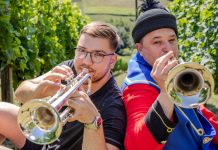
– People often ask me about my fondness for the blues and my collaboration with Tomislav Goluban. I’m really a ‘flower child’ who grew up on rock ’n’ roll. Once those wild youthful years had passed and matured, I began listening more to jazz, blues and somewhat quieter music. As it happens, Zagorje is currently home to the finest bluesman or harmonica player, Tomislav Goluban, and I’ve always loved that instrument. He came here to Vinski Vrh, was delighted by everything he found, decided to stay the night, and that is how three compositions came about – Libertin, Vinski vrh and Instrumental. Alongside our mutual affection and friendship, he often plays here, and I had the idea of ‘guided wine and blues tastings, pairing food, wine and music’. I would like the song Med bregi, from the album of the same name, which appeared around the time the Bregovita Hrvatska wine region was established, to become a kind of anthem for that region.
In the wine history of Hrvatsko Zagorje, Tomislav Bolfan will be remembered as the winemaker who, through numerous awards at the world’s most prestigious competitions, established the region as an excellent area for dry wines too.
– It simply proves that this climate can produce outstanding wines, and everything else is a matter of promoting those varieties. I believe Riesling, Sauvignon Blanc, Pinot Noir and Pinot Gris can achieve excellent results here. I have all those varieties, and we’ve received international recognition for each of them. But so you don’t think I make wine purely for those commercial reasons, I want to say, and always stress, that for me wine is above all love, spirituality, story and energy, rather than a business.
This unusual winemaker is distinctive in many ways. For example, his narrow, very tall stainless-steel tanks were made to his own designs, based on conversations he once had with the late university professor Gerhard Schubert. Among the conclusions of their reflections on Zagorje as a destination for top-quality wine was that ‘barrels should be as small as possible or, at least, tall and narrow’! They established that smaller barrels made it much easier to control and carry out the chemical processes that affect wine quality.
Tomislav Bolfan was among the first to challenge the stereotype of Zagorje as a white-wine region by planting Cabernet Sauvignon at Vinski Vrh. Thanks to that variety, along with Pinot Noir and Blaufränkisch, he believes Zagorje will finally have its own ‘powerful, full-bodied red cuvée’.
Tomislav Bolfan also raises Turopolje pigs, and at Vinski Vrh he bakes what is probably the most intriguing bread in these parts, using no fewer than four different heritage varieties of maize – from the oldest blue kernels to white, red and orange.
He was the first in Hrvatsko Zagorje to be officially certified as a wholly organic producer.
– The truth about healthy food, like every idea in the world that seeks the good of humankind, takes a long time to get through. I’ve been officially certified as a wholly organic producer for years. The entire winery is organic, and in that respect I think we’re still alone. But I do feel something is moving at last.
– Unfortunately, the problem is that the institutions of our beautiful Croatia are not receptive enough to this. In many European countries, the situation is different – they actively fund education and information for the public about organic production. Because the biggest problem is that the wider population doesn’t understand the difference between an organic and a conventional product. We have to keep working to raise consumer awareness.
– In Austria, there are two official publications printed in thousands of copies to promote organic production. Today, you can find not only wine there, but cheese, pork and veal from certified organic producers, Tomislav says.
That is why Tomislav always goes to nearby Austria for good advice, where, he explains, fantastic changes are taking place precisely in organic production. He mentions one of the country’s largest Sauvignon Blanc producers, who had no difficulty deciding to transform his entire production and become an organic producer across no fewer than sixty hectares of vineyards – literally overnight!
– I just want to ask what made him turn to it, as a major producer who already had a market and a name.
In Croatia, he finds someone to share his wine philosophy with only in Ivan Enjingi, the now somewhat ageing genius from Hrnjevac who, even in his eighty-fifth year, refuses to stop planting more vineyards. In an exchange of goods with Ivan, Tomislav acquired his first Red Angus cattle, marking the beginning of animal husbandry at Vinski Vrh.
– Old Enjingi has been sincerely committed to organic farming, heart and soul, for as long as he can remember. So acquiring Red Angus cattle from his herd was a logical move. We can’t practise organic farming without a closed, self-sustaining system.
– In other words, the resilience of a plant or vine depends on how much, and in what way, we help it feed itself. And you don’t do that with nitrogen or with organic pellets, which again are based on artificial substances without enough life in them. You have to give the vine real, living farmyard manure.
Tomislav was the first in Zagorje to ‘play around’ with making amber wines, and he explains that both Aromano and Tingo are merely experiments, explorations of wine’s possibilities.
Tingo, for example, was made without a single drop of sulphur during fermentation. He had to add a minimal amount only at bottling – ‘so the wine could remain in the bottle for five or six years without oxidising’.
A few years ago, Tomislav managed to fulfil one of his dreams and produce grape-seed oil. Unfortunately, among all the things happening at Vinski Vrh, the oil has so far remained merely an original souvenir.