When I asked Nikica Katić five years ago how he found time for wine amid quarries, crushers, motorways, wind farms, substations, water mains and some sixty employees, he answered without hesitation:
– In between.
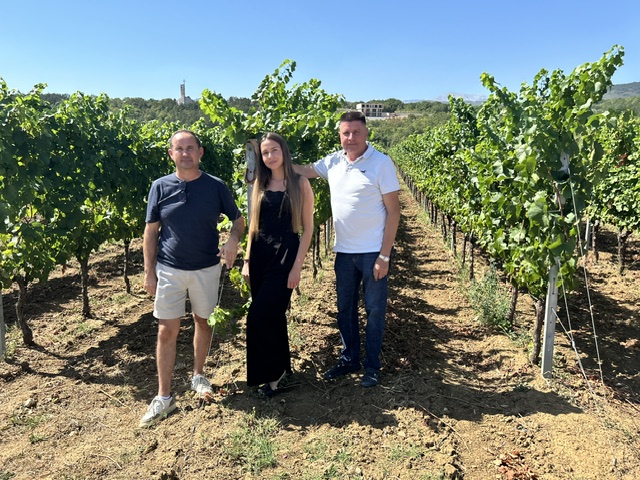
Over those five years, his in-between time has clearly expanded. His vineyards have grown to around fifteen hectares, his wines have begun winning serious awards, and the number of labels has reached thirteen. Meanwhile, the three-thousand-square-metre winery he began building beneath Vilinjak remains, for now, an enormous hole.
Nikica has already given it a name.
– Fata’s Pit.
He borrowed the name from Prosjaci i sinovi, from Jokaš, who spent his entire life digging for Emperor Trojan’s gold and eventually died in his own pit. For now, Nikica faces no such danger. He regularly climbs out of his, mostly to invest in an even larger winery.
– I had the plans drawn up here, obtained the paperwork and permits, and started digging. Then, in the meantime, I happened to buy the former Imota winery.
For most people, buying a winery is a decision. For Nikica, it happened.
And he did not buy just any winery. He bought a complex with a capacity of more than twenty million litres, spread over six or seven hectares, with more than ten thousand square metres of indoor space, its own electrical substation, boiler house, treatment plant, restaurant, workshop, distillery and millions of litres of concrete storage tanks.
It all started because he needed tanks.
– There was a facility down there that made Akvinta vodka. It was immaculate. Three or four million euros had been invested in it, and it operated for perhaps four or five years. They made premium vodka, employed about twenty people and exported to around twenty countries.
Adriatic Distillery fitted out the facility on Imota’s premises, then the whole operation ground to a halt almost overnight. From what Nikica learnt, the owner divorced, fell out with his business partner, his other businesses went downhill, and the distillery ended up in bankruptcy, allegedly over an unpaid electricity bill.
Years later, everything looked as though the employees had finished their shift and intended to return the following morning. Their uniforms were still in place, papers lay on desks, and ten or twelve thousand litres of vodka remained in the facility, some bottled, some in tanks.
– I was interested in the tanks. Their combined capacity was more than two hundred thousand litres, and I thought they could also be used for wine. So I bought them in the bankruptcy sale.
– I did it backwards. First I bought the equipment, then the premises. I wasn’t exactly forced to buy the winery, but I didn’t want to dismantle everything, move it or sell it on.
He bought the tanks, then, to avoid moving them, bought the entire former Imota winery as well. And so a construction contractor who already owned an unfinished three-thousand-square-metre winery became the owner of another, several times larger.
– So buying Imota simply made Fata’s Pit even deeper?
– Let’s put it that way.
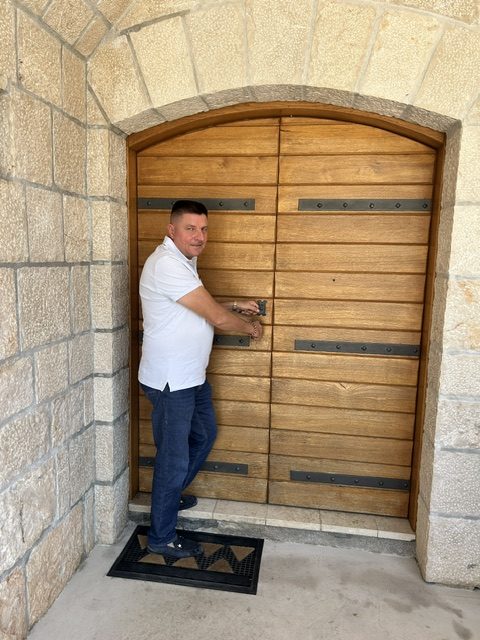
The pandemic halted construction beneath Vilinjak, while the purchase of Imota redirected Nikica’s money and attention towards the Imotski plain. There he found a fenced complex covering sixty to seventy thousand square metres, with all its infrastructure in place, but much of it wrecked, looted and abandoned.
– Today, it’s Alcatraz. But it has potential. All sixty or seventy thousand square metres don’t have to be a winery. The complex is in a business zone, so other activities can be developed there too.
As though six or seven hectares were not enough, he bought another twenty-thousand-square-metre plot outside the fence. It too was part of the bankruptcy estate and, as Nikica puts it, an interesting piece of land.
In the meantime, he is repairing roofs, installing solar panels and trying to halt the complex’s deterioration.
Yet Alcatraz has one room at whose door that deterioration seems to have stopped. Amid the dilapidated facilities and old concrete tanks, a hall has survived that could turn Imota into a place people visit again, rather than merely a monument to an era when wine was produced by the million litres.
The Mosaic Hall.
The monumental mosaic was created in the early 1980s by the professionally trained artist Slobodanka Matić Kovač, a native of Proložac, together with students from Belgrade’s Academy of Fine Arts. It is composed of natural stones sent by people from Imotski living in different parts of the world, making it a kind of monument to the region’s diaspora. At Imota, of course, stone was waiting for Nikica once again.
– What can I do? I come from stone. Stone is in my genes.
The hall is still used occasionally and, unlike much of the complex, requires no major work. Nikica sees it as the showpiece of the future project. His daughter Ilijana sees something more concrete: a place where Katich winery could welcome visitors and get serious about selling wine.
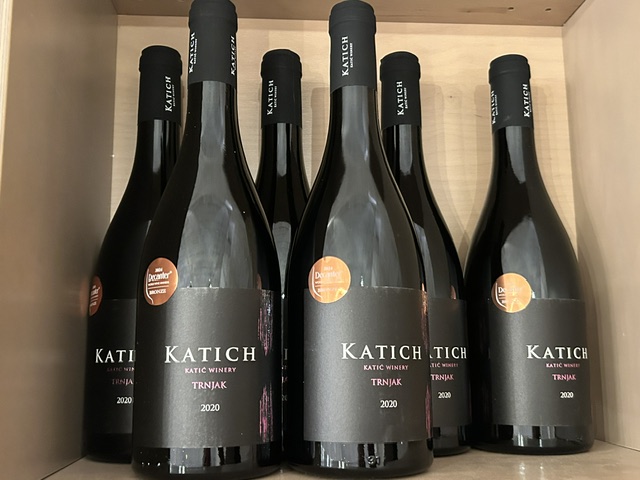
Nikica would build the tasting room beside the family home beneath Vilinjak, more than six hundred metres above sea level, surrounded by stone, machinery and Fata’s Pit. Ilijana wants it on the Imotski plain, beside the vineyards, the Imota complex and a mosaic that already has a story of its own.
– I want a tasting room here for myself, Nikica declared, settling the matter. — You can build the one for business down there.
Ilijana has a degree in economics. Her father thinks emotionally; she thinks strategically. What matters to him is where he feels at home; what matters to her is where she can bring visitors. He first bought tanks, then an entire winery to avoid moving them. Before buying anything, she would probably have calculated the cost of relocation.
That is precisely why she should one day take over the winery.
– I want to do this while Dad is the investor and can still finance everything, she admitted.
To Nikica, that division of responsibilities seems natural: he invests, oenologist Viktor Zdilar makes the wine, Ilijana works out how to sell it, and he is left with the tasting.
– In a few years, I might devote a little more time to wine. At least to tasting it. That’s about the only area where I could get more involved.
Meanwhile, the winery has reached thirteen labels. Nikica thinks there are twelve.
– Ilijana and Viktor will know better.
He does not know how many construction machines he owns either, so it is hardly surprising that he has lost count of a wine label. That is why Viktor and Ilijana are there: the former to keep track of the wines, the latter to ensure that at least someone at the winery keeps track of the numbers.
Viktor Zdilar entered the story long before Nikica bought Imota. He had worked there for years as an oenologist and knew Kujundžuša and the Imotski plain well. When the former wine giant went bankrupt, he began working for Katich winery.
– I hadn’t even bought Imota yet, and Viktor was already working for me.
Imota’s former oenologist thus returned to the old winery’s premises as the new owner’s oenologist.
Except that the new owner has yet to admit he is a winemaker.
– I’m still a construction contractor.
– Is there any chance that, over these five years, the winemaker has gained the upper hand?
– Unlikely. Without my construction business, there would be no winemaking either.
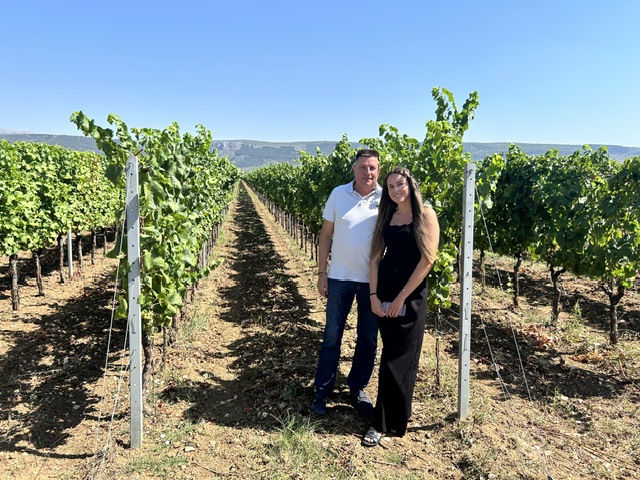
Unlike in 2021, when he insisted wine was a hobby and cheerfully gave away all forty thousand litres, today he admits that some of it does get sold. The rest is intended for friends, business partners and anyone who happens to get close enough to his car boot.
– Wherever I go, I always have wine in the boot. I give someone a bottle or two, someone else a case. People get used to it, and that’s how it goes.
Sales have begun, but the gifts have not stopped. The quantities have simply increased.
So have the costs. Nikica recently invested another €600,000 or so in equipment, improvements to existing vineyards and new plantings. That figure does not include the roofs and solar panels at the former Imota complex, or further work on Fata’s Pit.
– Winemaking can’t finance itself. Every year brings more investment.
– But you could make a living from wine today?
– I could make a living. I just couldn’t invest this much.
– So you’re the first generation, the one that has to build it all, and your children will enjoy the fruits later.
– If they want to.
His construction company still builds water mains, sewers, roads and electricity infrastructure, while the quarry and concrete plant remain among its principal activities. The yard is full of machinery whose precise number even the owner does not know.
– Some machines go, others arrive. Right now, another two or three are on their way from Germany.
– How many do you have, then?
– I don’t know. First we have to agree on what counts as a machine. Does a small vibrating rammer count, or only a forty-tonne excavator?
It all began with an Atlas backhoe excavator his father brought from Germany. In Katići, that was nothing unusual. Almost every house in the hamlet had an excavator, a lorry or another piece of construction machinery, and people from Lovreć spent decades working on trenches, excavation sites and building projects across the former Yugoslavia.
Nikica completed his first job as a private contractor in 1985, at the open-cast coal mine in Lukavac near Tuzla. Later, he built wind farms, motorways, substations, irrigation systems, water mains and sewers. His machines did anything that could be dug, crushed, levelled or filled.
He therefore approached viticulture from a direction few winemakers would expect: through stone.
Zlatan Plenković hired him to reclaim rocky karst land beneath Biokovo, where he was planting the vineyards that would later produce Ostatak bure. Vermeer machines weighing more than fifty tonnes crushed the rock and turned it into ground where vines could be planted. Nikica later carried out similar work in Komarna for Terra Madre and at other vineyard sites in Dalmatia.
– Did you believe then that you could make a vineyard out of crushed stone?
– I did. Karst reclamation was already being done in several places, and you could see it worked. I bought large Vermeers and tractors, so I was among the first to have machinery for that kind of work.
He still owns some of those machines, although he now uses them more often to build forest roads and farm tracks than vineyards. He sold one Vermeer to Sicily. Along with the stone, those machines crushed the last boundary between construction and wine.
Plenković also gave him his first new barrique barrels.
At the time, Nikica was buying Babić from the Primošten area, paying more than twenty kuna per kilogram of grapes and trying to make the best wine he knew how. He knew little about technology, varieties or the market, but he knew he did not want to economise on the raw material.
Plenković assured him that good wine could also be made from more modest grapes. Nikica did not listen. He bought the most expensive grapes he could find, filled the barrels Plenković had given him and wrote on the label:
– A not-bad wine made from grapes.
– Produced and bottled by Nikica Katić in whatever quantities he can manage, and emptied by whoever gets the chance.
Those first labels also established the winery’s name: Katich, with ch replacing the letter ć. He found the explanation in Lovreć’s history rather than in marketing.
– A plaque in our church from 1725 says it was consecrated by Bishop Blaškovich. It doesn’t use “ć”, but “ch”. I’ve seen the same thing in old cemeteries. I also have plenty of relatives in America, so I joke that we used ch because we make wine for the White House.
The White House has yet to be confirmed as a customer. For now, the boot of his car is a more reliable market.
The label told the truth: he gave the wine to friends and business partners, and the bottles were indeed emptied by whoever got the chance. Their reactions convinced him that the hobby might become something more serious.
Before planting his own vineyards, he searched for grapes around Dalmatia. He bought Babić in the Primošten area and Plavac mali from the Plančić brothers in Svirče. He used the four years he spent working on Vis to get closer to the island’s winegrowing world.
Viktor made a wine from the Plančić family’s 2015 Plavac that they still keep in bottle today.
– We never sent it to a competition because it isn’t made from a variety native to our region or from our own vineyards. But everyone who tastes it says it’s outstanding.
Babić has since disappeared from the cellar, while the Plavac remains as a reminder of the period when Katić was searching for his own identity in wine. Today, Nikica no longer looks for it on Hvar, Vis or in Primošten’s hinterland.
He found his own identity on the Imotski plain.
For years, he bought land there piece by piece from more than a hundred owners. Two thousand square metres from one, five thousand from another, ten thousand from a third. Every piece meant another contract, more paperwork and more negotiations.
– The plots here are so small and fragmented that I think I’m the only person who has managed to assemble a substantial area by buying from so many people.
His latest purchase was a vineyard of roughly two and a half hectares adjoining his existing plantings. It was planted at about the same time, but in Nikica’s judgement it was poorly established and will need restructuring.
With that plot, Katić now has approximately fifteen to sixteen hectares of vineyards. Around ten hectares form a larger, continuous block, an achievement on the Imotski plain, with its fragmented ownership, comparable to reclaiming karst.
Only here, Nikica could not bring in a Vermeer and crush the problem.
For their first plantings, he and Viktor toured the Imotski plain, found old Kujundžuša vines and took grafting material from them. They limited yields to a level earlier generations of Imotski growers would have considered an insult.
– Each vine carries no more than a kilogram or a kilogram and a half of grapes. Our elders used to say their work had been wasted if they didn’t get at least five kilograms. That’s why we have quality today.
The sandy, dry soil forces the vines to struggle, and in that struggle Nikica recognised something his machines could not produce: the character of the place.
That is why, among his thirteen labels, his favourites are wines made from two local varieties.
– For whites, I always choose our Kujundžuša, and for reds, Trnjak.
The man who began with Babić from Primošten and Plavac from Hvar returned to what grows on his own doorstep. It took dozens of excavators, a hundred purchase agreements and almost the entire wine map of Dalmatia for him to discover it.
In his early days with wine, Kujundžuša was a variety he still had to get to know. Today, it is his measure of how far Katić has come.
Viktor already knew it well from Imota, but at the new winery he could approach it in ways that had been impossible within a system exceeding twenty million litres: selecting vines, limiting yields and setting aside the best grapes for a separate wine.
With Viktor, Nikica learnt to explain how different methods can turn the same raw material into entirely different wines.
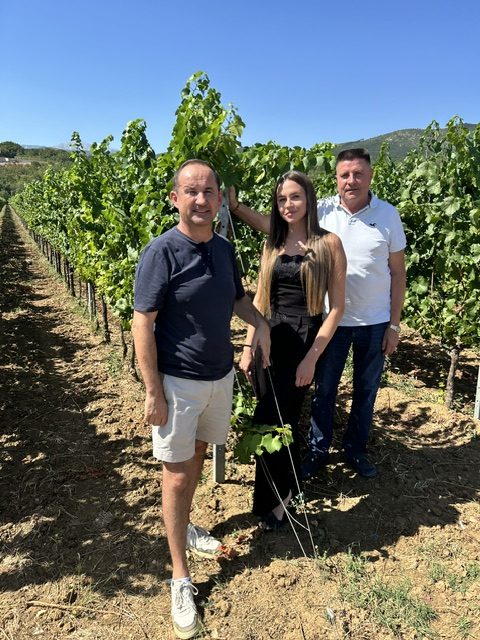
– Mirite Blanc ages on its lees, which are stirred, and the wine spends time in barrique barrels. That gives it a different aroma, flavour and character from wine made conventionally from the same vineyard. You’d never say they came from the same grapes.
– Ten years ago, could you have imagined yourself talking about lees ageing and the sur lie method?
– I hadn’t a clue.
Mirite is the name of the vineyard site. Hence Mirite Blanc and Mirite Noir, a white and a red wine with French additions to their names, although their story is rooted deeply in Imotski. The white Mirite is made from Chardonnay and Sauvignon Blanc, the red from Syrah, Cabernet Sauvignon and Merlot.
International varieties have given Katić some of its most powerful wines, but when choosing his favourites, Nikica returns without hesitation to Kujundžuša and Trnjak.
At a presentation in Zagreb in 2023, the Kujundžuša was compared with Chardonnays from Chablis, while the Trnjak was hailed as one of the finest wines yet made from the variety. Critics also praised the Pošip, Sauvignon Blanc, Syrah, Merlot Beg and both Mirite wines.
A year later, at the Decanter World Wine Awards, Pošip 2022 won silver, while Mirite Blanc 2021, Sauvignon Blanc, Trnjak and Kujundžuša won bronze. For Kujundžuša, it was a first international award.
Two years later, all five wines submitted returned with silver medals: Kujundžuša 2025, Pošip 2025, Sauvignon Blanc 2025, Mirite Blanc 2023 and Syrah 2021.
Nikica says he had expected none of it.
– When I started, awards never even crossed my mind. Everything came as a result of work in the vineyard and cellar. I was happy to have two or three thousand litres for friends and company: some to give away, some to drink with food cooked under the peka and a bit of tamburica music.
From the peka and tamburica, he has reached five Decanter silver medals in a single year, yet the word “winemaker” still gives him more trouble than the sur lie method.
– Did you expect to become one of the most decorated winemakers in the Imotski region?
– No. I still say I’m more of an investor and a construction contractor. I’m trying to encourage the younger generation to get more involved in wine and give them support.
When he speaks of the younger generation to whom he wants to leave the winery, among his children he is thinking chiefly of Ilijana. Through that generational change, Viktor would remain what he is today: the oenologist and the professional backbone of production.
At the Zagreb presentation, Ilijana stayed out of the spotlight, but followed the wines closely, listened to Viktor and later joined in the presentation. Since then, she has completed sommelier courses with the Croatian Sommelier Club. She has a degree in economics, a family and a realistic enough understanding of time to know that nobody can devote themselves fully to everything.
She does not see herself in the cellar making blends and deciding how long a wine should remain on its lees. That is Viktor’s job. She can apply her economics training where the winery needs it most: organisation, sales and creating a place where thirteen labels will no longer end up mostly in her father’s car boot.
The disagreement over the tasting room showed how that division might work. In the stone of the Mosaic Hall, Nikica sees belonging and proof of what a person can build. Ilijana sees a story she can tell a visitor, a reason to bring them to the Imotski plain and an opportunity to sell them wine after the tasting.
Her father has spent his whole life building. His daughter should finally sell what he has built.
Among the wines Ilijana will one day try to rescue from her father’s car boot, Pošip has a special place. It is not native to Imotski, but in Katić’s vineyard it shows how changing climatic conditions are redrawing the wine map.
The vineyard lies on the Imotski plain, approximately 250 metres above sea level, almost level with the source of the Vrljika at 256 metres. Summer days can be scorching, but the nights bring a cooling relief that vineyards on the coast and islands experience increasingly rarely.
– The other evening, it was thirty-nine degrees in Makarska at ten o’clock. When we got here, it was twenty-two. Those differences help our Pošip retain its freshness. It doesn’t get scorched, its alcohol isn’t so high, and it isn’t as heavy as Pošips from Pelješac, Korčula or Hvar can be.
– Of all our varieties, it gives us the most trouble. It’s the most sensitive.
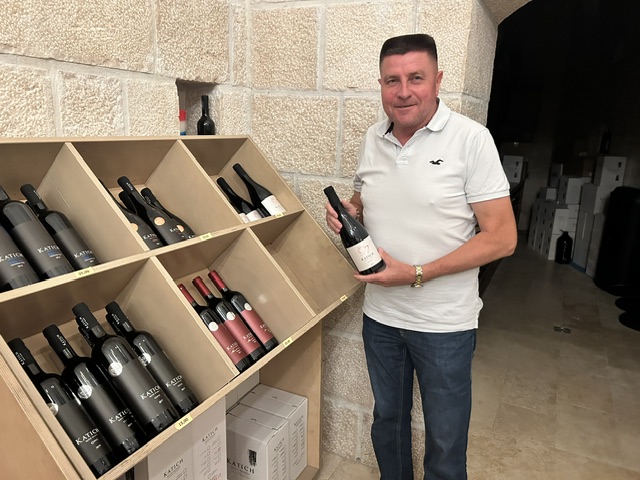
Yet Pošip was among the first wines to draw attention to Katich beyond the Imotski region. As early as 2021, tasting wines that were then almost unknown, Saša Špiranec singled out an impressive Pošip and probably the best Kujundžuša currently available, alongside reds worthy of respect.
Nikica was genuinely surprised.
– Praise feels good; we certainly don’t mind it. Especially when it comes from people who don’t know us and had never even heard of us before.
Five years later, Katich is no longer a chance discovery. Its wines have been presented beyond the Imotski region, won awards and found an audience, while Pošip, Kujundžuša and Trnjak have ceased to be merely bottles pulled from a car boot.
Well, not entirely. As long as Nikica drives, some of the distribution will evidently continue from the boot.
There is now a serious winery behind them. Two, in fact: one looks like Alcatraz, the other like an archaeological site for a future building.
Beneath Vilinjak, around a winery that still exists largely on paper, stone is once again waiting to become a vineyard.
Katići lies at approximately 600 to 610 metres above sea level, while Nikica’s old house stands at 720 metres. For years, he has been considering planting vines there, partly for the wine, partly to improve the winery’s surroundings, and partly because nothing in Lovreć can happen without a little local competition.
Stipe Đuzel planted a vineyard at almost seven hundred metres. Nikica would therefore only have to go a little higher.
– If you have any of that Lovreć spirit Petar Gudelj wrote about, why wouldn’t you want a vineyard higher than Đuzel’s?
Gudelj captured Lovreć’s need to compete with Imotski in the story of the Church of the Holy Spirit. The people of Lovreć immediately agreed it had to be the largest in the Imotski region and at least a metre longer than the church in Imotski. Then they spent forty years unable to agree on where to build it.
When they finally agreed, they built a church that remains the largest in Split-Dalmatia County.
– It was wider and longer than the one in Imotski, Nikica confirms proudly.
Later, the people of Lovreć erected a large cross above the village. The people of Katuni came to measure it, then built their own, two metres taller.
– So the people of Katuni did outdo you after all?
– They built theirs later, so they deliberately made it bigger.
– Surely you’re not going to knock yours down or extend it now?
– No. Let them have the bigger one.
The acceptance in his voice might deceive someone who did not know that his old house stands at 720 metres and that he has yet to plant a vineyard there.
In an age of increasingly warm harvests, a vineyard at 720 metres sounds like more than a matter of Lovreć rivalry. Nikica was turning stone beneath Biokovo into vineyards before he ever imagined becoming a winemaker, and he has the machines, the land and an old house at that altitude.
With him, decisions are the most dangerous part. Once he decides to buy tanks, he ends up owning the whole of Imota.
For now, something else is growing beneath Vilinjak: tomatoes, peppers and so many courgettes that even Nikica has failed to count them.
– Two or three courgette plants are enough for a family. But when you plant thirty or so, you have ten new courgettes every day.
– Did you plant thirty?
– Maybe more.
He also planted approximately two hundred tomato plants. He raises pigs, cures twenty to thirty hams every year, makes around 150 kilograms of kulen and another two to three hundred kilograms of sausages. Annual production approaches half a tonne.
For his kulen, he uses only meat from the hind leg and firm back fat. Even the whole leg is not good enough: he selects very specific cuts.
– People from Slavonia who taste it tell me I should change jobs and start making kulen. They say I’m even better at that.
The man who has yet to decide whether he is a construction contractor or a winemaker has thus, without intending to, acquired a third possible profession.
At the winery entrance, a fourth awaits him: shell collector.
The collection was left to him by Friar Mario Jurišić, a close family friend with whom he went on pilgrimages and other journeys. The friar collected shells all his life, and when he began wondering what would become of them, he decided to give them to Nikica.
– That’s how the shells passed from a priest’s hands into ours.
Nikica does not know exactly how many there are, or all the places they came from.
For him, the collection’s origins matter less than the fact that yet another thing has found a home with him. Just as the winery happened to him, so did the shells. One day, he might use them as evidence that there was once a sea at six hundred metres.
Coming from a man who made a vineyard out of stone, even that would not sound entirely implausible.
Patriotic memorabilia hangs on the walls of the tavern, wines age in the cellar, machines stand in the yard, vegetables grow behind the house, hams hang in the curing room and kulen sits in the office. Beneath Vilinjak, Fata’s Pit is waiting; on the Imotski plain, so is the former Imota winery; and new tractors are arriving from Germany.
– What exactly do you do?
– A bit of everything. There’s enough of me to go around, but nowhere enough money to pay me.
Five years ago, he claimed he dealt with wine in between everything else. Today, the in-between has grown larger than the work he tried to fit it around.
He is still a construction contractor, because without construction he could not finance the wine. He has become a winemaker, however much he refuses to admit it, because thirteen labels, around fifteen hectares of vineyards and five Decanter silver medals in a single year no longer fit within a hobby. He has become an investor because he is preparing the winery for Ilijana. Alongside all that, he makes kulen, grows vegetables, looks after abandoned vodka and, entirely by chance, collects shells.
The one thing he has yet to become is a man who has finished building his own winery.
– Will you ever finish Fata’s Pit?
– I have to. I’m hardly going to fill it in now.
Jokaš spent his entire life digging for Emperor Trojan’s gold and eventually remained in his own pit. Nikica faces no such ending. He simply has no time to stay in any of them.