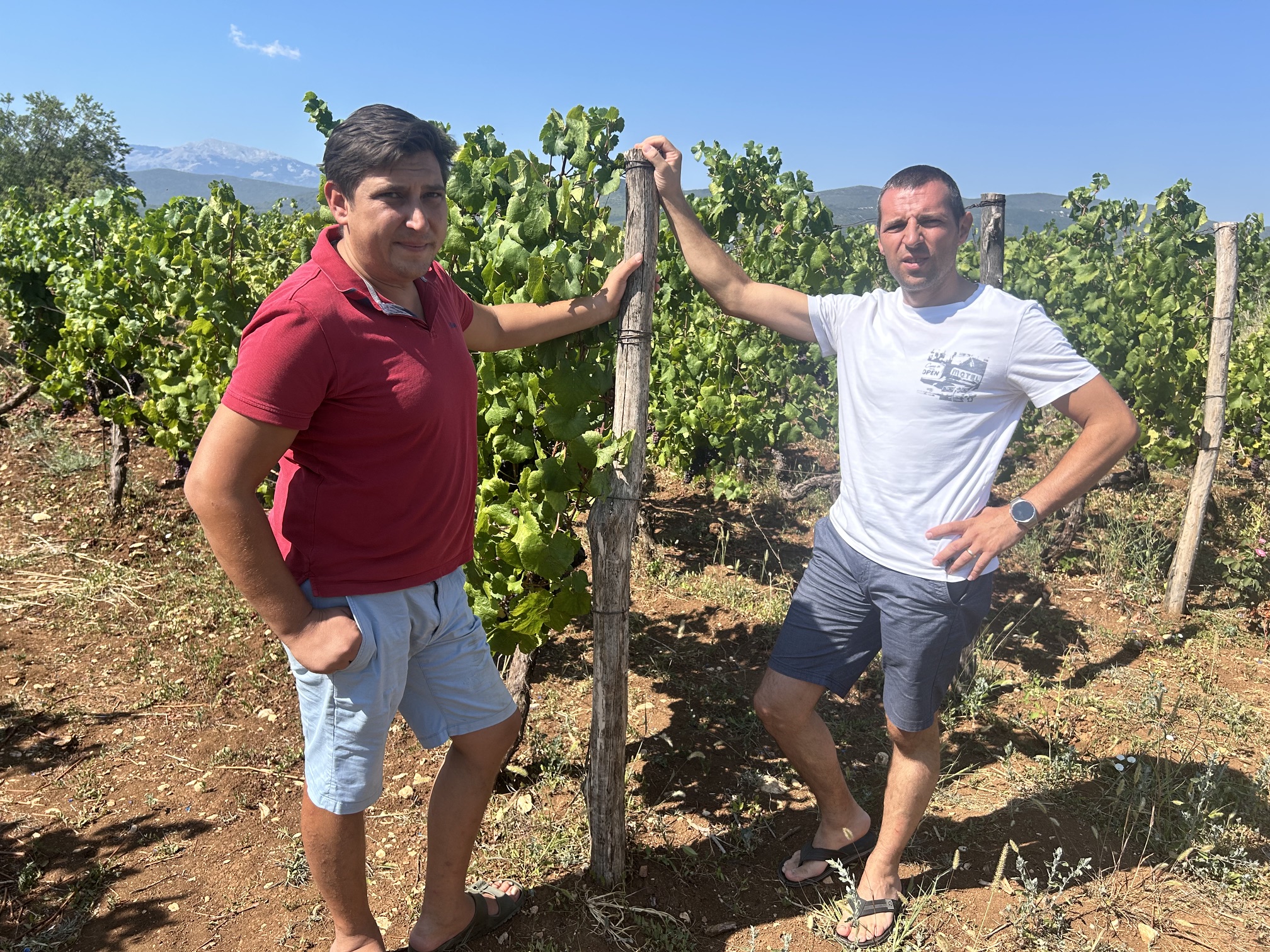
Ante Grabovac did not look like a man whose harvest was about to begin on 7 August. He seemed perfectly calm, almost carefree, until he glanced towards the vineyard in the middle of our conversation and decided there was no more time to talk.
– If we are going to pick this on Monday or Tuesday, that is another four days. No chance. There will be nothing left.
It is 6 August, a date that until recently, in the Imotski region, belonged to summer holidays, preparations for the Feast of the Assumption and almost anything except harvesting grapes. For years, the Grabovacs resisted entering the vineyard before 15 August, even when the grapes indicated that the calendar no longer applied. The problem was neither sugar nor acidity, but the fact that, between the beginning of August and the Feast of the Assumption, people in Imotski think differently.
Grapes, however, are not particularly sentimental about religious holidays.
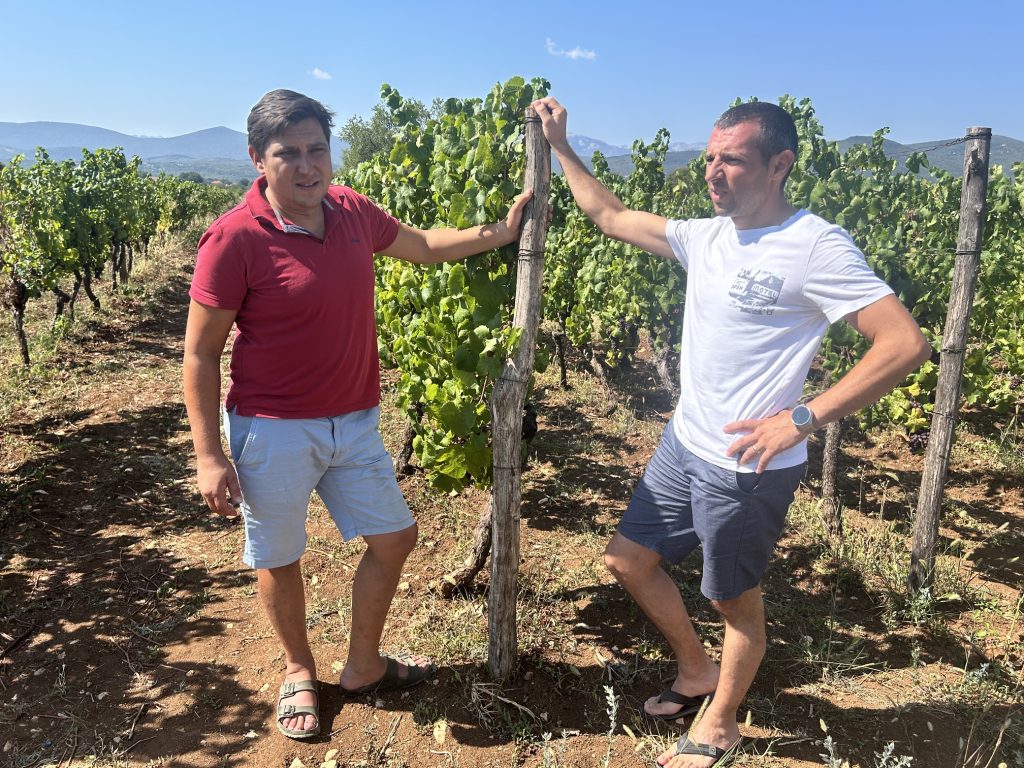
– If the figures tell us to harvest, we have to harvest, says Nikola Grabovac. – Those decisions must be made for the sake of quality.
While his sons are still discussing what can wait and what must reach the cellar the following morning, Ante has long since made his decision. He admits that he finds decisions easiest when he has 51 per cent of the necessary information. Nikola and Milan laugh at him for it, but that is precisely how today’s Grabovac Winery came into being some thirty years ago: with enough information to know where he wanted to go, and too little to know what awaited him there.
– When I started, I was driven by economic romanticism. I thought: everyone from Imotski will buy a bottle. Some one, some two… That illusion vanished very quickly.
He could not then have imagined a winery with almost twenty-seven hectares of vineyards, a tasting room once again running out of space, or sons fully capable of taking on the business. Still less a new winery, whose construction is now emerging as the next step. None of it, he admits, would have made sense if his sons had not returned. – If those two had not come back, it would all have come to an end.
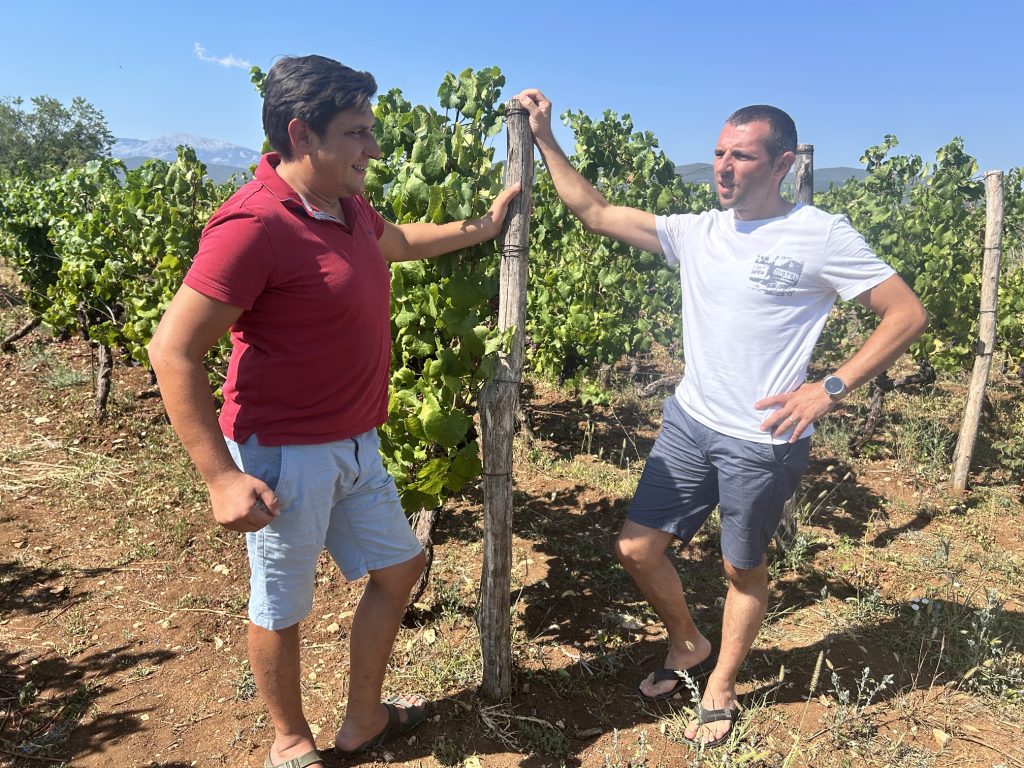
Perhaps that is why Ante now seems calmer than those who watched him launch the winery, enter politics or plant a vineyard where others saw only stone remember him being. Not simply because, as his sons joke, he had slept well that morning, but because he no longer has to make decisions alone.
Before him, one woman had been forced to make all the crucial decisions by herself. She had no choice about whether to continue making wine. She simply took two barrels, two children and the whole family onto her shoulders.
Her name was Mara Grabovac. She was forty-seven when she became a widow.
Ante was seventeen, his sister fifteen, and two older women also lived with them: Ante’s grandmother and her sister. With her husband’s death, Grandma Mara lost more than her life partner. Overnight, she became the head of a family in which everyone depended on her.
From 1975, she carried on making wine practically alone. These were not quantities that would attract much attention today: two large barrels of nine hundred litres each, several smaller ones and perhaps three or four thousand litres of wine altogether. Over the course of a year, she sold between fifteen hundred and two thousand litres. But viewed against the circumstances in which she worked the vineyard, ran the household and raised two children on her own, those figures no longer seem small.
Ante still remembers her taking wine and brandy by bus towards Studenci and the surrounding villages. A load on her shoulder or back, a bus stop and a late return home. Once, they waited for her well into the night, not knowing how she would get back or carry home what she had failed to sell.
Years later, while considering philosophy, languages, entrepreneurship and politics, Nikola found in Grandma Mara his most compelling answer to whether he could seek a life outside the winery.
– I could see myself doing many other jobs, but at the same time I knew how much the family tradition meant to me. If Grandma had managed, through such painful sacrifice, to keep our family in the wine world, how could I do something else? In the hardest times, she carried everything and kept the family together. You cannot forget that.
Grandma Mara died in 2024, in her ninety-sixth year. She lived to see two barrels become a winery that had once again outgrown its space, and the tradition she had preserved out of necessity become a business her grandsons returned to by choice.
That tradition also has much older written records. While researching their family tree, the Grabovacs found a copy in the State Archives in Zadar of a licence to produce and sell wine granted in 1812 to their ancestor, recorded in the document as Steffano Grabovacz – Stipan Grabovac.
They adopted that year as the official beginning of the family’s winemaking history, although Milan would happily add another nine. On Stipan’s old house, whose cellar was used to make wine, a plaque still bears an inscription in Bosančica, the historic Bosnian Cyrillic script:
– Stipan Grabovac built this house in 1803.
If the house already had a cellar and wine was made there, Milan reasons, the family history could be extended without any great pangs of conscience. At least by those nine years.
From Stipan Grabovac until the end of the twentieth century, the family made wine without major changes. Generations, quantities and circumstances changed, but their fundamental relationship with the vineyard did not. Grandma Mara prevented the tradition from breaking at its most vulnerable moment, and in the early 1990s, Ante decided that what the Grabovacs had done for themselves and local buyers for two centuries should become a modern winery.
In 1992, what Milan calls the modern era of Grabovac family winemaking began. Their first bottled wines reached the market in 1994, and a cellar was built the following year. They started with approximately two hectares of vineyards, a small production and an even smaller tasting room in the space now occupied by the shop.
Ante had no meticulously developed business plan. He had Kujundžuša, family experience and the belief that people from Imotski would buy enough wine out of loyalty to their homeland to make the whole thing succeed.
But decisions made with 51 per cent of the information had begun long before the cellar.
As wartime director of Imostroj, the Imotski factory that manufactured mortars, Ante ran a business in circumstances where waiting for all the facts was impossible. You gathered what you could, assessed the risk and decided before circumstances made the decision for you.
From 2000 to 2004, he represented the Croatian Social Liberal Party, HSLS, in the fourth term of the Croatian Parliament and served on several committees, including foreign affairs and agriculture. His connection with Dražen Budiša drew him to HSLS, as did the fact that, when the party was founded, it seemed the most acceptable political option.
– I was in opposition to the government even though I was part of it.
Over an amendment relating to lavender, worth a few tens of thousands of kuna, he was prepared to withhold support for the state budget. Parliamentary records show twenty-four contributions during his four-year term. He was neither among the MPs who spoke whenever they spotted a microphone nor among those who spent their term without saying a word.
Milan believes that an interest in politics never entirely disappeared from the family.
– A person is more than a winemaker; they are also a member of society. Politics is always there, whether we want to be involved or not. Although we would all be happier if we did not have to deal with it.
Nikola admits that he probably inherited his political curiosity from his father. Before returning fully to the winery, he was interested in local development, entrepreneurship and public affairs. Viticulture in the Imotski region depends on more than vines and winemakers: it also depends on land, fragmented plots, administration and a community’s ability to make decisions whose results will only become visible a decade later.
Yet when Ante launched the winery, his first business problem was the market he had counted on. People from Imotski are sentimental about Kujundžuša as long as they have a few barrels of their own wine in the cellar. Many people in the region still make wine because their families always have, rather than as a hobby. Selling someone else’s bottle to such a person is not easy. Explaining that it is better than their own is harder still.
That is why the greatest compliment a professional winemaker in Imotski can receive is:
– Yours is good. Almost as good as mine.
The market was also much smaller than Ante had imagined in his initial enthusiasm. There were not enough people living in Imotski to buy the quantities he wanted to produce, and many of those who remained had wine of their own. Today, Milan jokes that perhaps more people from Imotski live in Osijek than in Imotski itself.
The exaggeration is not a great one.
Nevertheless, Ante was right about one thing: without Kujundžuša, the winery would have made no sense. It was more than the most widely planted variety in the Imotski wine region; it was part of the identity of a place that had meanwhile lost faith in its own wine.
In its best years, the former Imotski wine giant Imota produced as much as twenty million litres a year. Today, that quantity sounds almost unreal. In the 1980s, around two thousand hectares of the Imotski-Bekija field were planted with vineyards, and even fifteen or twenty years ago, Kujundžuša was among Croatia’s ten most widely planted varieties, despite growing almost exclusively in a single wine region.
A severe frost in the mid-1980s destroyed a substantial share of the vineyards. Afterwards, attempts were made to continue production with far fewer grapes as though nothing had happened. Quantity remained more important than what was in the glass, and Kujundžuša gradually became synonymous with poor, watered-down, characterless wine.
The Grabovacs were not the only ones who tried to restore its reputation, but they were among the first to believe that the problem lay in what had been done to Kujundžuša rather than in the variety itself. Ante did not try to turn it into a wine it could never be. He wanted to restore its rightful, recognisable place on Croatia’s wine map.
Today, their Kujundžuša, like that of other serious Imotski producers, regularly sells out before the next harvest. Ante’s first goal has been achieved. But once the variety had found buyers again, the Grabovacs could turn to a more difficult question: was a light summer wine really the limit of its potential?
In its basic form, Kujundžuša is an ideal summer wine: light, fresh and easy to drink, usually with 11.5 to 12.5 per cent alcohol. The very qualities once held against it – its unobtrusiveness and lightness – have become its commercial advantage.
On the valley floor, it can give very high yields while retaining the quality needed for that style. For decades, its generosity ensured its survival, but later also brought it a poor reputation. When too much was asked of it, it gave plenty. It was not its fault that people then tried to make even more wine from all those grapes.
On hillside sites, it behaves differently. Older oenologists and growers Nikola has spoken to say that the best Kujundžuša grapes Imota once purchased came from the slopes around the field. There, the grapes reached higher sugar levels, unusual for what was considered average Kujundžuša, and the wines had greater concentration and more pronounced character.
Yet the site the Grabovac family has associated longest with its best grapes is not on a hill. It is called Čurčivuša, or Čivuša for short, and lies about a hundred metres west of the winery. It probably took its name from the Čurčija family, who once owned land there.
Nikola has no personal experience of wine from the new planting, because the vines have only just been planted, but the family memory extends much further back. His father and Grandma Mara had a vineyard there and always said the same thing: the best Kujundžuša came from Čivuša.
– For Kujundžuša, that site was the final word. Amen.
Nikola later tried to establish why. The soil at Čivuša is very warm. Of the vineyards on the valley floor, its vines are the first to stir, budding earlier and beginning their growing season with a head start that allows Kujundžuša to ripen more fully. What Ante and Grandma Mara knew through experience, the new generation is trying to explain through soil, microclimate and vine behaviour.
Perhaps that captures every generation of the Grabovacs’ relationship with the vineyard: experience is not dismissed because it has yet to receive a scientific explanation, but neither is a family belief accepted as proof merely because it is old.
Čivuša is an inherited site. Vučja Draga is its opposite: a vineyard Ante first had to imagine, then almost create.
A shooting range once occupied the site of today’s vineyard. It was surrounded by woodland the Grabovacs could not acquire, so the future vineyard took on an unusual shape from the outset. The terrain looked challenging, partly like rocky karst where only an excessive optimist could envisage a serious vineyard. Older people, however, recalled potatoes once being grown on some parts of it, and remnants of old vines were found during soil preparation.
Ante visited the site with winemakers and specialists involved in major Dalmatian planting projects and the reclamation of rocky terrain in the late 1990s and early 2000s. Among them were Zlatan Plenković and Ivica Kovačević of the Faculty of Agriculture. Together, they visited Istria, other European wine regions and Dalmatian sites where people were trying to show that vines could return even where stone had long displaced agriculture.
When Ante showed them Vučja Draga and said he intended to plant a vineyard there, not everyone was convinced he would succeed. But their doubts were mild compared with the reaction of those who knew him best.
– Ante has gone crazy again.
He knew how to turn such judgements into another reason to continue. His decision was not based on exhaustive analysis, but neither was it groundless. The site contained more fertile soil than appearances suggested, the terrain was not entirely bare karst, and the remnants of old vines showed that Ante was not the first to see a vineyard there.
Vučja Draga eventually proved to be one of the region’s most successfully reclaimed vineyard sites. Saša Špiranec saw in it the potential to become one of Dalmatia’s finest grands crus, and it allowed the Grabovacs to take Kujundžuša beyond the single style in which the market had previously accepted it.
There, they make it in the old way, with extended skin contact, as a macerated white wine. A variety usually described as neutral revealed aromatic and structural potential that remains hidden in its light, early-drinking summer form.
That does not mean all Kujundžuša should become powerful, weighty wine. Quite the opposite.
– If we are making fresh, easy-drinking Kujundžuša, we will not try to turn it into a heavy, highly structured wine. We will try to make the best possible wine within the style that comes naturally to it: an easy-drinking wine with lower alcohol.
But the Grabovacs equally reject the assertion that this is the only style it can produce. The valley floor gives it lightness and generous yields, while the hills give concentration and a different kind of ripeness. Between those two extremes lies territory they are only beginning to explore seriously.

The breadth of their vineyard plantings did not come from simply collecting varieties. Their vineyards fall into three distinctly different groups. Clay loam predominates in the southern part of the field, where fresh Kujundžuša has proved very successful. The northern part has brownish red soil with abundant gravel, giving the wines greater concentration. The third group comprises hillside sites, with different soils, airflow and temperature variations.
Even vineyards just two kilometres apart can differ so much that a variety seeming entirely unsuitable in one place produces surprisingly good wine in another. That is why Proložac has Pinot Gris and Pinot Noir, which most winemakers would instinctively place much further north, as well as Syrah, Viognier and Vranac, whose good results there cause considerably less surprise.
Bijakova separates the Imotski region from the sea, but it is more than a geographical barrier. In summer, daytime temperatures north of the mountain can be several degrees higher than in Makarska, while at night they fall five or six degrees lower. Those variations preserve freshness in the grapes during the final stages of ripening and give the wines potential for long ageing.
Comparing the Imotski wine region’s climatic indicators with those of other wine regions, Nikola reached a conclusion that initially sounds as unexpected as Pinot Noir in Proložac: in terms of vine-growing conditions, their closest match is Corsica.
– I have not been there yet, but I plan to go.
The Grabovacs, however, did not wait for a trip to Corsica to discover what could grow on the other side of Bijakova. Over the past twenty years or so, their vineyards have become a kind of testing ground where family experience is examined in the light of knowledge brought back from Geisenheim, Bordeaux, Montpellier and New Zealand.
Nikola Grabovac was not certain from the outset that he would end up in the vineyard. As he approached the end of secondary school, he was drawn to philosophy, until his mother explained that a university degree was not necessary for philosophising.
– She told me that, whatever I ended up doing, I could always philosophise.
He followed her advice, at least in the first respect. He enrolled in agriculture and continued his studies in Geisenheim, Bordeaux and Montpellier. Even after returning, he did not immediately join the winery. With his wife, he founded a Centre for Education and Culture, opened a foreign-language school and later worked in business consultancy. He helped people write business plans, navigate administration and overcome obstacles that discourage many before they even become entrepreneurs.
He could imagine himself in various careers. Wine was not his only option, but it was the only one from which he could never fully detach himself. The more he thought about Grandma Mara and what she had preserved, the less acceptable it seemed to leave the family winery to someone else.
He brought to the winery more than a degree and experience from major European wine centres: he brought a different way of asking questions. Older generations knew where Kujundžuša performed best because they had watched the vines for decades. Nikola wanted to know why. The fact that Čivuša had always produced the best grapes was not enough; he wanted to understand soil warmth, the start of the growing season, ripening dates and how vineyard practices affected acidity in the grapes.
His scientific interests therefore turned towards Kujundžuša. He investigated how the timing and intensity of shoot trimming affected the variety’s characteristics, particularly the preservation of acidity, which can fall rapidly in the later stages of ripening. His aim was to acquire knowledge that could be used in the vineyard.
– There is no need to prove anything in advance. We need to investigate what happens and apply what we learn in practice.
His older brother Milan entered the family story by a very different route. At seven, he played the lead role in Tomislav Radić’s film Anđele moj dragi – My Dear Angel. He played Jerko, a boy who witnesses his family’s suffering in the chaos of war and escapes in a basket carried by a donkey. The reviews were favourable, and a serious acting future seemed to lie ahead of him.
Today, Milan is not particularly keen to discuss it. When reminded of his film career, he usually says that he has already said everything about acting and has no intention of returning to that episode. During our conversation, however, merely mentioning that the Grabovacs love poets, artists and actors is enough for Nikola to remark that they themselves have no talent for writing, but they do have Milan.
– He is a talented actor.
– Proven, Milan agrees.
– And paid for it.
Today, Milan is the winery’s business and financial voice, but in family conversations he moves just as easily from figures to Ujević or Gudelj. Nikola analyses sites and vine behaviour, Milan thinks about markets and business development, and both know that neither technical expertise nor economics alone can run a winery.
The third member of the younger generation, their cousin and Ante’s nephew Mislav Maršić, is also an agronomist. He completed an internship at New Zealand’s Delegat winery and brought back to Proložac experience from a country that had turned Sauvignon Blanc into an internationally recognisable wine signature.
The three did not undo what Ante had created. They turned his appetite for risk into controlled trials: first planting a variety on a smaller area, watching its behaviour for several years, and expanding only after good results. Not every experiment had to end in a new label. The vineyard was the place to establish whether an idea made sense.
They planted Viognier in Vučja Draga in 2009. The idea developed among the winemakers and specialists involved in major Dalmatian planting projects, and Nikola believes Ivica Kovačević was its strongest advocate. Today, Viognier grows on several Dalmatian sites, but few wineries bottle it as a single-variety wine. The Grabovacs experimented with dry and sweet versions, taking a long time to decide which style suited it best.
Viognier also carries a story of possible Dalmatian origins. Part of that hypothesis arose from its former association with Vugava, although modern research has not confirmed such a connection. Nikola nevertheless does not consider the historical possibility entirely implausible.
The Roman emperor Probus, credited with an important role in expanding viticulture beyond Italy, came from what was then Illyricum. Wine from around Marseille was highly prized in the Roman Empire, and grape varieties travelled with people and armies. Some may have been taken from the eastern Adriatic, survived elsewhere and subsequently disappeared from their homeland.
The story is difficult to prove, but harder still to erase completely from the wine imagination.
In South Africa, it acquired an unexpected continuation. An Englishman who had fallen in love with Rhône Valley wines moved there, planted a vineyard and made a wine from Syrah with approximately five per cent Viognier. He called it Dalmatian.
When I learned about the wine, I contacted him simply to ask where the name had come from. His answer was straightforward: if Viognier originated in Dalmatia, and he was adding it to Syrah in the classic Rhône combination, naming the wine Dalmatian seemed logical.
DNA may confirm or dismiss that legend, but for the Grabovacs, the most important question is not where these varieties once came from.
– The undeniable fact is that both Syrah and Viognier give fantastic results in our region. We do not need to prove that they left here long ago. It is enough to see that they are suited to growing here and that we can make very good wines from them.
Syrah has become one of their favourite international varieties, while Cabernet Franc, planted in a young vineyard, quickly showed promise in their climate. Sauvignon Blanc demonstrated that the cooler nights behind Bijakova could preserve freshness even in a variety few would expect this far south. They also vinified Pinot Noir as a single-variety wine, darker than the examples they knew from its traditional regions, but interesting enough to keep trusting the site over the geographical stereotype. In a smaller vineyard, they also have several hundred Manzoni vines.
They produced the Imotski region’s first sparkling wine from Pinot Gris, Chardonnay and a smaller proportion of Pinot Noir. Today’s blend is approximately seventy per cent Pinot Gris, twenty per cent Chardonnay and the remainder Pinot Noir. It was another project that might have seemed misplaced on paper but found justification in the vineyard.
They demonstrated breadth through blends as well as varieties. Draga, made from Kujundžuša, Pošip, Žilavka, Chardonnay and Sauvignon Blanc, was conceived as a white wine that did not try to conceal its diversity. Ivo Kozarčanin once compared it to Enjingi’s Venje, the celebrated five-variety blend, and described Proložac as a possible Imotski counterpart to Hrnjevac.
The comparison was flattering, but what mattered more to the Grabovacs was that Draga showed how the breadth of their plantings could become a coherent wine rather than merely an impressive catalogue of labels.
Yet the greatest surprise came from the red varieties. The Imotski wine region proved naturally gifted for red wines. The Grabovacs became known for Kujundžuša, but increasingly people recognise them for what they do with Vranac, Syrah, Cabernet Sauvignon and other red grapes.
Such wines require what the modern wine business always lacks: time. Ageing cannot rescue a wine that had no potential to begin with. It can help it develop, settle and reveal layers concealed by youthful power, but it cannot later create what was absent from the grapes.
That is precisely why Nikola believes Imotski’s red wines have a major advantage: thanks to the climate, sites and long growing season, their potential is high from the outset.
When they open a 2008 Modro Jezero Riserva, a wine that came of age in 2026, they taste more than an old vintage. They also taste their own knowledge at the time.
– We remember that year and see how much we have advanced technically since then, but also how much our understanding of red wines has changed. And yet even that wine, made when we did not know what we know today, is still fantastic.
Such bottles confirm that the freshness preserved by Imotski’s cooler nights is more than theoretical potential.
The cellar contains another kind of proof that the Grabovacs know how to wait. Their wine brandy has been ageing in two barriques for eighteen years. They made it without a commercial plan, as another family experiment, and for a long time did not know what to do with it. If they decided to sell it, the price would have to cover all the years during which the barrels occupied space and tied up money.
So it will probably never reach the market. They plan to bottle it and share it with family and friends. After eighteen years of ageing, capital will become a gift.
The Grabovacs enjoy experimenting, but do not want to produce everything that can be made from grapes. Liqueurs do not interest them, they would not sweeten wine with honey even though Mislav is a passionate beekeeper, and the wine brandy remains an exception made more out of curiosity than for business reasons. Their experiments make sense only if they reveal something about the vineyard, a variety or the region’s possibilities.
Wine, however, no longer lives solely in the vineyard and cellar. When the Grabovacs opened their first tasting room around twenty-five years ago, wine tourism in the Imotski region was virtually non-existent. The small room occupied what is now the shop. They could hardly have imagined that they would outgrow it, replace it with a much larger one and eventually run out of space there, too.
Today, the Imotski area has between six hundred and seven hundred holiday homes. A number that twenty years ago would have sounded as improbable as Imota’s twenty million litres has become everyday reality. Guests staying in those houses come for tastings, celebrate birthdays at the winery or simply walk over from nearby.
They are not necessarily connoisseurs wanting to discuss shoot trimming, maceration or heliothermal indices. Generally, they are people who enjoy wine, food and beautiful things, and want to taste something belonging to the place they are visiting. For them, Kujundžuša is an ideal introduction to the Imotski region: light, fresh, unobtrusive and sufficiently local that they cannot experience it in quite the same way anywhere else in the world.
Tourism has thus brought Kujundžuša what it lacked for decades: an audience that does not compare it with wine from its own barrel.
The connection between wine and conversation also surfaced when they began considering the Imotski region’s first sparkling wine. One idea was to call it Cvit razgovora – the Flower of Conversation. In the meantime, an association of Imotski winemakers was established, and the name went to it.
Nikola cannot reconstruct with certainty who first suggested it, but suspects his father Ante was one of the principal culprits.
– I did not witness it directly, but I think Dad was among the guiltier ones.
For the Grabovacs, the connection between wine and literature has never been a marketing invention. Petar Gudelj and Tin Ujević enter their conversations as naturally as Kujundžuša and Vranac. Milan can recite Ujević’s Uspavanka iz Krivodola – Lullaby from Krivodol – especially when warning what happens to people who fly too high:
– You will want to embrace infinity, to fly as far as San Diego and San Francisco, until you break your wings here below the water, certainly closer than Jauk or Runovići.
– Surely the lullaby will not apply to you, too?
– We hope so. We hope so.
Gudelj is embedded even more deeply in their language. Because of him, but also because of Grandma Mara, Milan calls the mountain separating the Imotski region from the sea Bijakova rather than Biokovo. Biokovo, he explains, is the official name; people on both sides of the mountain have always called it Bijakova.
Gudelj saw much more in it than a geographical obstacle. For him, it was a mountain of culture and reverence, a vertical axis around which myths, life and language took shape. For the Grabovacs, it also explains their climate, separates them from coastal Dalmatia and preserves the distinctive world that developed on its other side.
– If it were Biokovo, it would be a hill. Bijakova is a mountain.
What matters in that sentence is not whether it was first spoken by the poet, Milan or someone long before them. What matters is that in Proložac, the difference is still understood.
Linking wine, literature and local speech also helps the Grabovacs challenge a stubborn stereotype.
– Many people think we from Imotski are rather more backward than we actually are. I am not claiming we are Vienna, but this region has made a serious contribution to Croatian culture and continues to do so.
The list extends far beyond Gudelj and Ujević. It includes writers, translators and artists who made their careers far from Imotski. Milan recalls the translator Mate Maras, who was often told on his travels that people from Imotski were everywhere. After trying for a while to defend himself against such remarks, he found the perfect answer:
– There are not many of us, but we are well distributed.
People who leave Imotski do indeed often become successful. Nor has anyone ever accused Ante Grabovac of being average. The winery is only one of the businesses in which he has proved it. Yet the business he began through his own decision is now run under rules in which his voice is no longer the only one. Another major decision faces the family: building a facility capable of supporting the winery’s further development.
Ante, Nikola, Milan and Mislav discuss every important issue. Milan likes to explain their system mathematically. If everyone agrees, there is no problem. If they split two against two, Ante’s experience is acknowledged and his vote carries greater weight. But if the younger three oppose him, Ante steps back.
– Without any problem, his sons insist.
– So your father has the casting vote?
– Only when it is two against two.
Ante fits into this democracy better than might be expected of a man who created the winery through his own decisions. His 51 per cent means he is prepared to act before reaching complete certainty. The younger generation prefers longer analysis, while he considers the possibility of a mistake more tolerable than a missed opportunity.
Vučja Draga demonstrates what Ante’s way of deciding can achieve. The new winery could be the next major test of the family’s system.
The existing facility grew alongside production. The cellar built in 1995 was extended and adapted, but a space sufficient for two hectares can no longer keep pace with today’s vineyard acreage and so many different wines. Winery capacity has become a limiting factor, making an entirely new facility the apparent long-term solution.
– We will see what happens over the next few years.
The sentence sounds more cautious than Ante’s “let’s do it”, but the direction is already clear. Just as the small tasting room once gave way to a larger one, the present winery has reached the limits of its possibilities.
Further growth depends on more than a new building. Official records show slightly fewer than three hundred hectares of vineyards cultivated in the Imotski region today, but the Grabovacs believe the real figure is closer to five or six hundred. Many small family vineyards are non-commercial and are not included in the Vineyard Register. Viticulture has therefore not disappeared to quite the extent official statistics might suggest, but it remains far removed from the roughly two thousand hectares of the past.
For the Grabovacs, the greatest obstacle to substantial expansion is the small, fragmented plots. Land exists, but there are not enough larger, continuous areas suitable for modern vineyards. Any consideration of a new winery must therefore include the question of where the grapes needed to fill it will eventually come from.
Family discussions of such matters are not formal meetings with an agenda. While one person talks about long-term development, another interrupts to ask whether they should harvest the Pinot first tomorrow. Ante comes and goes, sending someone to check the vineyard again. Milan jokes, Nikola tries to finish an explanation, and Mislav joins in whenever the subject and his work bring him into the conversation.
In such a discussion, it is difficult to identify the precise moment a decision is made. Someone proposes it, another disagrees, Ante concludes that he has enough information, and then everyone behaves as though they agreed from the beginning.
The only certainty is that in 2026, once again, harvesting must begin in early August. In the morning, they will start with the Pinots. Most of the vineyards can wait a few more days, but what Ante saw that afternoon cannot wait until Monday.
The grapes are the least impressed by the family’s democracy. They recognise neither a casting vote nor a three-to-one majority. They have only their own deadline.
So Ante gets up from the table again. The vineyard needs another check, and people must be organised for the morning. The conversation can wait.
The harvest cannot.
Before he leaves, just one question remains.
– After more than thirty years developing the winery, what are you proudest of?
Ante mentions no wine, vineyard site, medal or cellar.
– Those two. Without them, nothing else would make sense. I tell every winemaker that their most successful wine is the one for which they have secured a successor.
Ante was fortunate enough to have his sons return, but wise enough not to regard their return as an obligation to carry on doing everything his way. He gave them an education good enough to explain why he is sometimes wrong, and when he finds himself in the minority, he is willing to listen.
Perhaps that is a more demanding undertaking than reclaiming Vučja Draga.
One generation acquires, the second enjoys and the third squanders, Ante says, recalling an old saying. Yet he is not worried about the Grabovacs for now. His grandchildren are already showing an interest, particularly Milan’s younger son, who is rarely seen around the winery or vineyard without his work clothes.
He is seven.
– He is the keenest of them all.
The boy still knows nothing about economic romanticism, heliothermal indices or Emperor Probus. He does not know about Stipan Grabovac and the licence from 1812, and probably does not yet understand what Grandma Mara preserved by carrying wine and brandy towards Studenci.
He knows only that you go into the vineyard when the grapes can wait no longer.
Ante can therefore go and celebrate fifty years since leaving secondary school with peace of mind. His finest wine already has its successors.
And it seems they have theirs, too.