– That’s where Dad tricked me.
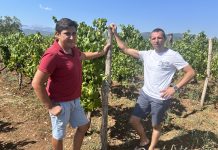
Ante Sočo returned in 1997 from Zagreb, where he had graduated in transport studies, and found the vineyards his grandfather had planted in Bušanje in 1925 or 1926: seventy-year-old vines without trellising, supported by stakes that constantly had to be cut, sharpened and driven into the ground.
He did not see a family treasure. He saw work he had done as a boy because he had to, and from which he could hardly wait to escape.
– I helped my mother and did everything that needed doing in the vineyard. I knew how to prune, tie and dig, but I hated it. I was just waiting for the day I could leave.
His grandfather was born in 1898 and was forty-nine when Ante’s father was born. His father left to work in Germany at eighteen, so after his grandfather’s death, Ante’s mother maintained the vineyards. She planted no new vines, simply preserving what was already there.
When Ante came home, he decided to pull everything out.
To his surprise, his father agreed. He had just one small condition.
– He told me: I’ll be retiring soon. Plant me a hundred vines so I have something to keep me occupied. Once they start bearing fruit, pull everything else out and do whatever you like with the land.
Ante agreed. He would plant a hundred vines, wait until his father had grapes for his own wine, then finally rid himself of everything that tied him to the vineyard. He planted Kujundžuša.

When it began bearing fruit, he made wine. It was not particularly good, just as Ante was not yet much of a winemaker. Nor did he intend to become one: those hundred vines were supposed to be the price of freedom from the vineyard, rather than the beginning of a new chapter in his life.
Except that the Kujundžuša he had planted did not look like the vines in the old family vineyards.
The new grapes were larger. The old vines had smaller berries, yellower and sweeter, which ripened earlier. They also had less acidity, which did not suit Ante, but the difference intrigued him enough to take his first serious look at what he had previously wanted to uproot.
– That was when I became interested in what was actually growing in those old vineyards.
There was no specialist he could ask, nor an internet where he could quickly find an answer. His brother-in-law Josip Gugić, an agronomist, recommended books and research papers, which Ante acquired and read. That was how he came across a degree thesis on the small-berried and large-berried variants of Kujundžuša.
The old vineyards contained more than Kujundžuša. Several other varieties grew among the white vines, along with roughly ten per cent red grapes. Earlier generations did not separate them: they harvested and crushed everything together and made wine from the lot.
– People can pretend today that it wasn’t like that, but in ninety-five per cent of households, everything was mixed together. Nobody minded if the wine oxidised either; they racked it when a film formed on top. Apart from the Imotski winery, more serious equipment only began appearing in private cellars in the 1990s.
Among those red vines, one particularly appealed to him.
He asked his mother whether she knew what it was.
– Sočuša, she replied.
– What do you mean, Sočuša?
– That’s what the old people called it.
His mother did not know whether it had really been named after the family surname, when it had arrived in their vineyard or who had planted it. It had been growing there long before Ante, mixed with Kujundžuša and the other vines, waiting for someone finally to notice it.
In the first year, he made perhaps thirty litres of wine from it. His mother still managed disease protection and told him when to spray, because Ante knew almost nothing about vine diseases. That year, the grapes became diseased, and they barely harvested enough to crush anything at all.
The little wine they obtained changed everything.
– I’d never had such a lovely wine before. The flavour stayed in your mouth so long that you could eat onions afterwards and even they wouldn’t spoil it.
It was not the fact that the vine bore his family’s name that attracted him. It was the wine.

Ante Sočo, who had planted a hundred vines only so he could uproot all the others, decided to preserve and propagate Sočuša.
His father’s trick had worked far better than even his father could have expected.
He began by grafting around five hundred vines. Sočuša was difficult to establish through dormant grafting, so they grafted it onto green shoots in June. Later, he had a vine grafter in Kaštela produce another thousand or fifteen hundred grafted vines on 1103 Paulsen rootstock, which would not encourage excessive vigour or overly high yields.
The more vines he had, the more he wanted to know what he was actually growing.
In Bulić’s Ampelographic Atlas, he found Mekušica. The description sounded familiar: grapes darker than Vranac, producing a soft, easy-drinking wine. Later, he also heard about it from winegrower Ante Gudelj in Poljica.
– When he described what he had, I thought: that’s my vine.
He went to Gudelj’s vineyard and compared the vines. He could see no difference between the Mekušica from Poljica and his own Sočuša.
Eventually, he sent a sample to the Department of Plant Genetics, then headed by Ivan Pejić. The analysis showed that Sočuša had the same genotype as Vranac.
And so one vine acquired three identities: in Sočo’s vineyard it was Sočuša, in Poljica it was Mekušica, and according to the genetic analysis it was Vranac. The official name was not decisive for Ante. He was more interested in what it showed him in the glass.
– It regularly reaches twenty, twenty-one or twenty-two per cent sugar and retains between five and a half and six grams of acidity. The wine can have fifteen per cent alcohol and still remain soft and lovely to drink. That’s ideal.
With Sočuša, he did not have to perform any great cellar wizardry to obtain a good wine. He regularly finished near the top in local competitions, and at the latest Cvit razgovora event, his red was the champion wine.
– Whether we call it Sočuša, Mekušica or Vranac, it always dominates here.
The hundred Kujundžuša vines planted to meet his father’s condition have meanwhile become approximately six thousand vines. Four thousand are in Bušanje, spread across around ten small vineyards on the northern side of the Badnjevica canyon. Almost a hundred metres in altitude separate the highest from the lowest.
These are vineyards without large flat expanses, wide rows or machinery. Real Dalmatia, says Ante: plot by plot, terrace by terrace, all worked by hand.
– Once the first vines started bearing fruit, I couldn’t stop. Wherever there was a lovely little piece of land, I’d plant it. It didn’t matter whether it could hold fifty vines or a hundred.
Bušanje is a village of white earth, springs and wells. Ante says water can be found almost anywhere at a depth of three or four metres.
– If it didn’t rain for forty days, I wouldn’t worry.
The canyon brings another advantage: air flows through it almost constantly, so there is no dew on the vines and disease is rare. Ante sprays his vineyards by hand, just three times a year.
– Only three times?
– Only three. I’ve never had a serious disease problem.
He did not want many varieties, but four that would allow him to make his own comparison between the wider world and home. On one side were Kujundžuša and Sočuša, inherited with the family vineyards; on the other, Cabernet Sauvignon and Riesling, which the literature presented as the most highly regarded red and white varieties.
– I didn’t choose according to what I liked. I wanted to be able to say at a tasting: now we’ll try what the experts consider the best, then what we have at home.
Cabernet Sauvignon was not particularly unusual in the Imotski region. Riesling was.
Ante appreciated Riesling more in theory than out of affection, because wines with high acidity did not particularly suit him. He planted it precisely to see what would happen when he brought one of the most highly regarded white varieties to Bušanje.
Friends warned him that Riesling could not reproduce everywhere what it achieved in Germany. They mentioned Plešivica as one of the few Croatian winegrowing districts where it might succeed.
Ante tried anyway.
He did not plant much: he wanted five or six hundred bottles, just enough to place it beside Kujundžuša in the glass. He named it Tintilinić, after the youngest of the Domaći, the household spirits in Stribor’s Forest.
– I think I’ve got the most out of it. And I think it’s good.
For decades, people from Imotski returned from Germany in Mercedes cars. Ante Sočo returned the favour by bringing Riesling into an Imotski vineyard.
– They say it’s the Rolls-Royce of white varieties, he reminded us.
– Can we call it that, then?
– You can call it whatever you like.
He did not sound like a man particularly concerned about whether a Rolls-Royce or a Mercedes was driving through his vineyard. It was enough that nobody else had such a car among their vines.
That, after all, had attracted him throughout his life: doing something nobody else had thought of.
That was also why, after returning from Zagreb, he did not abandon Bušanje, the village where he was born and briefly lived. The school had already closed, almost nobody remained, and asphalt only arrived in 1992 or 1993.
Until then, a narrow gravel road led to the village. When the dam was built in Ričice, a road was cut from the Red Lake towards Ričice, giving Bušanje a more substantial route too. The road changed, but the village did not fill with people.
– I always felt I had to preserve it. I was born there and lived there briefly, but something stays with you: a feeling for the old place, for your grandfather and grandmother.

The vineyard gave him one reason to return. He found another by chance at the market in Sinj.
He had gone to Sinj on business and, while waiting for a man who had to go home, took a walk around town. It was Saturday, the market was closing, and a woman was packing away honey and teas from her stall.
He began asking questions. Where was the honey from? What were the bees foraging on? How were sales?
In Bušanje, almost every household had once kept around ten hives. Ante had photographs of his grandfather’s apiaries, but hardly anyone from the younger generation kept bees any more.
He thought bees might provide another responsibility that would bring him regularly back to the family property.
– There were perhaps ten beekeepers at the time, and I was by far the youngest.
Soon, alongside the vineyards, he had around a hundred hives. Honey proved much easier to sell than wine: he never had enough of it, while initially he sold wine in bulk, even buying it around the village to resell.
The previous two years had been disastrous for the bees, with no honey. This season they had brought something in, but Ante was not sure which plants it came from. Bušanje has sage, broom, germander, bladder senna and other local flowering plants, but none produces reliably every year.
– I’d have to send the honey for analysis to see what it is. The bladder senna was flowering most heavily then, so it might be from that.
That was how he learnt about wine and bees: something would intrigue him, he would find a book, a research paper or someone who knew more, then try it himself. He had no mentor or winery to take over, only old vines he had intended to uproot and a habit of searching for answers until he found them.
Wine and bees, however, did not provide his living.
He earned the money for them in construction.
His father worked in construction, and from secondary school onwards, Ante spent his holidays working in Germany. He began as a labourer, continued working on building sites during his studies, then bought equipment for diamond drilling and concrete cutting.
It allowed him to make openings in walls for ventilation and air conditioning quickly and precisely. Nobody else in the Imotski region had such equipment at the time.
– A job that would take someone else all day, I could finish in two hours and earn two days’ wages. Getting started was expensive, but afterwards you could make good money.
– When those diamonds began putting money in your pocket, what did you invest it in?
– My hobbies and my loves. Wine and bees.
Around 2004 or 2005, he added scaffolding to his diamond-drilling business. Here too, the simplest jobs did not interest him: he would rather take on the restoration of a bell tower thirty metres high than remain firmly on the ground.
– There you are, thirty metres up. Go on, then. Do it.
He later handed diamond drilling and cutting over to his sons. While they were still at secondary school, he gave them that work so they could earn pocket money, while he increasingly stuck to scaffolding and heights.
Construction financed his wine, bees and ideas whose investment he could never know in advance would be repaid.
Then, in 2006, he decided to open a café. In a country where almost every substantial interior was clad in stone, he knew only one thing in advance:
There would be no stone in his café.
All the cafés in Imotski, he said, were full of stone or granite, glass, mirrors and suspended ceilings that made every space resemble the last.
Ante did not know exactly what he wanted, but knew very precisely what he did not want.
He wanted none of that. He wanted wood on the floor, an exposed structure and a space that would not look like another café assembled from the same recipe.
He took the idea to his friend Rade Jovičić, a sculptor in Zagreb, and tried to explain that the future Stribor needed a soul.
Rade recalled a saying:
– In this life of pain and misery, only four things are worth anything: old wood, old friends, old wine and old books.
They decided to follow it.
The space had four ugly concrete columns that could not be removed. Rade asked the waiter for paper and a pencil, drew a few strokes and said:
– We’ll turn them into trees.
Rade had acquired an old hollow tree, supposedly around five hundred years old, for a future heritage village on his property. When Ante arrived with his café project, part of the tree changed destination.
They cut the trunk into slices and used them to create a path across the floor towards the trees growing around the concrete columns. They made small tables from the branches, and one large table from the same wood.
Rade devised, drew and supervised, while Ante and his team made most of it with their own hands. The concrete columns became trees, slices of trunk became a path, and branches became tables.
Only when the forest was finished did they need to find it a name.
And so, in the land of stone, Stribor’s Forest came into being.
– The name came last. First we made the forest, then the café became Stribor.
Ivana Brlić-Mažuranić did not enter the story as a theme planned in advance. First, Ante rejected stone, then turned concrete columns into trees, and only afterwards realised which fairy tale he had stepped into.
Kujundžuša became Stribor, Riesling became Tintilinić, the rosé became Kosjenka, and the red became Regoč.
Sočo’s logic was simple: Kujundžuša received the lord of the forest, Riesling the youngest household spirit, the rosé a little fairy, and the powerful red a gentle giant.
– When you drink my wines, it’s as though you’re in a fairy tale. There’s always something happening.
His older son Mate is “to blame” for the winery’s new visual identity and labels.
He was supposed to appear at Stribor that day and explain how they came about. But the previous evening’s Cvit razgovora gathering had evidently run long, and even around noon he had yet to reach an agreement with waking up.
– I don’t know how the night knocked him out, but they’re hardworking boys. Both Mate and Stipe.
Mate could sleep through the conversation about the winery’s new face because he had already given it one: he designed labels that bring Stribor, Tintilinić, Kosjenka and Regoč into the same family of wines and fairy tales.
Unlike him, the younger Stipe needs neither waking nor pushing to work. According to Ante, his greatest punishment is being told by his father that he will not be working that day.
One has given the winery a new face; the other does not know what to do with himself without work. Both are already involved in the family businesses, have established their own diamond-drilling and concrete-cutting business, and are gradually taking over what their father began.

Ante started bottling wine around ten years after returning to Bušanje, in 2008 or 2009. Until then, he mostly sold it in bulk and did not remember the first bottle he sold.
He remembered one he gave away much better.
He asked a relative of his wife who lived in France to find winemaking equipment he could not obtain at home. A French winemaker with a small production operation and a wine shop lived in the same building in Marseille, so Ante sent her a bottle of his red through the relative.
It was Sočuša.
She liked it so much that she wanted to buy everything he had. The quantity was not enough for a substantial deal, but her interest went beyond a compliment.
She had the wine analysed and assessed what it might be worth on the French market.
Between fifteen and seventeen euros a bottle.
At home, grapes were then worth so little that people did not know what to do with them. In Marseille, a professional winemaker put a price on his bottle that showed him his work might be more than an unusual hobby financed by diamonds and scaffolding.
In 2013, he planted another 1,100 or so Sočuša vines, then travelled with his family to Marseille to meet the woman who had liked his wine so much.
She had a wine shop near MuCEM, bought grapes and made limited quantities of wine. She wanted to bring together small-production, hard-to-find Mediterranean wines, including Sočo’s Sočuša.
Ante tasted her wines there and saw at close quarters a small French wine operation that did not depend on owning vineyards.
She paid around two euros per kilogram for grapes, picked them herself, hired a refrigerated vehicle and transported them to the cellar.
– And how much did you tell her grapes cost here?
– I had to lie.
He could not admit that they were almost worthless in the Imotski region. He named a price plausible enough to prevent her from suspecting that a wine valued at fifteen to seventeen euros came from grapes that barely had a market at home.
The big French deal never happened. The wine shop later closed, and Sočuša never found a lasting place among Marseille’s small-production Mediterranean wines.
What remained were 1,100 new vines, planted after a bottle from Bušanje went to France and returned with a price Ante would never have put on it himself.
Even then, he did not turn the winery into his main occupation or make constant growth the aim of production. Wine remained something into which he put money earned elsewhere, time he never had enough of and curiosity he never lacked.
He is not a man who, for the sake of harmony among winemakers and promoting the region, will claim to like everything happening on the scene.
– I liked it when there weren’t so many of us.
It bothers him when someone with no connection to the land, vineyards or wine invests surplus money and becomes a winemaker overnight.
– Someone has no love for it, just spare money, and suddenly decides to make wine. That gets on my nerves. Wine will lose its soul that way.
He believes the Imotski winegrowing district has so far kept its distance from that. Few people have entered wine purely as investors; most grew up with the land, returned to it or have a family connection to it.
Even today, he does not complicate what he has always done simply. He places most faith in the vineyard site, the variety and straightforward cellar work. He has no plans to double production or plant all of Bušanje with vines. It is enough that what he has remains good, small and his own.
When he manages to escape the vineyards, bees, café and construction work, he heads for places with few people. Bosnia attracts him, particularly the Una, Bihać and Bosanska Krupa: watermills converted into holiday apartments, little river islands, shade, water and silence.
– I could spend a week up there. No crowds, no need for anything.
He has to go in June. If he does not manage it then, all his jobs catch up with him, and he loses his chance for the year.
In his youth, silence did not matter particularly. He listened to hard rock, went to concerts and still has a photograph with Štulić from those days.
– I was at a concert, and afterwards we sat together, drank and took photographs.
Yet a gold record by Arsen Dedić hangs on Stribor’s wall.
When he was young, Arsen did not appeal to him. It seemed like music for another age. Today, it suits him.
– He’s lovely to listen to. Before, I only listened to rock, the heavy stuff. Only now has Arsen clicked with me.
– Not many people can listen to him at twenty.
– Not many. But who drank wine at twenty? And sometimes it takes a little longer still to realise that when your father allowed you to uproot the vineyard, he was actually leaving you among the vines for good.