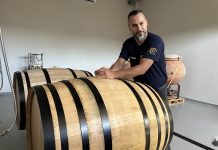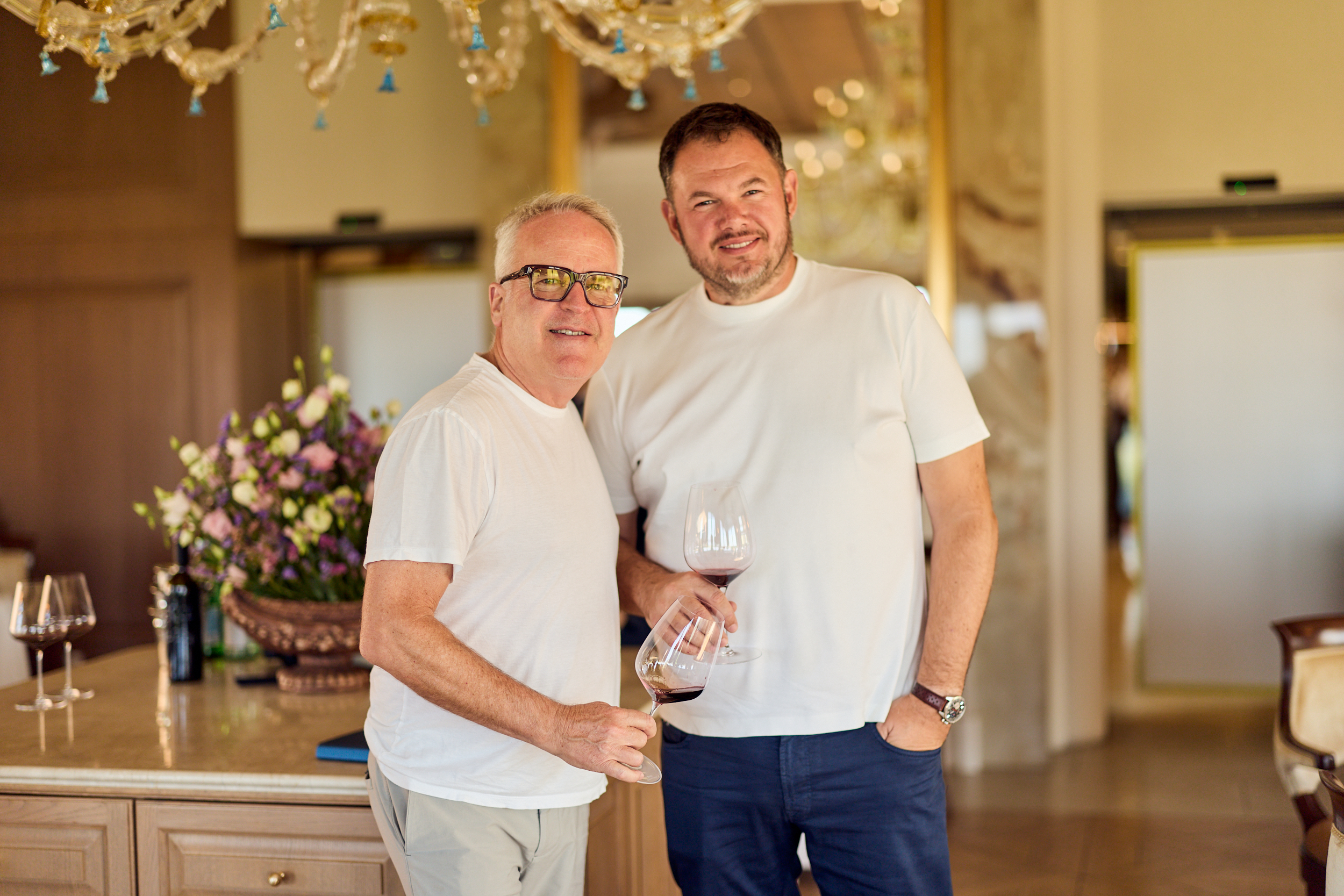
Igor Luković never approaches the Tisza without dipping his hands into it or washing his face with its water. He still does so today, although he has lived in Belgrade for many years. He grew up on its banks, secretly drank his first wines there and concluded that he did not particularly like them. They were sour and unremarkable. Many years later, when James Suckling gave him his first independent assignment, he found himself beside the same river again. This time upstream, in Tokaj, with a glass in his hand and a job that required him to assess the wines of one of the world’s most celebrated wine regions.
The journey between those two glasses would hardly fit into a neat CV. It includes newsrooms, a wine shop opened with borrowed money, wines that surprised him, winemakers he upset and people he learned from. It also includes a great deal of food. In fact, without food, perhaps none of it would have happened.
Igor was born in Zrenjanin and spent part of his childhood at the family’s stilt house beside the Tisza. His father was an actor and brought together people who might never otherwise have sat at the same table: doctors and shepherds, actors and craftsmen, bohemians and priests. Something was always cooking or roasting over the fire. His father loved to cook, his mother excelled at traditional Vojvodina dishes, and the aromas of his grandmothers’ and great-grandmothers’ kitchens have stayed with him.
For Igor, the Tisza was a place to eat, fish and listen to people. That was why he was not particularly moved when I asked him about Lola Novaković’s song Čamac na Tisi – A Boat on the Tisza.
– I have to admit, not at all. I do not like that kind of urban pop song from the sixties; it simply is not my music. I am fairly sure the boat is on the Tisza only because Tisa rhymes with “nisi”.
He had a ready answer about the song, but spoke at length about the river. It was there that he formed his first impressions of people and food, and the first licence he obtained was for a boat rather than a car. He also visited his great-grandmother in Novi Bečej, another town on the Tisza, where she lived in a traditional Pannonian house with three courtyards. Banat remained his homeland, although the personal map of his childhood extends beyond the plains.
On one side of the family, his ancestors had come to Vojvodina from Toplica. As a boy, he spent time there among forests, meadows and streams. During the first ten years of his life, he also spent part of every summer on Molat, so at home among the island children that he never felt like a tourist. He caught annular seabream and comber with a handline, jumped from rocks, dived and went in search of figs. His family tree also has roots in the Bay of Kotor, so he likes to think of himself as Mediterranean, too.
– My personal geography is, above all, a geography of flavours and aromas. Even as a child, I had the chance to get to know carp, scorpionfish and stream trout, as well as kajmak, buzara and poppy-seed strudel.
One taste, however, stands out as the moment when he first became conscious of his own senses. In Le Ventre des philosophes, the French philosopher Michel Onfray writes about a ripe May strawberry from his father’s garden that awakened his sense of taste as a child. Igor found his own strawberry on the Adriatic, in a large pot of date mussels cooked buzara-style.
– My parents could barely persuade me to put the first mussel in my mouth. Then it was as though something unlocked. Suddenly, I became aware that I could smell, taste and enjoy it.
Wine took longer. After those poor wines secretly drunk on the Tisza, a good deal of time passed before anything in a glass surprised him. As he recalled in an earlier conversation, it was an off-dry Muscat from a large winery. Today, he finds the experience slightly amusing, but at the time he discovered that wine could smell lovely and did not have to be diluted with sparkling mineral water.
Meanwhile, he studied literature in Novi Sad, completed specialist studies in journalism and worked in the media. He tried newspapers, television and radio before finding his place in magazines, features and columns. He does not consider himself a literary writer. Books, he says, helped him develop his style, while newsrooms taught him the craft.
He wrote about food before he began writing about wine. In the early 2000s, Serbia’s wine scene was taking shape again, and he learned from whatever books and magazines he could find. A substantial share of his modest budget went on bottles. He would take a bus from Novi Sad to Belgrade simply to visit a wine shop and buy a Portuguese wine he had discovered there.
Then, on a reporting assignment, he came across two opened bottles.
They were preparing a story for a small food magazine in a room at a Belgrade restaurant. On the bar stood wines left over from a party the previous evening. Igor poured himself some red wine, expecting little after reading on the label that it was Prokupac. It was a 2003 Prokupac from Ivanović, a then little-known winery in Župa.
– Its quality literally shocked me. I was speechless.
There was also a bottle of Duša Dunava Grašac. Those two wines convinced him that Serbia could make excellent wine. That same day, he decided to open a wine shop in Novi Sad. A few months later, he did so, with passion, borrowed money and, as it would turn out, less aptitude for retail than for writing and speaking.
Nevertheless, the wine shop opened doors for him. Restaurateurs, young oenologists and wine lovers gathered around it. From that circle emerged a group who completed sommelier training in 2006. Igor continued writing, began teaching and gained his first experience of wine judging. In time, retail began to feel too restrictive; he launched Vino & Fino magazine.
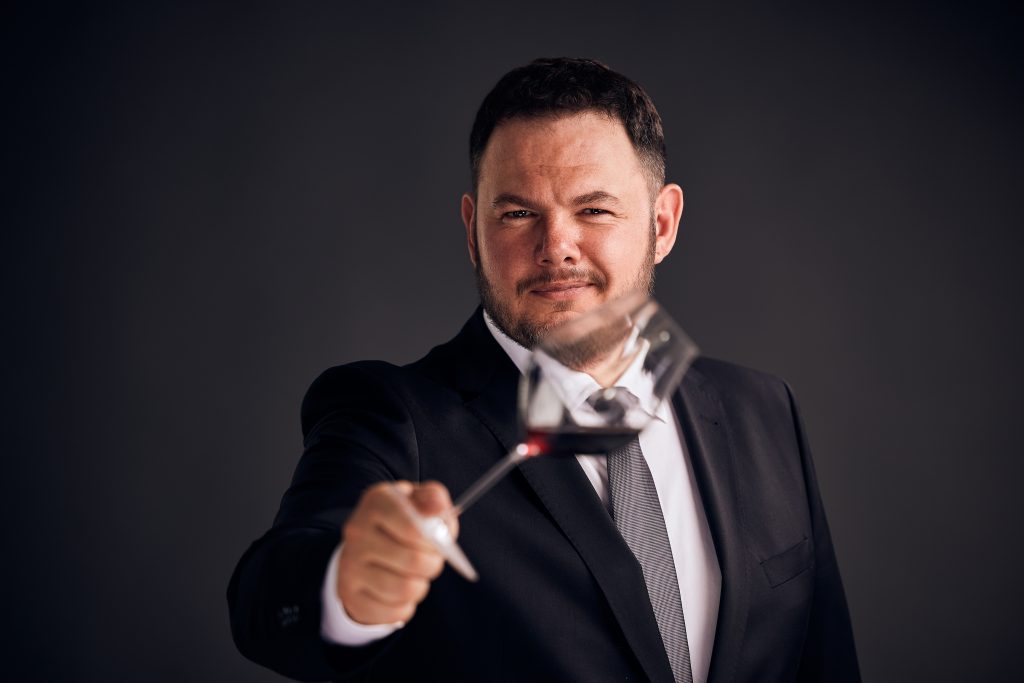
He entered the wine world just as Serbian winemaking was learning to believe in itself again. Winemakers were planting vineyards, building cellars and working out what kind of wines they wanted to make, while those writing about the wines had to learn almost as quickly. There were few good bottles available for comparison, few places where wine could be discussed seriously, and many reasons for every criticism to be taken personally.
– When we began describing and scoring wines for the magazine, it was difficult. We did not have enough experience, but we were learning, and so were the winemakers. They needed time to understand that a good score for one wine did not mean I would find everything they made afterwards excellent.
There were complaints and accusations that he favoured other producers. Igor did not stop scoring wines, but became more cautious about the certainty with which people, judges included, delivered their verdicts. He knew that behind every bottle stood a person whose sales might benefit from a score, or who might be hurt by it far more deeply than a judge at the tasting table could imagine. That is why he speaks more often about responsibility than about the power of his pen.
– When a judge comes along and tells you that your neighbour’s wine is better than yours, it is a serious blow to your ego. Wine is a matter of personal creation and emotion. I come from a family of actors: my father was an actor, and my sister is an actress. For a long time, I thought actors had the biggest egos, but now I think winemakers may have even bigger ones.
Igor says he can now sleep soundly after putting his name to a score, even if he does not always agree with the majority on a judging panel. He likes judges to discuss a wine after tasting it blind. Someone may draw his attention to something he missed; an argument may persuade him to return to the glass and revise his first impression. He no longer regards that as a weakness.
– A good wine judge must know how to keep their ego in check. Sometimes we make mistakes, and the colleague we disagree with may be right.
At his first major international competition, in Sofia, he met Konstantinos Lazarakis and Caroline Gilby, both Masters of Wine. He learned a great deal from them, he says. Later, Lazarakis put him forward to chair the jury of the Balkans International Wine Competition. Igor was surprised, and a little daunted by the responsibility. Until then, he had had to stand behind his own scores; now he also had to think about the order of samples, the composition of panels and the possibility that an organisational mistake might affect the result. Since 2019, he has also judged at the Decanter World Wine Awards.
Throughout it all, he never stopped looking back towards Banat. He returned to Zrenjanin to see family and friends, went fishing on the Tisza and, at local competitions, tasted wines made by people who had planted vineyards close to where he grew up. He could speak tenderly about the region when recalling his childhood, but affection alone was no reason to praise a faulty wine.
He believed there was room for good wine there, and saw just as clearly what producers lacked. Some made too little wine, some had yet to register their cellars, and some bought grapes elsewhere before trying to sell the resulting wine as an expression of their own region. Yet he saw progress at the competitions. He could follow how, after one harvest, a producer corrected what had gone wrong in the previous one.
Ivanović’s Prokupac and Duša Dunava’s Grašac had once convinced him that the domestic wine scene was worth his commitment. Some twenty years later, he expected those wines, like every other wine in his glass, to prove their quality on their own merits. That was why he laughed when I asked what it had been like, after tasting wines from Čoka to Gudurica, to arrive in Tokaj and judge for James Suckling.
– The way I was looked after was on a different level, but I did not feel any different. Good wine is good wine, wherever it comes from. There are excellent wines, and poor ones, on the Vršac hills, in Bordeaux and in Tokaj alike.
That summer, Igor had not been planning another professional change of direction. He was on holiday on Korčula and had to cut his stay short to return to Belgrade and help during Suckling’s visit to Serbia. He was not pleased about coming back early. A few days later, however, something unexpected happened: Suckling offered him a role on his team.
– I was shocked. He said it very clearly and directly, without beating about the bush, in a thoroughly American way. Of course I accepted.
For Igor, it was an unexpected offer, but its significance extends beyond personal recognition. A wine writer from Serbia joining Suckling’s team of tasters and writers represents one of the most significant international professional advances achieved by someone who built a career on the wine scene of this part of Europe.
He says he is still making it up to his wife for the interrupted holiday. Nevertheless, he feels that returning was worthwhile, also because of what Suckling was able to discover in Serbia. In roughly a week, he tasted almost 250 wines. Igor and his colleagues set out to show him small family cellars and large new wineries, different regions and varieties, and the ways winemakers interpreted them. Their guest had the opportunity to discover a scene about which, in Igor’s view, he had known too little.
– He discovered a new wine world. Alongside the wines, he was surprised by people’s energy. So much is still developing here, and people are sincerely excited about it.
That energy fitted well with what Igor had been following since the beginning of his career. He had been there when domestic winemakers were only beginning to prove that their wines could stand alongside those from better-known countries. Now he was guiding through Serbia a man whose scores are read around the world. When I tried to find out the name of a wine to which Suckling had given a particularly high score, he stopped me: he would talk about that once the results were published.

The story of Tokaj actually begins much earlier, with a writer from Novi Sad. Reading a memoir by Đorđe Sudarski Red about travelling upstream in a small boat to Tokaj, where the writer intended to get drunk on Tokaj wine, Igor first understood how the Tisza he knew from childhood connected to that place. The image returned to him when he set off on his first independent assignment for Suckling’s team. He did not, however, travel by boat.
Tokaj’s wines have long mattered to him. He is particularly interested in the sweet wines: the way acidity gives them freshness while the sweetness leaves room for everything else the wine can reveal. He speaks about them with such enthusiasm that it is difficult to bring him back to the question of how he felt when he arrived to assess them.
– I was not nervous. I was excited. I still am.
They took his visit seriously. At Sauska’s winery, which was closed that day, the chef travelled from Budapest to prepare lunch for him. Igor was taken aback by such consideration. Nevertheless, neither an excellent lunch nor a producer’s reputation could determine what he would write about the wines. Asked whether he had awarded anyone a hundred points on his first assignment, he answered briefly:
– I did not encounter a wine to which I would give them.
He remains every bit as serious about food as he is about wine. He loves fishing, cooking and eating, and is particularly amused that the world has only recently discovered how good tinned fish can be. He discusses it with an enthusiasm that could outlast many wine tastings. Sometimes he serves it with care; sometimes he turns it into what he himself calls a pretentious dish. Half joking, he laments not having become the man who built a career on the sardine before everyone else caught on.
When I asked who cooked best among Serbian winemakers, he chose neither of the two names I offered. He thought of Gaga Ivanović. He can still recall some of Gaga’s dinners from twenty years ago in detail: respect for the ingredients, precision in preparing traditional dishes and no desire whatsoever to show off.
– That was how he made wine, too. It was what made him great.
Today, much of Igor’s schedule needs rearranging. He edits Vino & Fino, judges at Decanter, takes part in international wine projects, runs GROW with Saša Špiranec and Zoltán Győrffy, and has been working with Caroline Gilby for years on a book about Serbian wine. Joining Suckling’s team has opened up a new area of work, but has not added any hours to his day.
– It has made my life enormously more complicated, but it has also forced me finally to give up certain things. Some reluctantly. Others should have ended sooner; I simply needed a strong enough reason.
As he says this, he does not seem like a man mourning his lost peace. He is more interested in what he will learn in his new role. I recognise that same curiosity when he talks about sardines, a dinner Gaga Ivanović cooked for him twenty years ago, or a night spent with his family on Sušac, beneath a sky with no lights other than the stars. On Sušac, the sea and wind both frightened and enthralled him. He is already thinking about Palagruža and Svetac.
Asked whether he prefers sailing the Adriatic or quietly fishing on the Tisza, he admits that what excites him at sea is travelling ever further. Then he returns to the river.
– There is only one you keep coming back to.
He has travelled far enough to know how much that return means to him. I also asked what language he dreams in while trying to reconcile everything he does.
– I dream in Serbian, then translate into English.
When he next approaches the Tisza, he will still lower his hands into the water. He was once a boy there who thought he did not like wine; today, that same river, a few hundred kilometres upstream, leads him to work he could have known nothing about back then.