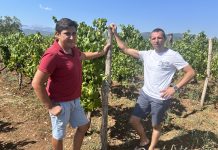
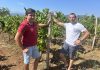
Bramble had engulfed the vineyard so completely that almost nothing could be seen beneath it. A plot in the middle of the Čara plain had lain untended for decades, and the old vines barely emerged through the dense vegetation. Davor Tasovac bought it intending to clear it and replant, unaware of what he would find there.
– When we started clearing it, I saw incredibly thick vines, unlike anything I had ever seen before. Among them were old Grk vines. Nobody had looked after that plot for perhaps fifty years. Bramble had grown over everything, but the Grk was still there.
The Čara plain belongs to Pošip. Grk once grew in Čara too, but gradually gave way to a variety that produced more grapes and cropped more reliably.
– You could always find the occasional Grk vine in our vineyards. We also have an old label from the days when the cooperatives in Čara and Smokvica operated together. My grandfather wrote on it how many grapes he had delivered, the strength of the wine and the sugar content. To me, that label proves that Grk is no newcomer here.
Davor had wanted to plant it before, but finding it beneath the bramble settled the matter.
– When I saw that Grk had already grown on that very plot, there was no longer any doubt. I decided we would bring it back there.
His friend Zoran Cebalo from Lumbarda gave him the canes for grafting. The variety so closely associated with the Lumbarda plain thus returned to Čara with the help of a man from Lumbarda.
– Zoran and I went to school together. When I told him what I wanted to do, he gave me the canes for grafting. We are friends with everyone, and we support one another. There was no drama about it.
Grk was once again growing in the middle of the Čara plain, among the Pošip vines. The first wine attracted attention simply because its label paired a variety with a place most people did not expect to see alongside it. Then came a Decanter gold medal. The following year brought another. – Suddenly, everyone wanted to try the Grk. They called and asked whether they could come and taste the award-winning wine. We sold practically half the production straight away, and after the gold medal, everything gathered even more pace. It was the first Grk from Čara, and that alone was interesting enough for people.

Sanja Tasovac remembers how much interest in the winery grew after the two consecutive awards.
– Guests would arrive and say they had read about Decanter. Before, they might not have cared where Grk grew, but now they wanted to hear the whole story. An award brings you enormous publicity, but also confirms that what you believe in is more than just an idea within your family.
The people of Lumbarda did not begrudge them their gold medals. There was singing and teasing, but it all stayed within the bounds of the usual island banter.
– It was all positive, Sanja says. – On an island, people have to tease each other a little. You couldn’t do without it.
Davor, however, has no intention of giving up the variety he grew up with.
– I would like us to be known for both Grk and Pošip, but Pošip is Pošip. I am in love with it. Grk brought us two great gold medals, but Pošip was part of our family long before we had a winery. It is the reason any of this began at all.
For generations, the Tasovac family tended vineyards in Čara. They delivered grapes to the cooperative, kept some for wine to drink at home and sold a little in bulk. They grew Pošip, Rukatac, Cetinka and Plavac Mali, but Pošip accounted for almost all their plantings.
– We may be a new winery, but we are not new grape growers. As a child, I went to the vineyard with my grandfather and father. There was always work to do with the vines in our household.
The vineyards were scattered across different parts of the Čara plain. Davor’s father Zlatko and his uncle had once worked roughly twice as much land together. After it was divided, Davor’s family was left with around two hectares.
– There came a time when selling grapes was no longer worthwhile, Sanja says. – You delivered them, but never received the full price. You worked all year, then depended on how much someone else would pay you.
Davor trained as an electromechanical technician in Korčula, but never seriously pursued that line of work. When his father asked whether he wanted to continue working in the vineyards, he said yes, just not in the same way as the generations before him. – I no longer wanted simply to sell grapes. I wanted to make my own wine. It had been on my mind for a long time, and around 2015 I started thinking about it seriously.

Zlatko was sceptical at first. The family knew the vineyard, but a winery of their own meant equipment, production, bottling and a market where nobody was yet asking for a bottle bearing the Tasovac name.
– Later, everyone supported me: my father, my mother and the whole family. Once we decided to go ahead, everyone was a hundred per cent committed.
In 2017, at the age of thirty, Davor took over the family farm. He bought a two-thousand-litre stainless-steel tank and made his first wine in it. The year seemed determined to test how serious he was.
– It was disastrous. Frost struck, and in some places the temperature fell to minus eight. I will never forget it.
What saved them was that their vineyards were not all on the same site. The frost did not affect them equally, so they managed to harvest enough Pošip to fill the tank. Two thousand litres of wine were the entire Tasovac winery.
– Did you manage to sell it all?
– We did, but it was a struggle. You have friends who want to support you, but nobody knows you yet, or can know whether you will survive.
The first bottle was bought by his friend, restaurateur Mate Kurtović.
– He believed in me from the very beginning. He was my first customer and a great support in everything. It is lovely to be able to remember who bought your first bottle.
The positive early responses gave them a reason to carry on.
– That gave us a real boost, Sanja says. – When people tell you they like your wine, you get confirmation that you are doing something right.
Pošip won gold at Sabatina, was named Dalmatia’s white wine champion at Vina iz davnina, and then international medals followed, including a Decanter bronze for Pošip Sur Lie 2020.
– The awards helped get our name out there. People started coming, production grew, and we began making other wines. But we never wanted to be big just so we could say we were big. Alongside Pošip, Pošip Sur Lie and Grk, the Tasovacs also make Plavac Mali and rosé. Yet the new labels did not change the rule they began with: only what they can grow in their own vineyards goes into the bottle.

Sanja was beside him before the first bottle, the first stainless-steel tank and the first medal. The two of them, she says, have been together forever anyway.
– It was his idea. Davor wanted to make his own wine, and from the start I helped wherever I was needed.
She trained in hospitality and tourism, but spent almost ten years managing a shop. Meanwhile, the winery was growing, and after work she would turn to guests, bottles and bookings, until she could no longer live both lives.
– It became too much. More and more people were coming, and I could no longer divide myself between the two places.
Davor makes no attempt to compete with her when it comes to speaking to guests.
– She speaks better than I do.
– He knows how to talk too; he just doesn’t want to, Sanja replies.
Her wine presentations regularly end in applause. Davor insists she was born for the job, while Sanja’s explanation for the ovations is not entirely serious.
– I tell them a little about the wines, then throw in something silly to make them laugh. I suppose they find it endearing. There has hardly been a group that hasn’t applauded at the end, and it embarrasses me every time.

Guests listen to the story of how the Tasovacs began, walk through the winery and the old house, then sit down in the stone courtyard. Alongside the wines, they taste the family’s olive oil, dry-cured ham, cheese, liqueurs and whatever seasonal produce the garden offers.
– We sell most of our wine directly here at home. We have kept the restaurants and friends we have worked with from the beginning, but we have no organised distribution beyond Korčula. We manage to sell everything on the island.
Their advertising is the house in Kampuš, the bottle a guest opens there and the story they take away with them.
– We don’t like putting ourselves in the spotlight too much, Sanja admits. – I am still not very good with the internet and PR. I hope Laura will take that over one day.
Laura is the eldest of their three children, followed by Nora and five-year-old Damjan, a real little live wire.
– The children help as much as they can. We are gradually involving them in the work so they develop good working habits. Whether they will one day want to carry on what we have started remains to be seen.
Their families and friends help in the vineyards, olive groves, harvest and tasting room.
– Whenever we have a big job to do, everyone comes. Without them, we would not have achieved half of what we have. August is the hardest month, when the tasting-room season is in full swing and the harvest begins at the same time. Then we literally work day and night.
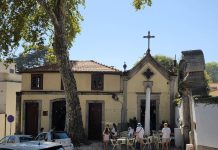
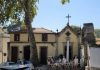
The winery first operated in a small cellar in Čara, close to the vineyards, but the space was unsuitable for a tasting room. The solution lay in Žrnovo, in the house of Davor’s mother Marina, built in 1860 in the hamlet of Kampuš. Moving from Čara made Tasovac the only winery in Žrnovo, although all its grapes still come from the Čara plain.
– My sister inherited the house, so we came to an agreement and sorted everything out. This is my mother’s family home, while my father is from Čara. That is why our vineyards are there and the winery is here.
One part of the house had once served as a stable. The Tasovacs restored it with their own hands and acquired modern winemaking equipment with the help of European funding. The thick walls, stone roof slabs and rooms added over several generations were more than a heritage to preserve. They were work the family knew how to do themselves.
– My father and I have worked with stone all our lives. We built, dressed stone, made boundary walls and dry-stone walls. Everything around this house, we did ourselves.
– Can we say, then, that you also built part of Korčula?
– We certainly can. My father and I built several kilometres of dry-stone walls, mostly around private houses, vineyards and olive groves. These days, I no longer have time to work for other people. Now I work only for myself.

The family’s stonemasonry did not begin with Davor’s father. His great-great-grandfather was also a master craftsman and had his own site where he quarried stone.
– When I look at someone’s work, I know straight away whether it was done by a master craftsman. I see how he laid the stone and made the joints. Someone else might simply say the wall is beautiful, but I know why a particular stone was put in a particular place.
– He notices details I don’t see at all, Sanja says. – I see that everything is neat, and he immediately finds something that should have been done differently.
The roofs were particularly demanding: thin stone slabs, extracted from natural layers in the ground, laid over wooden beams.
– Almost nobody does that today. The skill has been lost. We built the new parts of the house to blend in with what was here before.
Old Korčula houses have walls almost a metre thick. Davor calls them fortresses, but knows it is no longer possible to build in the same way today.
– It is too expensive, and there aren’t enough master craftsmen either. If I had had to pay someone to do everything I have done here myself, I could never have afforded it.
The restoration did not end when the winery opened. When work in the vineyards, olive groves and tasting room eases in winter, Davor picks up his tools again.
– If there is no work with the vines or olives, I build something. If I am not building, I am pruning vines or tending the olive trees. There is always something to do.
– They are forever working like mad, one friend said of them. – They don’t stop, from one morning to the next. The Tasovacs did not particularly dispute that diagnosis.

The combination of wine and stone earned them special recognition from the Suncokret Rural Tourism Awards for preserving indigenous grape varieties and traditional Korčula architecture.
– That award is especially dear to us because it embraced everything we enjoy: wine, the house and working with stone, Sanja says.
While restoring the house and lifting old boards from the ceiling, the Tasovacs found letters none of them had known existed.
– My great-great-grandfather Jakov sent them from abroad, and his wife wrote back to him. She kept the letters and hid them in the ceiling.
Jakov travelled to America and New Zealand, adding to the house when he returned. He spent twenty-four years abroad.
– When he left, his son was two years old. He did not see him again until he was twenty-four.
– So it was a great long-distance love story?
– It was, Sanja says, – but in the end she threatened to leave him if he didn’t come home.
In the surviving photographs, Jakov was not always alone, so Sanja has her own explanation for why it took him twenty-four years to listen to his wife.
– We have photographs of him with women. Perhaps that was why he couldn’t come back sooner!
The house grew piece by piece, after different homecomings and over several generations. Alongside it, the family preserves the story of a surname Davor finds in old records from Čara.
– We have a family tree, and the Tasovac name has been mentioned here for centuries. There is also an old legend about a woman of the Tasovac family who found the statue of Our Lady of the Čara Plain. To us, Čara is more than simply the place where we have our vineyards.
The house nevertheless brought them to Žrnovo, to old Kampuš, where the stone houses still stand close together. Sanja is glad that modern construction has largely passed this part of the village by.
– I love tradition. I would like the old houses to be restored, but to look as they once did. Then Žrnovo would remain a place people come to see, rather than yet another place where everyone has built whatever came into their heads.
The Tasovacs almost never lock the house. Guests know where they keep the key, and sometimes even the winery door is left open. The only real drama involving a lock happened on the very day of our conversation, when the cylinder broke and the door decided to demonstrate that it did, after all, know what it was there for.
– This time, it really did lock, Sanja says. – We, who never lock anything, ended up locked inside our own house. A disaster!
Today, the Tasovacs have around twenty thousand vines on various sites across the Čara plain, and approximately five hundred olive trees in Čara and Žrnovo. Davor speaks of that number as a limit rather than a starting point for further expansion.
– Twenty thousand vines is the maximum. I don’t want to bite off more than I can chew, I don’t want our quality to fall, and I don’t want stress to eat me alive.
The grapes are their own. In some years, they have taken a little from relatives, but they have not sought outside growers to fill more bottles.
– We make only as much wine as our own grapes allow. We can do something new with a variety or change the style, but I see no need to increase capacity.
Working with oenologists Igor Radovanović and Nikola Mirošević has opened up possibilities for different interpretations of Pošip.
– I am really looking forward to that collaboration. We are a small winery, working with volumes we can give our full attention to. I want to see what we can achieve together with our grapes, while keeping the wine our own.
Water circulates continuously in a stone basin in the middle of the courtyard. Sanja saw a similar fountain online, and Davor installed a pump and ran a pipe through it.
– We love water. When we travel, we always look for places near rivers or fountains, because they help us relax. Here, the guests find it interesting, but the children most of all.
For them, the couple want to create a small park in the lower part of the property. Sanja has no objection to calling it a wine kindergarten.
– We get a lot of families. Parents would like to taste wine in peace, but at the same time they have to keep an eye on their children. If we create a space where the children are happy and safe, everyone will be able to relax.
When they manage to tear themselves away from the winery, vineyards, olive trees and guests, the Tasovacs travel. For Sanja, that is her main way of letting off steam, while Davor prefers to unwind from work by doing different work – with stone.
– I enjoy it. Some people relax by doing nothing. That is when I find something that needs building.
That is why they have yet to finish everything they want to do in Kampuš. Around the house, there are spaces they can improve and walls Davor can rebuild. For the Tasovacs, completion is not a date, but a brief interval between two new jobs.
– We always say we’ll just do this one more thing, and then we’re finished, Sanja says. – And as soon as we finish, we spot something else.
In a vineyard in the middle of the Čara plain, Grk has been returned to the place where Davor found it beneath the bramble. In Žrnovo, a house from 1860 has been restored stone by stone. Between those two places, a winery has taken shape that sells most of its wine without leaving the island and, even after two Decanter gold medals, wants no more than it can grow itself.
– The island has its drawbacks, but to me its advantages are far greater, Sanja says. – Here, we have peace, people we love and a life that suits us.
– An island is an island, Davor adds. In his case, something else holds true as well: Pošip is Pošip, stone is stone, and twenty thousand vines are quite enough to fill a person’s life.