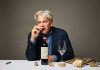
Kusić is the only Imotski winery with a sea view.
Its vineyards lie on the Imotski plain, which supplies ninety per cent of the grapes for its wines, even though the owner left Imotski at seventeen. He built the winery beneath Biokovo, above Makarska, on land his wife Antonela inherited from her mother. And so Petar Kusić looks out towards the sea from his own winery, while the Blue Lake looks back at him from the most prominent wall in the tasting room.
The painting is by Sanja Srzić, a relative of his wife. Antonela brought it as a surprise, presumably to make sure that, with all that view before him, Petar would not forget where he started.
As though he could.
– Winemaking is always a story about a place and a grape variety. Our vineyards are in Imotski, and that is the foundation of our production. We source Pošip from Čara and Plavac from Komarna, but we wanted our wines to contain Dalmatia in miniature: the freshness and style of the Imotski region, alongside the power of the south.
Biokovo stands between Imotski and the sea. That is why Kusić’s white wine is called Adrion, after the oldest known name of the mountain that connects two climates in his story. On one side lie the vineyards and family history; on the other, the cellar. Between them is Petar, who has changed cities, countries, wineries and ferries, yet never moved as far from Imotski as geography might suggest.
In his family, even the vineyards did not follow geography. They followed births.

Petar’s grandfather, also Petar, planted a vineyard in 1956, when his son Darko was born. That Darko, Petar’s father, uprooted the vineyard in 1982, the very year his son Petar was born. And when Petar had a son in 2012, he named him Darko and planted a vineyard again.
– So it goes Petar–Darko, Petar–Darko. We didn’t plan it, but that’s how it turned out.
In this family, then, it was clear in advance who would plant and who would uproot. Petar’s only good fortune is that his son Darko is not yet old enough to start uprooting.
The vineyard Darko removed was not the family’s only connection with wine. For years, Petar’s grandparents ran the Biokovo inn in the centre of Imotski and processed grapes in their own cellar. They sometimes handled an entire railway wagon’s worth.
– Back then, people drank wine by the bucket.
– By the bucket?
– A sić is a bucket. Wine wasn’t sold by the bottle and glass as it is today.
Kujundžuša dominated, of course. Petar’s father also made wine, but stopped in 1982, when he uprooted the vineyard. Petar cannot remember it: that was the year he was born. The family tradition seemed to have died out just in time for him to have to start all over again one day.
Petar grew up in central Imotski, far from the agricultural work of earlier generations. His uncle Tvrtko Bubalo, whom he describes as one of Imotski’s most passionate winegrowers, kept his connection with the land alive.
– He was the reason I grew to love agriculture and winegrowing. At harvest time, we always went to help him, my aunt and other relatives. Winegrowing takes a certain amount of stubbornness because something is always setting you back. I think I got mine from him.
Long before Petar, the Kusić family had scattered in different directions. Another winemaker with the same name comes from the Kupres branch: Petar Kusić, better known as Pero or Taso, who owns a winery in Zmajevac in Baranja. According to family tradition, his ancestor set out from Medov Dolac almost two hundred years ago, but snow stopped him at Kupres.
– Kupres could only have been the destination for people who got stuck there.
Another branch went towards Vojvodina, then Zagreb; Zvonko Kusić, a member of the Croatian Academy of Sciences and Arts, descends from it. Family lore also includes Grgo Kusić, the Dalmatian Gulliver, supposedly 237 centimetres tall and a member of Emperor Franz Joseph’s personal guard. Beside him, even Pero from Baranja, at 194 centimetres, might feel like one of the shorter members of the family.

– He told me there was another winemaker called Petar Kusić and that I had to meet him. He’s from the Kupres branch, but we all come from the same Kusić family. Ours are from Grabovac near Imotski. My grandfather moved to Imotski with his brothers when he was fourteen. One later ended up in Split, another in Makarska, and that’s how we scattered.
Petar is therefore neither the first Kusić to leave Imotski nor the only Petar Kusić making wine. He is, however, the only one who, after Imotski, Zagreb, Đakovo and Slovenia, ended up at a winery beneath Biokovo while commuting to work on Brač by ferry.
Before wine, basketball looked like the more serious career prospect for both him and his father.
His father Darko played for Yugoslavia’s junior national team in the generation of Mihovil Nakić and Andro Knego. He brought home gold from the European Championship in Turkey in 1976, but stopped playing at eighteen. Petar followed in his footsteps. The basketball club in Imotski, he says, lived through regular bursts of enthusiasm.
– Every ten years or so, a generation comes along that loves basketball. The club becomes really good, then fades away again.
Petar left Imotski at seventeen. He completed his final year of grammar school in Zagreb so he could train more seriously. He played for Mravi and Zrinjevac and trained with Marin Rozić, who would become Cibona’s long-serving captain. Rozić built a professional career. Petar broke his leg.
After recovering, he played for Medveščak for a while, but his basketball story gradually drew to a close.
– Well, if you’d already broken your leg, you could have switched to ice hockey at Medveščak.
– True. At least I could have stayed with the club.
Basketball opened the way to Zagreb, but did not keep him there. When it faded, agriculture remained. He had not enrolled because he imagined owning a winery. He simply knew he did not want to work in trade or sell what other people had produced.
– If someone had offered me a production job in Madagascar, I’d have gone to Madagascar. That’s how much I wanted it.
His first opportunity came in Đakovo, as a viticulture specialist on an estate with four hundred hectares of its own vineyards and another 365 managed by partner growers. From Imotski, where the former large-scale operation was already on its last legs, he entered a system whose dimensions he had previously known mainly from books.
– I desperately wanted to work in production, and I didn’t hesitate for a second. In Dalmatia, there were hardly any large vineyard estates where you could learn how production on that scale worked. In Đakovo, I worked with people who had spent their entire lives in those vineyards. The experience I gained from them was priceless. I’d recommend that kind of education to anyone.
He spent approximately a year and a half in Đakovo. When Enver Moralić bought Đakovačka vina in 2009, he offered Petar a move to Brič in Slovenian Istria. Petar had no family commitments yet and, once again, did not take long to decide.
The vineyards at Brič covered around forty hectares, but the entire operation worked differently. The large villa and winery amid the vineyards had grown more out of the owner’s love than cold calculation. In Đakovo, Petar learnt to manage a large system; in Brič, he moved closer to the cellar. His mentor was Iztok Klenar, an oenologist from Vinakoper, from whom he says he learnt most of what he was still missing at the time.
Brič was also where he and Antonela began living together. They had met while he was working in Đakovo, seeing each other in Zagreb, while she also visited him in Slavonia. Later, they married and had their first child in Slovenia.

Antonela is from Makarska and teaches mathematics and physics. They considered staying in Slovenia and having her look for work closer to Umag, but Petar knew what would happen if their children began nursery and school there.
– Then we’ll never come back.
So he decided to make the break. Moralić offered him a job in Kutjevo, but he turned it down.
– I took the plunge. I resigned even though I didn’t have another job yet. I knew that if we didn’t leave then, I’d never return to Dalmatia.
He did not remain unemployed for long. While still working in Slovenia, he received an offer from Rizman winery in Komarna, and in 2011 exchanged one job for another.
He arrived in Komarna practically at the birth of the new winegrowing district. Reclaimed karst is now a familiar Dalmatian vineyard landscape, but at the time it was territory without ready-made answers. Zlatan Plenković went first, followed by Andabak, the Štimac family, the Volarević family and others. Nobody yet had enough experience to lay down rules.
– We were all learning together. Karst was new to everyone.
That was when Petar’s experience in Đakovo became invaluable. He returned to Dalmatia with precisely what it lacked: knowledge acquired across large vineyard areas. Throughout his time at Rizman, he was head of production.
He stayed in Komarna for six years, until the end of 2016. There he learnt how successfully a vineyard could contend with stone, but also how stubborn a person had to be to try to overcome it. It was good preparation for Brač.
When Ivica Kovačević offered him a job at Stina, he was looking for someone to manage the vineyards. Petar had the Slavonian estates, Slovenia’s Brič and Komarna’s karst behind him. With around sixty hectares, Stina has one of Dalmatia’s largest vineyard operations, alongside Korlat. He arrived as a viticulture specialist, later became production director and, for the past two years, has been the company’s managing director.
– At Stina, I started in the vineyards again, then ended up as a director and bureaucrat.
Stina gave him a rare opportunity. Alongside its own vineyards, it bought grapes from different sites on Brač, turning each harvest into a comparative study of altitudes, aspects and soils. They learnt both from what succeeded and from the differences between sites.
In 2018, they began vinifying grapes from Stipančić separately. The site’s highest point reaches approximately four hundred metres, which might be considered too high for Plavac Mali to ripen reliably. The opposite proved true: alongside high sugar levels, the grapes retained an unusually low pH for a vineyard on limestone soil.
– After several years of monitoring it, we realised how distinctive Stipančić is. Personally, it’s my favourite Stina wine. It has the power of the south, but it isn’t overripe or heavy. It isn’t made in the style of those powerful Plavacs we’ve grown used to.
Petar nevertheless refuses to claim any particular label as his own creation.
– Everything we’ve done at Stina is the result of teamwork. I wouldn’t single myself out in the creation of Stipančić or anything else.
In Petar’s case, it is difficult to separate his work at Stina from everyday life. The ferry timetable determines his working day. In summer, he catches the six-thirty ferry from Makarska and returns from Brač on the two-thirty sailing. He gets home at around quarter past four. In winter, the first ferry does not leave until nine, shifting the entire day. When work becomes demanding, he stays overnight on Brač.
On his return, work at his own winery awaits.
– Stina is my number one, my love and my priority. I give it a hundred per cent.
– How much longer can you carry on like Škiljo from Zagvozd in Prosjaci i sinovi, looking at Brač with one eye and Biokovo with the other?
– I feel a moral responsibility towards Stina. The Andabak family have always treated me exceptionally fairly, and still do. I’ll stay as long as they need me.
Fortunately, Brač and Imotski have at least not conspired against him when it comes to harvest. At Stina, grape processing begins in early August and runs twenty-four hours a day at the height of the season. Kujundžuša is a late-ripening variety, so its harvest arrives as the work on Brač is nearing its end.
– Thanks to the difference in ripening times, it’s possible to do both.
Possible, then, it certainly is. The question is how.
Unlike oenologists who begin their own story only after leaving large operations, Petar is building his while simultaneously running Stina. He started before coming to Brač and has developed it alongside his work for others ever since, initially so quietly that Kusić winery was known mainly to the restaurateurs to whom he personally sold wine.
– I didn’t want to draw attention to it while working in other people’s wineries. Everything grew slowly and unobtrusively.
In Kusić’s case, slowly meant growing from a thousand to twenty thousand bottles, alongside hundreds of journeys to Brač, three children and a building that took ten years to construct.
When they returned from Slovenia to Dalmatia, Antonela inherited land beneath Biokovo from her mother, while Petar had family vineyards in Imotski. They decided, as he puts it, to bring their inheritances together: her land and his vines.
He began his wine venture in 2012 with his friend and kum, Ivan Puljiz, and approximately a thousand bottles. After three or four years, Ivan stepped away, and Petar continued alone. More precisely, with the whole family, although the children did not yet realise that by being born they had already joined the workforce.
– At first, they were little, so I couldn’t exploit them. Now they’ve grown up.
Petar and Antonela have a son, Darko, and two daughters, Anamarija and Marijeta. When the children were small, Antonela worked at school while looking after them, leaving most of the winery work to Petar. His mother Anka, relatives and friends helped. Without them, he says, even the modest production of those early days would have been impossible to sustain.
As the children grew, so did the winery. Petar’s sister Josipa also became involved, particularly on the hospitality side. Today, the Kusić family produces approximately twenty thousand bottles.
– I think that’s our limit. I don’t want to build something that the children will one day be expected to carry on. This is a business passed between generations, but you can’t decide what today’s younger generations will do.
The winery grew without a business plan specifying bottle numbers or a deadline for profitability. Petar did not see it as a business the family needed to live on. He had his salary, Antonela had her job, and they put everything earned from wine sales back into the cellar.

– Literally every last lipa. Buy a tank, buy a press, buy this, buy that. Believe it or not, since 2012 we’ve taken almost nothing out of the winery.
Alongside the vineyards and equipment, the building grew. First, they settled ownership and obtained permits, then built it section by section. After almost a decade, they opened the tasting room and visitor area. From outside, the building looks finished, but upstairs the space where the family hopes to live one day remains unfinished.
– When was the winery completed?
– It isn’t completed. It’s a lifelong project.
– So you’ll live upstairs one day?
– I hope so.
In winemaking, Petar explains, projects never reach their final form. There is always a need for another tank, a larger press, a new storage area or a space nobody knew was missing until yesterday. At Stina too, they have projects they have been carrying with them for ten years. Winemaking is a building site where, unlike a house, a harvest must also be dealt with every autumn.
Yet opening the winery brought him something income had not managed to provide: peace of mind.
– For years, it was a bottomless pit. You’re constantly thinking about how to finance the next thing. Since we opened the building, I’ve felt at peace. As though I’ve completed my part of the mission.
Perhaps he has completed part of it. The cellar has the necessary equipment, the wines have customers, and the family is involved. But as soon as Petar opened what he had spent ten years building, a new wish remained.
More vineyards on the Imotski plain.
That was where the story began, with the Kujundžuša, Chardonnay and Syrah that produced Kusić’s first wines. He named the white Adrion and the rosé Asanaginica. Later came Emotha, a red named after the old Latin name for Imotski.
Three wines, three names, and not a Kusić surname among them.
At first, Petar did not want the wines to bear his surname. While working in other wineries, it mattered even more to him not to push his own venture into the foreground. He wanted people to remember the wines and their quality, rather than the oenologist who made them.
– I didn’t want to put myself forward. Using your surname is common in winemaking, but I wanted people to recognise the wines by their names.
Adrion, Asanaginica and Emotha formed the core range of white, rosé and red, in a fresher style with more moderate alcohol levels. Each name was a different way of returning to the same region.
Adrion connected Imotski with the land beneath Biokovo. Emotha reached back to Imotski’s old Latin name, from its days as a Roman staging post. Asanaginica honours one of the best-known stories to emerge from the Imotski region, as well as women and the maternal devotion of its heroine.
The label omits the initial H.
– In Imotski, we swallow our Hs. We swallow them when we speak, so we swallowed this one in the wine’s name too.
Later, for the higher-tier range, he stopped looking for historical names. The varieties appeared on the labels: Pošip and Plavac Mali, soon to be joined by Trnjak. He sources Pošip from Čara on Korčula and Plavac Mali from Komarna, and has prepared a plot on the Imotski plain for Trnjak.
In his small winery, he has thus brought together the landscapes in which he grew professionally. Kujundžuša, Chardonnay and Syrah come from Imotski. Plavac takes him back to Komarna, Pošip towards the islands, and the cellar gathers them all beneath Biokovo.
– We wanted to have Dalmatia in miniature.

In that small Dalmatia, Imotski is no longer the poorer relation of coastal and island winegrowing districts. Petar knows what rocky ground gives a vine, and what more fertile soil and lower temperatures provide. He spent six years on karst and now works on Brač. Yet climate change is increasingly shifting the advantage inland.
Production on rocky ground is becoming harder, and even once-reliable colluvial and alluvial sites no longer offer the same security. Extreme years threaten consistent yields.
– It’s getting harder to maintain stable production on karst. In terms of quality, climate change is working in Imotski’s favour.
Petar’s grandfather achieved vineyard yields that would be unimaginable today. Quantity mattered more than quality. There had to be plenty of grapes, wine was sold by the bucket, and thirty or forty years ago, few people expected serious red wines from Imotski.
– Thanks to winemakers such as Jerković and the Grabovac family, who drove the whole story forward, the quality of Imotski wines has advanced enormously. Thirty years ago, you couldn’t drink reds like the ones made there today.
Brač still has the advantage of well-known indigenous varieties and an identity built around them over decades. It has Plavac Mali, Pošip, Vugava and vineyard sites with reputations of their own. As a whole, Petar admits, Brač’s wines are still a class above.
Imotski once produced grapes. Now it produces winemakers. Petar believes that the concentration of trained people working in production every day is one of the winegrowing district’s greatest strengths.
Knowledge, however, is not enough without planting material or land on which to establish a vineyard. That is why Petar measures Imotski’s future not only in new labels and tasting rooms. He measures it in young vines.
A lack of acidity is one of Kujundžuša’s main problems, particularly now that climate change is reducing acidity across Dalmatia. Other varieties helped it in traditional blends, among them Okatica. Georgian Rkatsiteli was also planted in the former Imota vineyards, precisely for its ability to retain acidity in a warm climate.
Petar is therefore interested in what old Imotski varieties might contribute to a shared wine once they cease to be viewed merely as remnants of the past. Traditional blends may contain an answer to what Kujundžuša lacks.
Clonal selection, in which he particularly highlights the contributions of Tomo Jerković and Milan Grabovac, matters to him both for wine quality and for vineyard economics.
Old plantings are often highly heterogeneous: one vine yields heavily, another lightly, a third almost nothing. Such diversity can contribute to a wine’s individuality, but makes it harder to plan yields and volumes for the market.
– Istria did that long before us, working with the Italians. When opportunities opened up to plant with European funding, they had good planting material and could establish vineyards yielding eight or ten tonnes per hectare with consistent quality. That makes economic sense. If you have enough grapes one year and not enough the next, it’s hard to keep a business going.
Imotski now has the foundations for better planting material, but no solution to the land problem. Private plots hardly ever come onto the market, and when they do, prices reach sixty or seventy thousand euros per hectare. Agricultural production cannot recoup an investment like that.
For him, state-owned land is therefore more than an administrative matter. It is the only realistic opportunity for new vineyards to be planted by people who still have time to carry the story forward.
He includes himself among those whose window for new planting is closing. He is forty-four, commutes to Brač every day, and returns to work at his own winery.
– If I don’t plant a substantial area of vineyards in the next two or three years, that part of my story is over. I’m not going to start planting them at sixty.
Planting on rocky ground is not realistic for a family winery of his size. Karst reclamation is too expensive, so Petar wants new vineyards on the Imotski plain, where his grandfather Petar and father Darko had theirs. Where one planted, the other uprooted, and he began again.
He does not want to speculate on whether his son Darko will one day carry on.
– I don’t want to find myself at seventy, feeling sad because the children don’t want to take over the winery. My father broke with the tradition too. I can’t expect something different from my son just because I started again.
That is why he considers twenty thousand bottles the limit. Enough to sustain and develop the winery, but not so much that it becomes an obligation his children cannot escape. They take part while they want to, help as much as they can and grow up alongside a cellar that is still unfinished. Petar leaves them the possibility of completing it, but also the right not to.
He has accepted his part in the family’s succession. He graduated in agriculture, passed through Đakovo, Brič, Komarna and Brač, planted a vineyard, built a winery and brought Imotski back onto the wall of a tasting room facing the sea.
And before the two or three years he has given himself run out, he will do what the Petars in this family do.
He will plant again.