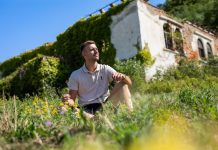
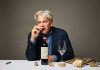
Valentino Herceg is a new young star of oenology in Hrvatsko Zagorje. He comes from Špičkovina, a village within the town of Zabok, on the border with the municipality of Bedekovčina.
To find out more about Špičkovina, I ‘consulted’ ChatGPT, trying to convince myself that artificial intelligence was well informed even about ‘unusual names of Zagorje villages’, which Špičkovina certainly is.
When I asked ChatGPT to decipher the meaning of the word ‘špičkovina’, it replied that, in Croatian, the word was not standard and did not appear in Croatian dictionaries, but occurred in slang and certain local dialects with several meanings: as a derogatory or mocking expression for stupidity, nonsense or exaggeration, and for something presented as first-rate when it really is not.
It also gave me several examples of usage:
‘That was a real špičkovina.’ → That was utter nonsense / something ridiculous / rubbish.
‘You’ve palmed off another špičkovina of a TV series on me.’ → You’ve given me another bad, overhyped series.
There is also, it added, a real place in Croatia by that name – Špičkovina near Zabok – ‘which is often the subject of jokes and wordplay’. In that context, the word could acquire a humorous, ironic tone:
‘It’s from Špičkovina.’ → As though something came ‘from nowhere’, ‘from a village in the back of beyond’.

When I recounted this little ‘research adventure’ to Valentino, I added that ChatGPT had not yet registered his numerous gold medals and champion titles, won in Bedekovčina, Štrigova and Sveti Ivan Zelina in just a year since he appeared with his wines.
– It looks as though I’ll have to respond to comments about Špičkovina for as long as I live, Valentino laughs.
– But since President Zoran Milanović mentioned our village, I think everyone in Croatia now knows where we are. In reality, the president inadvertently gave us publicity!
Milanović once said that Croatia could not be compared with Finland because the Finns had never had a civil war, prompting a wave of reactions.
– Instead of dealing with important issues, we now have experts on the Finnish war from Špičkovina or Vukovina explaining how many people died, as though they had personally counted them, Milanović said at the time, launching Špičkovina into the media spotlight. Communication experts compare me with Churchill. There’s a saying:
– Cobbler, stick to your shoes!
– We have a great many cobblers who want to be Renaissance painters, offering all sorts of advice, Milanović retorted to his critics.
– When I mentioned Špičkovina, I received lots of reactions and emails from all over Croatia. Some told me to go to hell; others understood it in the way I intended. The problem is that I wasn’t understood properly, added Milanović, who was then Prime Minister of the Republic of Croatia.
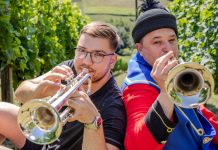
Valentino says nobody in the village held the remark against him. Quite the opposite: Milanović won a resounding victory in Špičkovina in the presidential election, and on one visit he was welcomed by the local wind orchestra, conducted by none other than – Valentino Herceg.
– It seems everyone everywhere discussed the president’s remark mentioning Špičkovina, except in Špičkovina itself. There was even an idea that our orchestra from Špičkovina should play the national anthem at his inauguration, but it fell through because of the limited space at the venue, says Valentino, a self-taught instrumentalist who, despite his commitments to his small winery and even smaller vineyard, and his oenological work at Badel in Žitnjak and Korlat, never misses twice-weekly rehearsals with an orchestra considered one of the finest in Hrvatsko Zagorje.

– The clarinet and wind orchestra help me unwind from everything. Here in Zagorje, wind orchestras are very active, going back to the days when they were associated with brass bands and volunteer fire brigades. A few years ago, our orchestra represented Croatia in Italy as the best in the country! And did you know that Špičkovina, with around nine hundred residents, has an orchestra of fifty members?
Once we move away from the study of place names, the conversation with Valentino turns towards the study of personal names. Or, in plain language: is there a connection between his name and the nearby village of Valentinovo?
– Valentinovo really is close to my Špičkovina, but there’s no connection. And I was born on 27 February, a little after Valentine’s Day, so perhaps any connection should be sought there instead. In any case, I was named after the Novi Fosili song ‘Valentino i Renato’…
– ‘Valentino and Renato, chocolate and cocoa, both are so sweet to me, but I don’t know which to choose’, sing Novi Fosili. Is there a chocolate lover in the family?
– My sister Korina. And listen to this – she works at Ledo developing ice cream!
– Valentino and Korina – rather modern names in the heart of Zagorje?
– Ha-ha, that’s why my son is called Gašpar!
Whatever subject we begin with, the conversation with Valentino Herceg turns in the opposite direction. For instance, whoever you speak to in Zagorje, every winemaker can boast of some wine heritage. Valentino could not point to that as the trigger that propelled him into the wine world. His father had a small vineyard planted with Traminer, Kraljevina, Pinot Blanc, Silvaner and Pinot Noir.
– That little vineyard gave me an appetite for this work, which is why I went to an agricultural secondary school and later to university.
– It seems that in that little vineyard you saw and understood what you didn’t want in the vineyard you would one day work yourself – you don’t have any of those varieties in your vineyard?
– You could put it that way. When I registered my family farm in 2019, my small, modest portfolio contained just three varieties – Graševina, Riesling and Muscat. I don’t have a single one of the varieties my father planted.
Valentino could prove to everyone that he had been right in 2025, when he won Grand Gold at Urbanovo in Štrigova for his 2023 Riesling. A few days earlier, at the Wine Fair in Bedekovčina, the same Riesling had been the competition champion, while the younger 2024 Riesling and his 2024 Graševina also won gold medals. And at the largest continental wine judging in Sveti Ivan Zelina, he received gold for Riesling and Graševina.
– I adapted my choice of varieties to climate change. Ever since 2023, when I first appeared in Bedekovčina and won three golds for three different wines, I’ve kept receiving confirmation that I chose the right varieties to plant.

– Riesling is a little distinctive. People don’t particularly favour it, and restaurateurs don’t even offer it in their restaurants. That’s precisely why I said: Why don’t we take this Riesling to a higher level?! And that’s why I devoted myself to it. People either like it or they don’t. My Riesling is closest to the Mosel style; it has a touch of petrol, but not too much.
– It’s similar with Sauvignon Blanc: people either adore it or say, ‘It’s all right, but give me something else.’
– Zagorje is ideal for that type of wine. Of course, Slavonia has good Rieslings too, but especially now that the climate has changed a little, Zagorje has greater potential for the variety. Its wines are closer to Austrian and German versions, from the area where the variety actually originated.
On the site of his father’s old vineyard, which he completely grubbed up, Valentino planted – Belina. An ancient variety in which he sees enormous potential for sparkling wine.
– Belina has that story, as the ‘Casanova of Zagorje’, and I didn’t need persuading. Quite a few winemakers are turning towards indigenous varieties, and that’s what everyone visiting Croatia wants to taste. And when you have Riesling and Chardonnay, descendants of Belina, alongside Belina itself in the same vineyard, you can tell the story of a family!
Valentino says his love of indigenous varieties began at university, where he became active in an ampelography group studying old varieties. As he puts it: ‘If the Dalmatians can have Pošip, Grk and Plavac Mali, the Istrians Malvazija and Teran, the people of Moslavina Škrlet and those of Međimurje Pušipel, why shouldn’t Zagorje folk build their identity around a wine of their own?!’
Valentino bought his Belina plants from Trgocentar, the Zagorje retail giant that recognised the project of the Faculty of Agriculture, the Department of Viticulture and Oenology and Krapina-Zagorje County, established a mother block of old Zagorje varieties and launched a nursery to produce and sell Belina plants.
Valentino is employed by the Croatian wine giant Badel. He spends most of the working year at Badel’s facilities in Zagreb’s Žitnjak district, while during harvest, as chief oenologist, he works around the clock overseeing the processing of grapes from Korlat, Dalmatia’s largest vineyard created by reclaiming karst terrain.
– What is it like working one hectare of your own vineyards compared with Korlat’s hundred hectares?
– I’m at Žitnjak for most of the year. I spend a month and a half or two months at Korlat during harvest, so otherwise I have no contact with the vineyards, except when we need to check the grapes.
– At Korlat, we carry out the initial winemaking carefully; after the first racking, the wine comes to Žitnjak for filtration, then goes to Sveti Križ Začretje to mature.
– So Korlat’s wines have a Zagorje touch?!
– That’s right. Korlat ages for several years in Zagorje, before finally being bottled at Žitnjak.
– How did you end up at Korlat?
– I finished university and joined Badel as a trainee. After spending four years down there with a colleague, I’ve been in charge at Korlat on my own since 2021.
– When you finish university, you think you know something and have learned something. Then you enter a system like that, see those quantities and realise you know nothing.
– Badel has given me experience and knowledge, but also the courage to face any situation – not even five hundred tonnes of grapes arriving in a single day can frighten me.
– What does it feel like to work at Badel, then spend every spare moment working in your own miniature vineyard? – Coming from a large system to small quantities and a smaller operation is a piece of cake. You just have to put in the effort to do everything as well as you can.

– Korlat is a good story and proof that the most important thing for good wine is good grapes. The stone there naturally reduces yields and gives you the essence. So it’s hardly surprising that there isn’t a wine drinker in Croatia who hasn’t tried Korlat’s reds.