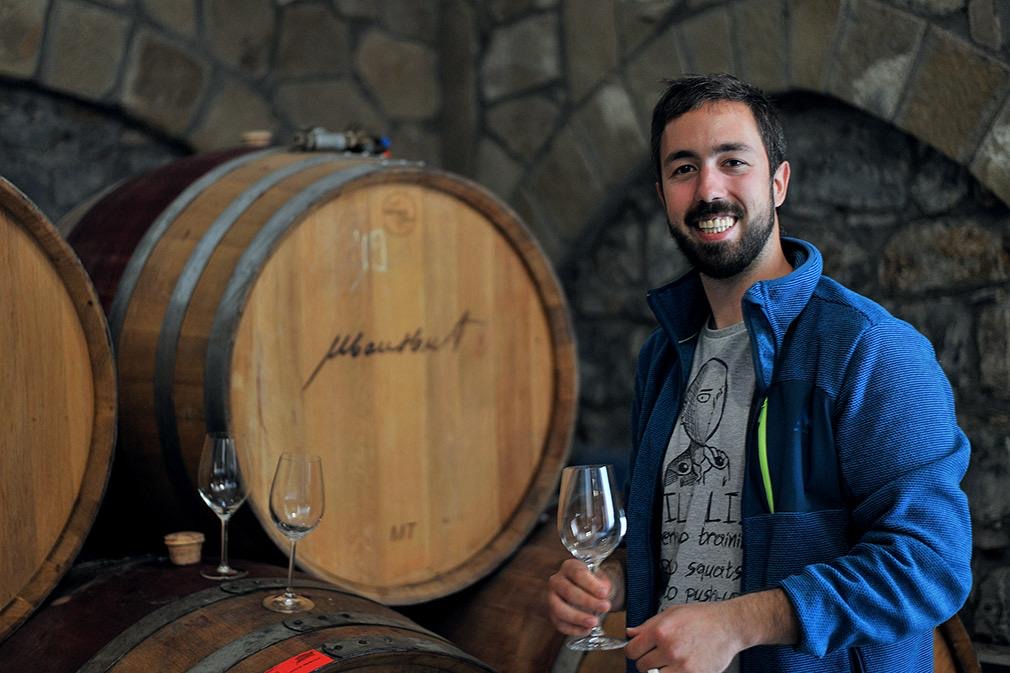
Kad je sestra Nadežda otišla u Rovinj, u onaj veliki Grand Park hotel, „trbuhom za kruhom”, u vinariji je ostao samo Ivan. Kuća se utišala, When his sister Nadežda left to work at the Grand Park Hotel in Rovinj, almost everything at the Ivanović winery once again fell to one man. Until then, they had divided the work: Ivan managed the vineyards and cellar, while she handled invoices, orders, emails and social media.
– The winery has gone back to factory settings, Ivan said. I’m a one-man show again.
It had first been that way when his father Dragoslav, known to everyone as Gaga, ran the winery. Ivan found himself alone for the second time after Gaga’s death. Now history had repeated itself in a far less painful form: Nadežda had moved to Rovinj, and Ivan had taken over her share of the daily work.
In the Ivanović family, things tend to repeat themselves anyway, particularly names.
– My great-grandfather Dragoslav had three sons: Ivan, Ljubiša and Zoran, whom everyone called Lola. Ljubiša was killed in the Second World War, Lola moved to Novi Sad and became a true Vojvodina man, and Ivan stayed in Aleksandrovac. My grandfather Ivan had two sons, Ljubiša and my father Dragoslav, Gaga. And Gaga named me after his own father. So, Ivan again.
Ivan and his wife nevertheless decided to break the pattern. They named their son Rastko.
– We discussed it for a long time. We agreed that our second child would be Dragoslav.
Tradition, then, has only been postponed. In a family that has passed its winery from a Dragoslav to an Ivan for more than a century, one new name does not mean the old arrangement has been abandoned.
The Ivanovićs were once among the largest winemaking families in Župa. Ivan’s great-grandfather Dragoslav founded the winery in 1919, although nobody knows what led him into the business. His father had been a blacksmith and farrier; Dragoslav became a winemaker and merchant selling around half a million litres of wine a year.
– He produced two hundred thousand litres and traded another three hundred thousand. After the war, more than a million and a half litres of wine and rakija were confiscated from the Marković family, and my great-grandfather was right behind them.
The scale of winegrowing in those days is difficult to imagine now. Župa had between six and seven thousand hectares of vineyards, almost as much as the whole of Serbia has today. Around eight hundred remain.
Dragoslav spent three years building a house resembling a small French château. Completed in 1939, it was intended primarily as a home, although beneath it lay a cellar worthy of the family’s ambitions. Today, that house is once again a winery.
Between those two periods came nationalisation.
– After the war, my great-grandfather was declared a traitor and everything was taken from him. All he had left was the house and an empty cellar. They even removed the large barrels, which had had to be assembled inside because they wouldn’t fit through the doors.
On the roughly 0.2 hectares of vineyard they retained, Dragoslav and his son Ivan continued making wine, but without a registered winery and mostly for customers they knew. Older people in Župa still remembered that “Grandpa Iva’s wine was excellent”, yet the family no longer dared return to a business in which it had once been so prominent.
Grandfather Ivan graduated in economics and worked first for the municipality, then for the company Sloga.
– He was a good economist, but for the state, not for his own household. It was probably fear after everything they’d been through. He used to tell my father: “You build something, and then someone comes along and takes it all away.”
The Ivanovićs thus had a house built to accommodate a winery, a cellar stripped of its barrels and a family history warning them against starting again. Gaga, however, was drawn to precisely what they were trying to discourage him from doing.
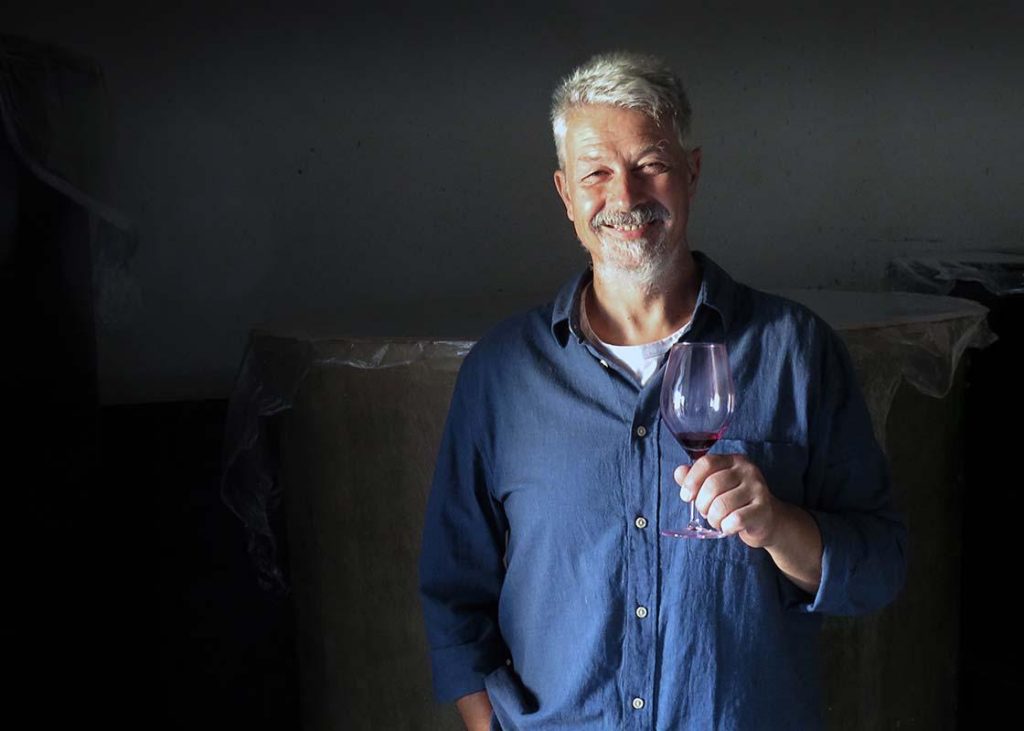
Gaga, Ivanov otac, bio je po struci tehnolog – specijalist za barut i eksplozive. „Rođeni kemičar“, govorio bi sin, „ali s nosom vinara“!
Dragoslav Gaga Ivanović had not trained as a winemaker. He was a technologist specialising in gunpowder and explosives, “a born chemist”, as his son describes him, employed at the Milan Blagojević factory in Lučani. He lived there with his wife Jasminka, known as Nina. Nadežda was born in Aleksandrovac, and Ivan in Čačak in 1992.
Gaga turned towards wine after an explosion at the factory. He had been given the day off and had not gone to work. His colleague and friend was killed at the very spot where Gaga usually worked.
– Every other minute, some shit happens, he would say afterwards.
He was already considering returning to Aleksandrovac and reviving the family winery, but lacked the money to make a serious start. An opportunity arose when he was due to travel to Iraq to implement a programme he had written himself. A salary of five thousand German marks was supposed to provide his starting capital.
Before he could leave, war broke out in Iraq.
The big earnings came to nothing, but Gaga did not abandon the winery. He returned to the house his grandfather had completed in 1939 and began almost from scratch.
His first official harvest under the registered name of the Ivanović winery was in 1996. Ivan was four, but remembers two barrels in the cellar, one holding four thousand litres and the other two thousand, an open wooden fermenter, a hand pump and a grape crusher.
– The fermenter was slightly conical and had very little in common with today’s versions. It was filled with grapes, then closed with boards braced against the ceiling.
He remembers the car even better.
– Our Yugo covered an insane number of kilometres. That Yugo practically built the winery.
Gaga used it to visit vineyards, bring in whatever was needed and deliver wine. At first, the wine was sold in one-litre bottles and demijohns. Another seven years would pass before the first standard wine bottle appeared.
In 2003, Gaga bottled his first Prokupac. At a time when the variety was mostly sold as cheap wine or disappeared into blends, few believed it could become Župa’s signature.
Gaga did.
– He made the wines he liked to drink. He used to say that, unless he was completely off his rocker, there must be someone else who would like them, too.
He took them to fairs, explained Prokupac to an audience that did not take it seriously and waited for the first confirmation that he had not been mistaken. It came at the Novi Sad Fair, with an award that gave him a reason to continue.
– He was a visionary. He believed Prokupac’s time would come.
Between 2005 and 2008, he worked with two Frenchmen and the Italian Lorenzo Maini, who saw far greater potential in Župa than most of the domestic market recognised at the time. For years, Maini spent four months annually in the Ivanović house.
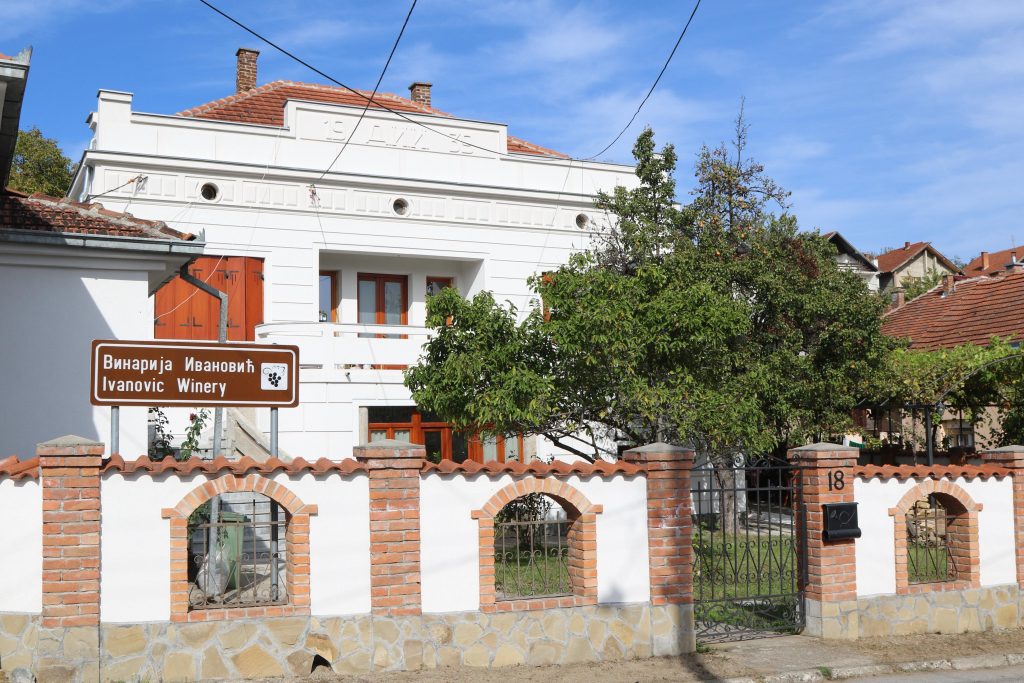
– We still call one room, which is now our office, Lorenzo’s room.
While those around him discussed Prokupac, vineyards and Župa’s future, Ivan was a secondary-school pupil far more interested in Warcraft.
– I was a hardcore gamer. I knew I’d go into winemaking one day, but back then none of it meant anything to me.
Gaga did not try to make the work look attractive or draw him in with easier cellar jobs. His rule was simple:
– You can’t make a pie out of shit.
That was why he built the winery from the vineyard upwards, repeating a sentence his son would only fully understand much later:
– Wine is made in the vineyard. That’s it.
Gaga was the face of the winery, but during the hardest years, it was Ivan’s mother Jasminka, whom everyone calls Nina, who held the family together.
– Without her, none of this would exist.
Once, they needed to deliver wine to Belgrade but did not even have enough money for fuel. There was a plastic bottle in the house into which they dropped their loose change. They cut it open, counted the coins and set off.
– That was before 2010. There was no money, but somehow we always kept going.
Their first real breathing space came with an export order to the United States. Five thousand bottles went overseas, enough for the winery to breathe a little more easily for the first time and begin investing again.
Those years also produced the wine that would become the Ivanovićs’ most recognisable label. Initially, it was to be called Numero Uno. A blend of Prokupac, Cabernet Sauvignon and Merlot, it so impressed a visitor from Luxembourg that he wanted to buy the entire production.
– Dad told him he could have no more than half. Half for him, half for our own market.
The buyer paid for his half, but the wine still had no label. Meanwhile, the Zvonko Bogdan winery released its Cuvée No. 1. Gaga went down to the cellar, thought it over and returned with a new name.
– It’ll be called No. 1/2, Numero Pola.
The explanation was as precise as it was playful: half the wine was Prokupac, the other half Cabernet Sauvignon and Merlot; half the production was destined for the customer in Luxembourg, and half for the domestic market.
– Everyone thought he was joking. He wasn’t.
The other well-known fractional label appeared in 2015, but this time the idea was not Gaga’s. Ivan proposed a Tamjanika fermented and aged in oak.
– If Prokupac is the king of Župa, Tamjanika is three-quarters of a king. Hence No. 3/4.
Gaga was reluctant to let his son have a larger quantity of grapes for the experiment.
– He was afraid I’d ruin too much Tamjanika. In the end, he agreed.
The wine succeeded, and for the first time Ivan left his own unmistakable mark on an Ivanović label. That did not yet mean he had fully embraced the work awaiting him. He was studying technology at the Faculty of Agriculture in Belgrade, progressing at a pace that could hardly have delighted his parents.
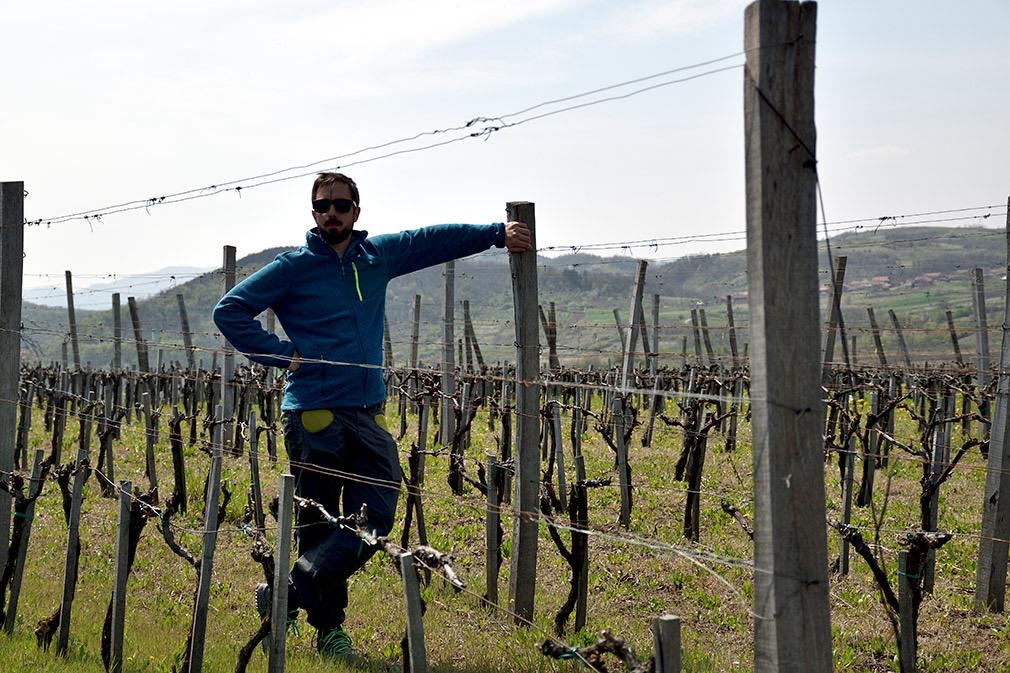
– I spent four years in my first year.
In 2016, as he puts it, he finally “got his head out of his arse”. His parents offered him the chance to study oenology in France, most likely in Dijon. He even spent a year learning French before taking an honest look at his own perseverance.
– I realised that if I hadn’t so much as seen a book in Belgrade, nobody in France was going to see much of me either.
He had had enough of the Belgrade jungle anyway. He returned to Aleksandrovac just before the 2016 harvest, without a degree but determined to stay.
– I’m a hands-on person. I wanted to work and learn in the vineyard and cellar. Besides, I’d always known I would do this. It just took me a little longer to get started.
After returning in 2016, Ivan worked through every task, from weeding and spraying to harvesting and cellar work. While Gaga dealt with growers, sales and the rest of the business, his son increasingly took charge of production.
– After the first year, he was already confident I could run the cellar.
There was, however, one thing he would not let Ivan do for a long time: drive the tractor. The old Tomo Vinković on Župa’s steep vineyards was no toy on which Gaga wanted his son to gain experience. Only in 2019, when his neck seized up, did he have no choice.
– We were both wearing spraying suits, looking like astronauts, and for the first time he had to let me have the tractor.
When the winery later bought a new one, Ivan was once again denied his turn.
– That was his new toy.
Just as Ivan became seriously involved in the business, Gaga fell ill. He died in December 2020.
Ivan was not left without winemaking knowledge. He had four harvests behind him and a father who already trusted him to run the cellar independently. But making wine alongside Gaga was one thing; taking over everything his father had done almost instinctively for years was another.
His greatest concern was the grapes they bought from other growers.
– Gaga visited vineyards and could judge whether the grapes would be right for us in ten or fifteen days. He knew whether it was worth waiting or whether to walk away immediately. You can’t learn that from a book. It takes experience.
After his father’s death, Ivan’s first aim was neither to improve the wines nor to prove he could do better. He wanted to preserve their quality, even if that meant producing less.
He was not entirely alone. Gaga’s cousin Saša Miljković, whom Ivan calls his uncle, remained beside him. He had worked at the winery since 2005.
– He’s like a second father to me and my right-hand man in production. I wouldn’t have managed without him.
Even with Saša there, the first years in charge brought costly mistakes.
– I must have ruined eight thousand litres of wine.
Anything that was not good enough to carry the label was neither salvaged at all costs nor quietly pushed onto the market. Ivan followed Gaga’s rule:
– Better rakija than disgrace. The mistakes went into the still, and from each one Ivan gained what he lacked: experience he could no longer acquire beside his father.
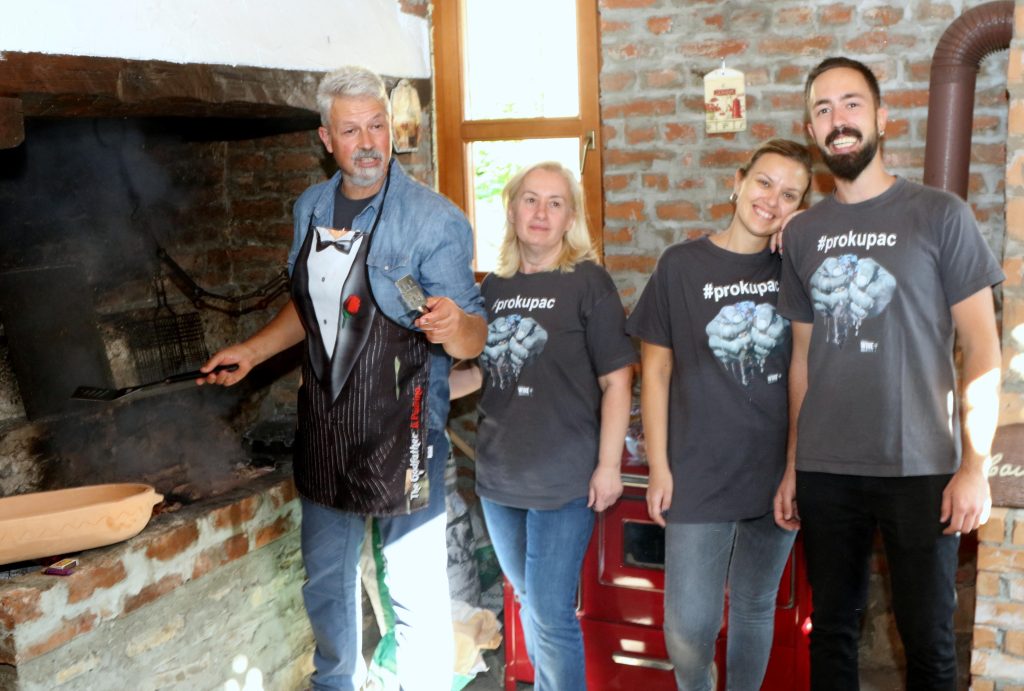
The first year without Gaga also brought confirmation of a project he had started. In January 2021, the Ivanović winery received Ecocert certification for organic grape and wine production, the first of its kind in Župa.
The certification did not cover every wine, only those made from grapes grown in their own vineyards: the red blend No. 1/2, the oak-aged Tamjanika No. 3/4 and the sweet wine Zanos. Their regular Tamjanika, for example, could not be labelled organic because some of its grapes were bought from other growers.
– We’d been farming according to organic principles for around fifteen years already. The inspectors examined the vineyards and cellar, analysed the soil, leaves and wines from previous vintages, and approved an accelerated procedure.
Gaga did not live to see its completion.
– The certificate arrived after his death. It was his project. I only finished it.
The path towards their first certified wines could scarcely have been complicated by a worse year. Hail devastated the 2020 crop. From three and a half hectares of their own vineyards, the Ivanovićs harvested just three tonnes of grapes, less than a fifth of the usual quantity.
That was precisely why Ivan wanted to increase their area of Prokupac and depend less on purchased grapes. The winery had an old vineyard from which it took grafting material, and then bought the neighbouring vineyard that Grandpa Đorđe had tended until his death.
He was over ninety.
– I’d watch him pushing his wheelbarrow and going off to spray with a copper sprayer on his back. If I said I was tired, I’d feel ashamed because I knew he was out in the vineyard.
Đorđe said the vineyard had been planted when he was seven or eight. Alongside Prokupac, it contained Smederevka, Župljanka and Plovdina, and his stories were as valuable to Ivan as the old vines.
– I truly loved listening to him. From his memories, we could work out how old the vineyard was.
Gaga had always said wine was made in the vineyard. After his death, Ivan had to add something to that sentence: a good vineyard also passes on the experience of those who tended it before you.
Organic certification did not mean every wine in the cellar would automatically be good enough for the market. Nothing demonstrated that better than the 2020 Zanos, a sweet wine made from Tamjanika, Sauvignon Blanc and Sémillon planted together in the vineyard.
The fermentation refused to stop.
– We’d never used anything to stop it. We work with native yeasts, and that year they simply refused to stop working.
They put the wine out in freezing weather and briefly calmed it down. As soon as the temperature rose above zero, the barrel woke up again. Instead of the 160 to 200 grams of residual sugar that drinkers expected from Zanos, the wine finished with around fifty grams and, by Ivan’s estimate, as much as seventeen per cent alcohol.
– We ended up with something completely new. I wasn’t even sure whether we should bottle it.
The vineyard had changed, the blend had changed, and this was the first time the Ivanovićs had vinified Sémillon. Ivan did not pretend it had all been planned.
– I’m still learning. It’s the sort of job that lets me experiment a little.
His experiments did not lead him towards ever heavier, more extracted wines. The more responsibility he took on, the more clearly he distinguished his own taste from his father’s.
– Gaga’s white wines were rich and aromatic, but they could tire the palate. I’m reducing the alcohol and looking for more freshness and balance. I want wine that’s easier to drink.
He calls himself neither a natural nor a conventional winemaker, but a winemaker of minimal intervention.
– If the grapes are good, there’s no need for much chemistry. You just need to guide them.
He has not changed Gaga’s fundamental philosophy: quality still begins in the vineyard, and anything that falls short does not reach the market. What he has changed is what follows: the style, the approach to alcohol and the way the wine speaks to its audience.
That is where the distinction between Gaga’s winery and Ivan’s would first become clear.
One of his first steps towards a different audience was Jara, a pét-nat made from Tamjanika and Prokupac. Combining white and red grapes later gave Ivan the idea for a still rosé from the same varieties.
The first attempt, from the 2024 harvest, failed.
– The maceration was too long. The wine picked up too much tannin and became a heavy rosé, exactly what I didn’t want.
It became rakija.
A year later, he returned to the same idea, adjusting the process to what the mistake had taught him. He macerated the Prokupac for just four hours, then added Tamjanika, pressed them together and let them ferment. The blend was seventy per cent Prokupac and thirty per cent Tamjanika.
He called the wine CF, from the English term “co-fermentation”.
– I wanted a proper summer wine, lighter than what I usually make, but not an entirely light rosé. Something between rosé and the deeper-coloured wine we call ružica.
He produced five thousand litres, a bold quantity at a time when rosé was not the centre of attention in Serbia. From the outset, he earmarked some for export, but the more important reason lay closer to home.
– A good part of my audience still consists of people who followed Gaga. I wanted to make something modern, something outside the traditional style, and bring the winery closer to a younger generation.
He was not turning away from the audience he had inherited, but neither did he want the Ivanović winery to remain forever a monument to his father’s taste. Jara and CF were no break with tradition: both came from Tamjanika and Prokupac, the two varieties without which Župa is unimaginable. What was new was what Ivan did with them.
Gaga had needed to convince the market that Prokupac deserved a serious bottle. Ivan is trying to bring the same variety closer to a generation seeking more freshness in wine.
And he still respects Gaga’s shortest rule: if the experiment fails, better rakija than disgrace.
Outside the cellar, Ivan once liked nothing more than getting away from the ground. He took up hiking, completed a mountaineering course and, in 2019, climbed to 3,900 metres in Cappadocia. His next goal was to break the four-thousand-metre barrier in Morocco’s Atlas Mountains.
First came the pandemic, then Gaga’s illness and death. The trip was postponed, and the winery no longer left him enough time for serious climbs.
– The mountains are still in me, but I don’t have time now.
So he brought a little of the mountains into the winery. He installed climbing holds in one room and created a small climbing gym. There, he also practises varzesh-e pahlavāni, a traditional Persian discipline combining gymnastics, martial movements and strength exercises.
– People hear “Persian yoga” and think of yoga in the Indian sense. That’s not what it is. It’s an old form of warriors’ training, using wooden clubs and shields, with lots of repetition and circular movements.
After Gaga’s death, he learned through repetition in the winery, too: he tried, made mistakes and tried again, until decisions that had once belonged to his father became his own.
Even the words he uses to describe his world are not always understood outside Župa. Ivan calls them “Župa-isms”.
– When you need to hammer something firmly into your head, we say you have to zabidžiti it. Gidža means a vine. And when someone’s face is grubby, they’re prškav.
He did not find those words in dictionaries. He heard them from people like Grandpa Đorđe, from the growers Gaga bought grapes from and from guests who had been entering their house for decades. Rambo Amadeus reached for the same language when looking for a name for a wine waiting in the cellar. He suggested around twenty archaic expressions associated with Župa, the Ivanovićs and Prokupac. None stuck.
In the end, the wine received the simplest possible name: Gaga.
For years, Dragoslav Ivanović had told audiences that Prokupac could produce great wine. At a time when almost nobody took the variety seriously, he bottled it, carried it to fairs and waited for the market to catch up with his belief. Later, people began calling him the godfather of Prokupac, and his Župsko crno vino was counted among the labels that changed the Serbian public’s attitude towards the variety.
Meanwhile, Prokupac gained its own international week, reached the wine lists of leading restaurants and became a symbol of Župa’s winegrowing revival. Gaga lived to see the day when he no longer had to defend the variety, but not the wine that would bear his name.
He began that wine in 2017. After his death, Ivan and Nadežda finished it. Just seven hundred bottles were filled.
When they first presented it in 2021, they opened three.
– It’s a wine he started and we finished.
It was not the first task Ivan had completed in his father’s place. The organic certificate had also arrived after Gaga’s death. The difference was that the certificate confirmed how the Ivanovićs had farmed their vineyards for years, while the wine preserved their shared work, completed by Ivan and Nadežda after their father was gone.
Gaga’s name remained on seven hundred bottles. All the others had to show who Ivan Ivanović was.
With Nadežda’s departure for Rovinj, Ivan took over invoices, orders, emails and social media alongside the vineyards and cellar. The winery really had returned to “factory settings”, but not those of Gaga’s time.
In the house his great-grandfather Dragoslav completed in 1939, almost all the threads are once again held by an Ivan. Gaga revived it as a winery, and his son, after four years in his first year at university, realised he could not escape it after all.
Now he has a son named Rastko.
– We agreed that our second child would be Dragoslav. If that agreement is fulfilled one day, another Dragoslav will run through the house. Until then, Ivan is making sure that names are not the only things passed down in the family.