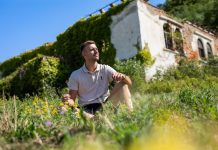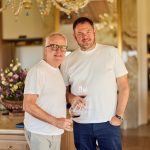
– We had a wine tasting room, exceptionally well equipped, in a separate building. A genuinely serious tasting room. And nothing happened.
– Absolutely nothing?
– Nothing. Zero.
Ten years ago, I probably would not have heard such an admission from Stipe Đuzel. Back then, his wine story was still full of future tense. He would finish the tasting room, develop a visitor attraction, offer guests Croatia’s highest vineyard, caving tours, a botanical garden, an iris collection and anything else that occurred to him as he tried to build an entire experience around a few thousand litres of wine. He said he would not even begin marketing until everything was finished. Until then, he would rely solely on word of mouth.
Today, he produces almost ten times as much wine, cultivates four and a half times the vineyard area, and the whole family makes its living from the business. The tasting room is finished, the world’s largest auger stands outside the winery, and more than 250 different irises bloom in the garden. Almost everything he announced back then has indeed been done. Only Stipe Đuzel now sees it all differently.
– I am no longer the same man I was when we first met!
– What does that mean?
– It means I simply do not have the time now. And when I say I do not have the time, translated into financial language, it means I no longer want to waste it tilting at windmills.
He worked for Bayer for sixteen years, was its sales manager for Albania and learned what large companies do with a product that fails to find buyers.
– When a company like that launches a product and it does not sell, it will not struggle with it for years. It immediately moves towards what does sell.
– Did Bayer teach you that you can give up on wine, too?
– No. I will not give up on wine. I make my living from it.
In winemaking, he says, hard reality eventually prevailed.
– It took me five years to realise that our main focus had to be Kujundžuša. We started with different varieties, tried Chardonnay, worked with Trnjak and eventually arrived at Kujundžuša, which now practically supports us.
Once, he tried to build an entire little world around wine. Today, everything leads back to the vineyard.
And what he built along the way still stands.
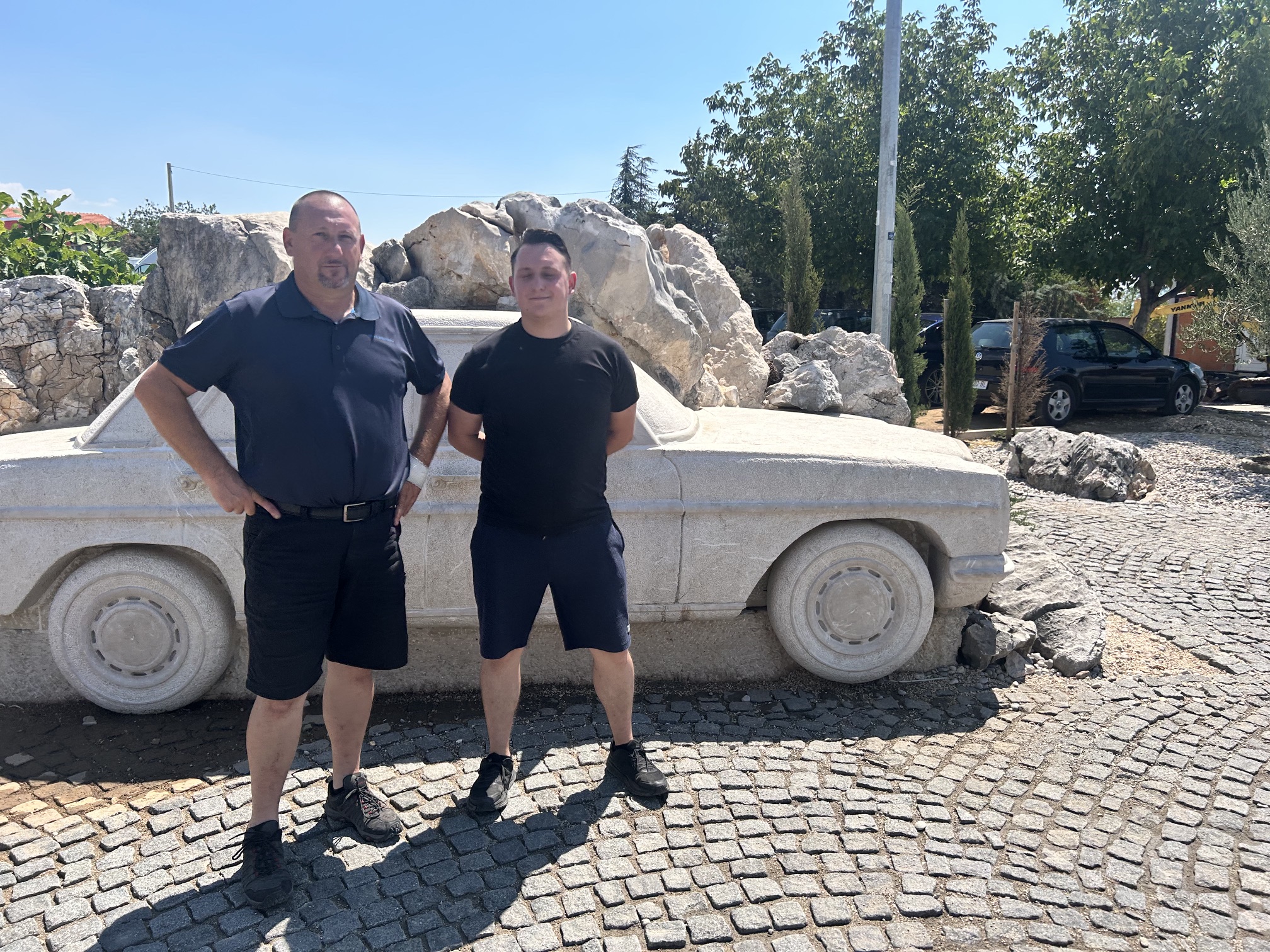
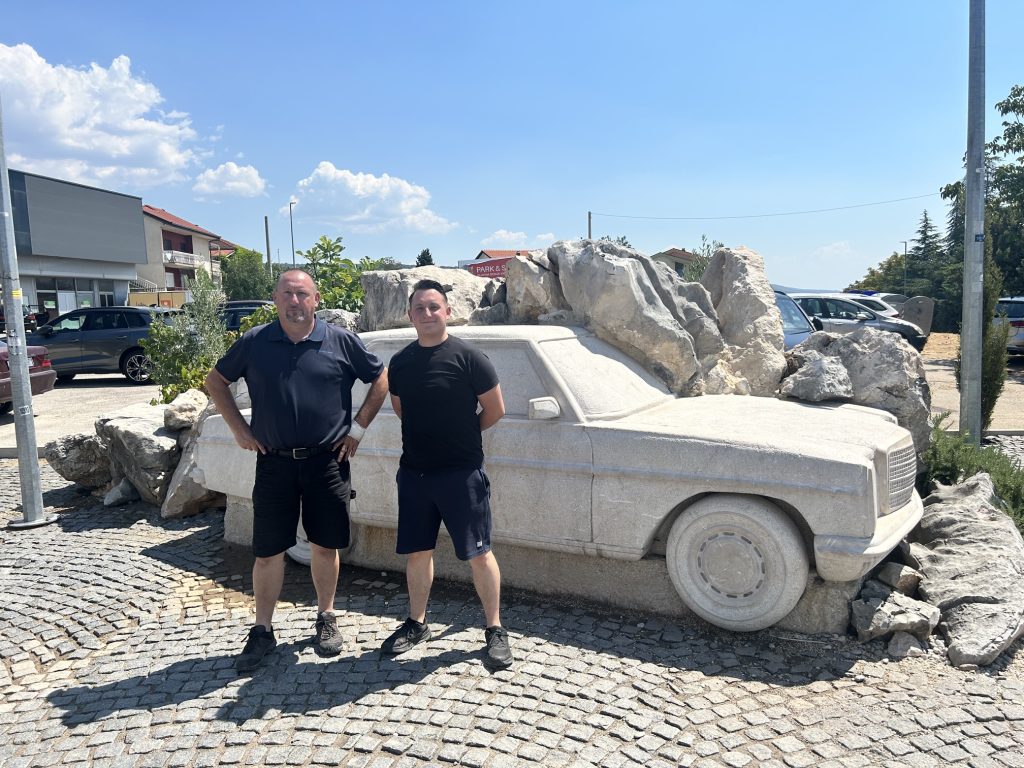
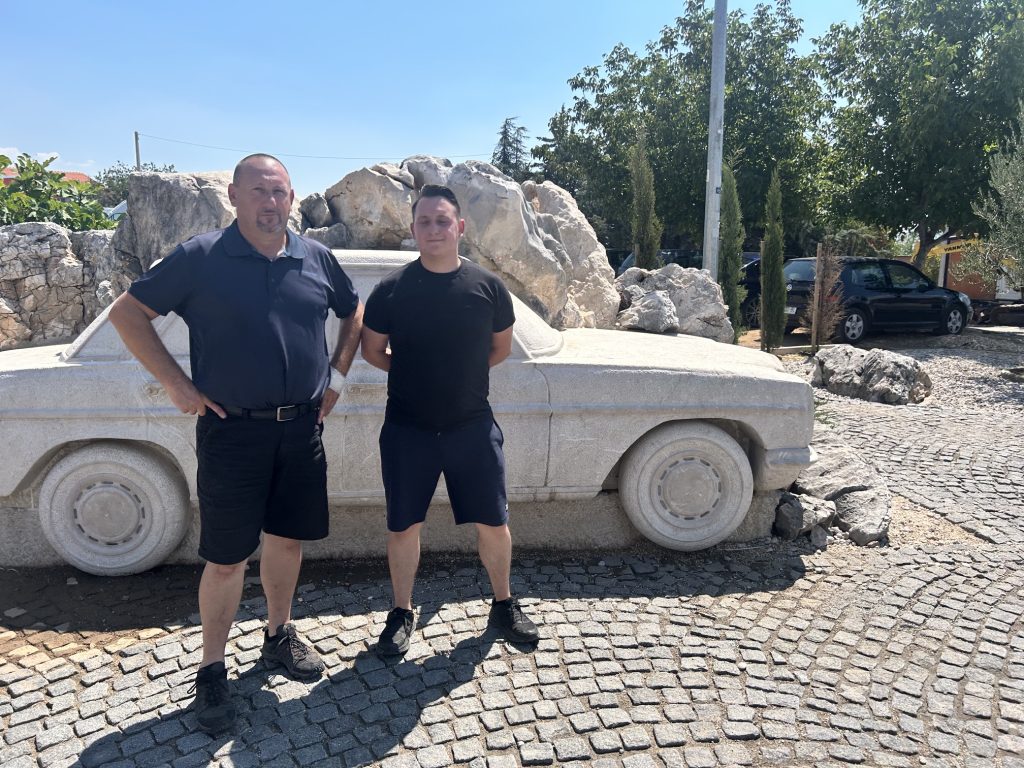
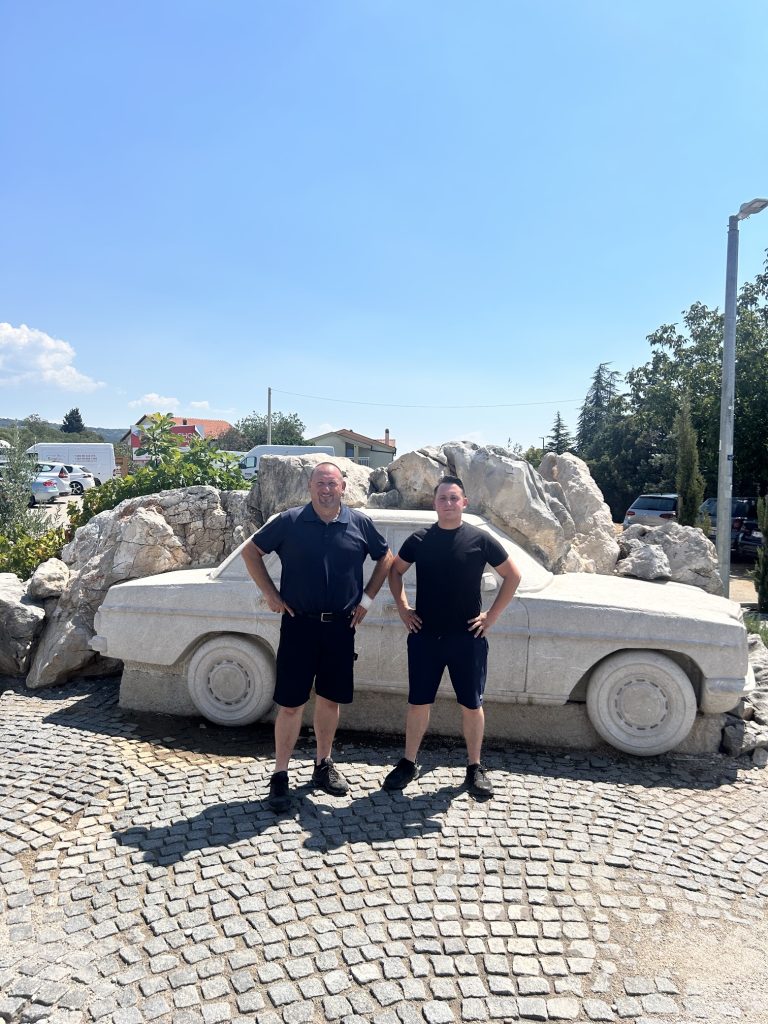
We spoke in front of the Monument to Imotski’s Emigrants, far better known as the Mercedes monument. I watched the road and car park, but could see no car of the make to which the monument was dedicated.
– I keep looking, and there is not a single Mercedes. Only BMWs.
– I have to contradict you. I have three Mercedes.
– Three?
– A Sprinter, an E-Class and an A-Class.
– So you are the old guard. You are not giving up.
– I am not. Things are not quite as people say, but Imotski still has Mercedes cars. And there will be more.
We first met in precisely the world Stipe was still planning to finish. We stood beside his vineyard at Podi, above Imotski, while he pointed towards a ridge barely twenty metres away.
– If I had planted the vineyard just a little further over, beyond that ridge, there would have been nothing to my story about Croatia’s highest vineyard. Figs and olives grow here, while a kilometre away the climate is entirely different. Our ancestors were not fools. They always knew where vines could grow.
The vineyard lies at 688 metres above sea level, but Stipe generously rounded that figure up to 700 for the wine label. Many told him the site was extreme and restrictive; some even said the grapes could not ripen there at all. He did not try to persuade them through argument.
– They all changed their minds completely when they tasted the wine.
At the time, the winery did not yet provide his livelihood. He bottled his first wines only in 2016: approximately eight thousand bottles, which sold out within a few months. Everything he earned went back into the vineyard and cellar.
– It had always been smouldering inside me. If I had not started, I would have burst! I did not know whether it was the right financial decision. Everything I earned went back into the winery, and it was all expense. But it gave me enormous satisfaction.
Even then, Stipe was much more than a winemaker. He was an agronomist working for Bayer, previously a production specialist at a dairy in Bihać, a caver descending into Imotski’s pits, a mountaineer short of free weekends, a passionate rock fan and a man who built his house where he could see Biokovo, Zavelim, Vran and Čvrsnica.
He put a window in the living-room wall so that, whenever his heart desired, he could glance from the table towards Zavelim, the mountain of fairies and elves. Underground, he sought a different world.
– Within a kilometre of where we are sitting, there are ten pits. Descending into one is an incredible feeling, literally entering a new world you have only heard stories about. Pits are where reality and myth intertwine. As far as fear is concerned, I would descend to the centre of the Earth.
He spoke just as passionately about Pink Floyd, AC/DC, the Stones and Bruce Springsteen, as well as Čađavi Krakuni from Grubine. He passed his musical tastes on to his children: his daughters Ana and Antonija played piano and clarinet, while the youngest, Bože, played percussion and bass guitar.
– There is nothing surprising about that. Imotski is a rock town! All right, people here also listen to Mate Bulić and Thompson. If Parni Valjak were playing at one lake and Thompson at the other, I would go to Thompson. But if Bruce Springsteen were playing somewhere at the same time, I would go to Springsteen.
Stipe never seriously pursued music because, as he used to say, there was a house to build. Once it was finished, he threw himself wholeheartedly into a vineyard full of limiting factors. Alongside Chardonnay, he planted Trnjak, a variety that then required almost as much stubbornness as the site where he had chosen to grow it.
– If I had followed the majority’s logic, I probably would never have entered the wine business, and certainly would not have planted a vineyard at seven hundred metres. Instead, I chose both a site others avoided and a variety almost everyone had given up on.
Among the few remaining old vines, they marked the best, took cuttings and sent them to nurseries. Until then, Trnjak had largely disappeared into vineyards and blends, but Stipe saw in it a new face of Dalmatia.
– It is a masculine, red, Dalmatian, full-blooded wine. Trnjak has been saved!
The vineyard they told him was impossible is still there, at 688 metres. It is simply no longer the highest vineyard cultivated by Croats.
– You have lost one title, though. You no longer have the highest vineyard.
– We have the highest vineyard in Croatia.
– But no longer the highest vineyard cultivated by Croats.
– You can put it that way.
Ivica Dilber, owner of the Knebu winery in Tomislavgrad, planted vineyards at almost a thousand metres above sea level. Stipe makes no secret of his opinion of the man who went almost three hundred metres higher.
– Was there any jealousy when Dilber planted his vineyards?
– No, none. What he has done is on an entirely different scale from mine. It is the same enthusiasm I had when I started, taken much higher. Financially, I cannot match him, and I take my hat off to him.
He pauses briefly, then adds:
– But I must also say that he has taken an enormous risk. If my site was on the limit, his is already beyond it.
Meanwhile, Stipe’s vineyard has gone from an experiment to a decade of experience. It has been bearing fruit since 2015, and what he once defended through instinct he can now support with results repeated from vintage to vintage. The site naturally limits yields, requires almost no protective treatments, and its later start to the growing season shields it from spring frosts that strike vineyards on the valley floor.
– We have never had frost damage up there. In 2026, a half-hectare vineyard down in the field suffered some frost damage, but that has not happened up there yet. The growing season begins about two weeks later, and the vines avoid the most dangerous part of spring.
They harvest the Chardonnay relatively late. In September and October, night temperatures fall to eight, nine or ten degrees, the vines gradually slow down, and the grapes retain freshness. Stipe believes that at 13.6 per cent alcohol, he has reached the limit the site can deliver in a normal harvest.
– When I drink our Chardonnay, I get what Chardonnay should be by definition. That site gives it pure varietal character.
What his father had to explain to visitors ten years ago, his son later explained to professors in Požega.
– When I said at college that we had Chardonnay at seven hundred metres, they did not believe me, says Bože. – They kept asking how it was possible, whether we had irrigation and how the vineyard behaved. The Chardonnay vineyards they knew were at around 180 or 200 metres. When I said ours was at seven hundred, the textbook questions immediately began.
He no longer had to seek answers only in books. He had grown up beside that vineyard and, after studying, began looking at it as a winemaker.
– Up there, we do not get hail as we do in the field, or spring frost, and in summer there are large differences between daytime and night-time temperatures. It could be twenty-five degrees at seven in the evening, and around midnight guests on the terrace would need to wrap themselves up. I think that shapes the grapes’ sugar levels and aromas, and at that altitude the air is constantly moving.
Yet altitude alone is not decisive. The vineyard lies on the southwestern side of the ridge, while the land immediately beyond it opens towards the northeast.
– If it were just two hundred metres further away, it would be hopeless, says Stipe.
– Hopeless, Bože confirms. – Figs and olives grow on our side, while a kilometre away everything is completely different. That is where the microclimate ends.
Meanwhile, his father has found another small wine interest: a variety with almost no connection to Imotski.
– I was looking for a variety just for myself, something we would drink at home. I had liked Traminer since my student days, when I travelled around Slavonia, and later, through my work at Bayer, I came to know almost every significant vineyard there. So I chose it.
They planted only 250 vines. On the dry, calcareous soil, Traminer proved more resilient than expected, and they harvest it almost last, sometimes not until mid-October.
– At first, we made it as a fresh wine, then I decided to macerate it. I gave the last vintage eight days on the skins. The wine is reddish, but it has not oxidised; that is the colour of its skins. Everyone tells me it is lovely, but I am not satisfied yet.
From the first substantial crop in 2019, they also tried to make a dessert wine. They dried the grapes, but approximately a hundred litres escaped the plan: the French yeast had not read its own instructions, and they failed to stop fermentation in time. Instead of a sweet wine, they obtained a semi-sweet one for family and friends.
Traminer is not the variety on which the Đuzels will build their future, nor is Stipe trying to turn it into a new Imotski sensation. It remains in their vineyard for a simple reason:
– I like it.
The world’s largest auger outside the winery is 15.15 metres tall, 10.3 metres wide and weighs more than four tonnes.
To tourists, it generally looks like a giant corkscrew.
– Can we write, then, that you have the world’s largest corkscrew outside the winery?
– We can write whatever we like, but someone will always come along and say it is an auger, not a corkscrew.
It was made in 2013 by Stipe’s friend Petar Mustapić, a passionate collector of antiques and hand tools from Vinjani, with the intention of breaking a Guinness World Record. The town of Imotski could not find space for such a large exhibit, so the auger remained dismantled for years.
When Stipe began landscaping the area around the winery in 2019, he decided he had found exactly what was missing.
– I was the biggest fool. Just before Covid, I was investing in visitor facilities and tourist attractions, and then the pandemic disrupted everything. Even so, I kept persuading Petar to put the auger here. For years, he refused because he knew that once we assembled it, it would stay outside the winery forever.
Eventually, the auger was assembled and remained where Stipe wanted it. The winery is not on the main road, and people do not pass it by chance, but those who come specifically for wine get something unexpected, too.
– In reviews, people often write that they came to taste wine and the auger was a bonus. I was not trying to send any particular message with it. I simply wanted an attraction.
Not far from the auger grows another of Stipe’s attractions. When we first met, he was collecting irises and had only a few dozen. He said the iris was Croatia’s national flower and wanted to create a garden unlike anything else in the country.
He travelled, called acquaintances and exchanged rhizomes, and the collection grew to more than 250 different irises.
– Back then, we had only the beginnings of it; now, during flowering, the place is full of irises. I have no particular explanation. Something simply takes hold of me.
His family learned that something “taking hold” of Stipe generally meant another investment, another project and months of work.
– When the children were small, everyone at home dreaded my new ideas. I would arrive with some notion, and they would immediately jump up.
One such notion came to him at a winery near Trieste, where a single vine grew beneath the tasting room’s glass floor.
– Technically, it was not difficult at all. I immediately said: if they have one vine, we will put in fifty.
The fifty vines beneath glass were never planted.
– Thank God that idea never happened. I am not on the main route. I would have invested a huge amount in something hardly anyone would see. My family learned how to rein me in.
Nor did the open-air museum of old wine presses he sought in Hrvatsko Zagorje and on Vis materialise.
– I wanted to collect and display them all. You do some childish things in life, too. Looking back now, I see that my family were tugging at my legs the whole time, trying to bring me down to earth.
They did not manage to stop him in everything. That is why an auger that looks like a corkscrew stands outside the winery, with more than 250 irises flowering behind it.
But they saved him from fifty vines beneath glass.
– Today, I can say that the money spent on tourism could have planted another two or three hectares of vineyard. Now I can only laugh about it.
The auger catches the eye, the irises create a floral spectacle in May, and the tasting room was fitted out as he imagined. The business figures, however, did not turn out as expected.
– I made a tactical mistake. And if my family had not held me back, I would have spent much more. However charming all those ideas look today, that is the truth.
Meanwhile, the family also entered the café business. At Blue Lake, they opened Jezero, a profitable venture that has not given Stipe the rhythm he enjoys in winemaking.
– Winemaking is a much calmer business. After harvest, the first and second rackings and clarification, there comes a period that is nirvana for me. The days shorten, you go into your cellar at half past four in the afternoon and filter wine. An ordinary person would pay to do that. Believe me. For me, it is complete relaxation.
Yet the café at Blue Lake did not become an extension of the winery.
– How much of your wine does Jezero sell?
– Very little.
– How little?
– None.
Ten years ago, Stipe imagined wine at the centre of a broader tourism offering. Today, the winery itself provides the family’s livelihood.
– When we first met, we were making a few thousand litres. Now we have reached twenty-five or twenty-six thousand, and could perhaps sell thirty-five thousand. Back then, we had about one hectare; now we cultivate four and a half: two of our own and two and a half rented. That is the biggest difference. Wine has become our main business.
Production has reached a level that supports the family, but Stipe believes they are still on the edge of viability. They must continue growing, although he does not want to turn the winery into a large industrial operation.
– I admire the Grabovacs, and I have to acknowledge that. You need to see how much they have grown, how they have expanded and how their whole operation works. We could all learn from them. But I would still keep ours strictly a family business. Five or six hectares would be the maximum for us.
If he had the money he invested in tourist attractions again today, he would no longer search for old presses or design vines beneath glass.
– There is almost no labour left in Imotski. That will be our greatest limitation in the future. So I would plant five or six hectares using a modern vineyard system that would reduce the physical work.
He has also changed his mind about water. His first vineyards were planted without irrigation and have survived thanks to deep roots developed over some fifteen years. He would no longer plant a new vineyard without water.
– My mentor Nikola Mirošević spoke about that when he warned about reclaiming karst for vineyards. He said those vineyards would fail without water, and he was right when almost no one else was thinking that way. I used to oppose irrigation. Today, I would install the pipes as soon as I planted.
Stipe is ready to plant new vineyards and knows how he would do it.
All he lacks is land.
Asked what the Đuzels would plant on that land, the answer comes quickly.
– Kujundžuša, says Bože.
– If I were planting ten hectares now, all ten would be white varieties, Stipe adds. – Perhaps I would leave half a hectare of pure Trnjak so we could experiment with it.
Trnjak was once almost his entire wine mission. He still believes in its quality, but no longer closes his eyes to the market.
– We could experiment with Trnjak’s style. It can reach fifteen or sixteen per cent alcohol, but we could also keep it at thirteen and a half with fully ripe grapes. It has lovely tannins and behaves beautifully in the cellar. However, without a strong restaurant scene, premium red wines are difficult to sell. People simply no longer drink them as they used to.
In the end, hard reality prevailed. The Đuzels are not large enough to keep capital tied up in red wines for years and then seek special sales channels. Kujundžuša has become the wine that practically supports them.
They devised no attractions for Kujundžuša and built no elaborate marketing structure around it.
– We did not promote it excessively. We simply said: drink it, it is a good wine for drinking. We worked on quality, and the market did the rest itself.
The wine’s style, changing tastes and what visitors wanted during Dalmatia’s summer months all aligned: freshness, easy drinking and less alcohol.
– The Makarska Riviera has always been our main market, but in recent years Split has gone crazy for Kujundžuša. It is a huge market that lasts 365 days. We sell almost everything in Dalmatia.
Journalists and sommeliers began describing it as Dalmatia’s counterpart to Žlahtina from Vrbnik. Stipe calls it the white wine of Dalmatia’s future, explaining its greatest advantage without oenological embellishment.
– It has ten or ten and a half per cent alcohol, eleven at most, but it is ripe. That is what makes it special. I cannot harvest another variety at full technical ripeness with ten and a half per cent alcohol. To put it plainly: it simply makes you want to keep drinking.
– Would you experiment with its style? I ask Bože.
– I would keep it an easy-drinking wine, but explore the variety’s possibilities. It can be slightly more or less aromatic, with a little less or more alcohol. At the moment, quantities and space limit us. Once we have more grapes and expand the winery, we will have more freedom.
The problem is no longer whether good Kujundžuša can be made, but whether there is enough of it.
– If we made a serious move into Zagreb alone, we would need a hundred hectares. And all the Imotski winemakers together, including Grabovac, have no more than about fifty. That is why we are barely present in shops.
For now, they do not need shops. They sell everything they produce directly or on the Dalmatian market, but without new vineyards there can be no next step. Stipe says there are more than a hundred hectares of unused state-owned land in the Imotski region.
– That is enormous capital. Because of it, we are missing out on millions of euros in European funding. We do not have land on which to carry out projects, so we simply cannot access that money.
As an association member, he travelled to Zagreb, spoke to ministers and listened to explanations that they had to wait for a new agricultural land law.
– It is beginning to feel like a hidden-camera prank. There is nobody we have not spoken to. We have been to Zagreb about ten times, and every time we got nods of agreement. We are waiting for surveys and ownership issues to be resolved, while the years pass.
– And that land is on good sites?
– On the finest sites imaginable.
Stipe knows what he would plant and how he would establish the vineyards, and he has a market that would drink the wine.
But he still has no land.
While Stipe waits for land, Bože waits for his father to give him full control of his first barrel.
– What motivated you to study winemaking? When you made that decision, the winery was not yet the family’s most important business financially.
– I thought logically. I have been in this all my life. When they were planting vineyards, I played among the vines with a little digger. They worked, and I drove my toys beside them. I have been around the vineyard and winery since I was small.
He considered programming and was also attracted to criminal investigation, but ultimately saw no sense in abandoning everything he already knew and starting again in an entirely different profession.
– If you have spent your whole childhood and youth in this business, why struggle with something else? When I was choosing a college, I already had almost twenty years of experience in the winery and practically a ready-made job. I went to study winemaking in Požega and ended up working with my old man. And I will stay here.
– Has Bože brought anything the winery did not have before?
– Social media. I practically have no life there, Stipe replies. – Today, he is what I was fifteen years ago. He takes over things I no longer have time for or find difficult.
They work together in the vineyard and cellar.
– Where Stipe is slowing down in getting around and communicating, I fill the gap. On the technical side, in the vineyard and cellar, we work together.
– Is he still in charge, though?
– He is. There is no hiding that. He already lets me do some things independently, but he is still in charge.
– When someone comes out of college, practical experience matters most, says Stipe. – Especially if they have someone beside them who can show them the work. We have our own technical team within the family. As for what Bože will ultimately become, we will see.
Their connection extends beyond wine. Stipe passed music on to Bože long before he began passing on the business. At eleven, he took him to a Red Hot Chili Peppers concert, where Bože fell asleep after the first song, and the very next day to a Roger Waters concert, which became a turning point for him.
He also inherited the need for wine to be something other than his sole interest. He has completed a basic mountaineering course, is preparing for an advanced high-mountain course and has several winter ascents behind him.
Stipe estimates that when we first met, hobbies occupied approximately forty per cent of his life and work sixty. Today, he says, the ratio is ninety to ten in favour of work.
– Sometimes I get frustrated because I feel certain things are passing me by. The years are going by, and I am waiting for him to take everything over.
– Has he let you make a wine entirely on your own yet, from the initial idea to a full barrel?
– Not yet.
– Our quantities and demand have not allowed that kind of experimentation so far, Stipe explains.
– But within the next two or three years, I plan to make at least one barrel entirely independently, Bože continues. – Then Stipe can taste it and say whether his is better or mine. I am still learning.
Keeping up with regulations has become a greater problem for him than selling wine. Almost every day, he says, brings another electronic record or administrative obligation.
– The overregulation has become unbelievable. It will destroy small producers because they simply cannot keep up with everything. The state applies European Union rules, as it must because we are part of the Union, but I fear viticulture will suffer the same fate as livestock farming. You can write that.
The rhythm of wine eventually drew him out of corporate life and into his own cellar. But today, the Đuzels are no longer a family content to produce a few thousand litres, sell them through word of mouth and wait for all the tourist attractions to be finished.
The winery has become their main business, and Jezero café their second.
Towards the end of our conversation, the whole of Imotski was awaiting Thompson’s concert, which was supposed to bring hospitality, business and music together for the Đuzels.
Only Stipe was not waiting for the songs.
– You are a rock fan, but Thompson brings business.
– I used to define myself much more strongly. Today, I would say I like both Parni Valjak and Thompson, because I fell in love to songs by both. But I will not be going to the concert. And now you see the absurdity of this business.
– What remains to be done? I ask Bože.
– Expand the winery, plant new vineyards and, if possible, raise the quality of the wines further. Take it to another level.
Stipe is still waiting for land on which to plant Kujundžuša. Bože is waiting for the first barrel he will make entirely himself.
Stipe is still in charge.
But he is no longer the same man he was when we first met.