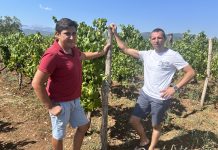
The news of Alen Bibić’s death cannot be neatly contained in a few lines, because nothing about him was ever small, easily reduced or one-dimensional. He could be described from many angles, and each would be true, yet none would be enough. He could be presented as a great winemaker, an innovator, a man of shrewd marketing instincts who understood that wine was not only what was in the glass but everything surrounding it; as a convivial man who could create an atmosphere around a table that made people stay longer than they had intended; as Vesna Bibić’s husband and one half of one of Croatia’s most distinctive gastronomic stories; as a linguist who demonstrated even on his labels that words carried weight; as a man who looked out at the world from the hinterland of Skradin without becoming its servant. Alen Bibić was all of these things, and more, because there was always something about him that eluded any tidy definition.
His assertion that you cannot be involved in wine unless you sleep above your barrels was neither a pose nor a memorable sound bite. It summed up a way of looking at life and work. That sentence held his character, his philosophy and his awareness that wine cannot be made from a distance, casually, bureaucratically or through declarations of intent. Wine demands closeness, presence, the kind of attachment that does not end when the working day is over. For Bibić, it was never a job to be done and left behind, but a way of life. That simple statement contained both his stubbornness and his tenderness towards work he never regarded as a job. What he did was not wine production in the usual sense, but a constant attempt to draw the utmost from the land, the variety and the moment, regardless of what anyone might say, write or prescribe.
This also holds the key to what made him special. He would not accept clichés, ready-made definitions or other people’s limitations. A single passing, almost dismissive remark about Debit was enough to sustain him for years in his desire to show how impoverished that view was. Not out of spite, but because he refused to accept simplifications. To him, Debit was not “yellow wine to go with trout”, but a realm of possibilities, a variety he stretched from freshness to dessert wine, from sparkling wine to skin contact, simply to show how broad its range could be when someone took it seriously. It was not enough for him to be told that a variety made wine for this or that dish, from this or that area, within a particular stylistic range. He wanted to reveal the breadth, potential and life of the variety.

He did the same with everything else. In his hands, Plavina, Lasina and Babić were not merely a heritage but a living organism, something that breathed through blends and conveyed a sense of place that could not be imitated. Equally, he had no difficulty turning to Syrah or Sauvignon Blanc if he saw potential in them, but he always brought them into his own context, his own land, his own signature. His wines were never merely technically sound; they always took a position. Bas de Bas was not only an outstanding Syrah but a statement about value, about wine having a price that did not depend on other people’s expectations. Aleph was something else again, perhaps the closest expression of what Bibić truly was.
That persistence was not born in comfort. His personal wine story began neither in favourable circumstances nor on a stage already set. It began in the years after the war, when properties had been devastated, burned and in places mined, when working conditions were rudimentary and life depended on improvisation, generators, resourcefulness and the belief that something could be rebuilt and brought back. There was something greater than a business plan in that return. It was also a pledge, both familial and personal, a debt to his grandfather, to the land, to what had been interrupted and needed to continue. This was no romantic return to an idyll, but the arduous task of creating the basic conditions for life and production where they no longer existed. That is precisely why everything he later created carries additional weight. It grew not from a favourable opportunity, but from a stubborn belief that starting again was worthwhile.
An intriguing tension between roots and curiosity was always alive within him. On one hand, he was deeply rooted in his region, its tradition and the varieties that had shaped the place he came from. Plavina, Lasina, Babić, Debit and Maraština were neither mere folklore nor declarations of local identity made for the market. They were living facts of identity, varieties he took seriously, thought deeply about and restored to dignity. On the other hand, he felt no inferiority towards varieties from other wine worlds. He worked with Syrah, Grenache, the Cabernets, Merlot and Malbec, experimenting, planting, uprooting, abandoning what seemed wrong to him and keeping what found meaning beneath his skies and in his soil. He was a slave to neither tradition nor fashion. He followed what he believed to be true.
That is why his wine world could look like a jumble, but only to someone who failed to understand that Bibić’s order ran deeper than surface impressions. His labels did not spread in every direction because he did not know what he was doing, but because his love was truly expansive and he did not know how — perhaps did not even want — to tame it into a few tidy ranges. Every new idea, every improvisation born of necessity, every forgotten tank, every rearrangement of wines before a new harvest could become the beginning of something new. For someone else, it might have remained a technical footnote. For him, it became a wine with an identity, a story and a purpose. His world of labels emerged not as planned expansion, but as the natural consequence of a man who was constantly thinking, tasting, experimenting and turning chance into meaning.
This was one of his greatest gifts. He knew how to turn wine into a story, but not in the banal marketing sense. For him, the story was not an embellishment but an extension of reality. This was apparent in the names of his wines, in which he revived the Dalmatian language not as an exotic detail for a label, but as a genuine layer of identity. As a scholar of Slavic languages and a linguist, he did not approach this casually. Those names contained not only playfulness but knowledge, passion and a desire to bring something forgotten back into circulation. It was his way of showing that wine could carry history, language and place without becoming a museum object, remaining alive and alluring instead.
When he named his great wine Aleph, it was clear that this was no mere literary reference or decorative display of learning. Borges was no incidental ornament in his cellar. That choice reveals how well Bibić understood that wine was not only sensory qualities, not only structure, extract, tannin, acidity and finish. Wine is also an idea, an experience that cannot be exhausted by technical description. Borges’s Aleph, the point containing the entire world, seemed to belong naturally in Bibić’s cellar, that space where, sitting at the table, it was easy to feel that you needed nothing else, that everything was already present in that glass and that moment. Few wines are like that, and fewer still are the people who can conceive, name and offer them in a way that makes everything fall into place.
Alen Bibić belonged to that rare breed of people who created not only substance but context. For him, wine was never separate from the table, food, conversation and people. That is why his story is inconceivable without Vesna Bibić. They were not simply a married couple in which one made wine and the other cooked. They formed a whole, an organic union in which wine and food became two languages expressing the same thought. He recognised what she was doing in the kitchen, complemented it and turned it into a complete experience. Thirteen courses and thirteen wines were neither a competition in inventiveness nor a demonstration of vanity, but a natural expression of their shared understanding that gastronomy was not a sequence of effects, but a way of thinking, feeling and communicating with the world.

In that world, great matters and small details were approached with equal seriousness. For Bibić, even salt was not merely salt. It could age in barrels, absorb traces of wine, change its texture and meaning, turn from something everyday into the subject of a story and an experience. This may be the clearest evidence of his nature. He saw no boundary between large themes and small details, because he knew that an experience often rested on precisely what others failed even to notice. Anyone who had sat at his table knew that nothing happened there by accident, yet nothing felt strained either. Everything was considered, yet effortless, as though it could only have been that way.
It is hardly surprising, then, that people who visited him, wherever they came from, felt they had entered a space charged with a special energy. Anthony Bourdain was not a man to be impressed by trivialities, yet in Plastovo and Skradin he recognised something that made him stay longer, raise his voice and say without reservation what could not be commissioned, acted out or packaged. When someone like that describes food and wine as world-class, it speaks not only of the quality on the table and in the glass, but of the experience as a whole. Bibić knew how to create precisely such complete experiences.
He was, then, a winemaker, but much more besides. He was a host in the fullest, most old-fashioned and gracious sense of the word, a man who knew how to bring people together, build an atmosphere and turn an ordinary tasting into an evening that lingered in the memory. He was an innovator for whom novelty was never an end in itself, but always had to be grounded in experience and meaning. He was intelligent about marketing, not by inventing myths or selling empty promises, but by understanding how authenticity could be recognised, shaped and communicated. He was sociable without being superficial. He loved people, conversation, encounters and atmosphere, but knew that all of it mattered only if there was substance behind it.
Perhaps the secret of his place in Croatian wine lies in precisely that rare complexity. He was not merely a successful producer or a man with several cult labels. He left behind a way of looking at wine that will outlive every individual bottle. He left the idea that wine must have character, that it must not be afraid of its own place or its own price, that it need not accommodate prejudices, that a local variety can be raised to greatness in the right hands, and that tradition is preserved not by sealing it away but by compelling it to keep breathing.
That is why his passing is more than the loss of a single winemaker. With him goes a particular kind of energy, a rare combination of knowledge, courage, good humour, erudition and hunger for life. Gone is a man who knew how to connect Plastovo with Borges, Debit with the world’s finest tables, the Dalmatian language with a top-class label, salt with wine, seriousness with charm, stubbornness with hospitality. Gone is a man for whom it was not enough that wine should be good. He wanted it to be alive, made wholeheartedly, unmistakably its own and great.
People like that leave more than wine behind. They leave sentences, dinners, friendships, memories of conversations that stretched deep into the night, bottles that are no longer merely bottles but small capsules of a personality. His thought remains, too — seemingly simple, yet immense — that you cannot be involved in wine unless you sleep above your barrels. That sentence contains an entire biography. An entire dedication. An entire life.
Perhaps that is the truest way to remember him. Not only for what he made, but for how he lived what he did. For his closeness to his wine, his region, his people and his table. For the fact that nothing about him was cold, routine or detached from life. Everything was in circulation, everything connected, everything immersed in the same world. A world now poorer for the loss of a great man, but richer for the mark he left.