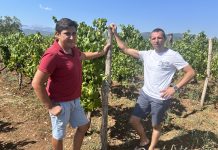
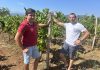
When Boris Drenški Bodren, the ‘world king of sweet wines’ from Rusnica near Hum na Sutli, presented his latest creation, the sparkling wine By the Way, even he probably could not have imagined how emblematic that name was, how perfectly it captured his entire life in wine. For Boris, his internationally acclaimed predicate wines happened along the way, just as his entire wine story happened, and continues to happen, on the side. From the very beginning, he has called it a ‘professional hobby’, an escape from his archival work in the state archives.
Even his ice-wine harvests, given climate change and the increasingly rare opportunities to pick grapes at temperatures below –7°C, could be described as a passing stop on his journey of adoration for — gemišt. Or gemić, or simply gem, as Boris affectionately calls that refreshing combination of wine and water about which some wine writers, such as Ivo Kozarčanin, are prepared to write an enormous treatise.
Even the ancient Greeks mixed wine with water, in six different ways. ‘One quarter should be wine, with three nymphs added’, reads a record from the fifth century BC. They called that mixture hesiod. Alexis was four parts water to one part wine. Diocles contained one third wine and two thirds water, nikokares just one sixth wine, while a half-and-half mixture was called strong wine. Homer even wrote about mixing wine and water in a ratio of 1:20. The blind poet was evidently blind to the delights of wine too. That should not really surprise us, because wine at the time was dreadful, unpleasant to drink and served only to get people drunk. Indeed, most wine remained like that until the last century. Mixing plain water and wine was common in Dalmatia because the water was not clean, so wine was used to disinfect it. Besides, wines were too strong to drink on their own, and with water and a piece of bread they also served as a snack during work in the fields. Adding soda or mineral water changes a wine’s taste, so špricer and gemišt are cocktails that cannot be made with just any wine. It needs low alcohol, ideally no more than 12 per cent, a light aroma and more pronounced, fine acidity. In a word, it must be a wine that, after a sip, makes your lips and tongue produce a fairly loud smack, Ivo Kozarčanin once wrote.
To his archival exploration of ancient Greece, we should add that wine-and-mineral-water or soda-water ‘blends’ are also drunk in Germany, Austria and Switzerland under the names schorle, gespritzter or spritzer, while Hungarian fröccs, with its different ratios of wine and soda, is pure art: a small fröccs, one decilitre of wine and one of soda water, is kisfröccs; a large fröccs, nagyfröccs, is two decilitres of wine and one of soda water; hosszúlépés is one decilitre of wine and two of soda water; házmester is three decilitres of wine and two of soda water; viceházmester is two decilitres of wine and three of soda water; háziúr is four decilitres of wine and one of soda water; albérlő is one decilitre of wine and four of soda water, and so on. Saša Špiranec, one of Croatia’s foremost wine authorities, also considers gemišt ‘a matter of culture and common sense on hot summer days’.

– Sometimes I feel certain wineries are ashamed of gemišt, as though they consider it inferior and want to promote some ‘higher culture’ of wine drinking.
– In Bedekovčina, at our wine fair, we can get through as many as twenty tankfuls of wine for gemišt, drunk with roast suckling pig, Boris Drenški Bodren says.
– But these days, everyone wants to swirl a glass! The Slavonians, with Prosinečki, had to open our eyes — we were the last ones left! Boris laughs, adding that the emergence of Zagorski Bregi, a joint project by Zagorje’s best wineries and Krapina-Zagorje County encouraging the revival of the region’s tradition of mixed-variety wines, is really a return to a lost wine past — a kind of field blend like Austria’s Gemischter Satz — and those wines are ideal for gemišt!
Zagorski Bregi is a commendable attempt to revive and give commercial value to a tradition that, according to the Croatian Agency for Agriculture and Food, accounts for an astonishing 70 per cent of total wine sales in Krapina-Zagorje County.
Boris’s Zagorski Bregi contains Riesling, Chardonnay and Pinot Blanc, and leading Croatian wine critics consider his version ‘the perfect base for gemišt’.
– I’d make larger quantities of Zagorski Bregi, but the others have taken up my space. When I first appeared at En Primeur with that wine, people would come up to me, say, Bodren! Those are sweet wines!, then immediately turn around and go to another stand.
– My Bregi is the base for a sparkling wine I bottle in 0.375-litre bottles, leaving just a little residual sugar.
– You know, there are people who like sweet sparkling wines, and people who will come to like them once they taste my ‘on-the-side’ By the Way.
Boris’s ‘obsession’ with gemišt is no newly concocted story riding the wave of Zagorski Bregi. Of himself and Tomislav Bolfan, who over the past twenty years have become synonymous with Zagorje wine, Boris says they are not typical representatives of the region. — Perhaps the first, perhaps the last, but we aren’t typical — we’re more of an extra layer in Zagorje’s wine world, an addition to the story, Boris thinks.

Budući da se gotovo jedini bavio predikatnim vinima u Zagorju, što podrazumijeva i držanje grozdova na lozi dugo nakon što su ostali već As almost the only person making predicate wines in Zagorje, which involves leaving bunches on the vines long after everyone else has harvested, he was long spoken of in his home region as ‘a lazy fellow who can’t even be bothered to pick his grapes’.
Despite the worldwide fame he earned with his ‘sweet treats’, Bodren would not be a true Zagorje man if his soul did not open at the mention of – gemišt.
– I see a trend coming for light summer wines, and I think Zagorje gemišt should be part of that story. The ideal blend would be local varieties — Moslavac, Kraljevina and Štajerka – spiced up with Chardonnay and Graševina. You just need to find a good balance between those varieties. The time of gemišt is coming!
– Yet here in Zagorje we seem ashamed of it, while on the coast everyone asks for ‘gem, gem, gem’… Everyone splashes a little mineral water into their wine.
– Today, the only problem is the high alcohol levels that have climbed in wines. If I were making wine for gemišt, the alcohol wouldn’t exceed nine per cent!
– The harvest would be much earlier, and there should be no added sugar – as there regularly was until recently, Bodren says.
It was much the same twenty-five years ago, when Boris went with his fellow ‘gemišt drinkers’ to Gornja Radgona in neighbouring Slovenia.
On the way home, they stopped at an inn to ‘refill the tanks’ with a few more gemišts.
Unfortunately, there was no wine left for gemišt, so the waitress offered them a sweet wine.
– What do you mean, sweet? Boris asked.
– Do you know about late-harvest wines? the waitress coaxed him.
– Well, we’ll give it a try, since we’re here, Boris shrugged, persuading his friends to follow his example and do something probably unprecedented in their lives – drink something other than gemišt.
Their reaction was surprising, so unexpected that it is entirely understandable that, several decades later, Boris remembers the occasion as though it were yesterday.
– The wine wasn’t too sweet, just nicely so, and little by little we relaxed, got a sing-song going and all sorts. I wanted us to pay and leave, but no… the waitress said, Now I’ll treat you!, and bought us a bottle of ice wine. A miracle!
– From then on, ice wine was all that existed for me, Boris recalls of his entirely accidental encounter with something that would later become one of the greatest hallmarks of Croatian winemaking.
From a complete wine novice, with no wine gene whatsoever in his family, Boris Drenški – Bodren won no fewer than sixteen Decanter medals in just a few years: six golds, six silvers, three bronzes and one commendation.
His Bodren 2009 ice wine won a Regional Trophy in 2011 and was ranked among the world’s top ten sweet wines.
All this without leaving the garage of his family home in Rusnica, in Hum na Sutli, making him Croatia’s most significant garagiste in the most literal sense of the word.
Boris did not leave his public-sector job at the Croatian Health Insurance Fund either, keeping his ‘secure salary’.
Wine was, and remains, a passion – but also a hobby.

– Around the time of that first sweet-wine experience, I decided to plant vineyards, without the slightest idea what or how. All I knew was that I wanted to make wine for my own needs – to have some for gemišt.
– But ice wine changed everything. I decided that was all I wanted to make.
– I began attending lectures by the renowned Gerhard Schubert, read a little literature, and soon realized wine was more than gemišt!
– I bought a thousand litres of wine for my fifteen hundred litres of gemišt, but I wasn’t interested in that any more.
– I began feverishly buying wines, looking in them for what I’d like to have in my own vineyard.
– Very quickly, I settled on Riesling, Pinot Blanc, Pinot Gris, Chardonnay and Traminer – varieties that remain the backbone of my cellar today, Bodren recalls of his beginnings in wine.
He wasted no time dreaming about his ‘sweet treats’.
Less than a year after his Slovenian initiation into the world of predicate wines, Boris could already boast of his first drops of selected-harvest wine.
He made around twenty litres – ‘purely to find out, so I could send it to the Institute and see from their reaction whether I was on the right track’.
At the Institute, of course, they wondered why someone with such tiny production was sending wine for assessment at all.
– Everything passed without a hitch. I only wanted an answer to one question: do I know how to make this?
– And what I’d produced was awarded a predicate classification too.
– I don’t know, but I was driven even further by some crazy need to prove that Zagorje had the potential to be different from the usual stereotypes – that it could produce the most beautiful sweet wines.
– Perhaps I wanted to be different from everyone else, to have something others didn’t.
– And I managed to prove that those very Zagorje acids, once the object of ridicule, were ideal for sweet wines, Boris recalls of his beginnings.
He ventured into his first ice-wine harvest as early as 2004.
It went rather unsuccessfully – the blackbirds, which ate all the berries, benefited most.
When he went into the vineyard to check a sample, the surviving berries across the entire plantation could barely fill a yoghurt pot!
That was when he decided to buy netting for all his vineyards and protect them against pests.
He spared no expense, investing in fifteen kilometres of four-metre-high netting, with which he literally covered all his then seven and a half thousand vines in two layers.
And he vowed to try an ice-wine harvest again the following year.
He was as happy as a child to have achieved something with Chardonnay that, only a few years earlier, he had known nothing about.
He felt as though he had conquered the world — and decided to seek international confirmation of the quality.
He sent samples to London for Decanter’s annual wine judging.
– Ivan Enjingi got me hooked on Decanter with his great success in 2004. I read and analysed it all.
– Some people told me:
– How did you even dare send samples to London with such tiny production?!
– So what? If they want them, they’ll take them; if not, what can you do?
– And it’s just as well I didn’t listen to anyone.

– I had to go from Hum na Sutli to London to get confirmation of quality – to be taken seriously in Croatia!
– After my success in London in 2008, I focused exclusively on ice wine and selected-harvest dried-berry wines – the very top of the top!
– Different from everything else, thicker, syrupy; low alcohol compared with other producers, but that is precisely what I aim for and what I’ve become known for.
– I want my alcohol levels between six and eight per cent. The lowest I’ve achieved so far was with Chardonnay – 6.2 per cent.
At first, everything happening with his wines was simply honest fun and a personal challenge.
But the story very quickly brought awards, wine and a great deal of attention, and Boris found himself facing – reorganisation.
Although firmly settled in his public-sector job, today as an archivist at the Croatian Health Insurance Fund in Bedekovčina, he never stops dreaming or making new moves.
– Now we ought to plant another twenty thousand vines. We have to! You’ve got a tractor that isn’t fully used – seventy horsepower, like driving a good Golf and not making use of it!
– And greater quantities give you more credibility on the market. Currently, I make up to four thousand 0.25-litre bottles a year.
– Without Decanter, I wouldn’t be where I am.
– It gave me such a tailwind that I’m no longer sure whether it was good or bad.
– I had to increase production…
– You go from nothing to something – and now you can’t stop!
– Either you move forward or you go under!
– On the other hand, I think my successes gave other winemakers the encouragement to get started, because they had nothing to lose – only to gain, Bodren says.
More than ten years have passed since the ‘media explosion’ sparked by the brilliant, almost meteoric success of his sweet wines.
Yet Boris no longer appears at Decanter competitions.
In fact, he did want to keep taking part, but…

– After those successes of mine, the organisers introduced a new requirement every producer had to meet.
– They demanded that anyone entering ice wine produce at least three hundred litres of that nectar a year.
– At the time, only Kutjevo Winery could meet that condition in Croatia.
– I had five varieties, and couldn’t produce more than 150 to 200 litres from any one of them.
– When I began filling in the entry form, I reached the quantity and realised I didn’t meet the requirement.
– I begged them to turn a blind eye and let me in, but hit a wall.
– From then on, I simply stopped entering competitions.
However disappointed he was at the time, Boris found a way to turn the whole story into motivation rather than loss.
For example, during his ‘gold rush’, Decanter had a panel of experts judging all the wines of Central and Eastern Europe under one ‘umbrella’.
– And in that field, I was the champion of Central and Eastern Europe. I won the Regional Trophy!
– Today, almost every country has its own panel judging only its wines, so more trophies are awarded too.
– So when I became champion of Central and Eastern Europe, I succeeded Stanko Ćurin from Slovenia on the throne.
– Then someone said that we small producers from small countries, with our modest quantities, were ‘disrupting the market’.
Angela Muir MW, then chair of the judging panel that also covered Croatia, decided to visit Boris and see the conditions in which his masterpieces in tiny bottles were made.
She did not announce her arrival – she simply called him when she appeared outside the winery.
Boris was, of course, in his archive, and when she called, he asked her to wait half an hour while he came home from work.
– When she saw my winery – literally a garage – she didn’t say much more.
– She became reserved towards both me and my wines.
– And that attitude later spilled over into Decanter’s relationship with me.
In an article in Jutarnji list, Saša Špiranec further explained the situation:
– Angela Muir is a well-known wine consultant whose work would have little purpose if homemade wines like Boris’s continued overwhelmingly to beat those in which a hundred times more money is invested.
That ‘by-the-way’ encounter with Angela Muir, and everything that later happened at Decanter, did not shake Boris’s determination to continue making the world’s finest sweet wines.
He never changed the conditions in which he works, either for appearances or for prestige.
– I’m still in the garage; nothing has changed. I’ve stayed with the same setup – there was simply no need. Nothing forced me into new premises. The tasting room holds about ten people, big enough for everyone to feel comfortable. We can talk there for as long as we like – there are no time limits. People come when they want, have a drink, taste, talk.
– That’s what I like best.
And, he admits, he does not miss Decanter.
Boris still works as an archivist at the Croatian Health Insurance Fund; he has never devoted himself entirely to wine. It has always been, and always will be, something ‘on the side’ – his professional hobby.
– Everyone laughs when I tell them that. Perhaps that’s why I’m not so successful.
????
– All right, I’m successful in marketing terms, but I’ve never capitalised on it. I’ve always been recognised by the professionals, but not by the merchants. They only look for the cheapest deal.
– Realistically, the best market is here at home. Exports and sales abroad aren’t a reality. Our people like a drink, like treating others – and that’s that.
– I’ve tried quite a few Austrian sweet wines and come across Canadian ones too, but they’re all gentler, with less residual sugar.
– They harvest as early as October, when temperatures there start dropping below zero, but the grapes haven’t reached technological ripeness.
– My ice-wine harvests have twice the Oechsle reading – hence that syrupy character.
Just as his ‘garage winery’ surprises everyone who visits him – who knows what people expect – Boris is also different from others in the very way he makes his sweet wines.
– It’s true, I don’t follow the rules in production either. For example, the rules say grapes for ice wine should be picked at –7°C, but I do it at –15°C. My sugar levels are always considerably higher.
– I’m happy when I hear the frozen berries rattling against the press, and the thick must only starts dripping after an hour – and that goes on for four to five hours.