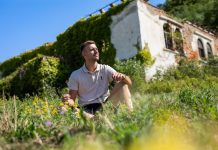
Vedran Kiridžija spada u rijetke vinare koji nadgledaju vinograd — iz mora.
DokVedran Kiridžija is one of the rare winemakers who keep an eye on their vineyards – from the sea.
While others struggle along Pelješac’s hairpin bends with sprayers on their backs, he swims below Dingač, looks up at the hillside and decides whether the vines need help. If they do, he will get out. If they do not – there is no reason to spoil a swim.
This approach to winemaking may sound like a joke, but for almost forty years it has produced some of the most distinctive Dingač wines on Pelješac.
On Pelješac, they will tell you there is a simple way to understand who Vedran Kiridžija is. Just listen to him talk about the vineyard. While others talk about technology, oenologists and analyses, he talks about sun, stone and wind. And about Plavac Mali, which, if meddled with too much, can be as stubborn as the people who grow it.
Kiridžija has always been like that, after all. A man who does not like being told how things are done. On Pelješac, they have a simple name for such people – their own man.
Some American visitors once learned this first-hand when they found themselves in a vineyard in Dingač at the height of Pelješac’s summer heat.
That day, winemaker Marija Mrgudić had brought them from Dubrovnik straight to the hillside above Potomje. By the time they had woken up, eaten breakfast and set off, it was already one in the afternoon, and the sun was roasting the stone like an oven. The temperature was, as people on Pelješac like to say, over five hundred degrees.
Down in the sea, Vedran Kiridžija was swimming and looking up towards the vineyards.
When he spotted Marija’s red car halfway up the hill, he called her at once.
– Are you mad?! Do you realise how old you are?!
When she explained that the Americans had come to visit, Vedran gave them a brief lecture over the phone on the proper way to live on Pelješac.
– You get up at five in the morning.
– By seven, you’ve seen what needs doing.
– Then you go home, have a shower and head out to the shop to see what’s new in the village.
– Until nine.
– At nine, you lie down on the sofa and watch television until lunch.
– After lunch, you have to lie down again for a bit.
– Then you go out, then lie down again until four.
– At four, you have a coffee, listen to the news and go to the sea.
But, Kiridžija stressed, until five o’clock your head must be in the shade and your foot in the sea.
When Marija translated this for the Americans, they exchanged glances and finally asked:
– How much money does this man have to be able to live like that?
They had not understood that it was not a matter of a bank balance.
It was the Pelješac way of life.
And Vedran Kiridžija is one of its most steadfast guardians.
Indeed, if the English heard his daily routine and the way he explains the vineyard, they would probably award him an honorary doctorate in sarcasm and sustainable idleness.
Kiridžija is, in fact, something like Pelješac’s own Monty Python – except that his jokes have been aged in the sun and in barriques.

Kiridžija’s wine story, however, began at sea rather than in a vineyard.
Like many men from Pelješac, he spent years as a seafarer. He sailed the world, earned decent money and did the work that had given generations of people from this peninsula a better living than they could find at home. He married, built a house and then, to his friends’ astonishment, made a decision that sounded almost irrational to them: to leave the ships behind and return to Potomje to tend a vineyard.
– Unlike the many people from Pelješac who spent years going to America, I did the opposite, Kiridžija says.
– I said it out loud: Goodbye, America!
Many laughed at that sentence. Such things, they said, were easy to say but rarely put into practice.
Kiridžija, of course, proved them wrong.
Admittedly, he says, he did go back to America once more. But only briefly.
– I went shopping for some good clothes and shoes. There you go – they lasted me almost thirty years.
When he returned to Pelješac, twenty thousand vines were waiting for him.
Half of them in Dingač.
– I was never afraid, he says.
– I’ve got the best site.
In Dingač, however, things rarely work the way winemaking manuals imagine they should.
Kiridžija often says that Plavac Mali is a remarkable variety, but only if you let it do what it knows. And on a site like Dingač, where the sun beats down on stone and the sea reflects heat back towards the hillside, this variety can reveal a character found in few other places in the world.
His vineyards contain around twenty thousand vines, almost half of them in Dingač. The vines are old, deeply rooted in stone and accustomed to the droughts that have troubled southern Dalmatia increasingly often in recent years.
– These vines don’t even notice the droughts, Kiridžija says.
– There’s no need to water them either, as some modernists do.
And by modernists, he means winemakers who have begun introducing new techniques, machinery and interventions in Dingač.
His approach is different.
One year, he recalls, he treated the vineyard with sulphur just once, at the end of May. While some neighbours sprayed their vines as many as twenty times, he scarcely visited his for three months.
– I swim, look at the sky, look at the vineyard and see that nothing needs doing.
On Pelješac, they will tell you that sentence contains more winemaking philosophy than many a hefty book.
When he talks about modern interventions in vineyards, Kiridžija usually becomes a little more animated.

In recent years, new vineyard owners have appeared in Dingač, often people from elsewhere who have decided to adapt the hillside to modern technology. Some have begun crushing the stone, levelling terraces and changing the soil structure to make the vineyards easier to work.
Kiridžija regards such experiments with a considerable degree of distrust.
– That’s not how you grow grapes in Dingač, he says.
He explains that crushing the stone changes the soil’s chemical composition, and that this very stone, he maintains, is one of the key reasons why Plavac Mali produces the wine it does on this site.
He has a simple name for such vineyards:
Beaches.
On Pelješac, that is one of the gravest insults you can level at a vineyard.
Because Dingač, as the old vine growers will tell you, is a place to understand, rather than to prettify.
Kiridžija, however, is more than a man with firm views on vineyards. He also guards some old Pelješac wine customs that have now all but disappeared.
One of them is called tajano.
It is a word you will not find in most dictionaries, but one that older vine growers on Pelješac understand very well. Tajano means blending different Plavac Mali wines – most often Dingač with Plavac Mali from the valley vineyards – to produce a wine that retains the character of the finest site while gaining a little softness and ease of drinking.
Such wines have been made for a long time, most often in years when Dingač did not yield enough grapes to fill the large barrels. Dingač was always dominant, but a little other Plavac Mali would be added.
– Tajano has been made on Pelješac since time immemorial, Kiridžija explains.
– Dingač is always the main thing. The rest is just there to help.
Many remember the word from an old piece by Miljenko Smoje about the legendary Pelješac winemaker Ivo Violić Indijan, who once sold Lepa a wine with a handwritten label bearing a single word – tajano.
Kiridžija, however, ran into one small problem when he decided to give his wine that name.
His packaging supplier refused to make the boxes.
Somewhere on the internet, he had found that tajano meant – wine with marijuana.
Kiridžija just laughed.
On Pelješac, wine has been blended for centuries.
But not with weed.
For years, Kiridžija’s Dingač wines have belonged among the upper ranks of Croatian reds, but he has never been a man to speak of that with restraint.
Quite the contrary.
– I know what I’ve got, he says without hesitation.
– I’ve got the best red wine in the world. Let someone prove me wrong if it isn’t so.
On Pelješac, nobody takes such statements too seriously. Wine is always praised there with a measure of humour and self-irony. But a look inside his cellar makes it clear that a rather serious archive also lies behind that sentence.
It holds almost every vintage he has made over the past twenty years or so.
One of them, the 2012 Dingač, spent a long time ageing in a Spanish-made barrel of American oak. When oenologist Leo Gracin, his longstanding friend, tasted it, he reportedly said it was a wine that must not be spoiled by any blending.
– This is the best wine in the world, he said.
Kiridžija immediately turned that sentence into an acronym.
On an improvised label, he wrote just three letters:
NVS.
Asked what they meant, he replied in all seriousness:
– Najbolje vino na svitu. The best wine in the world.
The only thing about that wine that troubles him a little is – the alcohol.
His Dingač wines almost invariably exceed fifteen per cent.
– I’d like it to be lower, he says.
– I pick before everyone else, but I’m always a day too late.
He has concluded, he adds with a laugh, that in Dingač it is not just the day of the harvest that matters.
The hour matters too.
Despite all the praise his wines receive among connoisseurs, Kiridžija has never been particularly sentimental about the market.
On the contrary, he often talks about selling wine with the same measure of irony he brings to everything else.
– If I made small quantities, I’d sell it all, he says.
– But I’ve got more wine than I need.

Wine would sometimes sit in his cellar for years, waiting for the previous vintage to sell out. A Zagreb distributor who had sold his wines very successfully for a while once tried to explain why sales were no longer what they had been.
– Do you know where your customers are? he asked.
– Where?
– In Remetinec prison.
Kiridžija just laughed.
– It’s true, he says.
– Those HDZ fellows liked eating well, drinking well and signing the bills.
In passing, he adds an interesting detail from that period: he was once among the founders of the party on Pelješac.
But he did not stay long.
These days, Kiridžija sometimes says he is retiring.
Of course.
Rather like many roads in Dalmatia – planned for decades, but never built.
Because, as he likes to say, he will keep making wine until Hajduk win the league.
In other words, Pelješac can comfortably count on another century of supply.
In the meantime, Vedran Kiridžija remains what he has always been.
One of Dingač’s last authentic bards.
A man who knows how to quarrel with a vine, but always makes peace with the wine. A winemaker who watches his vineyard from the sea, claims his Plavac Mali is twice as good as anyone else’s, and makes wine as though it were merely something he does in passing between a swim and an afternoon nap.
On Pelješac, they will tell you there are winemakers who make wine.
And there are those who live with wine.
Kiridžija belongs to the latter kind.
So when he presents a wine today called ‘Vrime je’ – ‘It’s Time’ – it may sound like an announcement of his departure.
But in Dingač, time does not run by the clock anyway.
In Dingač, time runs by Kiridžija.
And it will for a long time yet.