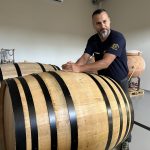
– Perhaps I’m a little too complicated to introduce in a few sentences, says Nenad Posavec from Klanjec as he begins his story. First of all, playing on the term “garage winemaker”, I’d describe myself as a “pantry winemaker”. My operation is so small that I can work in a pantry – and I do.
And so, with a reference to his size, this small producer of great wines began telling his story. Nenad Posavec from Klanjec has just one hectare of vineyard behind him, in his hands, or simply under his care. By the standards of Slavonian wineries, or those elsewhere in Croatia, even in places where consolidating plots is exceptionally difficult, that is a negligible area.
– “Pantry winemaker” is a term you could use for most Zagorje winemakers, or for all the hobbyists and wine enthusiasts who make up the majority here. And those people are giving up and selling everything, because they’re getting older, and tending a vineyard becomes physically harder with age, however small or large it may be, Nenad says.
– Here, a love of wine is a tradition, something we learn from birth. Everyone, absolutely everyone in Zagorje, has a small or slightly larger vineyard, just as, until recently, every household could boast a cow of its own. The Sutla valley widens around here, providing larger areas of farmland, so there were wealthy farmers with big vineyards and big cattle sheds. My grandfather fitted that picture perfectly. He came from Kačkovec, six kilometres south of Klanjec. They made wine and took the better-quality batches by ox cart to Zagreb and its taverns.
People used to drink a great deal.
– When I started making wine, a man came to see me from a tavern I hadn’t even known existed. It was relatively close by: over one hill, then another, and across a gully. His tavern was part of the family house. You’d never have guessed it was a tavern – more a little bar where you could have a quick drink standing up. And he told me he sold more than ten thousand litres of wine a year!
An anecdote from Klanjec’s history shows just how much substance there is to Nenad’s claims about the thirst of Zagorje’s people. Entitled “Klanjec, My Town, How I Love You”, it was written by Veljko Čižmek Sr. back in 1970 and appears on the town’s website. In it, he describes no fewer than thirteen taverns in a town of just 2,500 souls:
– Competition used to be fierce, because there were thirteen taverns. I’ll list them straight away: Blažičko, Dečman, Posavec, Kupiter, Županić, Iveković Bino, Petrišić Ivica, Kobali and Špoljarić. Iveković Štef had a café and a carom billiards table – the better sort of gentlemen, who weren’t much for drinking, went there. Then there was Bertek, the popular Fačkulinka inn, and Šimanuvič Ročic. The old locals, as they call us, drank heavily. You can tell from how many taverns we needed – they were quite a crowd. Broz Krešo even had the barber come to the tavern to shave him, and afterwards he washed with wine instead of water. Jemerčić the furrier had the first bowling alley in Croatia. Another of our Klanjec men built it underground, with a bar and private booths. It was dug beneath Broz’s hill by local craftsmen and masons in 1865, and our own Mirko Iveković created it. Little romantic verses were engraved in that bowling alley… In winter, the people of Klanjec went to the taverns and played cards every day, while those who played for money kept hiding so their wives wouldn’t find them…
When I read that little passage to Nenad, he simply laughed.
– That’s how it was. People used to drink!

Prisjećajući se svojih vinskih početaka i trenutka kad je odlučio da mu vinarstvo bude životno usmjerenje, Nenad priča da su njegovi roditelji Recalling his beginnings in wine and the moment he decided to make it his life’s work, Nenad explains that his parents had a vineyard literally “above Sever’s house”.
– It was only five hundred vines. We worked it as a family, but because it was down in a gully, it wasn’t particularly appealing. There was no view, no chance to rest your soul. My parents had always dreamed of a vineyard cottage on a hill, somewhere to spend their weekends. It stayed a dream for years, until a woman decided to sell her cottage in the early 1990s. It was exactly what my parents had been looking for. They began renovating it, and it came with a relatively large vineyard by Zagorje standards, although it was badly neglected.
Nenad was then in his first year of secondary school and says he found nothing too much trouble. He admits, however, that his parents left the harder vineyard jobs to his brother, so they never put him off wine.
– Perhaps that’s why I never came to hate the vineyard: they never managed to make it a burden for me. I would skip around those vineyards, and I loved the new one because you could work with a beautiful view over the valley.
Inspired by Sever’s wines, then the best in Zagorje and streets ahead of everyone else, they planted Pinot Gris.
– I’d always keep about a hundred kilos of grapes from the harvest for myself, to play around with and make some wine. And I must admit I did quite well, even though it was purely a hobby. We sold most of our grapes to Sever. The price was very good, and we did that for two years, until grape prices plummeted and selling them no longer paid. Then I said: “We’re not selling grapes to Sever any more – I’ll make some wine for the local drunks!” But the wine turned out far better than anything intended for drunks, and we managed to sell it very well!
Did you surprise yourself?
– Yes.
Today, Nenad says that transformation – from a conventional grower selling his grapes to others into an experimental “winemaker for drunks” – triggered everything he went on to do.

– That really seems to have been the turning point. I was intrigued by the idea of trying again the following year, when the conditions would probably be completely different. Then we acquired another plot adjoining ours. We planted Chardonnay and Sauvignon Blanc there, and that Chardonnay later won everything there was to win in Croatia. Later, we bought another plot above the existing vineyards, a hundred metres higher in elevation.
Nenad’s way of thinking is unusual. Listen to him for a while, and it comes as no surprise that, after finishing grammar school, he decided to enrol at the Business School in Zabok to improve his knowledge of sales and winery management. His choice was not between Poreč, Požega or Zagreb as places to study winemaking. He wanted to know what would help him develop his own distinctive wine venture as a business. Yet the school in Zabok fell far short of his expectations.
– Pure theory with nothing to do with running a business.
– Since I don’t have the formal grounding in oenology you get at the Faculty of Agriculture, I tried things they strictly forbid there.
Such as?
– For instance, they recommend taking wine off its lees promptly after fermentation, otherwise it will spoil. That’s basic winemaking! Especially in large tanks. That’s what the theory says, and practice bears it out – the wine really does spoil. But I discovered that the full lees never spoil. That’s why my wines have more body. I call those lees the wine’s mother, because they cradle it.
Nenad shared his findings with “the people at the Faculty of Agriculture”, hoping they would send someone to study the process.
– Whether they did anything, took me seriously or swept my findings under the carpet, I honestly don’t know what’s happening about it now.
– Those lees are fascinating. They’re alive and clearly working all the time. I kept one batch on them for two years. It was Graševina. I’m sorry I had to sell it all, but I needed the money. It tasted soft, almost like drinking oil, with a texture similar to an ice wine but without the honeyed notes. And you could still taste that wine hours later.
The lees, his “mother of the wine”, are not Nenad’s only discovery.

– There’s something else. Without any sophisticated technology, without cooling the vessel, I’ve managed to stretch fermentation out for as long as I want. It isn’t about chemicals, because chemicals have no place in my cellar. The chemical industry would go bankrupt if it depended on me. I stumbled on that, too, by doing things the profession doesn’t prescribe. I don’t add sulphur to my wine until a year has passed. I leave it that late so I don’t kill the lees. In other words, my first racking after fermentation is only a year later. I don’t touch the vessels at all!
– On the other hand, I don’t use wooden barrels, only stainless steel. First, wooden barrels are expensive, and I can’t afford them. Second, I don’t have a suitable cellar for wood. A cellar for wooden barrels needs fresh, clean air and the right relative humidity, while all my cellars are dry.
What do you do differently in the vineyard?
– I try to save working hours. For example, I mow at the full moon, because all the water goes to the tips of the grass, and after mowing then, it takes much longer to grow back. That saves me at least two mowings a year! Imagine how much that could save someone with large vineyards! I don’t use any herbicides, either, because I don’t believe all those chemicals stay in the grass without reaching the grapes. Once, when my strimmer broke and I couldn’t afford a new one, the grass had already grown up to the bunches. I decided to flatten it with my foot, parting it down the middle! I’ve done that ever since, and my vineyard looks just like my neighbour’s, which he mows five times.
– I don’t use any soil fertilisers now, either. It all comes from the grass, just mulch. I apply very small amounts of foliar feed, and only when the leaves show me that something is missing. Long ago, an older man who taught me to prune told me I had to stand beside the vine, because it would tell me everything. And it really does.
You talk to your vines?
– Of course! Look, the shape and colour of a leaf tell you exactly what it lacks. I haven’t put manure or artificial fertiliser into the vineyard for at least twenty years. I was the first person here to stop rotavating and let grass grow throughout the vineyard, and the first to stop hoeing the whole area and work only around the vines.
Nenad Posavec’s individuality and candour have earned him something of a following among lovers of his wines.
– Although I initially intended to work with restaurants, I ended up selling only to private customers. I have around five hundred regular buyers, loyal people who form a small, closed circle of – I dare say – friends. When they come here and have a glass, they start confessing, so I’ve become a kind of confessor, too!
So you’ve become Father Nenad?
– Ha, ha, ha! My grandmother Matilda used to say that, too!
– I never dreamed of becoming a winemaker, and I’ve never had a role model in wine. I never particularly liked what my colleagues were doing. I always had objections, either to their wines or to how they worked in the vineyard and cellar. My wine journey is different from everyone else’s. I literally haven’t spent a cent on marketing. If I could duplicate or triplicate myself, I could produce at least ten times as much and sell it all. But then I wouldn’t be me. I wouldn’t have control over the wine. So I’d rather say I scrape by on a minimum wage than turn my wine story into a business.
Nenad admits that his wines do not provide him with a living so much as a means of surviving. He manages to pay himself a modest minimum wage without owing anyone anything. There is no money for investment.
– Everything here is improvised! Since I didn’t have wealthy parents, there were many things in the cellar, from equipment to vessels, that I couldn’t afford, so I had to improvise. I wanted to go as fast as a Ferrari, but I had a little Yugo. That’s why my Yugo is full of modified parts. I didn’t have money, so I had to think twice about whatever I wanted to do. People who have money hire others to do their thinking for them. In the long run, that isn’t good, because it all leads to outright commercialism.
– My wines are honest. I don’t fiddle with anything or buy artificial aromas. They’re stable in themselves, even though they contain no preservatives apart from a minimal amount of sulphur. The whole global wine scene looks like mass-produced Cekin chickens, and I prefer a home-reared bird.
The excellent results his Chardonnay achieved at wine competitions prompted friends and admirers to nickname him Mr Chardonnay.
Why are you so obsessed with Chardonnay?
– Chardonnay responded best to all these pet ideas and experiments of mine, both in the vineyard and in the cellar. There was no strategic planning behind it, because everything I do comes spontaneously. On the other hand, Chardonnay doesn’t produce those generous yields people in Zagorje expect, so it isn’t exactly a godsend for this region.
Nenad considers the hills around Klanjec, specifically the southern slopes of Cesargradska gora, “Zagorje’s only true grand cru”.
– The wines here have more body and considerably less acidity than those elsewhere in Zagorje. There’s less disease in the vineyards, too. In summer, an interesting breeze comes out of the forest towards evening, blowing only within a metre and a half of the ground. It lasts half an hour, but even in that short time it cools everything down. Nenad Posavec is a winemaker from a pantry, a philosopher from a vineyard and a rebel with a cause. In a world that demands “branded chickens”, he remains faithful to his home-reared bird – simple, honest and authentic.