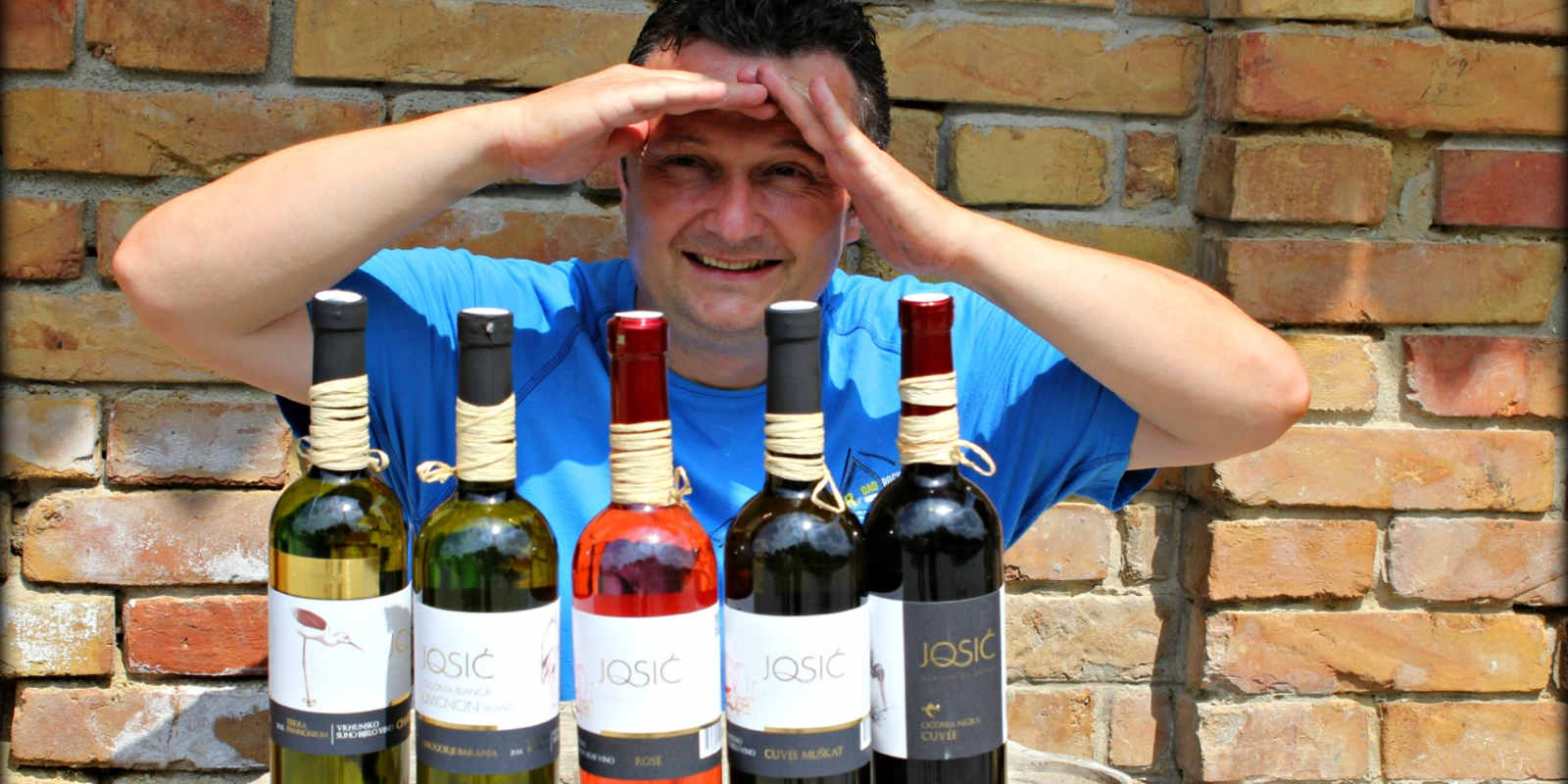
When the registrar at his wedding said the name Dragan Vasić, an awkward silence fell among his friends.
“Who’s that?” they asked, looking around.
“Me!” said the groom.
“What do you mean, you? You’re Janko!”
Only people who do not know him call him Dragan anyway. A local rascal who made up new names for the children in his street gave him the nickname in childhood, and even Janko never discovered why that particular one had fallen to him. He did not object much. Over time, he grew so fond of it that his real name began to sound as though it belonged to someone else.
“Dragan sounds a bit silly to me. Janko is different.”
Under that name, he did almost everything for which he is known today: worked in the wire business, planted vineyards, founded a winery, brought Smederevka back into serious wine conversation and won Serbia’s first Decanter gold. But becoming Janko meant more than changing his name. It required a particular talent for turning every hobby into a passion, every passion into a business and almost every conversation into a competition.
All you have to do is mention meat jelly in his presence. Journalist Igor Luković made that mistake at a wine fair. He was on the telephone, explaining to someone how he made it, convinced that nobody around him was listening. Janko, naturally, was listening.
“Do you actually make it yourself?”
“I do.”
“Then we’ll have a competition.”

Luković tried to get out of it by explaining that there were different styles, that their meat jellies were not comparable and that not everything needed to become a duel. It did not help. For the next two years, Janko reminded him of the challenge whenever they met, until their dishes finally appeared before a panel at the Serbian House of Wine. They were served anonymously, the judges tasted them and the winner was declared unanimously. Janko won, of course.
He still recites the recipe as though he needs to prove his victory all over again to anyone who might have missed it.
“Pig’s trotters and one beef foot, for body. I leave everything overnight, throw away the meat in the morning and cook two smoked pork knuckles in the jelly…”
He takes sarma, stuffed cabbage rolls, just as seriously. His friends call his version pesničara, from the Serbian word for fist, because each roll is the size of a human fist. To him, a small sarma is not a matter of taste but an incorrect ratio of meat to cabbage. Since his wife Jelena does not eat cabbage, Janko claims to have found a solution that suits them both.
“That’s why my sarma is so big: to make the cabbage acceptable.”
On one television programme, he was given seventeen minutes to prepare pike-perch in a white sauce, smoked carp risotto and sarma in an earthenware pot. The organiser watched him as though he were overturning a centuries-old domestic order in front of the cameras.
“Women spend two days preparing sarma, and you’re going to make it in seventeen minutes!”
He did. According to his explanation, there was no culinary magic involved, just good organisation-the same instinct that had made him spend hours as a boy watching women roll out pastry before trying to make pies himself. When Stevo Karapandža appeared on television in Little Secrets of the Great Masters of the Kitchen, Janko waited for Thursday at 7.15 p.m. the way other children waited for cartoons. He still knows every word of Arsen’s opening theme song.
“Would you like me to sing it?”
The question is generally unnecessary, because by then he has already started.

At his winery in Plavinac, visitors sometimes notice the cooker and apron before the barrels and bottles. A guest might be served potatoes that have taken four hours to prepare, a rump steak his son calls “a cow”, or an enormous pig split open in a way that reminds Janko of a flying squirrel from a cartoon. His kitchen is a place of pleasure, but also of responsibility: if he has invited someone to his table, nothing may be done by halves.
The same applies to wine. The only difference is that the cooking story began in front of a television, while the vineyard story began with a blow to the head.
Above his right ear, he still carries the bump he acquired in his fifth year at school when he struck a vineyard stake. His mother had two vineyards in the village of Udovice, two kilometres from where he would build his winery many years later, and Janko spent much of his childhood among the vines. His parents eventually sold the vineyard, but he says he dreamed about it for the next twenty years. In those dreams, it always looked perfect.
“For a long time, I was afraid to go back. I didn’t want to see that it was no longer how I remembered it. When I finally went, everything was neglected. Perhaps the vineyard never looked the way it did in my head, but I still live with that more beautiful image.”
He learned to cook by repeating other people’s movements, while his return to wine began with an attempt to rediscover his own vineyard. Getting there required a detour through a steelworks and the wire business.
An electrical technician by training, he spent thirteen years rewinding electric motors, initially in a cold rolling mill, under conditions he did not remember with nostalgia. Yet as soon as he received his first substantial pay packet, he knew what to spend it on: he bought a small vineyard and planted 250 vines.
“Just for myself,” he said at the time.
That “for myself” lasted far longer than today’s winery might suggest. From 1992 to 2006, he made wine almost continuously, missing only two harvests, but gave no thought to commercial production. He worked at home, with the equipment and knowledge he had: well enough to enjoy the result, and modestly enough not yet to imagine that he had become a winemaker.
In the meantime, he had to sacrifice the vineyard for a business opportunity that emerged during hyperinflation and sanctions. He began trading in wire, initially bringing small quantities from Romania in his own car. After sanctions were lifted, he became an exclusive importer. In his best years, he sold as much as two thousand tonnes annually.
The business gave him financial security, but he did not believe it would last for ever.

“I did well in wire, earned money and lived comfortably, but life lasts longer than twenty years. When I realised that the business didn’t have much of a future, I had to turn to something that would endure.”
An old joke in Smederevo has it that Tito once misheard that the area was best suited to growing iron rather than grapes, and consequently had a steelworks built there. In Janko’s case, that supposed misunderstanding worked in reverse: a man from the steelworks, who had made his money selling wire, began bringing Smederevo back to grapes.
The turning point came at one of the first wine salons in the Sava Centre, probably in 2004 or 2005. Serbia was then divided into nine winegrowing regions, whose representatives had brought wines showing what was happening in their respective areas. There were plenty from Župa, alongside wines from Oplenac, Knjaževac and the sandy vineyards. Smederevo, a town once renowned for wine and grapes, was represented by three bottles with labels that looked as though they had survived several countries.
Janko stood before them, staring at an absence where he had expected to find his town.
“I said to myself: if nobody else will do it, I will. Smederevo must have the wine it deserves.”
Before turning that decision into a winery, he spent two years visiting cellars. Jelić Winery was among his first stops. He visited Božo Aleksandrović and, in Župa, met Milan Spasić and Mića Minić. He travelled to taste wines, but also to understand serious production, equipment and the people worth learning from.
“Milan Spasić helped me the most. I can freely say that he was my teacher.”
When he began buying equipment in 2006, he also called on Božo Aleksandrović to discuss deliveries. They were drinking wine and talking when Božo suddenly asked:
“When did you actually catch the bug?”
Janko told him how, back in 1992, he had spent money intended for two summer holidays on his first plot. He worked the vineyard for five years, then sacrificed it to develop the wire business. That loss proved temporary: wire supplied the capital he needed to return to wine on a much more serious footing.
Janko Winery officially began operating in 2006. Its first wine was Zapis beli, and the following year it offered six labels. Janko finally had his own winery, but he still lacked the wine that had prompted his decision that Smederevo must no longer stand behind three forgotten bottles at wine salons. For that, he needed a variety that already bore his town’s name.

At the time, almost nobody regarded Smederevka as a grape capable of producing serious wine. It was drunk as a simple table wine, often in quantities that mattered more than the contents of the glass. For many wine connoisseurs, hearing its name inspired an urge to move away from the stand rather than any curiosity.
Janko saw that low standing as another reason to devote himself to it.
“God gave us a variety that bears the name of our town. Failing to make use of that would be a sin.”
He found support in Smederevo’s history. A winegrowers’ and winemakers’ cooperative had been established there as early as 1909. Two years later, a wooden fortress was built beside the stone one for the Smederevo Autumn festival, at the spot where visitors arrived by boat from Belgrade. Grapes and wine were exported, and in 1927 the Smederevo Winegrowers’ Cooperative won a gold medal for Smederevo White and Tamjanika.
Tamjanika, then, had held an important place in his town’s wine history. It also had a place in Janko’s personal memories. The Župa winemaker Mića Minić once set before him a bottle of his first late-harvest Tamjanika, of which only one hundred bottles had been made. A large, bib-like label hung around the bottle, bearing the production quantity.
“I asked him how much it cost, and Mića told me it wasn’t for sale. It was for giving.”
Janko kept the bottle for two years, then opened it with friends. The wine delighted him so much that he later regretted not drinking it alone with his wife Jelena.
“It was the best Tamjanika I have ever tasted.”
Even so, he never seriously considered producing it as a wine in its own right. If he was setting out to restore the identity of the Smederevo winegrowing district, he saw little sense in choosing as its principal indigenous grape one whose name was more closely associated with another region.
“Why should my indigenous variety be Tamjanika when Smederevka is the natural choice here? I’m grateful to my friends from Župa for everything they taught me, but I have no doubts: in Smederevo, we must make Smederevka.”
For the first vintage, however, he did not quite trust it. He enhanced it with 17 per cent Župljanka and three per cent Tamjanika, later declaring himself a “sinner” for doing so. He doubted that Smederevka alone could offer enough aroma, structure and appeal to overturn the reputation it had acquired through years as a cheap wine.
Then that blend was named the best Serbian wine made from an indigenous white variety at a blind tasting in Spain. The recognition gave him enough confidence to repeat the recipe the following year. When Milan Spasić grubbed up his Župljanka, Janko took another step: he reduced the blend to 97 per cent Smederevka and three per cent Tamjanika. He still considers that the best Smederevka he has made.
Producing good wine, however, was not enough. He had to persuade people at least to taste it. At the Wine Salon in Kragujevac, visitors walked away as soon as they heard he was offering Smederevka, so he turned the bottle around to hide the label.
“Taste it, then guess what it is.”
The answers came one after another: Riesling, Sauvignon Blanc, Chardonnay. Only one visitor guessed the variety correctly. When Janko turned the bottle back around, people who had been avoiding Smederevka moments earlier began buying it. By the end of the salon, he had sold more of it than ever before.
“At every competition it entered, my Smederevka scored higher than 80, perhaps even 90 per cent of the Tamjanikas. I have a right to be proud, because when you see the history you have, you have to carry it on.”

He did not banish Tamjanika from his vineyards altogether. He planted it specifically so that a small proportion would give Smederevka an aromatic signature, preserving in the new wine a trace of another variety that had belonged to old Smederevo.
Over time, he began making Smederevka without any lingering unease of the kind that had led him to add Župljanka in the first vintage. On the plot beside the winery, he planted another 1,500 vines, with the intention of surrounding the cellar entirely with vineyards.
“Château Janko-why not?”
It was to be the finished expression of the decision he had made before those three lonely bottles in the Sava Centre: a winery amid its own vineyards, and a wine that no longer hid behind a label turned away from view.
By 2009, Janko had planted more than nine hectares of vineyards; the plantings later grew to sixteen. Alongside Smederevka came Chardonnay, Traminer, Riesling, Merlot, Cabernet Sauvignon and Cabernet Franc, followed by the variety on which he intended to build the second part of his indigenous wine story: Prokupac.
The first substantial harvest, in 2015, almost ended up being sold in bulk. The grapes did not promise the wine Janko wanted, and there was little confidence in the cellar that it could be rescued. He nevertheless put the Prokupac into barriques, although he was unsure what would come of it.
On the fourth day, Goran Perić arrived at the winery, looked at what he was doing and wasted little time choosing his words.
“Everything you’re doing is wrong. Two minutes of extraction in the morning and two in the evening. Nothing more.”
Janko listened. The wine remained in barriques until June the following year. Slavomir Ćirović, a man for whom Prokupac meant far more than another variety in the cellar, also helped give it a new direction.
“Prokupac can be Pinot Noir,” he told him after tasting from the barrel. “Not Merlot, and not Cabernet Sauvignon. Delicate like Pinot, but serious.”
That sentence changed the way Janko thought about the variety. He stopped trying to turn it into a powerful red modelled on international grapes and began looking for its own delicacy, freshness and aromas. That was how Baš Prokupac was born.
The wine started well on the domestic market, then the Americans took almost all of it. After the first substantial order, Janko retrieved bottles from shops and warehouses so that he could send them across the Atlantic. The next vintage was even better, but the story repeated itself.

One buyer from the United States tasted the 2016 and 2017 vintages and chose the younger one without much hesitation. He immediately ordered 1,150 bottles for New York. Three days later, a distributor already working in Chicago came for seven hundred bottles, increased his order to 1,200 after the first sip and tripled his planned quantity of Zavet as soon as he tasted the new vintage.
Of approximately five thousand bottles of Prokupac, only a fifth remained for the domestic market.
“We actually sent the Americans less than they asked for. That left a gap here, but when you make such a small quantity, you can’t be on every market.”
That was precisely why Janko considered indigenous varieties the most important part of Serbian winemaking. With Cabernet Sauvignon, Merlot or Chardonnay, you had to compete with the entire world. Prokupac could open doors because others did not have it.
Smederevo’s Prokupac also differed from the wines of Župa and Toplica. The warmer area gave it riper, sometimes jammy notes, while differences between daytime and night-time temperatures helped preserve the freshness Janko sought in all his wines.
“Its potential grows year after year. I expect serious awards, but the vineyards are still young. Only now are the berries getting smaller and the bunches more compact.”
He foresaw a great future for Prokupac, while speaking more cautiously about Smederevka. He believed its ultimate potential was more limited, but that was no reason to give up. Quite the opposite: getting the best out of a variety everyone had already written off suited his character far better than making a wine whose existence nobody needed to justify.
“Smederevka has to succeed. It is our variety. God gave it to us.”
Not every variety arrived in his vineyard as part of a grand plan, however. One came because planting had left a gap.
Something in the vineyard layout had not quite worked out, leaving room for roughly three hundred vines. It was early June, a time when planting material could no longer simply be chosen from a catalogue: orders were placed months in advance. Janko nevertheless called the Rauscedo nursery in Italy and asked whether they had anything that someone had ordered and subsequently abandoned.
They had 112 two-year-old Shiraz plants, the same number of Sangiovese and 64 Cabernet Sauvignon. The person who had reserved them had never appeared, and the total almost exactly matched the space remaining in Janko’s vineyard. That was how Shiraz came to Smederevo.
His oenologist insisted that the variety did not belong there, but Janko was stubborn enough to ignore the advice. Its first crop in 2010 suggested that the soil and climate might, after all, produce something special. Two years later he planted another seven hundred vines, followed by a thousand the next year and as many again in 2019.

A bottle he received from South Africa also helped him make that decision. A regular customer who had become a friend called him while travelling and asked what he would like him to bring back.
“A good Shiraz.”
He received a bottle with a black label and a long-bodied dog printed near the bottom. He tasted the wine and immediately thought that one day he would like to make something similar.
The first proper harvest came in 2012 and filled two barriques. Janko sold five hundred bottles while the wine was still in wood and did not want to offer the remainder at tastings because there was too little of it. Word spread nevertheless, and some buyers offered him between fifty and a hundred euros a bottle. He turned them down, explaining:
“I’m not selling my soul to the devil. I’ve sold as much as I planned, and I can give the rest away. I wasn’t sure I could find a better wine with the money I would have received.”
The Shiraz matured along with the vineyard, although not every year fulfilled expectations. Heavy rain struck just before the 2015 harvest, forcing them to salvage the grapes, which ended up blended with another red wine. The following year brought a more substantial result, and Bifora 2017 eventually rewarded Janko’s stubbornness far beyond anything he could have expected.
At AWC Vienna, it was named best mature red wine, ahead of Australia’s The Pioneer Shiraz 2016 and South Africa’s V Shiraz 2017. At the same time, Janko became the first Serbian winery to receive three AWC stars. Six of its wines amassed 548.5 points, averaging almost 91.5. It also once again took the title of best national producer.
“It turned out that the pupil had beaten the teacher,” Janko said, recalling the South African bottle that had inspired him to make his own Shiraz.
Bifora’s success showed him that the variety had found more than a place to survive in Serbia: it had found conditions in which it could produce a great wine. Its planting had begun by chance, with a few hundred uncollected nursery plants, but everything that followed came from his need to see through whatever he believed in.
An even more important award for the winery had arrived several years earlier. In 2014, Stari zavet 2011 won a gold medal at the Decanter World Wine Awards and the Regional Trophy for the best Central and South-Eastern European red wine over £15. It was the first Decanter gold for a Serbian wine.

When the award was announced, Stari zavet had not even been released. It reached the market afterwards, and the entire production sold out within a few months, practically without promotion.
“That was proof that I was doing things well, and tremendous encouragement to keep going in the same direction.”
The award also set a standard that every subsequent wine had at least to try to reach. Janko admits he felt the pressure, but vintages were already maturing in the cellar in which he had enough confidence to shake it off quickly. He still considered Stari zavet 2011 the best wine he had made, although he saw a possible successor in Zlatno runo 2019.
He did not respond by increasing production as far as he could. The cellar had a capacity of one hundred thousand bottles, but he bottled approximately fifty thousand a year. His sixteen hectares yielded around 93 tonnes of grapes, and he bought none from other growers.
“If demand grows, we’ll regulate it through the price. We won’t touch the quality.”
Premium wines accounted for most sales, and Janko said that he sold more than ten thousand bottles a year from the highest range alone. He had no need, then, to become big in volume. His excesses took another form: whenever a vineyard offered him a wine sufficiently different from everything he already had, he could not bring himself to lose it within an existing label. He would create a new one, as happened with Testament and Crveni zapis, Merlots made from grapes grown in different vineyards.
Janko did not want to combine them merely because they were the same variety. The sites produced such different wines that blending them, as he put it, would be like mixing “grandmothers and frogs”-a Serbian expression for putting together things that do not belong together. Similar decisions gradually brought the range to fifteen labels, then a sixteenth.
“Everyone swears they love wine, but I’ve proved it. People ask why I have so many labels and tell me it’s complicated and commercially demanding. All of that is true, but I’m a winemaker, not a conventional businessman. When I get the chance to make something new, I don’t want to miss it.”

For a man who had made good money selling wire, this business logic was not particularly businesslike. Rather than producing more of what the market already wanted, he bottled a separate label whenever he believed a wine deserved its own name. He then sold some wines before they even had labels, and avoided fairs if he did not have enough mature bottles to show.
“Turning up at a stand just to be seen, with wines that aren’t ready yet, is bad publicity as far as I’m concerned.”
He looked for aroma, freshness and minerality in wine. Merlot was the easiest variety for him to work with, while Traminer caused the most headaches. He described its grapes as a nightmare, clinging to the shoots and difficult to pick, but he would not abandon it simply because it complicated his life. At Janko’s winery, complications were more likely to end in a new idea than in surrender.
Over time, his wines also acquired a visual identity connected to Smederevo. Cyrillic typefaces inspired by features of the Smederevo fortress were created for special labels, allowing the wines’ appearance to carry something of their place of origin. Baš Prokupac had already received such a label, while Smederevka, the variety that had set the whole story in motion, was still waiting for its Cyrillic edition.
Janko did not want to expand the cellar further or increase the number of bottles, but he did want to give people more reasons to visit the winery. On the neighbouring plot, he planned accommodation, a restaurant and a wine shop, along with a larger tasting area. The cellar was to become a complete visitor destination, where wine would offer a way into Smederevo, its fortress, vineyards and cooking.
His children were gradually joining the business. His daughter was training as a sommelier and working in a Belgrade wine bar, his older son occasionally helped in the vineyard and cellar, while the youngest was still far from deciding what he wanted to do. Janko did not want to push them towards wine merely because someone would one day have to carry on the winery.
“I don’t force them. I’m waiting for them to get hooked and get into wine themselves.”
He knew from his own experience that a vineyard would not accept obligation as sufficient reason. The first had won him over in his fifth year at school, left him a bump above the ear and kept returning in his dreams long after it was gone. He paid for the second with money intended for a summer holiday, the third with his earnings from wire, and later planted enough to surround the winery with vines and start joking that Smederevo was getting its own château.
Throughout that journey, he never stopped cooking. Alongside the wine, the cellar still produces enormous sarma, four-hour potatoes and the meat jelly for which he is willing to pursue an opponent for two years. To him, gastronomy is another expression of the same hospitality and the same need to make whatever he offers as well as he possibly can.
Perhaps that is why it is never easy to tell where work ends and pleasure begins for him. Wire gave him the money for vineyards, the vineyards gave him a reason to restore Smederevka, Smederevka gave the winery its identity, and the wines brought him back to the table, among people for whom he would pour a glass before explaining why their sarma was too small.
Asked which other producer’s wine he most enjoys drinking, he names Aleksandrović’s Trijumf Gold. He considers Casanova di Neri’s Tenuta Nuova Brunello di Montalcino the finest wine he has tasted, while Zvonko Bogdan’s winery made the strongest impression among those he has visited. He readily acknowledges other people’s success, just as he can accept that someone cooks well, provided they do not claim their meat jelly is better. One thing, however, he will concede to nobody:
“I admit that someone may make better wine than I do, but I won’t concede that anyone loves wine more than I do.”
Dragan Vasić might consider such a statement excessive, but Janko would not. That, presumably, is how you become Janko.