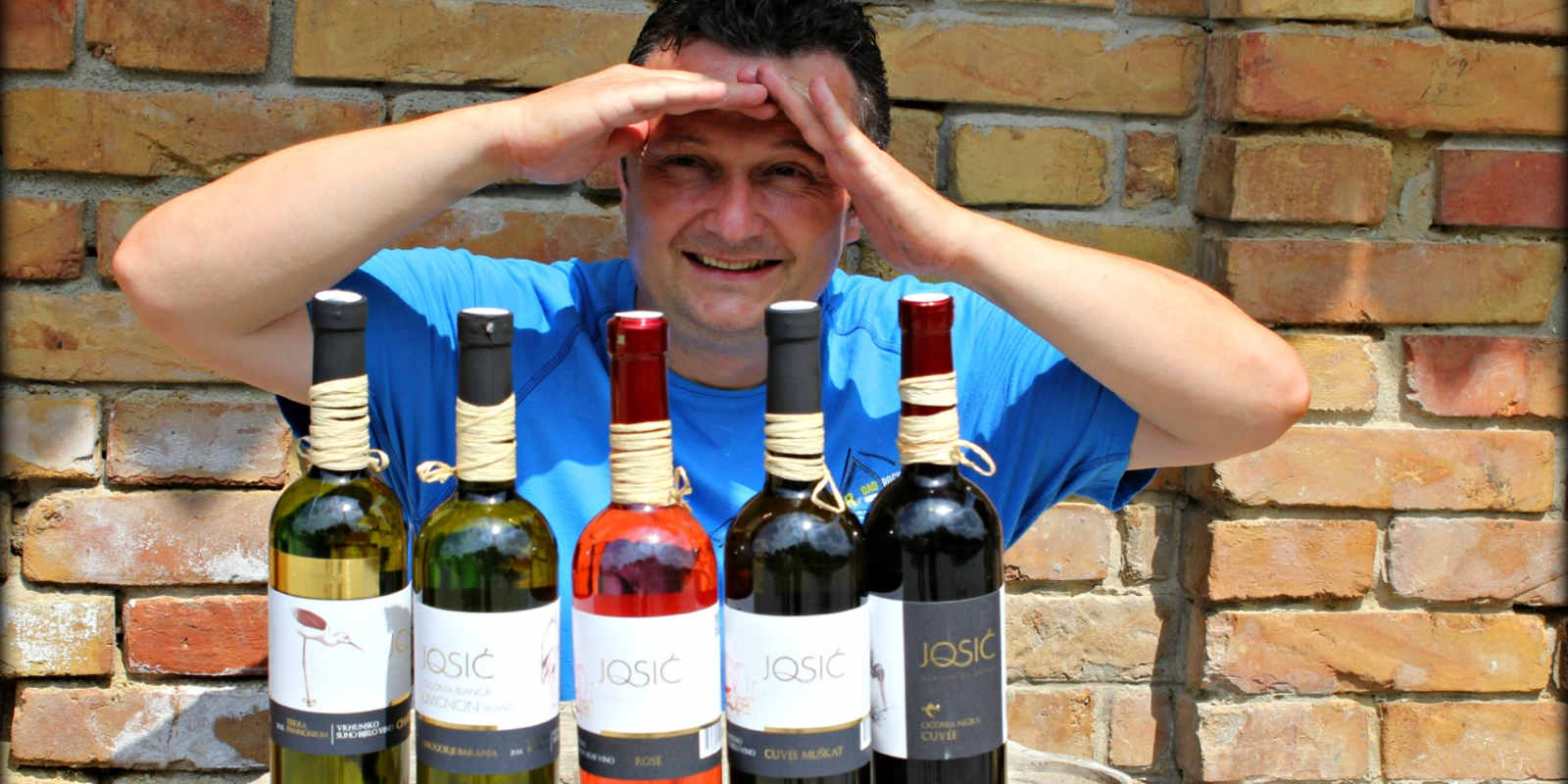
(Written for the wine magazine Pécsi Borozó)
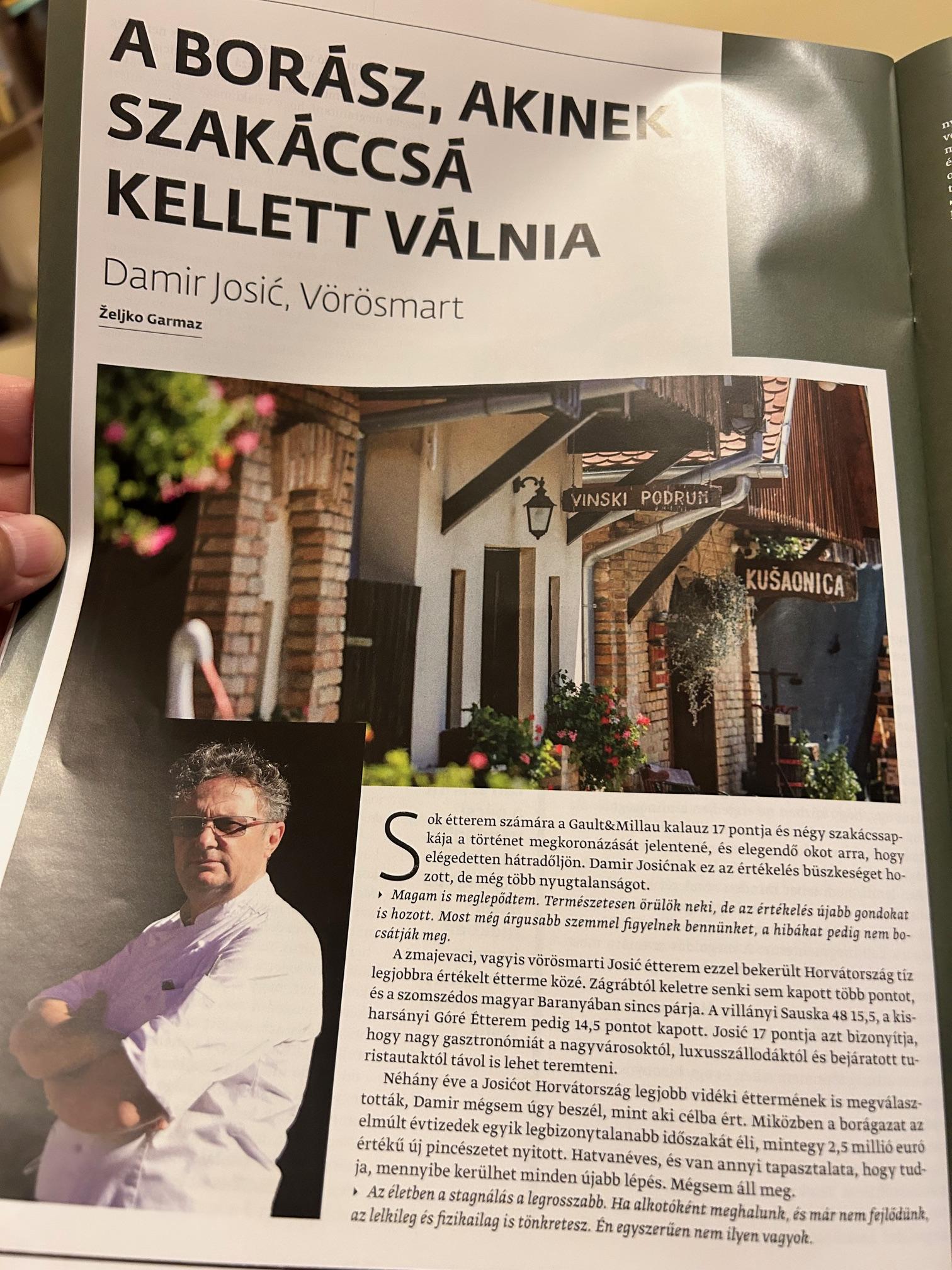
For many restaurants, 17 points and four toques in the Gault&Millau guide would be the crowning achievement of their story and reason enough to rest contentedly. For Damir Josić, the rating brought pride, but even more restlessness.
“I was surprised myself. Of course I’m pleased, but the rating has brought us new worries too. People are watching us even more closely now, and mistakes are not forgiven.”
That rating placed Restaurant Josić in Zmajevac among Croatia’s ten highest-rated restaurants. No restaurant east of Zagreb scored higher, and none in the neighbouring Hungarian part of Baranja matches it either. Sauska 48 in Villány has 15.5 points, while Góré Étterem in Kisharsány has 14.5. Josić’s 17 points confirm that great gastronomy can be built far from big cities, luxury hotels and established tourist routes.
A few years ago, Josić was also named Croatia’s best rural restaurant, but Damir does not speak like a man who has reached his destination. While the wine industry is going through one of its most uncertain periods in decades, he has opened a new winery costing approximately €2.5 million. He is 60 and experienced enough to know what every new step can cost. Still, he refuses to stand still.
“The worst thing in life is stagnation. When you die creatively and stop moving forward, it destroys you mentally and physically. I’m simply not that kind of person.”
When he bought a neglected vineyard in Zmajevac in 1999, he had no intention of creating one of the region’s best-known family wineries. He began with six hectares and an old gator, a traditional cellar dug into the hillside, in an area only just recovering from the war and peaceful reintegration.
“Back then, I could have walked naked through the entire surduk and nobody would have seen me. There was no running water, no electricity and no proper road.”
Thanks above all to Deneš Šoja, then mayor of the municipality of Kneževi Vinogradi and one of the principal champions of the wine route, infrastructure reached the surduk, the sunken lane lined with cellars, creating the conditions for winemaking and tourism to develop. Among the first guests were Hungarians, crossing the border in years when there were virtually no domestic visitors.
“I’m grateful to them for recognising our quality and our hard work. They put their trust in us at a time when we hardly had any domestic guests. They’re still very important to us, and we’re fond of them too, because they appreciate good food.”
Josić shies away from the suggestion that his winery and restaurant enjoy something approaching cult status among Hungarian wine and food lovers, but the connection goes deeper than the Hungarian number plates in the car park. In Villány, he learned what red wines could mean to a region and fell in love with Cabernet Franc. Long before that, his grandmother had cooked in the homes of wealthy families in Budapest.
Twenty-five years later, a new winery stands beside the old cellars, connected to the restaurant by an underground passage. That connection shows how Josić sees his work: wine and food are not two businesses that happen to share an owner, but a single story.
“I don’t feel that I’m just a winemaker or just a chef. I think of myself as a gastronome. I can’t imagine a serious wine lover who isn’t also a food lover. I’ve never met one. Wine and food have been inseparable for as long as they’ve existed.”
The restaurant opened in 2009 as a natural extension of the winery. Josić already had substantial hospitality experience from his pizzeria As in Osijek, but in Zmajevac the wine needed a table of its own, and Baranja needed somewhere to present its ingredients and dishes with greater ambition than before.
Experience alone, however, was not enough. The restaurant ran into difficulties, its culinary identity remained unresolved, and Damir struggled to find chefs willing to come to Zmajevac and build a serious kitchen. Rather than ask others for something he could not precisely explain himself, he decided to go back to school.
“I saw it as a kind of destiny: you have to get an education, whatever it costs you in health and money, because it’s your only way forward. If you want to know what you’re asking of your chefs, you have to understand the subject. From personal experience, I would say that every restaurant owner should have professional training in hospitality. Study and work-that’s the only way.”
He first completed the culinary programme at the Kul IN Culinary Institute in Sisak, then continued his studies at ALMA, Scuola Internazionale di Cucina Italiana, in Parma. At an age when most people of his generation rely on what they have already learned, Josić started with the fundamentals.
“Without the foundations, you can’t even begin anything serious. Once you master them and work in Italian restaurants, you begin to understand which direction you should take. But everything you learn has to connect with your own local culinary story. Only then can you find your own niche.”
He did not return from Italy to copy Italian cooking. His education helped him see more clearly what had been in front of him all along: techniques once used in Baranja but subsequently all but forgotten. They needed to be refined and brought back to the table.
His family heritage helped him do that. His grandmother had cooked in the homes of wealthy Hungarians in Budapest and passed her knowledge on to Damir’s mother. Through his studies and travels around Europe, Josić came to recognise more clearly the shared culinary heritage of the former Austro-Hungarian Empire.
“From Italy through Austria and Hungary to Baranja, you find similar ingredients and almost identical dishes, perhaps with minor variations. We share the same culinary heritage. There’s no need to reinvent the wheel when defining Baranja’s cuisine. It’s all around us: fish, game, paprika and local ingredients.”
What he learned in Parma did not change the foundations of his cooking, but his approach to them. The changes lie in the handling of ingredients, more precise techniques, sauces and textures that make a familiar dish better without making it any less rooted in Baranja.
The best example is taške, the filled potato-dough parcels that generations of people in Baranja grew up eating. Josić compares them to ravioli, although they are made with gnocchi dough, which must be light, almost airy. After returning from Italy, he gave them his own signature.
“It may sound banal and silly, but we all ate them here from childhood. I applied some of the experience I’d gained in Italy and took their flavour up a notch.”
When he realised that the restaurant lacked expertise in desserts, he returned to Sisak and completed Kul IN’s pastry programme. He added several contemporary desserts alongside the traditional sweets and is currently particularly proud of a creamy pistachio dessert inspired by the French pastry tradition.
Meanwhile, taške filled with jam, poppy-seed noodles and flambéed pancakes remain. The restaurant’s ambition is not to turn Baranja into a copy of some distant culinary capital, but to show how far its cuisine can progress. Alongside game, perkelt stews, fiš-paprikaš and Black Slavonian pork, there is therefore room for foie gras or lamb with a chocolate demi-glace without the cooking losing its sense of place.
Today, Damir no longer pursues that idea alone. The kitchen is led by Danijel Biro and Adam Rajndl, two young local chefs on whom he is building the restaurant’s future. The story has come full circle: a man who had to train because he could not find chefs willing to stay in Baranja is now passing his knowledge and responsibility on to young men from the area. His greatest achievement may therefore turn out to be neither the 17 points nor the four toques, but the moment when the restaurant no longer depends solely on his energy.
“This is the result of the efforts of all our staff, not just mine. It’s true that I trained to understand gastronomy and hospitality and raise the standard of the whole venture, but without my staff and our guests I couldn’t have achieved anything.”
Josić is not a fine dining restaurant in the conventional sense, but it draws on that world’s precision, technique and ambition. At the same time, it retains generous portions, familiar flavours and Baranja’s hospitality. At weekends, large numbers of people pass through the spacious dining room, and the kitchen must take a traditional perkelt every bit as seriously as a contemporary plated dish.
The relationship with Hungarian guests is evident on the plate too. The state border divided Baranja, but not its culinary memory. Perkelt and fish dishes are cooked on both sides, although their versions have diverged considerably over time.
“Fiš-paprikaš isn’t the same throughout Croatia, and in Serbia I’ve eaten versions that had almost nothing in common. We should also distinguish fiš-paprikaš from the fish soup so widespread in Hungary. They’re similar, but both the preparation and the ingredients differ.”
Hungarians at Josić most often order fiš-paprikaš or river-fish perkelt, while Croatians enjoy visiting the restaurants of Villány. The two sides of the border are therefore more than competitors: for decades, they have watched, compared and encouraged one another.
In Villány, Josić also found confirmation of his most important idea as a winemaker. When he arrived in Zmajevac, Baranja was almost entirely devoted to white varieties, especially Graševina, while red varieties had survived only in traces following systematic uprooting during the Yugoslav period.
“For years I went to Villány with my family. My favourite indulgence was duck with a Cabernet Franc from one of the local producers. Those wines can be spectacular. I believed Baranja could produce red wines of equal merit.”
He was among the first to replant Cabernet Sauvignon, Merlot, Shiraz and Cabernet Franc. That ambition gave rise to Cuvée Superior, one of continental Croatia’s most recognisable red wines. Josić’s Cuvée found its way onto the wine lists of many restaurants, while Cabernet Franc became the variety of which he is proudest.
“It’s very demanding, and we’re still learning how to work with it. We’re young as a winery, even though we’ve been around for 25 years. Still, I’m proud to have encouraged the return of red varieties to this area.”
His three favourite wines remain Cabernet Franc, Shiraz and Cuvée. But a serious question now hangs over the market for red wines: consumption is falling globally, and buyers are turning to fresher, lighter wines with less alcohol.
“We haven’t felt the decline yet because our production isn’t large, but the fact is that people are drinking less red wine. Lighter styles with lower alcohol will be in demand, and the range of varieties will have to change too.”
It is at precisely this moment that Josić has made the largest investment in the history of the family business. The new winery, costing approximately €2.5 million, covers around a thousand square metres and has an annual capacity of roughly 300,000 bottles. Built with support from European Union funds, it is connected underground to the restaurant. Investing in the middle of a wine-market recession seems contradictory, but Josić says he no longer had a choice.
“Our existing premises had become too small. We were working in almost impossible conditions and had to build a new facility to get production properly organised. Now we finally have conditions that meet professional standards, and we can continue developing and experiment more in our winemaking.”
The new winery was not built simply to increase capacity. More important are closer quality control and the ability to maintain a consistent standard from year to year. Modern equipment makes the work easier and leaves more scope to adapt the wines to a rapidly changing market.
“We can establish standards that we couldn’t previously maintain every year. We’re better equipped technically, we’ve installed the equipment we needed, and the whole process is simpler.”
The old cellars have not lost their purpose: wines still mature in wooden barrels there. They preserve the history and atmosphere that first drew people to Zmajevac, while the new facility allows the winery to survive in an age when romance is no longer enough.
The new winery faces a task more difficult than increasing the number of bottles: anticipating what wines people will drink in five, ten or twenty years. Falling consumption is only part of the problem. The other is already visible in the vineyards.
“Climate change is no longer something still to come. We’ll have to turn to varieties that cope with it better and are more resistant to drought. We shouldn’t shy away from it, but see it as a challenge. Even so, very difficult times lie ahead.”
After a quarter of a century spent proving that Baranja can produce great red wines, Josić must be prepared to question his own convictions too. If the climate and the market demand different varieties and lighter wines, the winery will have to adapt.
“That isn’t a possibility; it’s a certainty. Otherwise, we won’t survive.”
Josić also speaks openly about the loss of momentum in Baranja’s wine and food tourism. From the deserted cellar lane of the years following peaceful reintegration, Zmajevac has grown into an important wine destination in eastern Croatia, but the initial impetus is no longer enough.
“I’m pleased that over these 25 years I’ve helped spur the development of this small part of Baranja, in both gastronomy and winemaking. My only regret is that things have stalled. Something is still missing.”
In such surroundings, he sometimes feels like a locomotive with no right to slow down. As the owner of both a winery and a restaurant, he must think simultaneously about vineyards, the cellar, the kitchen, employees, guests and new investments.
“Someone has to be the locomotive, but it’s hard. I’m pulled in a hundred directions. I’m 60 and I’m still not giving up. You receive much more recognition from outsiders than from local people. It’s hardest to succeed at home.”
Nor does Josić have an entirely rational explanation for ending up in Zmajevac.
“As a boy, I came here with my father, who bought wine in the Catholic surduk. When I found myself here again later, something drew me in. It was as though someone had said: you have to come here; this is your path in life.”
Had he known what that path would cost him, he might never have set out. Sometimes it is better not to know everything. Even now, there is no guarantee that the market will grow, that the climate will be kind or that Baranja will emerge from its stagnation. There is only a choice between standing still and trying again.
Damir Josić has already made his choice. Can we still expect much more from him, despite his having turned 60?
“If my health holds up, yes.”