Lukša Hropić does not yet have a fumar. He has a chimney, of course, but not a proper Lastovo chimney, the kind that distinguishes old houses almost as faces distinguish people. There used to be one, but it collapsed with age, and his grandfather replaced it with an ordinary chimney.
– I will build it when the time comes. It will be a replica of an old Lastovo fumar, not to send anyone a message, but to keep that tradition alive in my family. As we Dalmatians get older – and perhaps Croatians in general – we become increasingly attached to the things our ancestors did.
It is slightly unusual that Lukša, of all people, has no fumar. He was thirty-five when we spoke, and had taken part in the Lastovo Carnival in every one of those years, the first time when he was barely over a year old. He is president of the volunteer fire brigade, fished with his grandfather using nets, traps and longlines, knows how to cook sardines on a spit, is restoring an old stone house and built much of his winery with his own hands. It would be hard to find anything more thoroughly of Lastovo than Lukša Hropić, except perhaps a Lastovo man with a fumar.
What he still intends to do with the fumar, he has already done with wine.
Mention Grk, and almost anyone who knows anything about Croatian wine will first think of Lumbarda and its sandy vineyards. Lukša would not argue with that. It was on Korčula that he learned almost everything he knows about the variety, found his two most important winemaking mentors and, along the way, his wife. Yet he did not bring Grk to Lastovo from Korčula. He simply brought it back.
– Where I now have my Grk vineyard, a man received an award for quality back in Austro-Hungarian times. I do not know whether it was for the grapes or the wine, but the state gave him financial support, and he built a stone house on the plain. So Grk was on Lastovo. Older people told me about it.
According to one version, it was specifically the Grk wine that won the award. After more than a hundred years, it is difficult to prove whether everything happened exactly that way, but the essential point is undisputed: the variety existed on Lastovo long before Lukša Hropić. It disappeared almost according to the pattern by which so many good things vanished in Dalmatia. First came phylloxera, then an era when a vineyard’s worth was measured primarily in kilograms.
– People planted varieties that produced lots of kilos. It was classic socialism: as many grapes as possible. Grk yields little, even though it has quality, so it no longer fitted into that system.

Njegova je obitelj nekoć imala između sedam i osam tisuća trsova. Grožđe se predavalo zadruzi, a u vinogradu su zajedno rasli kuč, His family once had between seven and eight thousand vines. The grapes went to the cooperative, and Kuč, Maraština, Plavac, Babić and other varieties grew together in the vineyard, expected to deliver large yields rather than an identity of their own. After the cooperative collapsed, the vineyard shrank to around three and a half thousand vines. Lukša gradually cleared most of them, kept around five hundred old Maraština vines and started again.
According to older islanders, in its best years the cooperative processed a hundred wagonloads, approximately a million litres of wine. They would fill the entire winery and, reportedly, even a cistern originally intended for water. On an island that once produced a million litres, Lukša can now boast a far smaller but perhaps more telling figure: he has never sold a single litre of wine in bulk.
– There are not many vineyards on Lastovo, and grapes are very hard to come by. Perhaps Bire influenced me too. He used to say, “No bulk wine, only bottles!” I do not think Grk deserves to be sold that way, and neither does Maraština.
After the days of wagonloads, cisterns and anonymous wine, Lukša gave Grk back its bottle, label and the place from which it had almost disappeared. He did not, however, try to turn it into a Lumbarda wine made on another island.
– My Grk is different from Lumbarda’s. The soil is sandy here too, but the vineyard has no sea view, is sheltered by high hills and is not directly exposed to sea salt. Night-time temperatures may also fall a little further here. Every terroir has its own story.
And that was precisely what he wanted: to discover how Grk speaks when it returns home after a long absence, rather than prove that Lastovo can copy Lumbarda.
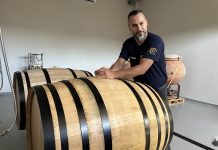
Lukša’s small, tidy, modern winery occupies the ground floor of the old family house on Pod Stražom street, almost in the centre of Lastovo village, close to the square where the Lastovo Carnival takes place. The area’s name is no coincidence. Lastovo was built inland, hidden from view at sea so that it would not attract pirates and other uninvited visitors.
– There was some kind of guardhouse up above, so the area beneath it was called Pod Stražom – beneath the guard post. Lastovo’s position overlooking the plain keeps it hidden from the sea. That is why the village is not on the coast.
His winery is therefore somewhere the sea cannot be seen, although it determines almost everything that happens there. The sea decides when equipment will arrive, how late materials will be, whether a tradesman will get there on time and how long the island will remain cut off from the mainland. Lastovo is an open-sea island in every sense, exposed to wind, sun and storms from all directions.
– Every island is distinctive, but Hvar, Brač and Korčula are still closer to the mainland and connected to one another. Lastovo is truly out in the open sea. That determines everything, including my business.
He remembers periods when nobody could leave the island for three or four days. On the mainland, if you realise halfway through a job that you are missing a part or a bag of material, you get into the car and go to a shop. On Lastovo, such an oversight costs days of waiting.
– When you order something or start a job, you have to plan much better than someone on the mainland. They go to the shop for whatever they forgot, but if I have not ordered the materials in time, the work stops. Friends on Korčula put things on the morning or afternoon ferry for me, so over time you learn to manage and build connections. But you cannot get anything the same day. Everything takes several days.
Life on Lastovo is consequently not particularly gentle on a private business owner, and still less on a winemaker. Winemaking requires substantial investment, a constant supply of equipment, bottles, corks, labels and winemaking products, and the ability to anticipate everything before it becomes urgent. Yet Lukša does not speak of island isolation as an injustice. It is a circumstance he grew up with, just like the sea, the southerly jugo wind or the distance.
– Here, you learn to find a way and plan well. It is certainly difficult, especially when you run a private business, but island life has its advantages too.
Those advantages need no grand words. There are nursery and preschool places, children who can move about freely, and a sense of safety that has almost become a luxury in cities. There is, of course, another side: several days of storms, healthcare that can never be as accessible as on the mainland, and a helicopter that, in an emergency, is part of island life rather than a dramatic scene from a film.
– Children are free here. There are many good things, but when a storm comes, when someone needs more serious medical help or a helicopter, you see all the challenges of island life. Eventually, you get used to it somehow, and it becomes normal.

In a place like this, a young person’s decision to stay cannot be taken for granted. Many find jobs in the police, the military, the Nature Park or another public service. Private businesses are few, and each requires several things to align: an idea, money, family, a market and the stubbornness to endure when none of the others seems particularly convincing.
– In Dalmatia, we are born with a kind of local pride. You are always drawn to the place where you were born. When I finished university, there was a possibility of staying on to work there, but science for its own sake did not especially interest me. I am more practical. I want to know whether something makes economic sense in production, whether it can deliver more, better and higher quality.
He completed forestry secondary school in Karlovac and considered studying at the Faculty of Forestry, then wondered what he would do with that qualification on Lastovo. He enrolled in Mediterranean Agriculture in Split and continued his graduate studies in Zagreb. Strong demand prevented him from getting onto the winemaking programme, so he ended up studying Organic Agriculture, but secured permission through formal requests to take all the winemaking courses.
He completed his thesis under Professor Đani Benčić on Piculja, an indigenous Lastovo olive that he considers an almost semi-wild variety with enormous potential. Although his thesis concerned olives, olive growing on Lastovo did not offer him enough scope for a substantial business.
– To make a living from olives, I would need a thousand or fifteen hundred trees. The plots here are small, and that is hard to achieve. In viticulture, you can obtain more substantial results on a smaller area.
Practical calculations led him towards the vineyard, but he met the person who would show him what a vineyard could become in a student room. In Zagreb, he became the roommate and close friend of Matej Jovanov, son of the renowned oenologist Janko Jovanov, and through him began joining harvests on Korčula.
– Until I entered that world with Janko and met private winemakers, I did not really see Korčula as such a wine island either. Then you see what those people do and what they have, and look at what we have here. You realise it can be done on Lastovo too. What was missing was knowledge, an idea and a different way of looking at the whole process.
On Korčula, he found two men who shaped his winemaking in different ways. He considers Janko Jovanov one of the fathers of modern Pošip and Grk, a man with an artistic feel for wine who approached every tank as a separate personality.
– From Janko, I learned that you cannot be rigid, have a single recipe and use it to make good wine every year. Each year is different, and every tank has its own story too. Later, when it is time to blend, you need a feel for what to do, how and when. Timing matters.
Janko had the standing of a father figure for Lukša, while Frano Milina Bire, although much older, became almost like a friend from secondary school. The most important things Lukša took from Bire were a systematic approach, impeccable cleanliness and perfectionism.
– Some things I saw and did at his winery, I still do exactly the same way today. Sometimes you ask yourself why you do something in that particular way, and the answer is: because that is how it should be done. Today, I require the same approach from everyone who comes to work at my winery.
From Janko, then, he gained freedom, and from Bire, order. One taught him to listen to the wine; the other showed him how clean the place where he listened had to be.
He began planting his first vineyard in 2016, and Grk a year later, on his own land that he had cleared and an adjoining church-owned plot he leased. On Lastovo, however, it is not easy for a young person to start something of their own, especially a winery.
– These are enormous investments, and you need family support. My parents helped me a great deal, Matej helped with the projects, and my sister and my wife Darija were in the vineyard too. Everyone got involved.
His parents, Margaret and Luka, provided more than support from the sidelines. His father worked in the vineyard and mowed between the rows, his mother helped wherever she was needed, and Darija accepted that family life could hardly be separated from vines, the cellar and guests arriving to taste wine. At the outset, Lukša also received a self-employment grant, and later funding through the wine sector support programme for investment in the winery and marketing. Without that assistance and a family willing to work, the business would have struggled to develop on the island.
Yet neither money nor planted vines could remove the loneliness that comes when a young person does something for which there are no immediate examples or sources of reassurance. His mentors were on Korčula, at least a sea crossing away, and every problem in the cellar ultimately remained his own.
– I would go to Korčula occasionally to recharge my batteries. There, you see that you have support. Someone tells you that you are doing things correctly, that you are on the right path and that it all makes sense. Then you return to Lastovo with pride and renewed energy.
When he decided to establish a vineyard, he first approached Janko, who simply told him, “Well done, that is a sensible idea.” Afterwards, they discussed the site, the variety and how everything should be done.
He bottled his first wines after a small initial harvest of only a few hundred litres. He took a bottle to a restaurant, explained that it was Grk from Lastovo and left it for them to taste. Instead of an order, he received a call saying the wine was not good.
– I got a little frightened and called Janko straight away. He told me, “That is how it goes, my Lukša. People will say all sorts of things about wine, but you’ll see.” He always told me that an oenologist carries no weight until he makes a wine, because the wine speaks for him. I can talk to you about this and that, but you have tasted my wine, and either you liked it or you didn’t. It is the same with a tiler: he can talk all he likes about being a great craftsman, but in the end you have to look at how he laid the tiles.
That first blow did not turn him away from wine. It simply showed him that a bottle bearing his own surname was no longer a student exercise or a project under a mentor’s guidance. From that moment, there was no Janko, Bire, university or Lastovo to hide behind. In the glass was Lukša Hropić.

Prvi je grk bio snažno vino s približno 14 posto alkohola. Mnogi ga i danas smatraju Lukšinim najboljim, premda se on s time ne slaže. S The first Grk was a powerful wine with around fourteen per cent alcohol. Many still consider it Lukša’s best, although he disagrees. Over time, he began seeking lower alcohol, greater freshness and drinkability, while retaining its southern character.
– We make our wine largely for summer, and fourteen per cent alcohol is a lot when temperatures are high. I want the wine to be serious and have the character of the south, but it must retain its freshness and be easy to drink.
For the first two years, he sold almost everything on Lastovo. Later, enquiries began arriving from elsewhere, and through distributors the wine reached Michelin-starred restaurants. Lukša had not been going from restaurant to restaurant persuading them to put it on their wine lists.
– It all happened by word of mouth. People would taste the wine, then take five or ten cases. Later, distributors began calling, but I did not have the volumes they wanted. It is still the same today: there is only as much as there is.
Alongside Grk, he now makes Maraština, rosé and a red Cuvée. He deliberately chose the name Maraština rather than Rukatac, because for a long time almost any homemade white wine on Lastovo was called Rukatac. He regards his Cuvée of Merlot, Cabernet Sauvignon and a little Plavac Mali as his most personal wine. The tasting room he is completing will allow him to experiment further with Grk and Maraština and connect them more closely to Lastovo’s food.
When I ask which dish he would single out as most recognisably Lastovo’s, Lukša makes no attempt to invent a gastronomic spectacle that could command a high price in a restaurant.
– It is Dalmatian cooking. Grilled fish, boiled fish, popara and brudet fish stews, broad beans, collard greens… People ate both the leaves and the flowering tops of the collards. They lived on what they had.
Yet there is one dish from that simple cuisine that he has seen only on Lastovo: sardines on a spit. He knows how to prepare them himself, and the whole trick is keeping the delicate fish from falling apart over the fire.
– You thread the sardines onto the spit with the backbone underneath. First, you cook them on that side, then turn them so the backbone faces upwards. That way, they stay firm and do not fall off the spit.
His favourite fish are grouper and John Dory, but these days he goes to sea less often than he once did with his grandfather. Wine, the house, his family and firefighting leave him little spare time. He became president of Lastovo’s volunteer fire brigade in 2016, when it had little equipment and a barely adequate station. Through donations and their own work, the younger team gradually built it up.
– Every fire is small until it becomes big. If you get there quickly, if a little rain falls or there is no strong wind for a while, you can contain it. If you do not arrive in time, everything changes.
The Lastovo Carnival is woven just as deeply into his life as firefighting.
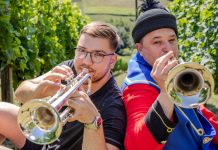
– I have never missed it. My grandmother had costumes for when we were one, three, six or eight years old, and always made sure we were dressed. It is our identity, something that simply gets under your skin.
Today, his little son Luka has his own lira, the traditional string instrument, and when carnival time comes, he picks up wooden spoons and plays on a cooking pot. His grandmother kept a costume for Lukša, and he preserves a grape variety for his son. One inheritance is passed on through music, another through a bottle, but both survive only if someone chooses to live them.
Lukša estimates that more than half the houses in the old village now have no permanent residents. Some people left the island, while others built houses by the sea from the 1970s onwards and moved to the bays. Lukša, however, never wanted to leave the village.
– Every island has bays, but not every island has architecture like this, these houses and these fumari.
That is why his story is more than an account of reviving Grk. Bringing back a variety is easier than bringing back people: you plant a vine and, if nature allows, after a few years you have grapes. To bring life back to an island, you need work that provides a living, a house where a family wants to stay, and a sense that the effort is not in vain.
Lukša does not speak as a man who believes he is saving Lastovo through his own example. He simply says he saw what others were doing, looked at what his island had and concluded that serious wine could be made there too. The difference between him and the many people who may have seen the same thing is that he decided to try.
One day, he will return the fumar to the old house. Grk has already been returned to Lastovo, to the vineyard where, more than a century ago, a story began that his generation had almost forgotten.