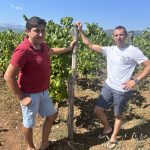
A few days before his wedding to Tena in the spring of 2025, Krunoslav Sontacchi wore the kind of smile men sometimes muster when they realise that an era of their lives is coming to an end. It was not sadness, more a mild, resigned wistfulness as Kutjevo’s last bastion of bachelorhood prepared to walk down the aisle.
When I told him, “Kruno, there goes the last one,” he simply gave that half-ironic laugh of his, the laugh of a man who is not quite sure whether to run away or order another bottle.
A year later, there is no trace of that wistful version of Krunoslav Sontacchi.
Marriage, it turns out, has not slowed him down. It has only made him move faster.

DanToday he talks faster than before, works more than before and delves ever deeper into organic production and wines that bear less and less resemblance to what Slavonia is used to drinking. Tena Sontacchi, a talented photographer who has evidently taken the lead in the new visual design of their labels and wine packaging, has not turned Kruno into a quiet family man. Judging by the past year, she has simply sharpened his focus.
– These days I no longer wander around on Saturdays looking for a wife, he says with a laugh.
– And believe me, that takes a lot more energy than looking after a vineyard.
With Krunoslav, though, even humour is never just humour.
Because behind the man who entertained Croatia for years with Kitokret, a wine whose label depicted pedigree Lipizzaners in the throes of sexual passion, now stands one of Slavonia’s most serious organic wine projects.
Nowhere is this clearer than in Sjenomir, a wine that, like its maker, refuses to fit into neatly defined categories. Made from red grape varieties and Graševina macerated for three days, it sits somewhere between rosé, blanc de noirs and something else entirely that makes no effort to define itself clearly.
Even its name sounds like something out of Slavic mythology, although the explanation is much simpler and typically Kruno.
– Sjenomir, he says, because dark varieties give rise to shadows.
And indeed, few wines so closely resemble their makers.
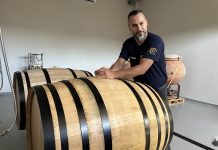
It is hard to explain Krunoslav Sontacchi to someone who has never sat with him in the cellar as he talks, all at once, about wild yeasts, Stipe Mesić, soil microbiology, Pinot Noir and the sex lives of Lipizzaners.
For years, Kruno deliberately did everything he could to keep people from taking him too seriously.
While others were developing serious wine labels, the Sontacchi family created Kitokret, a wine that for decades straddled local wine legend, Slavonian piss-taking and sheer marketing genius.
The first labels showed Lipizzaners from Đakovo having sex, accompanied by the slogan: “One glass for your health, two to get your cock going.”
While some rolled their eyes, others bought bottles precisely because of the label.
Few noticed that behind all this circus was a man who took wine frighteningly seriously. While people laughed at Kitokret, Kruno was also making one of Slavonia’s most interesting Pinot Noirs, stubbornly championing red varieties in a region almost automatically identified with Graševina.
The Sontacchi story has always hovered between very serious wine and an almost pub-like brand of self-mockery. Krunoslav and his brother Antun once decided to stage Kitokret’s first major presentation outside Kutjevo at Croatia’s erotica fair at the Zagreb Fair grounds, while Stjepan Mesić, according to family legend, launched both his presidential campaigns in the Sontacchi cellar, with regular consignments of Kitokret sent to Zagreb.
Even when he is not talking about wine, Krunoslav seems to create little local mythologies without realising it.
His dachshund Spačko, for instance, spent years sleeping in a wine barrel, and a few St Martin’s Days ago Kruno, his father Hrvoje and his brother Antun built an enormous bottle in the winery courtyard. With a capacity of ten thousand litres and clad in pebbles, it looks like some surreal Slavonian monument to wine.
The bottle, however, has nothing to do with wine.

Its interior is intended for drying kulen, Slavonia’s traditional cured sausage, while space alongside it has been set aside for a kotlovina cooking station and a barbecue.
At the Sontacchis’, even architecture ends up combining wine, food, humour and a little madness.
Yet for years this was also the problem with Krunoslav Sontacchi. Some people were so fascinated by the labels, jokes and local legends that they failed to notice the serious, obsessive winemaker slowly developing behind it all.
While the regulars in his bar asked for “a little more acidity for a spritzer” in his top-quality blends, Kruno was already experimenting with wines that were more like small oenological laboratories than conventional Slavonian bottlings.
The first serious indication that Krunoslav Sontacchi would not remain merely a local wine eccentric came with Superslav, his unusual blend of seven white grape varieties, which initially sounded to people around Kutjevo almost like another of his jokes.
That was probably how it was meant to sound.
The wine’s name suggested several entirely different associations. The football theory was dismissed immediately: Krunoslav had never seemed particularly interested in football, so it was hard to believe he had been inspired by the nickname the British media once gave Slaven Bilić.
Closest to the truth was the explanation that it reflected a kind of pan-Slavic idea of Kruno’s: a wine intended to bring together everything he loves about this part of Europe. Alongside Graševina, Traminac, Müller-Thurgau, Rhine Riesling, Sauvignon Blanc and Yellow Muscat, the blend included Morava, a Serbian hybrid of Rhine Riesling and a local genotype developed in Sremski Karlovci.
Still, knowing Krunoslav, it is hard to believe that any grand ideology lay behind it. He simply wanted to make a wine unlike anything anyone around him had made before.
Superslav, a blend of seven white varieties macerated for ninety days with minimal sulphur, marked the beginning of everything that would later draw Krunoslav completely towards natural wines.

Then came a rude awakening.
When it was first presented at a wine festival in Zagreb, almost all the bottles had oxidised.
For most winemakers, that would have been reason enough to take a few steps back, return to safer techniques and forget the entire experiment. With Krunoslav, precisely the opposite happened.
– I learnt a few things the hard way, he says today, almost gently, like a man who has since accepted that without mistakes there can be no great wines.
That failure was the moment when he finally made up his mind and decided to go even deeper into spontaneous fermentations, wild yeasts and wines that would not always be entirely predictable.
Even within the family, Superslav had prompted gentle mockery from the outset.
– If you’d asked me, the wine should have been called Picokret, his father Hrvoje used to say.
– But Krunoslav doesn’t understand that, and he’ll never make a great winemaker.
He said it with a laugh, of course.
At the Sontacchis’, it has always been difficult to separate family banter from very serious matters.
The most interesting thing about Krunoslav Sontacchi today is that his natural wine story is not new at all. Long before natural wines became a trend, an Instagram aesthetic or an obligatory pose in urban wine bars, he was already moving into organic production with little fanfare and little need to talk about it as an ideology.
– As soon as I took over the vineyard, I started adopting an organic approach. The first thing I did was stop using herbicides, he says.
In those years, the Sontacchis were still contracted growers and had no machinery of their own. Kutjevo d.d. handled crop protection in their vineyards, as it did for most smaller growers in the area. Only when that arrangement was discontinued in 2011 and they lost that support did Krunoslav start buying his own crop protection products and developing his approach to the vineyard more seriously.
That is where his serious commitment to organic winegrowing really begins.
They stopped using herbicides in 2009, moved into organic production in 2011 and applied for official certification a few years later. The first bottles bearing the organic logo left the Sontacchi cellar in 2022.
But even that was not enough for Kruno, and he soon moved towards the stricter principles of the natural wine movement.
An interesting paradox emerges here.
On the one hand, the market has gone completely mad for natural wines in recent years.
– As soon as something becomes a trend, Kruno says, suddenly everyone has “natural wines”, even people who hadn’t given them a thought until yesterday.
In such circumstances, certification does become important, because it confirms that there is real work behind the story, rather than merely a new label and a good marketing pitch.
On the other hand, the natural wine scene is often met with ridicule.
– They call us hippies and stoners, he says with a laugh.
– As though we were a bunch of weirdos making wines that are high.
This is where Krunoslav becomes most interesting. Despite all his experiments, spontaneous fermentations, minimal sulphur and wild yeasts, he never sees natural wine as a fashionable rebellion against conventional winemaking.
On the contrary, the idea that natural wine must automatically be cloudy, volatile or unclean infuriates him.
– Just because a wine is natural doesn’t mean it’s allowed to stink, he says bluntly.

That sentence reveals the greatest difference between Krunoslav Sontacchi and some producers who have found a new market identity in natural wines. He is not interested in posing, belonging to a movement or the aesthetics of alternative wine culture. What interests him is whether a wine, without industrial aids or technological crutches, can still be a great wine: alive, full of character, precise and stable.
And that is a much harder task than it might first appear.
When Krunoslav Sontacchi talks about wine, it soon becomes clear that he is no longer interested solely in making it, but also in how far a person can go in trying to remove from the bottle everything he considers unnecessary.
That is why he now talks almost obsessively about soil microbiology, bacteria, spontaneous fermentation and minimal intervention. In his account, wine is no longer separate from the vineyard, and the vineyard is inseparable from the soil in which it grows.
– We no longer talk about protecting the vineyard, but about activating the soil, he explains, describing the microorganism-based preparations he has been using in recent years to restore and stimulate microbial life in his vineyard soils.
For most organic producers, crop protection still largely comes down to copper and sulphur, but Kruno is trying to go a step further here too. He has reduced the amount of copper used in his vineyards to almost the bare minimum. Copper is precisely what conventional producers often cite as their main argument against organic farming, pointing out that, as a heavy metal, it accumulates in the soil over time and destroys the microbiome organic winemakers are trying to preserve.
That is why he now puts much more faith in microorganisms than in conventional crop protection.
The idea, he says, is to “unlock” everything naturally present in Slavonian soil, reduce fertilisation and allow the vineyard to regain its own balance. The same logic continues in the cellar, where spontaneous fermentation, wild yeasts, minimal intervention and long ageing become parts of the same philosophy.
This approach requires far more manual work, precision and patience than conventional production. Harvesting must be done by hand, the grapes must reach the cellar undamaged, and spontaneous fermentation must begin under strictly controlled conditions as soon as the grapes arrive from the vineyard.
– You simply can’t do things like that on an industrial scale, he says.
The wine that best describes Krunoslav Sontacchi today is Sjenomir.

Već na prvu djeluje kao da odbija pripadati jasno određenoj kategoriji. Nastao je kao kofermentacija crnog pinota, cabernet sauvignona i From the outset, it seems to refuse to belong to any clearly defined category. Made by co-fermenting Pinot Noir, Cabernet Sauvignon and Graševina macerated for three days, it simultaneously recalls a more serious rosé, a blanc de noirs and something else entirely that makes no effort to fit a neat definition.
That is precisely what interests Kruno.
– We’re not strictly bound by colour here, he explains, describing a wine that grew largely out of his “zero waste” philosophy.
Free-run juice that most winemakers would keep separate becomes part of a new whole, while the macerated Graševina adds structure and takes the entire wine in a completely new direction.
– Once you figure out how it works, you use everything, he says.
With him, lees, additional maceration or some seemingly incidental part of the process can easily become the starting point for a new idea, a new wine or a new experiment.
Even the wine’s name came about in typically Kruno fashion, somewhere between improvisation, symbolism and local wit.
– Sjenomir, because dark varieties give rise to shadows.
And indeed, few wines so closely resemble their makers.
Like Kruno himself, Sjenomir seems to refuse to belong to just one world. Today, that willingness to take risks is what most distinguishes Krunoslav Sontacchi from the majority of Croatian winemakers.
While much of the wine scene tries to produce wines that are as safe, easy for the market to understand and technologically controlled as possible, what still excites him most is evidently the possibility that a wine might surprise him.
Without that risk, wine apparently no longer interests him at all.
And yet, despite all this new seriousness, Kruno has lost none of the old Kutjevo self-mockery that for years made it impossible to tell quite where the piss-taking ended and the serious wine story began. He will still interrupt a serious conversation about wine with a joke at his own expense or some almost pub-like quip, as though he feels a little awkward about allowing anyone to take him entirely seriously.

It is interesting how naturally this latest phase of his life, including his marriage to Tena, has become part of the whole story. Tena has evidently brought a certain visual discipline and calm to the winery’s identity, without trying to turn Krunoslav into something he never was. On the contrary, she seems to have sharpened his focus and freed him to go even deeper into what truly interests him.
That is why he no longer seems like a local wine eccentric playing around with natural wines, but a winemaker who, after years of wandering, mistakes and experiments, has finally found his own voice and is now trying to take it to the very limits of what he can achieve.