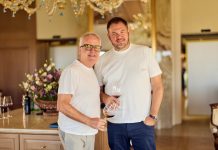
The only restaurant in Hrvatsko Zagorje where you can order and drink wine from Donja Pačetina, made by father and son Josip and Nikola Grozaj, is Kramberger in Krapina, on Ljudevit Gaj Square. There, ancient Belina – better known in the world of ampelography as ‘the father of Chardonnay’ – can be enjoyed with wild boar on pumpkin-seed oil foam and buckwheat porridge.
Whether the appearance of Grozaj’s Belina at Kramberger restaurant was coincidental or not, future textbooks will say that what Dragutin Gorjanović-Kramberger achieved in archaeology, through his research and study of the ‘diluvial man of Krapina’ – about whom he wrote and published no fewer than fifty-three scientific papers during his lifetime – Josip Grozaj achieved in ‘wine archaeology’, demonstrating that Belina is a parent of Chardonnay.
Belina Starohrvatska, or, as listed in the book Grape Varieties of Hrvatsko Zagorje, Belina Velika Bijela, Heunisch Weiss, Weisser Heunisch, Gouais Blanc, is considered the variety that ‘most influenced the development of the range of grape varieties in Central and Western Europe’. The monograph’s authors note that great interest in its origins emerged after the discovery in 1999, subsequently published in Science, that Belina, together with Pinot, was a parent of no fewer than sixteen French varieties, the best known of them Chardonnay.
That discovery prompted a search for Belina in Croatia. Yet the national scientific project Ampelographic and Genetic Evaluation of Indigenous Grape Varieties, carried out from 2002 to 2006, failed to find it, and the variety was thought to have disappeared from commercial vineyards. Only in 2006, with the launch of the project Protection and Revitalisation of Indigenous Grape Varieties of Hrvatsko Zagorje, was Belina Starohrvatska identified in several vineyards. This discovery confirms that, unlike in most other European winegrowing areas, the variety survived in Zagorje right up to the present day.
Josip Grozaj remembers that search well.

– In our Sveti Križ winemakers’ association, we came up with the idea that we, as a region, should put something of our own in the spotlight, like so many places we’d visited around the world. At the same time, people from France contacted the Faculty of Agriculture and the Ministry of Agriculture, saying they had evidence about Belina’s origins. They had established that Belina was a parent of certain French varieties. Then the faculty and ministry contacted us, and we began searching neglected and old vineyards to find a Belina vine still surviving in Zagorje.
– In the end, they found one vine in Krapina, at Ljudevit Gaj’s old house, and established that it was around 150 years old.
The vine Grozaj mentions had long been under the special care of agronomist Ivan Hršak, who submitted a request to the Public Institution for the Management of Protected Natural Assets of Krapina-Zagorje County to initiate its protection. The institution forwarded the documented request to the State Institute, and the study of the vine established that it did not match any standard variety. Ivan Hršak propagated it by grafting and planted two hundred vines of that variety in his own vineyard, intending to tell the story of Gaj’s wine: a variety that had survived phylloxera, whose grapes Ljudevit Gaj himself had nibbled.
Josip also recalls an unusual anecdote with a smile:
– In 2021, a man from Belgrade called me and introduced himself as Mr Gaj’s lawyer. He said he represented the fourth generation of Gaj’s descendants, who had heard about the vine at their house. I received power of attorney to try, on their behalf, to find out everything about the connection between Belina and Chardonnay.
After years of wandering through Zagorje’s vineyards, which ultimately revealed a whole range of forgotten, authentic varieties, some literally on the verge of disappearing, Josip decided to establish his own mother block containing no fewer than eight different types of old Zagorje Belina.
– They differ only in details, but they are different nonetheless, he says. The Trgocentar project grew out of that mother block, as the second stage in restoring our heritage. We couldn’t afford that second step, but we did what we could – find the old varieties and preserve them. Trgocentar continued producing grafted vines.
In his mother block in Donja Pačetina, Josip Grozaj planted thirty varieties and financed the production of grafted plants for another thousand vines, which he planted in his vineyard. The history of Zagorje winemaking can no longer be written without mentioning the Grozaj family, the first to have a commercial Belina harvest, producing around five hundred litres. Today, they bottle at least two thousand litres of Belina every year.

– Belina takes us back fifty years or so, to the time before it was widely grubbed up and replaced by higher-yielding varieties. Its return to Zagorje also reminded us of the old saying that Zagorje folk like to drink a bucketful of wine. It’s light, easy to drink, with unobtrusive aromas, and precisely that kind of wine is coming into fashion. With Belina, you don’t need gemišt! You can drink it all night. Our first Belina, released in 2010, had just 10.5 per cent alcohol.
Josip’s main job at the time was representing the Slovenian company L-Inox from Ajdovščina, a manufacturer of stainless-steel tanks and presses. That work took him to many Croatian wineries, helping equip their cellars – from Pelješac to Ilok.
– The Belina story also determined my son’s path. Nikola was in secondary school in Bedekovčina at the time, and when he saw what was happening around him, continuing his education in Poreč was the logical choice. Now he runs everything – I’m with the grapes up to the press, and from there on it’s all his!
Our conversation with Josip took place in the family café, Gigi – a nickname borne by every male member of the Grozaj family.
– In our café, only wine sells! We have beer and coffee too, but everyone orders wine. Zagorje folk are loyal to wine.
The walls of Gigi Bar are hung with photographs of Josip’s other passions – hiking and playing in a wind band. For almost forty years, he played saxophone in the Sveti Križ Začretje Wind Orchestra, and one of his favourite appearances was in 1998 in Vittel, France, at the Croatian national football team’s camp.
– What do the Pačetanci play?
– Mainly marches and Croatian songs.
Josip stresses that, after agreeing to collaborate with the Zagreb Majorettes in 1995, the Pačetanci Wind Orchestra became the City of Zagreb’s ceremonial orchestra! They even changed their name to the Zagreb-Zagorje Ceremonial Orchestra Pačetanci. Just a year later, they recorded no fewer than eighty-five appearances on various occasions: officially representing Croatia at the Venice Carnival, performing with the Zagreb Majorettes at the Vatroslav Lisinski Concert Hall and recording a live audio-video cassette, accompanying all the Croatian national football team’s matches, and welcoming Croatia’s handball team at Pleso Airport after it won Olympic gold in Atlanta.
When he is neither in the vineyard nor playing the saxophone, Josip satisfies his need to ‘let his mind roam free’ by hiking, usually alone, without company.
– I’ve climbed Triglav six times, and once I climbed it at –22°C, on 6 January 2018. Alone, with nobody else. When something calls you, you go.
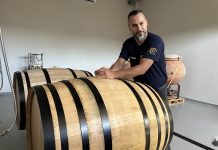
When talking about the winery, so full of tanks that not even a needle could fit inside, Josip knows that demand for their wines currently far exceeds the thirty thousand litres they produce each year. They sell almost all of it through Gigi café, the Kapljica wine shop in Sveti Križ Začretje and Kramberger restaurant in Krapina.

– You could say that our limited production is precisely why you don’t see our winery anywhere. We sell almost everything at our own doorstep. And we aren’t trying to spread the word about the winery, at least until we decide to expand production.
– You know, what’s distinctive about our winery is that family always comes first. Perhaps we might have done some things sooner, but… When Nikola had three children, we said: Build your family, the winery can wait! So we turned things around and put work in second place. First a house for one son, then for the other – the cellar will get its turn!
Nikola confirms his father’s words:
– I didn’t have three children for my wife to raise them, for me to see them only at dinner, for them to be in bed at ten… I want to live with them, because children really are our greatest wealth. Family comes first, and I have no intention of putting the ease and comfort of family life in second place for anything else, including wine.
That is why the Grozajs present themselves to the public at just five events a year – in Bedekovčina, Krapinske Toplice, Krapina and Pregrada.
– We make what people want – fresh, young wines. We’re about gemišt and companionship rather than ageing.
Their varieties include Silvaner, Yellow Muscat, Zweigelt, Belina, Graševina and Riesling, along with 950 Traminer vines.
– From those, we get around five hundred litres of wine. If they were Graševina vines, we’d have four times as much. That’s why Traminer is disappearing from Zagorje.
Even that did not stop Nikola from making Traminer the subject of his final thesis in winemaking studies in Poreč. For his thesis, he produced a regular-harvest, a late-harvest and an ice wine – the first of its kind in Zagorje.
– For my thesis, I had to make regular-harvest, late-harvest and ice wines from Traminer. The only difference was how dried the berries were and how much sugar had accumulated. The required parameters included alcohol of around fourteen per cent, which is very difficult for ice wine, but I managed it – the difference between the ice wine and regular harvest was just 0.7 percentage points. It was the 2011 vintage, while I waited for ice-harvest conditions until 28 January 2012.
Nikola remembers his first ice-wine harvest well, carried out with his father at Bodren’s. He was in his first year of secondary school, and it was Zagorje’s very first ice-wine harvest.
– Bodren decided to take a risk and produce that kind of predicate wine, but he didn’t have suitable equipment for pressing frozen berries. We, on the other hand, were among the first in Zagorje to import a pneumatic press. One day, he simply called us:
– Gigi, please help. How much do I need to pay, just so we can do this ice-wine harvest?
– No way are you paying for it. It’s a challenge for us too, Dad replied.
– We started harvesting at midnight. Up in Hum, the snow was knee-deep and the temperature was –21°C. We had a truck, and the press was on the truck.
– The first drop came out after almost three hours. Pure honey! The conditions were extraordinary; even the press was freezing. But we did it, and finished everything at seven in the morning.
Studying in Poreč left a lasting mark on Nikola, who still works in Zagorje as a travelling sales representative for an Istrian company.
– Studying in Istria gave me enormous experience, from the mentality to the approach to winemaking and production technology. In Poreč, the emphasis is very much on practical work; we spent more time in the vineyard and cellar than in classrooms. In the second semester, we were already given our own vineyard to maintain, from pruning to ripe grapes. We harvested, vinified, bottled the wine, submitted it for judging and appeared at Vinistra as Student Wine. I was among those who won a gold medal for their Malvazija Istarska. That group included Ana Ritoša, Marko Fakin… people who grew up among Malvazija vines and have spent their whole lives with them.

Even the latest addition to the Grozaj family winery’s range, the Zweigeltino liqueur, was made under the influence of Istrian Teranino, a hybrid created by combining Teran, fruit brandy and around ten kinds of spices.
– Yes, Zweigeltino is my Zagorje answer to Teranino. We made plenty of gift packs for companies that like to give their business partners something towards the end of the year. And the question always came: did we have a little brandy too? Since we hadn’t registered a distillery, I decided to make an alternative to spirits, and that was Zweigeltino, an aromatised red wine. Zweigelt is an excellent variety as a base for a liqueur. I know most producers in Istria sweeten the wine in their Teranino with sugar, while I decided to use blossom honey as the sweetener. It complements it beautifully, giving it body and richness. We started with a hundred litres, and now make around four hundred litres of Zweigeltino a year.
The story of Josip and Nikola Grozaj is more than a wine story. It is a story of a legacy written in wine rather than ink, of a vine that survived centuries and of the people who brought it home. Their Belina is more than proof that world-renowned varieties can originate in Zagorje too – it is a reminder that perseverance and love can revive even what seemed lost forever.
With his own hands, Josip preserved the past; Nikola breathed a future into it. And between them, in the family café Gigi, the present flows every day – cheerful, warm and full of life. In a world forever searching for something new, the Grozajs show that the greatest values lie in the old: in the land, in family and in simplicity. Because, as Josip likes to say, ‘With Belina, you don’t need gemišt. And Zagorje folk, you know, like to drink a bucketful of wine.’