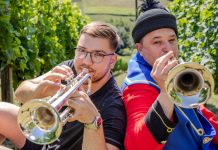
Ako akronim TOMOS sugerira da je ta nekad popularna „tovarna motornih koles“ iz Sežane, a nije, sjedište tvornice motorkotača bilo je u Kopru, zašto onda ne bi bilo moguće da Igor Jambrešić, deklarirani hadezeovac, dva puta kandidat za gradonačelnika Klanjca, uskoči u poIf the acronym TOMOS suggests that the once-popular tovarna motornih koles-motorcycle factory-was based in Sežana, when it actually stood in Koper, why should it be impossible for Igor Jambrešić, an avowed member of the Croatian Democratic Union and twice a candidate for mayor of Klanjec, to help his political opponents in the Social Democratic Party by lending them his drums for a Plavi Orkestar concert at Zahvale jeseni, the town’s main autumn event, filled with fun, merriment, excellent music and other attractions on the main square? And these were the very drums that, after his exuberant musical youth, had spent years stored in the basement of his family home, set up and ready for another performance.
– I must admit I was surprised when I heard rumours that the Plavi Orkestar concert would be cancelled because I supposedly wouldn’t lend my drums to put someone else’s mistakes right. That’s ridiculous. Klanjec is a small town; we all know one another. The least I can do, if it’s within my power, is help make sure something that benefits the whole town goes ahead and everyone can enjoy it.
– What happened?
– A mishap, I’d say-a careless oversight by the organisers. They failed to notice in the contract they’d signed with the performers that Plavi Orkestar bring only drumsticks and cymbals to their concerts. Everything else their drummer, Admir Ćeremida, better known as Ćera 2, needs is the organisers’ responsibility. So in the end, it turned out I’d saved the concert, ha, ha, ha! – says Igor Jambrešić, the current head of the Klanjec winemakers’ association.
Igor and I spent a long time sitting in a local Klanjec bar called Bull, which brings back many memories of the days when, as a youngster, he played there at least a hundred times, with different bands under different names. One of those combinations was even called Igor&Igor.
– We’d play until four in the morning, then head off to Trešnjevka market!
Igor recalls how Loša from Plavi Orkestar asked him, with some surprise, why people in Klanjec were interested in the band and whether he was sure anyone would come to their concert.
– I told him everyone ends up surprised. After all, I started out as a drummer when the tamburica players in Čizmeki ruled Klanjec.
– My father used to play the accordion, and I remember them rehearsing in our garage. Even as a little boy, I’d sit behind their drums, which were kept there, and start banging away.

Igor will never forget having his own drum part at a festival on Lake Bedekovčina as a boy, or having his own band, Peharčeki, while attending secondary school in Zagreb.
– I played with older lads, and the pocket money I earned playing at a wedding was fantastic as far as I was concerned.
– Music is in all our genes here. After all, didn’t Antun Mihanović write Lijepa naša domovino, Our Beautiful Homeland, in nearby Zelenjak? Still, knowing where the monument to the Croatian anthem stands today-in wooded countryside surrounded by hills on every side-we’ve always joked about which way Mihanović was looking when he found inspiration for those lyrics – says Igor Jambrešić.
Klanjec’s winemakers like to say that their steep vineyard sites are the only true grand crus of Zagorje. Their rivals elsewhere in Hrvatsko Zagorje respond with a countercharge:
– How can Klanjec’s winemakers talk about wine quality when the man heading their local wine association makes blackberry wine?
And that blackberry wine producer is, you guessed it, Igor Jambrešić.
Naturally, he takes these remarks from colleagues outside Klanjec as a joke. In his view, placing a blackberry wine producer at the head of the association proves that Klanjec’s winemakers and wines stand so far above everything else that they can afford to have someone who works with blackberries as their president.
– We’re joking, of course, but the truth is quite different. There are six or seven winemakers in the Klanjec area who sell their wines, and we’re all mates and friends. We’ve agreed that every two years one of us will take over the leadership, keeping the association and the tradition alive. Under that rotation system, it simply happened to be my turn…
– Fair enough, but how does it feel, as a fruit wine producer, to chair an association of conventional winemakers?
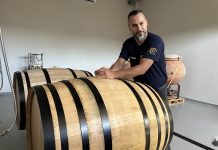
– The other winemakers don’t look at me askance. After all, the legislation puts us all in the same category, and my Kupilek is made in the same way as grape wine: we use the same equipment and technology. Two of my barrels are at Petrušić’s right now, and in the spring his barrels will end up in my cellar.
As a blackberry wine producer, Igor knows that his wines can never enter churches as altar wine for Mass, because they are not made from grapes.
– Do you feel bad that Kupilek will never be a wine for spiritual refreshment?
– It doesn’t bother me. I enter Kupilek in competitions where grape wines compete. In Zelina, where an enormous number of samples arrive, they’ve created a separate fruit wine category. They would do the same at smaller competitions, but there aren’t enough fruit wine producers there.
– And the scores my Kupilek earns at those respected wine competitions are simply a sign that I’m on the right track…
If we consider Zagorje in the light of the familiar joke that wine fumes keep its air permanently at an alcohol level of at least one part per thousand, Igor’s Kupilek can only be seen as a classic Zagorje sociological oxymoron. Igor knows this too, and makes a point of saying early in our conversation that he also produces a small amount of conventional wine in his cellar for family use. But…
– I know everyone wants to know why we make blackberry wine. So how did it happen? As a family, we had a small blackberry trellis. In the late 1980s, agronomists from Dona, then a giant in fruit juice production, visited us, analysed our soil and found it ideal for growing berries. My father Ivan and mother Dragica signed a contract to supply them and planted the first thousand blackberry bushes in our garden, on 0.37 hectares. The yields were very good, and on paper the whole venture looked promising. The contract meant we would grow, pick and deliver fresh blackberries, and the buyer would take them and pay us. But that successful partnership was short-lived. It lasted until the early 1990s, when Dona collapsed. We were left with a plantation full of blackberries, no alternative plans, and a need to find a way through.

Sa svojih 17 godina ja sam prodavao kupine na Trešnjevačkoj tržnici. Nije tada bilo puno proizvođača i prodavača kupina, osim nas na – At seventeen, I was selling blackberries at Trešnjevka market. There weren’t many blackberry growers and sellers then. Apart from us, the only others at the market were Eko kupine Viduka.
Remembering those teenage days-nights behind the drums and mornings at the market-Igor says people constantly told him about the healing properties of blackberries, which were good for iron levels in the blood.
– When the problems with the buyer began, the value they placed on our blackberries was insulting. Dad went to see Gerhard Schubert at the Faculty of Agriculture in Zagreb. He advised us to start making fruit wine and even gave us a recipe.
Igor says they spent several years fine-tuning the product. They had to get it right and spend time repeatedly putting their new knowledge into practice.
– What mattered was maintaining the level of quality that more and more people were starting to recognise. If you buy Kupilek, you have to know what you’re buying!
The Jambrešić family made their first experimental barrel of blackberry wine in 1993.
– Those first blackberry wines were high in alcohol, around sixteen per cent. Compared with today’s eleven per cent, that’s a world of difference! Schubert was against sulphur and saw alcohol as the main preservative.
– I remember the stereotypes we had to deal with at our first public events, such as wine festivals in Zagreb. People would come to our stand, we’d offer them a taste, and they’d refuse, saying it was for women and sick people, not for men.
– I asked the Institute of Viticulture and Oenology how much blackberry wine was being put on the market in Croatia overall. Their answer was that we were the largest producers not only in Croatia but in the entire region.
Before long, blackberry wine production had become a serious business for Igor Jambrešić. Ten years after that first experimental barrel, he defended his graduation thesis on a professional economics degree course. Its subject was A Business Plan for the Production of Medicinal Blackberry Wine.

– I can say I’m one of the lucky people who now works in a business I fell in love with as a child and later developed through my education.
More than that, Igor became a model of success: his successful blackberry wine venture is featured as a case study in an agricultural secondary school textbook.
– A wonderful, major reward for me and my family!
Unlike his parents, who embarked on their blackberry venture without much planning-they planted the bushes without knowing what they would do with the fruit-Igor leaves nothing to chance. He often remembers the words of his grandfather Mirko, who, when they first planted blackberries in the field, said to Igor’s father Ivan:
– Are you out of your mind? We throw those things away, and you’re planting them! Are you mad?
– At college, I learned where the best business ideas come from. There are two sources. The first is market research. The second is what happened in my case: turning an everyday problem into an advantage.
– Since we started doing everything ourselves with the blackberries, like all-purpose machines-from growing the raw material to processing and selling it-we soon realised we needed to ease the workload, at least on the fruit-growing side. So we decided to work with contract growers. We also found agents to handle sales to wholesale drugstore distributors in Germany, Austria, Italy…
The brand, Kupilek, is a story in itself. It has become synonymous with the Jambrešić family, Klanjec and Hrvatsko Zagorje.
– People think the name Kupilek was created by joining kupi and lek, which would presumably mean Buy a remedy! No. The story is different: kupi is our word for blackberries, while lek is the Zagorje word for medicine. So Kupilek means a blackberry remedy! We didn’t intend it to suggest buying medicine, but I’m glad it prompts that reaction.
The entire visual identity for Igor’s blackberry products-which also include jam, fruit syrup and pressed juice-as well as his raspberry wine, was created by Izvorka Jurić of Design Bureau, now called Dig Studio. She also devised the new brand slogan, Zdravica od bobica: A Toast from Berries, with an echo of health in the Croatian word for toast.
– When I was a boy selling blackberries and blackberry wine at the market, people bought the product saying it improved their iron levels. I can’t confirm those claims, but people kept coming back and buying more. That’s why I can’t believe they were buying it just because it looked nice, tasted nice and sounded nice.
– We also make raspberry wine. It smells lovely, and with that wine we’ve been fruit wine champions of continental Croatia two years running. People buy the raspberry wine too; they think it’s fun. But they still keep buying Kupilek.
– Have you ever got drunk on blackberry wine?
– Once we were in a vineyard cottage and ran out of wine, so we carried on with Kupilek. When you get drunk on Kupilek, it’s healthy alcohol, ha, ha, ha!
Today Igor processes around thirty tonnes of blackberries a year and produces about 25,000 litres of blackberry wine alone. His own blackberry plantations cover almost two hectares, while his contract growers are based in Varaždin, Ludbreg, Koprivnica and Slavonia. Having plantations in different parts of Croatia, he says, reduces the impact of adverse weather that might strike one part of the country but is unlikely to affect every grower.

With everything running smoothly, Igor is finding more and more time for hobbies. No, the drums are definitely a thing of the past-except when he needs to fetch them from the basement and rescue friends from problems of their own making.
In recent years, his way of letting off steam has been restoring Tomos motorcycles.
– A friend of mine in Zagreb takes care of the mechanics and the engine. Everything else is my job, from sourcing and organising to assembly.
– How many bikes have you put together that way?
– I have six finished, and orders for two more: one for my uncle, the other for a friend.
– Why Tomos?
– There’s always been a Tomos in the family. When I was in the fourth year of primary school, I had a serious traffic accident on a Tomos with my cousin.
Igor says he even met his wife Branka on a Tomos. She is from Klanjec, he says. They have a flat in Zagreb, but in summer they would come to swim in the Sutla River.
– I used to come on my Tomos. That’s how it all started.
– The idea of putting Tomos bikes together had always been there somewhere. What triggered it was my son asking me to buy him a scooter. I was so terrified of scooters and their little wheels that, wanting to steer him away from one, I offered him a ride on an Automatic my brother had left with me for three days. I put a helmet on him, he rode a few laps and fell in love with Tomos! That gave me the urge to start restoring them… My daughter Eva got a little Tori Cross, my wife Branka has her own bike, and I ride an APN. Everyone in the family has their own Tomos. I’ve matched them to each person by power and size. If the Tomos bikes of Igor’s childhood were made in Koper, Igor has done everything he can to put Klanjec on the world map for anyone interested in restoring those motornih koles.