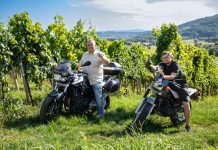
After his second harvest with Aleks Klinec in Goriška Brda, Bojan Baša had a fairly good idea of what the romance of winemaking looked like.
They were up before six, picking from early morning and processing grapes late into the evening. Conversations about wine took place along the way, while their hands had more pressing work to do. He saw that behind the beautiful bottles, long dinners and conversations about nature were aching backs, blisters and days when nobody asked whether you felt like working.
At the end, Klinec asked him:
“Do you still want to plant a vineyard?”
Bojan did not hesitate.
“I do.”
Aleks looked at him and delivered his verdict:
“If you’re that much of a fool, go ahead and plant it.”
The road to that vineyard, however, had been anything but straight. Long before he ever thought about vines, his life revolved around a basketball court. In the late 1980s, Vojvodina Basketball Club had one of the most talented youth teams in its history, and Bojan Baša was its captain. In 1989 and 1990, he led the team to two Yugoslav cadet championships, in a country where competition among young basketball players was almost as fierce as it was among the seniors.
Basketball was not his hobby. It was his identity.
At the same time, Dragan Tarlać, Dejan Bodiroga and Željko Rebrača were growing up in Vojvodina. Dušan “Duda” Ivković saw an opportunity to bring the province’s best young players together, let them develop as a team and, within a few years, turn Vojvodina into a club capable of challenging Europe’s finest.
The club’s management chose a different path. Instead of backing young players, it recruited established names, and the generation scattered before it had a chance to show what it could do.
“Our youth teams were incredible, but unfortunately the first team never reflected that. The club’s policy was to bring in proven players and keep us youngsters on the sidelines. It was as though they didn’t have the courage to take a risk.”
After secondary school, an opportunity finally seemed to emerge. He was due to move to Dubrovnik, joining a young team that planned to win promotion from the First B League to the top tier of Yugoslav basketball. His plane ticket was bought, arrangements had been made for him to continue his education, and his first serious opportunity in senior basketball lay ahead.
He never reached Dubrovnik.

War broke out, the country fell apart, and so did the sporting system in which he had grown up. He played a few more seasons in Serbia, but the circumstances were no longer the same.
“Then I started working. And that was the end of it.”
The court on which he had imagined his future was behind him. Basketball remained a love, but it was no longer a plan for his life.
Nor did he inherit a winemaking business. His father was an agronomist, but died in 1998, long before Bojan planted his first vine. He never saw his son’s vineyard.
Bojan graduated in economics and entered the world of finance. For the next quarter of a century, he dealt, as he puts it, with other people’s money. He worked in banks and major corporations, became chairman of an executive board and reached the highest levels of banking management at a very young age.
Unlike in basketball, risks there could be expressed as percentages, plans entered into spreadsheets and the consequences of decisions predicted, at least to some extent.
Wine also entered his life through the bank.
Working for Société Générale, he travelled frequently to Paris, while his French colleagues never arrived in Belgrade empty-handed. His director, who was also something of a professional mentor, would return from his travels with cases of carefully chosen wines. The bank’s management would then gather: seven locals and six French colleagues, a group jokingly nicknamed “the Magnificent Thirteen”.
Bottles were opened, wines tasted at leisure, and conversations ranged over grape varieties, regions and vintages. These were Bojan’s first serious encounters with wine.
“The French being the French, they like to show off their wines. Those gatherings opened up an entirely new world for me.”
That was around 2006. Soon afterwards, he met winemakers from the wider Brda area, among them Aleks Klinec, Vasja Čotar, Stanko Radikon, Franco Terpin, Dario Prinčič and Paolo Vodopivec. They were some of the leading names in natural wine and long skin-macerated whites on both sides of the Slovenian–Italian border.
He was particularly drawn to Klinec’s Gardelin, a skin-macerated Pinot Grigio. A variety he had previously associated with light, fresh white wines acquired colour, texture and an entirely different character in Brda.
One evening in Medana set everything on a new course. There was local dry-cured ham on the table, food prepared by the hosts in front of their guests, wine, and people who spoke of it as part of life rather than a product. They ate, drank, cooked and talked deep into the night.
Bojan realised that he was drawn to more than what was in the glass. He was drawn to the way these people lived with wine.
Dinner provided the spark, but Klinec would not let him make his decision at the table alone. He invited him to work two harvests alongside him and discover winemaking stripped of its romance.
Around the same time, in 2008, Bojan bought 5,700 square metres of land on Fruška Gora, at a site called Matej near Sremski Karlovci. His plans had little to do with wine. He wanted an escape from the city, somewhere to barbecue when friends came over, a little land and a view towards the Danube.
There was a neglected orchard on the property.
After spending time with Klinec and the Brda winemakers, Bojan began looking at it differently. The site faced south and southeast, with plenty of sunshine and a view of the water. Later analyses revealed just how varied the soil was. On one plot of only about 3,000 square metres, he found no fewer than three soil types.
He decided to plant roughly 3,000 square metres with the variety that had completely captivated him: Pinot Grigio.
He spent two years preparing the ground. He sowed barley, wheat and oats to suppress weeds, and clover to increase nitrogen in the soil. He cleared the abandoned orchard and scrub by hand, unwilling to let an excavator strip away the thin layer of humus above the clay.
In 2010, he planted his first 1,300 vines.

His neighbours did not predict much success. His approach to protecting the vineyard was unusual at the time, and on Fruška Gora, with its humidity and disease pressure, many were convinced he would not last long.
“They told me, ‘You’ll see. Your vineyard will be dead in three years. You can’t do it like that.’”
Bojan was not working entirely without crop protection, as later accounts sometimes suggested. He farms using a combination of organic and biodynamic principles. He uses elemental sulphur, copper-based preparations, nettle and horsetail teas, and seaweed. Depending on the weather, he carries out between four and seven treatments a year. He has no certification and does not consider it essential. What matters more to him is knowing what he actually does in the vineyard.
“The important thing is to act responsibly towards ourselves, nature and the children who will inherit this land.”
In 2012, he went on something of a wine pilgrimage to Georgia. Together with Paolo Vodopivec, Vasja Čotar, Franco Terpin and a group of winemakers from Piedmont and Sicily, he spent two weeks visiting small cellars, clay-vessel makers and places where centuries-old traditions of making wine in qvevri were still part of everyday life.
Georgia did not give him a recipe to copy. It confirmed his direction: spontaneous fermentation, as few additions as possible, and enough time for the wine to complete the processes it had begun.
“Wine is made in the vineyard. The winemaker is there to observe and, when necessary, guide what is already happening.”
In the cellar, he uses no selected yeasts, enzymes or products designed to speed things up. His wines ferment spontaneously, undergo extended skin maceration and age for two to three years in wooden barrels. After bottling, they spend at least another year, often longer, in bottle. He neither fines nor filters them and, as a rule, adds no sulphur.
Bojan has never wanted to shape a wine to fit a preconceived idea.
“I want it to express the vineyard, the precise site and the year. All sorts of things happen in a vineyard over twelve months. It’s a living thing. My role is to listen, observe and help nature.”
His first Pinot Grigio harvest came in 2013. Extended maceration extracted pigments from the skins, producing a wine that was neither white nor rosé, but reddish amber, unusual from the very first glance.
The quantity was almost symbolic. From around 1,300 vines, he obtained four small barrels, eventually filling 833 Burgundy bottles and 101 magnums. He made the wine for himself and friends who enjoyed that style, with no serious intention of adapting it to the market.
Plenty of people he had never met liked it too.
The year 2014 brought one of his first serious tests. Rain fell almost throughout the growing season, disease swept through the vineyards, and many producers lost much of their crop. To his neighbours’ surprise, Bojan’s vineyard fared considerably better.
“They looked at me in disbelief. How could I, who in their view didn’t spray, have healthy grapes, while they treated their vineyards so often and had nothing?”
For him, this was no proof that he had discovered a magic formula. It was simply a sign that a vineyard in which he had spent years trying to establish a balance might withstand more than people had predicted.
For a long time, his wines were better known abroad than in Serbia. While they were becoming sought-after in European, American and Asian natural-wine circles, the domestic scene still knew relatively little about Baša. When they finally gained a more substantial presence on the Serbian market, they prompted the curiosity that comes with wines that resist familiar categories.
Jantar, his skin-macerated Pinot Grigio, became his best-known label. It was later joined by Veliki Jantar, one of the wines that established Baša’s reputation on the regional amber-wine scene.
Confirmation that his wines were no longer merely a curiosity for a small circle of enthusiasts came with Furmint 2019, named Serbia’s best orange wine for 2022.
But Pinot Grigio and Furmint were only the beginning.
As he bought neighbouring plots, usually around 3,000 square metres or half a hectare whenever his finances allowed, he began thinking about varieties that were disappearing from Fruška Gora or had been pushed to the margins of its vineyards. He was not interested in planting whatever the market currently found easiest to sell. He wanted to bring back old varieties and find planting material with a history and some genetic diversity.
For two years, he marked and selected the best old Grašac vines at Oskar Maurer’s vineyards. Miloš Kostić from Prokuplje gave him scion wood from century-old Prokupac vines, while Raca, a grafter at the MB Pantelić nursery, helped turn his more unusual ideas into reality.
Today, he grows Pinot Grigio, Furmint, Tamjanika, Morava, Grašac and Prokupac at Matej. Furmint accounts for the largest share, but Morava, from which he produces only around 1,500 bottles, increasingly surprises him.
“Perhaps Morava is the undiscovered gem.”
He plants densely, at up to around 7,500 vines per hectare, and keeps yields low. As a rule, he leaves about 700 grams of grapes per vine, rarely more than a kilogram. He does not want to force a variety into a power it does not possess, but to concentrate what the site can naturally give it.
Furmint nevertheless holds a special place. Oskar Maurer and Erne Sagmeister also work seriously with it on Fruška Gora. They use the same or related clonal material, but on different soils, with different exposures and microclimates, allowing the variety to reveal three distinct faces in their wines.
This brought Bojan’s thoughts back, after many years, to Duda Ivković.
Duda had once believed that bringing together a few exceptional talents could create a team capable of conquering Europe. In basketball, that plan never had its chance. In the wines of Fruška Gora, Bojan, Maurer and Sagmeister are now trying to show what one variety can achieve when three stubborn men approach it in three different ways.
“Perhaps we can now do in wine what Duda wanted to do in basketball: try to conquer the world.”
Except that Bojan still has no winery of his own.
At Matej, around 28,000 vines grow on more than four and a half hectares. Some 35,000 litres of his wines are ageing in wooden vessels, his labels sell in thirteen countries, and Baša still moves his barrels between other people’s cellars.
He calls himself a nomadic winemaker.
“Barrels under our arms, and we set them down wherever we find a suitable spot.”
He made his first vintages at a friend’s place, where part of the cellar could be freed up for him. Then he and Đorđe Bikicki spent several years as “guests” at Oskar Maurer’s. They would pick at Matej in the morning, then transport grapes and barrels 120 kilometres north. When they filled Maurer’s cellar, Bojan moved to Erne Sagmeister’s in Kanjiža, where he spent another three years. In 2024, he made his wine in Krčedin, at Dragan Stevanović’s Breg winery.
For years, he had planned to build a cellar above the Furmint vineyard, at the top of the hill, with a paved access road and an electricity supply. The slope would allow several levels and gravity-fed winemaking, without unnecessary pumping. Alongside the cellar would be a tasting room and a small restaurant where he would do the cooking himself.
Despite exports and growing demand, the market was never his original reason for making wine.
“I don’t want to make wine for the market. I want to make wine for people I want to see again.”
First, the pandemic and the global crisis delayed his plans for a cellar of his own.
Then came 2025.
In March, Bojan was pruning 28,000 vines on his own. He regarded pruning as meditation: music, a view towards the Danube and a vineyard where his thoughts seemed to settle of their own accord. It was then that he began experiencing difficulty swallowing.
At first, he did not take it seriously. He had wanted to lose weight and changed his diet, so he attributed the weight loss to his new regime. When he began eating normally again, the weight kept coming off. Swallowing became increasingly difficult, followed later by back pain and a feeling of pressure.
He went for a gastroscopy.
The biopsy result arrived by email while he was alone at Matej. For two days, he could not summon the courage to open it. He was afraid of what might happen to him if the news was bad and he was alone in the vineyard.
He waited until he returned to Belgrade. He and his wife Jelena opened the message together.
The diagnosis read: oesophageal adenocarcinoma.
They held each other and cried for fifteen minutes.
Then Bojan said:
“There’s no time for grieving. The war starts now.”
He did not enter that war alone. Jelena and their four children were beside him.
Chemotherapy followed and, in October, an eleven-hour operation. Treatment continued afterwards, and for the first time Bojan had to accept that he would not be able to do everything at Matej himself.
As it happened, the 2025 harvest was the best the vineyard had ever produced: around 22 tonnes of grapes.
Bojan did not have the strength to process them all. He had to sell almost half.
“Those grapes were pure gold. Friends offered us an excellent price, but it was still terribly hard to watch them go. I hadn’t planted the vineyard to sell grapes.”
Aleksandar “Aca” Todorović from Ražanj took the remaining twelve tonnes into his cellar.
“Boki, bring your barrels,” he told him. “I know you’ll be on the operating table. Just explain how you work, and I’ll do everything from A to Z. It would be a shame for a vineyard like that, in a year like this, not to become wine.”
When Bojan was able to visit after the operation, they tasted the young wines together. They were, he says, fantastic.
They also roasted a lamb on a spit.
Biodynamic consultant Miloš Marković, who had been working with Bojan for several years, took over the vineyard.
“You don’t have to be physically present at all,” he told him. “My team knows what needs doing. Come when you can.”
Erne Sagmeister, Aca Todorović, Dragan Stevanović, Miloš Marković and the other people to whom he had entrusted vineyards, barrels and wines over the years became the team that could step in for him, just when he had believed a small winemaker was irreplaceable.
It turned out that the winemaker without a winery did have a cellar after all.
It simply was not built of bricks.
Then the circle began to widen. In Novi Sad, chefs and winemakers organised a dinner for Bojan. At Zemun Market, a long table was laid for the Gozba feast. Funds were raised at the Karakterre festival and in Zagreb, while exhibitors at Lovran Unfiltered contributed bottles to a joint raffle. Winemakers, chefs, restaurateurs, distributors and people who had been drinking his wines long before they knew he might one day need them joined the efforts.
These initiatives are not what makes Bojan Baša important. They simply revealed how many people he had touched before he ever needed anything from them.
Bojan believes that, once everything has turned out as it should, he will gather everyone who stood by him at Matej and throw a huge party.
“To bury this whole nightmare once and for all.”
And afterwards?
Judging by his life so far, he will probably once again do something sensible people will try to warn him against. Plant another almost forgotten variety, move his barrels to a new cellar, leave a wine on its lees for another year, or finally build his winery at the top of Matej.
When that happens, someone, somewhere, is bound to call him a fool. Once again, Bojan will hear it as permission.