Every year, the town of Klanjec organises “Zahvala jeseni”, a celebration of autumn that brings together all generations and caters to every taste – a proper community knees-up!
The programme moves between cooking shows, music, sporting competitions and all manner of local high jinks. A local newspaper once reported that, at the “international cooking show Cook What I Tell You”, visitors from Poland, the Czech Republic and Slovakia were helped with making pork cracklings by “our own Ivan Petrišić Keko, who did more toasting than assisting”.
The year before, a “musicians’ kitchen” had set out to discover the best soup for sobering up. Into the cooking pots went “Benc’s carrots from Krapina and stock hidden in an Ožujsko beer bottle, Ventek’s truffles from Risvička gora, Armand’s African plum, and – Keko’s Graševina and homemade bacon”.
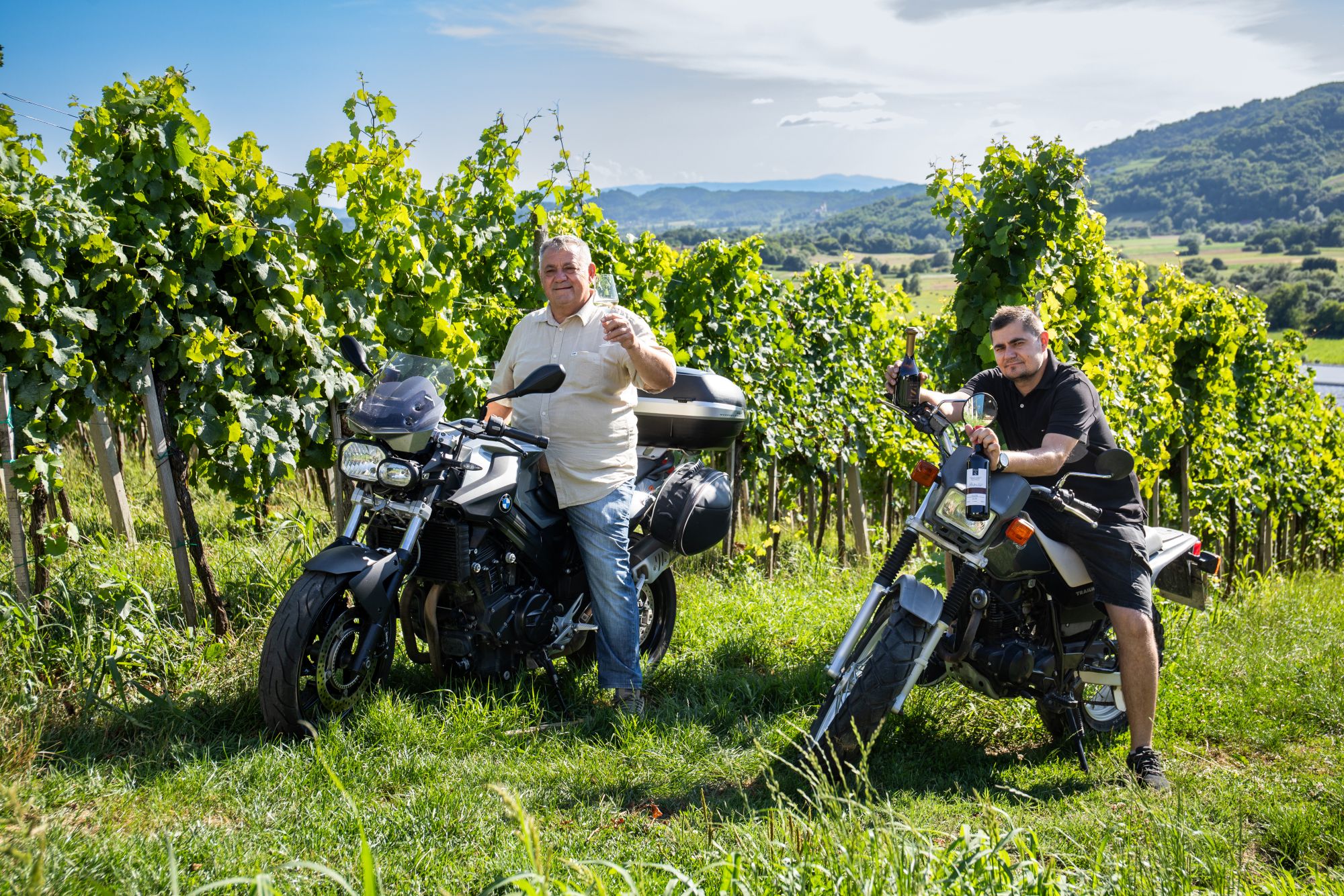
The activity report of the Sokol Klanjec motorcycle club lists Ivan Petrišić Keko as a board member and founder. He used to ride a Honda and a Suzuki, and today makes do with a BMW 800R, while keeping a thirty-five-year-old, 125cc Yamaha in his garage.
– Is there any part of life in Klanjec that you aren’t involved in, Ivan? I asked when I sat down with him and his son Filip in their wine cellar on Šenoina Street.
– Is it possible to open a tin of pâté without a Petrišić popping out? I added.
Ivan and Filip, his youngest son, looked at each other and answered in unison:
– No!
Then came a list that fully confirmed their omnipresence.
– We’re involved in every part of community life in Klanjec, says Filip, a member of the local Feniks darts club, which once hosted multiple world champion Boris Krčmar.
Both Filip and Ivan are active members of the Kuna hunting association. Ivan says he has been “active in tourism in Klanjec for twenty-four years – two and a half terms as president of the Klanjec Tourist Board, and four terms as president of the Krapina-Zagorje County Tourist Board”.
Their name is also associated with Klanjec’s first bowling alley and the local stationery shop. And back in 1993, the town’s first carnival was organised by the well-known singer and restaurateur Branko Greblički Ventek and – Ivan Petrišić Keko, along with a few friends.
People still talk about Ivan’s carnival costumes. A major exhibition at the Cultural Centre, devoted to the best costumes from the first fifteen or so years of Klanjec’s carnival antics, showed how determined he had always been to keep up with current affairs. Residents remembered his portrayals of “Kerum and Seka”, “County Prefect Vlasta Hubicki and Sonja Borovčak”, and “a shepherd with a sheep”…
If you encounter snow on the motorway between Bosiljevo and Kutina, don’t worry: four of Ivan Petrišić Keko’s tipper trucks are responsible for maintaining that stretch in winter.
There is no need to worry on Klanjec’s roads either. If you get a puncture, his tyre workshop is there to help. These days, it is run by his middle son, also Ivan, while his eldest, Marko, works in a bank.
– When I opened the tyre workshop, I was the only one within thirty kilometres. Now there are two others between Klanjec and Kumrovec.
The Petrišić family refuses to be left behind. On social media, they advertise:
“New in Klanjec! Alongside our tyre service and car wash, we’ve now opened a shop selling car parts, car care products, oils, batteries, pressure washers…”
Filip was a highly promising footballer whose dreams were cut short by a road accident.
– As a kid, you have no idea where life will take you. I played football for a long time, even professionally, Filip says.
– I played for Inker in Zaprešić, then a top-flight club. I joined the team straight after the generation of Modrić and Ćorluka – in fact, I stepped into Ćorluka’s position.
– Before that, I played for Klanjec, until I was spotted and invited to join Inker. My grandfather Josip drove me there every day for eight years. Training in the morning, school in the afternoon, while Grandma and Dad were in the vineyard…
Just as he was about to sign a contract with an Austrian second-division club, he was involved in a serious road accident. A friend lost his life, and Filip suffered severe injuries.
– After that, football was no longer my priority.
His father Ivan adds that the whole family made sacrifices to support Filip’s career.
– We saw his talent and wanted him to succeed. Sadly, the accident stopped him, but thank God he survived.
For the past ten years, Filip has headed the family farm, supported by the entire family.
– Grandma Mira and Dad started it all, he says.
– After my grandparents died, I moved here with my wife and children, renovated the cellar, and that’s how it all began.
Filip and Ivan always speak proudly of Grandma Mira, who came from the Balon winemaking family in Slovenia’s Bizeljsko region.
Ivan recalls that, while he was running the tyre business, his mother Mira “carried the vineyard on her back”.
– She was there from morning till night, he says.
– When I need to explain to someone today why we never gave up the vineyard, I say: because of our love of the vine, our family tradition and – Mum Mira.
Ivan began renewing the family vineyard in 1984.
– For years, we sold ten to twelve tonnes of grapes to tavern owners. But the returns were too small, so I decided to take winemaking more seriously. One of our first customers was Ventek and his Vila Zelenjak.
Today, more than forty years later, Petrišić wines are still the house wines at that popular restaurant.
– I’d say we’re somewhere between fifth and tenth in Zagorje’s wine rankings today. There are bigger producers, but we’re comfortably in the middle.
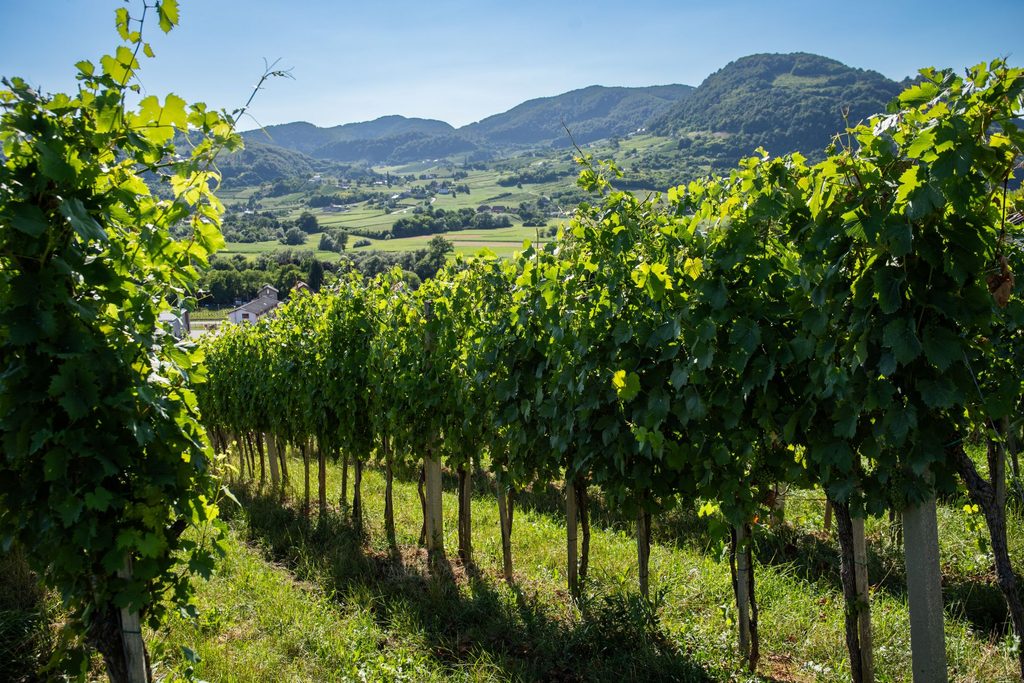
Under Filip’s leadership, they planted a new vineyard and installed soil drainage – a rarity in Zagorje.
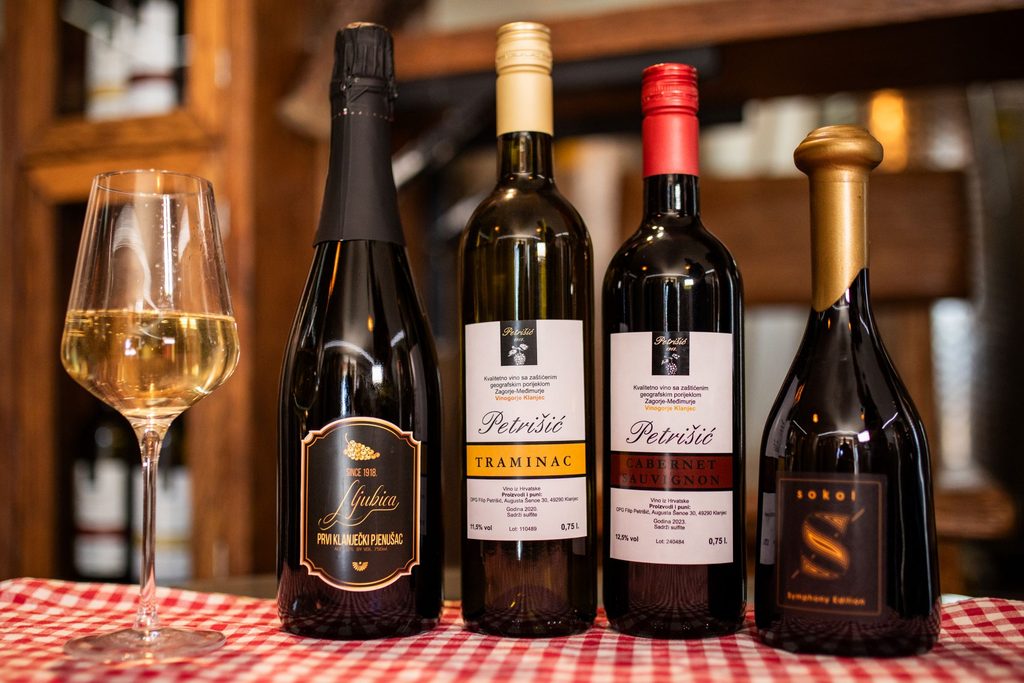
– We have the largest vineyard in Klanjec: 1.75 hectares, with ten thousand vines. Graševina is the main variety, alongside Žuti Plavec, Riesling, Sauvignon Blanc, Silvaner and Traminer. For reds, we have Frankovka and some Cabernet Sauvignon. And, of course – our Sokol.
Writing about the Petrišić winery without mentioning Sokol would be like writing about Ivica Dobrinčić from Vrbnik on the island of Krk without mentioning Sansigot and Trojišćina, leaving out Svrdlovina when discussing Mladen Anić from Smilčić in Ravni Kotari, or overlooking Malvasija Dubrovačka in a story about Niko Karaman. These winemakers are a kind of vineyard archaeologist, rescuing from extinction varieties that, not so long ago, had dwindled to literally a handful of vines in old, neglected vineyards.
– Essentially, we and the Sever family harvest and press the remaining Sokol in Klanjec together, then divide the wine according to how many vines each of us has. Sokol doesn’t yield a crop every year. A few years ago, grapevine yellows attacked it, infecting forty of the three hundred and fifty vines in our vineyards.
– If we had ten thousand litres of Sokol, we could sell every drop. It’s ours alone; you won’t find it anywhere else, and that makes it special. Tomislav Bolfan tried planting it, but none of the vines took… Sokol only seems happy in Klanjec, although even here it doesn’t produce every year! We sold the entire previous vintage to a cruise ship sailing to America. In our most successful harvest, we made just three hundred and fifty litres.
– We saved the variety, and that’s what matters most to us. It’s a real wow! And as long as it exists, Sokol will belong to Klanjec!
– Sokol is always the first variety to ripen. Back when you couldn’t buy table grapes in the shops, Sokol was effectively our eating grape. It had slightly larger berries and high sugar levels…
Sokol, the pride of Klanjec, is an indigenous variety that, not so long ago, had been reduced to barely twenty vines. Local winemakers Petrišić and Sever raised the alarm and, working with the Faculty of Agriculture, drew attention to the need to preserve and propagate it. Today, around seven hundred vines of this Muscat-like variety grow on the hills around Klanjec. Its aromatic character falls somewhere between Sauvignon Blanc and Yellow Muscat.
A vineyard above Klanjec, popularly known as Sokol, appears in a record from the local Franciscan monastery dating to 1686. A little over a century ago, the Franciscans wrote that Sokol wine was worth far more than other wines even in poor years:
– Wine prices this year are at rock bottom. Good white varietal wine fetches no more than fourteen coins per litre, while ordinary wines sell for eight to twelve. Despite these low prices, the monastery has nevertheless sold Sokol for twenty-eight coins. Incredible, but true, reads the entry from 1909.
According to the documents, the Franciscans made wine from Sokol until 1934, while older residents of Klanjec remembered it being used for wine right up to the end of the Second World War. The new authorities confiscated most of the monastery’s vineyards and distributed them to those considered “more deserving”. As members of the Association of Winegrowers, Winemakers and Friends of Good Wine have written, the recipients failed to recognise the value of the vineyards they had been given, and most sold or neglected their plots. Sokol disappeared along with them.
But not entirely. Father Velimir Tomašković, the monastery’s longstanding administrator, grafted a few Sokol vines.
The variety takes its name from the vineyard site of Sokol near Klanjec. That site is mentioned in historical literature as early as the seventeenth century, and its long cultivation there gives grounds for considering Sokol indigenous to Hrvatsko Zagorje. It also appears to have an exceptionally narrow growing range: it has not been found in other vineyards surveyed, and genetic analysis has revealed no match with other grape varieties worldwide.
To complete the picture, Ivan adds another important strand of family tradition:
– Licitar-making! My grandparents, Filip’s great-grandparents, made those decorated gingerbread ornaments. Grandma worked as a court clerk, but the two of them made licitari together.
– Grandpa Ivan died in 1969, but my father carried on the business. I must admit that I was more interested in getting an education and opening a business of my own, so straight after military service I went into the tyre trade.
And so, between vineyards, tyres, motorcycles, darts, hunting, decorated gingerbread and wine, the Petrišić family continues to keep Klanjec ticking.
After all, as they themselves say:
– In Klanjec, you can’t open a tin of pâté without a Petrišić popping out!