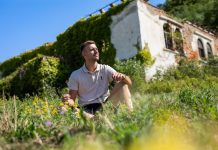
Several decades after he began buying neglected and forgotten neighbouring plots on Vuglec breg in the village of Škarićevo, Boris Vuglec explains his idea of a successful “holy trinity” – vineyard, winery and restaurant – with the same enthusiasm he brought to explaining it to his family in 2001. Or, indeed, to himself much earlier, when he found work as a young man and settled in nearby Krapinske Toplice, watching sorrowfully from there as the hillside where he had grown up and spent the happiest days of his life fell into decline. Boris was a highly successful businessman whose income would have allowed him to live wherever he wished. Yet his personal universe never left that hill, from which, in clear weather, he could see the distant ski slope on Sljeme when its floodlights came on at night.
– I love living with this hill. My roots are here, and somehow this is where I feel most at home. It’s also where I learned to ski, on skis I made myself, Boris recalls nostalgically.
At eight years old, he thought nothing of heading into the nearby forest, finding an ash tree, cutting it down and making himself a suitable pair of skis.
– We made our own runs and jumps. On those simple little wooden skis, I could jump as far as twenty metres.
He was never alone. The Vuglec breg of his childhood teemed with life. The three Vuglec families helped fill the nearby primary school, where each of the eight grades had more than thirty children.

– That’s really where the whole story should begin. There were three families on the hill, all called Vuglec, but we weren’t related. I asked my grandfather whether we’d had some connection in the past, and he said he couldn’t remember any either. When a friend offered to put together a family tree, we started investigating every document we could find in the church, registry offices and so on. The results go back to the early eighteenth century, more than three hundred years, and confirm what Grandpa said: the three Vuglec families from Vuglec breg were never related!
– My childhood was wonderful because there were so many children in all three houses. That had already changed by my generation. In our house, there were just my sister and me, and two children in the neighbouring house as well… In my parents’ generation, there had been seven children in each household. They scattered to Zagreb, Germany and all sorts of other places, and their children would come here for the holidays. Those holidays on the hill, summer and winter alike, were something special.
– Today, there are only twenty children altogether across the four grades of the primary school in Škarićevo.
The decline and neglect of Vuglec breg lasted more than twenty years. The hill had become, quite literally, true to its name – a corner, a forgotten backwater – until 2001, when Boris decided to restore it and bring back the splendour he remembered from childhood.
He was forty at the time and worked in construction and building services. He remained heavily involved in that business, for a while alongside his wine venture on Vuglec breg, until the major economic crisis of 2008.
– Most of our work was installing building services. As subcontractors, we worked on thousands of flats in Zagreb. When the Magdalena Hospital was built in Krapinske Toplice, we did the electrical installation.
Boris says he employed an average of around forty permanent staff a year, working on the construction of more than three hundred flats. At the height of the business, he had seventy employees.
– I was in that line of work for twenty-seven years, until the crisis ruined me. But despite all the problems caused by the company’s collapse, we managed to save Vuglec breg…

During his years in the electrical business, Boris lived in Krapinske Toplice, watching Vuglec breg gradually empty out. That earlier career places him in my special category of “electrical winemakers”: people whose wine ventures grew out of businesses connected with electricity, such as Tomislav Bolfan, Slavko Kalazić and Ernest Tolj. Yes, Boris had his little vineyard on Vuglec breg, and his vineyard cottage, too. But what hurt him most was that his parents were the hill’s last remaining residents. The last of the Mohicans of Vuglec breg!
– I decided to buy and consolidate all the plots belonging to members of the three Vuglec families, living and deceased. That wasn’t something you could do overnight. There were more than thirty different owners. And that was when I realised how firmly my childhood memories rested on sincere friendships. Those heirs, many of whom had spent their holidays with me on Vuglec breg, recognised something of their own childhood in my ideas and readily agreed to the terms I offered for their land.
– I resolved the ownership issues within two years. By the end of 2003, I’d bought practically everything.
You know the stereotype of Zagorje people taking every little dispute to court. Did anyone resist your consolidation plans through legal action?
– No, there really was no need, although I did have to bring quite a few formal proceedings against deceased owners, because that was the only way to clear the title to a plot.
Boris had planned every detail of reviving Vuglec breg and transforming it into one of Zagorje’s most recognisable destinations. There was little need for improvisation or makeshift solutions. Even before he began consolidating the land, he had advisers for the vineyard and winery: Nenad Kantoci, an oenologist from Pregrada, and the legendary Gerhard Schubert.
– We left nothing to chance when planning the wine venture. Everything was worked out by professionals. And you could say I was born in a vineyard, too. Perhaps I didn’t have particularly advanced knowledge of winemaking, but I had a vision of the wines I wanted to make.
– From the very beginning, as we worked out the idea of Vuglec breg down to the smallest detail, we knew what we wanted. When we planted the vineyard, we were already thinking about who would buy the wine. We wanted to develop tourism and sell everything here at our own doorstep. We planned the entire infrastructure: roads, paths, vineyard, winery, restaurant, guest cottages and a “green beach”… We restored and refurbished all the old buildings.edili.
I onda se počelo sve raditi u fazama.

– Then we began doing everything in stages.
While consolidating the estate, which eventually reached an impressive twenty hectares by Hrvatsko Zagorje standards, and planting the vineyards, Boris also built the winery. By 2003, Vuglec breg was ready for its first harvest. Before the must from that harvest had even fermented, he had begun work on the restaurant, which opened its doors on Christmas Day in 2005. A few months later, Vuglec breg welcomed its first overnight guests. Today, its accommodation can house fifty people.
– Everything followed in sequence. We kept to the agreed timetable. We insisted on traditional Zagorje architecture. We also insisted on setting high standards in everything we wanted to do: winemaking, the restaurant and accommodation. We really were pioneers of wine tourism, a step ahead of everyone else. So it’s hardly surprising that transforming Vuglec breg from an overgrown wilderness into a destination better known than Krapinske Toplice was described as a major undertaking.
The standards Boris imagined – and achieved – are illustrated by his decision to enrol restaurant staff in sommelier training from the outset. He also says that “our range of wine glasses was something many Zagreb restaurants don’t have even today”.
He insisted on explaining to guests that “sparkling wines make ideal aperitifs, unlike the customary rakija, which at Vuglec breg is now served exclusively as a digestif”.
– We were the first in Zagorje to start making sparkling wine in a serious quantity, five or six thousand bottles. Now we produce an average of around twelve thousand bottles a year. Our total annual production is sixty thousand bottles of different wines, half of which we sell here on the estate.
– I’ll venture to say that we’ve done more than anyone else to promote sparkling wine in Croatia!
– We’ve made Vuglec breg so recognisable that people simply want to come up to the hill for lunch!
When it came to sparkling wine, Boris’s eyes were opened by Volker Maier of Weingut Maier in Baden-Baden, Germany, also known as a former shot-putter.
– Volker is our friend, and he makes sparkling wine at his winery. Once, he brought his entire winery team here, and they introduced us to every stage of production, down to the smallest detail.

Around that time, oenologist Jasminka Šaško joined the Vuglec breg team. Twenty years later, she still has the final say in the cellar. Before applying for the job at Vuglec breg, she had begun her career at the Sveti Križ Začretje Agricultural Cooperative.
– That saying seems to follow me: be careful what you wish for – it might come true!
– When I was studying, I travelled to Zagreb and back to Zagorje every week, and I would always gaze longingly at the cooperative’s vineyards above what is now the Roses Outlet Centre. I’d think how lovely it would be to work there one day. And a month after graduating, I got a job there.
– Then one day I read a double-page feature about Vuglec breg in Večernji list and thought: I don’t know anything about this place. I told my husband we should go and have a look. But when we got there, there wasn’t even a road, nothing. We reached the spot where the restaurant stands today and found building work going on. I looked around, liked what I saw and thought how lovely it would be to work here, too. Very soon afterwards, Boris invited me for an interview.
– If I hadn’t believed in this venture, I would never have come!
Considering that Vuglec breg was the first Zagorje winery to approach sparkling wine production so seriously, it is surprising how little this startled Jasminka. As a young oenologist who spent time with legendary figures from Croatia’s upland wine region, Ivan Turk and Franjo Jambrović, she saw sparkling wine on these hills as a natural next step.
– I was a member of the Friends of Good Wine Club, and I often listened to Ivan Turk and Franjo Jambrović, who were constantly championing sparkling wine on these hills. So it wasn’t unfamiliar territory to me.
– Besides, the stereotype of Zagorje as a region of sour wines provided an almost ideal foundation for sparkling wine. We turned those very prejudices to our advantage.
Today, Vuglec breg makes five sparkling wines: Pjenušac crveni, Vuglec Extra Brut, Pjenušac Muškat Dry, Baronial Brut Nature and Jasminka Demi Sec. Yes, you read that correctly: one of its sparkling wines, the most expensive at sixty-five euros, is named after Jasminka Šaško. It is the only example I know of a winery owner thanking his oenologist in this way for her immense dedication to developing the estate’s wines.
– Jasminka isn’t, as some people say, the crowning achievement of my career. It’s an expression of our teamwork and friendship. To me, Jasminka is one of the sparkling wines we make, although it is a little different and has a very interesting story, because it brings two wineries together. That is rare in itself.
Jasminka is made by the traditional method from fifty per cent Chardonnay, with Graševina, Riesling and Silvaner making up the rest. It spends around four years on its lees, and its botrytis and honeyed notes come from the dosage: an ice wine from Bodren.
Interestingly, Jasminka Šaško does not include her namesake among her three favourite wines from twenty years at Vuglec breg! Her first choice is the Cabernet Sauvignon 2011.
– It was a powerful wine and a strong argument for including Cabernet Sauvignon among the varieties recommended for Zagorje. It was so good that, less than a month after releasing it, we promptly withdrew it from sale and returned it to the cellar for several more years of ageing. I think that Cabernet Sauvignon finally reached customers only after six or seven years in the cellar.

– Among the other wines I’ll never forget are a sparkling wine from 2015 and the Sauvignon Blanc 2021.
The involvement of the whole family in shaping every part of the venture shows just how much Vuglec breg is a family project. The guest cottages are named after people who left their mark on the hill’s past: Lac, Mica, Dragec, Imbra, Jana and Jagica. The restaurant is called “Pri baki Rozi” – “At Grandma Roza’s” – after the Roza whose recipes underpin its menu. The bar area is called Pelnica, an old Zagorje word for “a place to drink”.
Boris’s son Mario is his right-hand man, his wife Ksenija handles the accounts, and his daughter Nives, a graduate of the Academy of Fine Arts, is responsible for Vuglec breg’s visual identity. Nives has also made sure that every restaurant guest receives a kiss: on the wall, she has placed an enormous reproduction, painted by her own hand, of Gustav Klimt’s famous The Kiss. Thanks to Nives, you could say Vuglec breg has become Zagorje’s answer to Belvedere Palace! With one small difference: at the Austrian Gallery in the Belvedere, Klimt’s The Kiss keeps company with works by Claude Monet, Hans Makart, Egon Schiele, Vincent van Gogh and Paul Gauguin. Here, you admire Nives Vuglec Antolić’s The Kiss while eating ajngemahtec, the traditional chicken and vegetable soup, meat preserved in a wooden lard tub, štrukli and turkey – which must carry the “Zagorska purica” certification.