We had been talking for several hours when Mladen Micak, by then rather tired, asked me a question I will never forget. A winemaker, winegrower, restaurateur and who knows what else from Marija Bistrica, he wanted to know:
– Are we going to talk about wine at all?
– Dear Mladen, the energy you pour into a hundred different things has fascinated me so much that, in the context of your life story, wine hardly deserves special treatment over everything else you do, I replied.
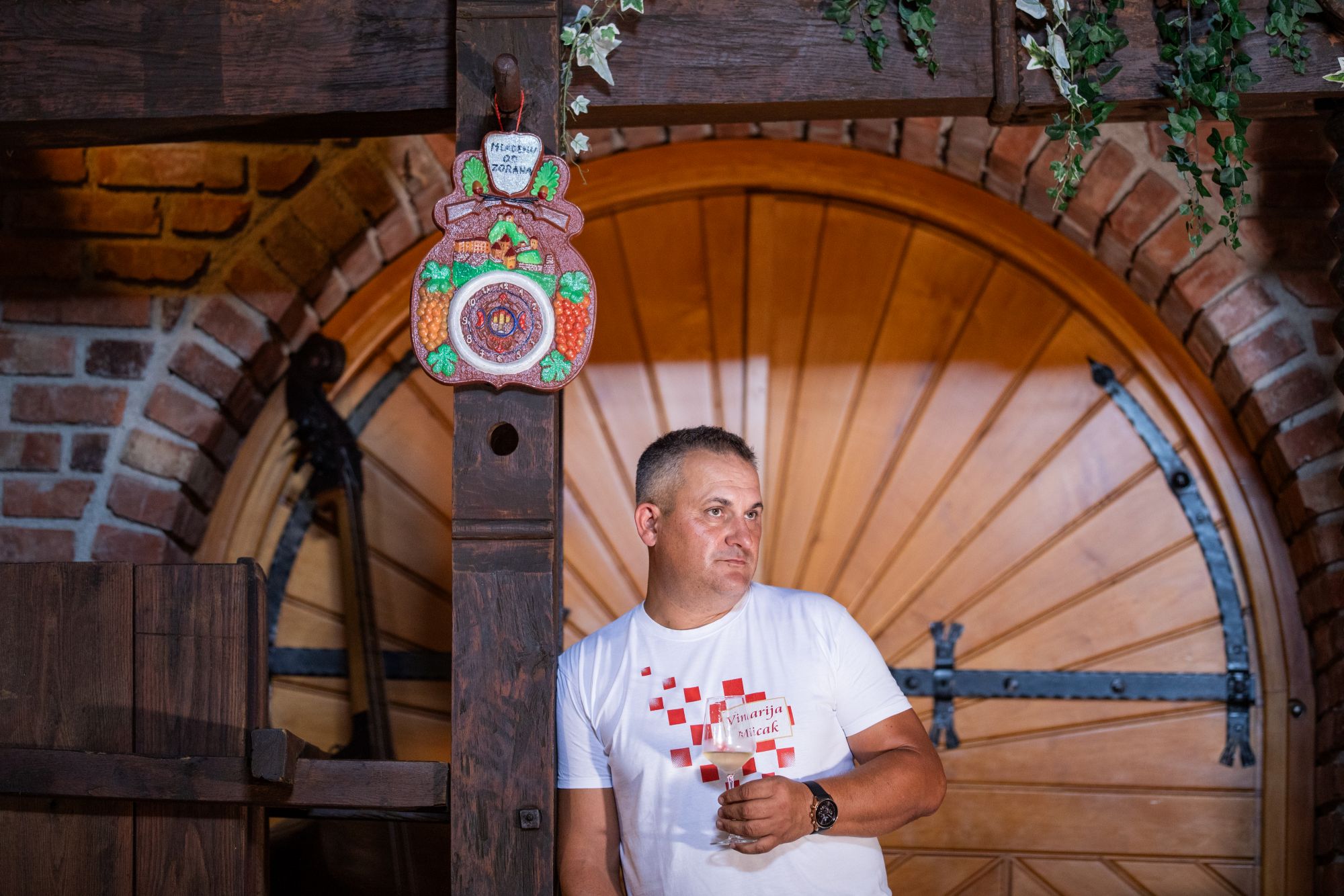
I do not think I exaggerated that compliment in the slightest. Nor did I diminish his wines, some of which are among the finest in Hrvatsko Zagorje. All you need to do is step into his Zagorski dvori and the questions begin pouring out. Mladen’s explanations are expansive, and his answers invariably lead to more questions.
Take the inscription at the entrance to Zagorski dvori, written in the local dialect:
YOU HAVEN’T KNOWN TRUE FRIENDSHIP
UNTIL YOU’VE BEEN TO MICAK’S KUMOVO.
The story of Mladen’s social invention, which he calls Kumovo, is a textbook illustration of how a hospitality network grows. At its heart is the Croatian idea of the kum: a godparent or wedding witness, and often a friend whose bond with you is considered almost as close as family.
– Since my first kum is Dalmatian, Dalmatia has also become a big market for my wines. But I have plenty of friends from Moslavina, too, whose friendship means a great deal to me. Spending time in Moslavina, I realised that they wanted to visit the shrine in Marija Bistrica and pray to God, and that they needed a friend here.
– And so, together with them, I brought 176 friends into this circle of kumovi. Nothing is written down, there are no rules or statutes. We all help one another, one hand washes the other, and we have our gathering once every two years. Everyone brings something from home that they’re proud of – pancetta, prosciutto, wine, shellfish, truffles – and brings along their own kum, so that my kum and I can meet him and his kum. We started with twelve kumovi, and within a few years the circle had grown to two hundred. You hear about everything there! It’s like a classic hospitality pyramid.
Mladen also supports the war veterans known as the Tigers, who often organise artists’ gatherings in Zagorje. Our Micek, as everyone affectionately calls him, comparing his friendliness to a cat’s endearing nature, has never charged them anything.
– They repay me through friendship and the time we spend together. Besides, they’ve awarded me the title of Honorary Tiger!
He is rather fond of the nickname Micek, too. In several places around Zagorski dvori, he has had cats carved into the wood, and the animal promptly became the restaurant’s mascot. You will always find black tomcats in the courtyard, along with his terriers of indeterminate pedigree, Grega the Winegrower and Rubi the Moslavinian.
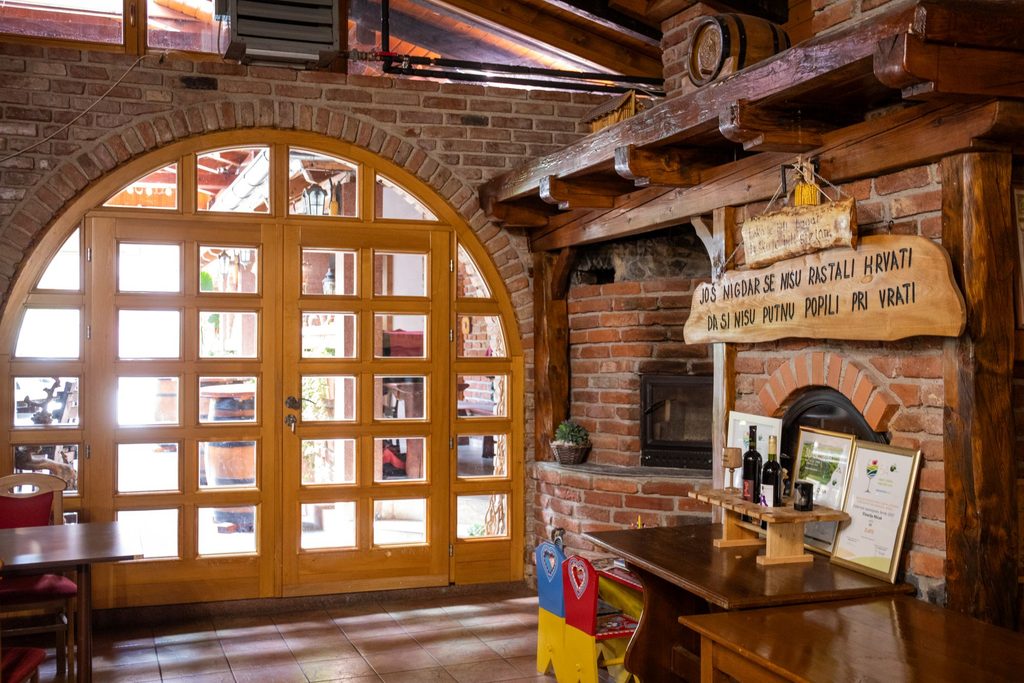
Once you have heard about the kumovi, the cats and the dogs, and stepped inside Zagorski dvori, Mladen will draw your attention to two more carved sayings:
CROATS HAVE NEVER SAID GOODBYE
WITHOUT ONE LAST DRINK BY THE DOOR.
IT’S EASY TO BE RICH.
IT’S HARD TO BE HAPPY.
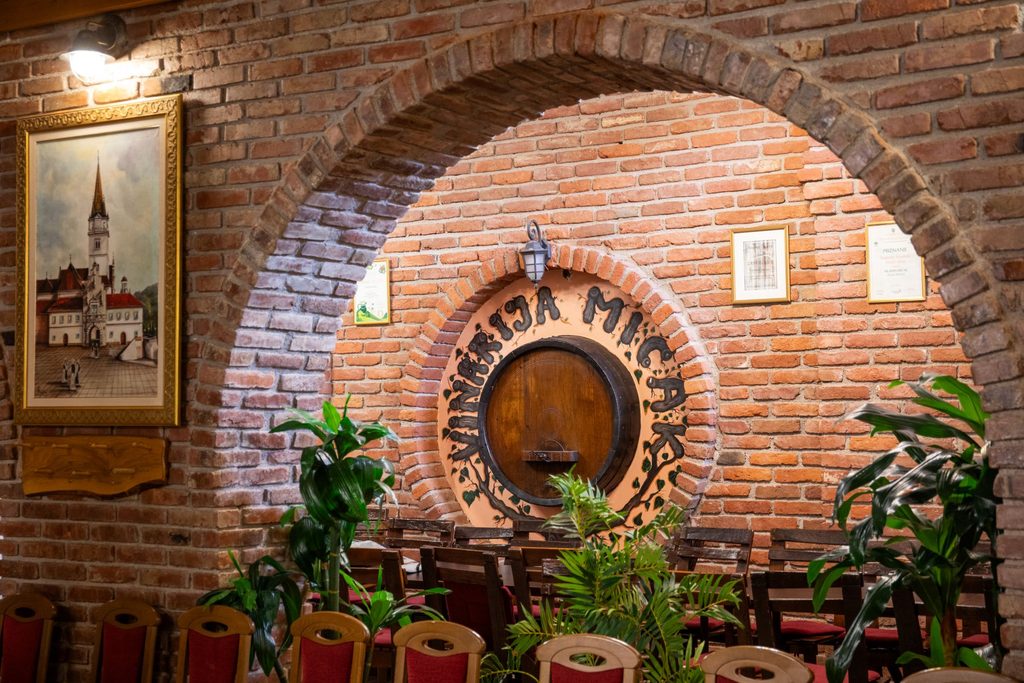
Then comes the story of the 33,700 bricks built into the restaurant’s walls, which Mladen naturally plastered himself. Four entire lorry loads of “hand-washed bricks” went into Zagorski dvori. He had tracked them down in Jarun, Bedekovčina and Bjelovar.
– We had to buy them, demolish the buildings, bring the bricks here, wash them and build the walls…
But to borrow Mladen’s own words: “Are we going to talk about wine?”
If you were telling someone your wine story chronologically, where would you begin?
– I’d start with my grandfather Dragec, who was a botanist and winemaker: Starohrvatska Belina, Kraljevina, a thousand vines. After him came my father, a metalworker, and then me. I was already driving a tractor at ten, and by twelve I knew the vine-training systems my grandfather had taught me.
Naturally, growing up in that environment and then abandoning the vineyard would have been sacrilege. If I had to paint a picture of my childhood, it would show us in the vineyard, with my grandfather on my left, my father on my right, Uncle Mladen in the middle and my brother Mario beside us, all pruning the vines into shape. And you couldn’t go wrong, because you could always ask Grandpa! My grandfather never broke a fruiting cane in his life: he would always trim it first and then finish pruning the rest of the vine. That’s the old-school approach I’m trying to pass on today to the younger generation – my two wonderful sons and two wonderful nephews. My boys are still young, in the seventh and sixth grades, but they already know how to prune every vine. They’re excellent students and musicians like me. My nephews are even further along: the younger one is fifteen and has enrolled in culinary school, while the older one has enrolled at the Faculty of Agriculture.
Much like that childhood picture of the whole family together in the vineyard, today’s scene would look little different.
– A lovely family story, working and living alongside my brother, Mladen would say.
– We fell in love with this demanding profession, which faces enormous challenges today, especially as we’re constantly fighting various viral diseases and searching for certified resistant varieties. Meanwhile, we keep trying to persuade our neighbours, who are regular guests at Zagorski dvori, to clear their neglected plots. Slovenia sorted that out twenty years ago, while in Austria they’ll fine you fifty thousand euros if they find a viral disease, and impose restrictions on you as well.
Mladen says that the Micak family’s winemaking remained purely amateur until his degree dissertation in 2004.
– Until then, Dad had a hectare of vines…
– I studied from 1997 to 2004. My studies took a little longer because I was importing barriques from Bordeaux, which was a serious business! We imported year-old barrels that had been used once, ideally seasoned with wine for southern Dalmatia, Plavac Mali and the French varieties grown there. Importing them was very difficult. I did it all with the help of Tomaž Lisjak, a professor at the college in Ajdovščina, and another Bosnian friend of mine. Every month, we brought in a lorry load of barrels. Then that bomb went off in Paris, and the barrels disappeared. Or rather, those year-old barrels are hardly offered any more, and when they are, the prices are much higher. These days, any barrel in France – neither new nor just a year old – costs two hundred euros. I used to sell year-old barrels on Pelješac for that amount. A new Seguin Moreau barrel costs eight hundred and seventy euros plus VAT.
Did Zagorski dvori exist before you started your wine venture?
– No, Zagorski dvori came later. The wine story began in 1958, in my father’s day. Around the time of my degree dissertation, we registered a family farm, then opened a place for day visitors, followed by a traditional vineyard tavern. Zagorski dvori took shape in 2013 as the business IVANIKO, a name formed from those of my sons, Ivan and Niko. I handle the winemaking, and my wife Nikolina runs the restaurant.
Mladen is immensely proud that Zagorski dvori offers no fewer than eighty dishes.
– We open at weekends and take groups by prior arrangement, so we have time to prepare whatever our guests want. If they insist on ćevapi, we’ll make those too, but in our own way. We don’t need a butcher’s shop; we have a family farm that supplies us. The women come on Thursdays to roll out the dough for štrukli, so they can be baked on Fridays. We have just three soups – Zagorje soup, beef soup with homemade noodles and ajngemahtec, our traditional chicken and vegetable soup – and three or four kinds of strudel…
And Mladen admits that, year after year, he has also been among Zagorje’s champions at making štrukli, the region’s traditional cheese-filled pastry.
Where did you win that title?
– In Bedekovčina, where Štrukljijada is traditionally held the day after Vinarijada, the wine festival. Winning there doesn’t make you the champion of Zagorje – it makes you the world champion! Over five years, we came first twice and second three times. We make baked Zagorje štrukli using my grandmother’s recipe.
At Zagorski dvori, is the restaurant an extension of the winery, or does the winery enhance the restaurant?
– I still don’t know the answer…
– Winemaking is my passion, and I’ll never let it grow beyond what I can manage. But I’ll never be a typical restaurateur either. Let’s say it’s half and half! That’s why we divided the responsibilities: my wife runs the restaurant, and I run the winery. You simply can’t do both entirely on your own. When the wine is fermenting, you can’t receive visitors because gas builds up in the cellar.
– I’ll never choose completely between the two. I’m a winemaker first and foremost, and I prefer the vineyard to drinking parties, but I also love people, company and playing music. Together, it all creates a fantastic synergy.
– In Bistrica, you don’t have to be exceptionally clever. You need to know your calling, work hard and offer local food, which, thank God, Zagorje has in abundance… Zagorje is much better known for its food than its wine! Venture a little beyond the region and people haven’t even heard of Micak, Bolfan, Kopjar or Sever. Even if you asked about them at a petrol station in Zabok, I doubt everyone would know who they were. Not everyone is immersed in wine the way we are. But Zagorje turkey, štrukli and duck – people certainly know about those.
Mladen stresses that all the food for Zagorski dvori comes from four family farms run by his mother-in-law, his mother, his sister-in-law and himself. And then we are back to food…
– Did you know that a turkey hen has to spend two hundred and forty days on its feet and weigh between 3.6 and 4.2 kilos to meet all the requirements?
And it is the Zagorje turkey that is protected, rather than specifically the hen? What is the difference between a hen and a tom?
– Enormous. For a start, three of us can eat a hen on our own. Once roasted, it weighs 2.2 kilos. A tom weighs five or six kilos. But the Zagorje turkey hen is the best in the world!
You favour the hen over the tom?
– Absolutely. The tom is excellent, too, but the hen is our world-class offering. The tom matters more in catering because you can cut fillets from it and cook it for a larger group, whereas a hen is only enough for three people.
What about duck?
– Oh, duck is a wonderful thing. What makes it special is that dark meat with its intense aroma. Young people don’t know what a Zagorje duck, or raca, is. They find it too intense, and unless it’s spit-roasted, they can’t eat it. It has its advantages over both turkey hens and toms.
What advantages?
– It’s cheaper, much cheaper, and it has its own fat for dressing the mlinci.
For Mladen, potatoes are the foundation of Zagorje cuisine, “followed by homegrown beetroot, homegrown horseradish, wild salad greens and then turkey”.
– We Zagorje people are a little mad, and we like eating turkey with orahnjača, our walnut roll. Try it! Try Easter ham with walnut roll, too! And horseradish can be combined with apple, pear and cream. It’s a fantastic flavour enhancer.
The Croatian national shrine of Our Lady of Bistrica, just a kilometre and a half from Zagorski dvori, may be the greatest boost to Mladen’s food and wine venture.
– When you live in a place that is home to a national shrine, you’re proud of it. Most of my groups visit the shrine, and I’m quite sure I wouldn’t even be in this business if it weren’t here.
Why?
– I’m an agronomist by training, but I come from a family of shopkeepers. Before Zagorski dvori, we had a retail business – my mother did, that is. I could certainly have had an easier life than tending twenty-five thousand vines. But I’m not working myself to death. Vineyard work means fresh air and no mobile phone, and driving a tractor is easier than dealing with paperwork or waiting tables.
– And with the shrine so close, you’re simply grateful to be where you are. My wine is used at the altar, and through that I’ve come to know one parish priest, then another, a third and a fourth. Sometimes they take my wine to Kaptol, the seat of the Church in Zagreb, which is a big thing and a great honour for a little Zagorje man.
Just when you think that, between the kumovi, the bricks, the food and everything else, you will never get round to discussing wine with Mladen – something he himself had wondered about – it is time to talk about rakija.
– Graševina has always fed and sustained our family, but so has the Bistrica plum. That’s how we started. Grandpa was a superb rakija maker. The Bistrica plum was something extraordinary here; it kept the family fed. I’m talking about the 1960s. Sadly, not a single one remains. Plum pox virus took them all.
And rakija is often accompanied by a song…
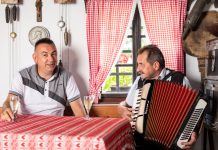
– I sometimes play for our guests, too. I can play four instruments!
– My music teacher was Branko Jirasek from Buzet, who also taught Jadranka Šverko. He moved from Buzet to Marija Bistrica, and his late wife was my schoolteacher. I learned the accordion in Jirasek’s class, and for twenty-five years I played the trumpet in the orchestra of the Lovro Ježek cultural society. My younger son plays the violin and the older one the piano, so I have to help them, too.
– And when guests arrive, I pick up whichever instrument is needed – to survive!
– My advice is that every winemaker should learn to play something, or at least sing.
Why?
– When you’re holding a tasting in the cellar, there’s the official presentation, and then there’s being down there with your guests, drinking the same wines they are. Many people think winemakers are hiding something. The history of Zagorje’s sour wine casts a long shadow… This used to be Austria-Hungary, and with the old varieties that dominated here, it was difficult to reach eleven per cent alcohol without adding sugar. Only those who could afford it, the wealthy owners, had sugar. But that wasn’t what made Zagorje wine sour. Our barrels used to be contaminated. My grandfather would take five litres of water up to the vineyard hut to wash a barrel. There was no water up there. Naturally, wine from barrels like that tasted vinegary.
After graduating with a dissertation on Cabernet Sauvignon, which later became the flagship of the Micak winery, and having sold his imported year-old French barriques throughout Croatia, Mladen spent some time working as a junior researcher at Jazbina, the University of Zagreb Faculty of Agriculture’s experimental vineyard and winery. There, he says, he fell in love with Traminer and Chardonnay.
– But now everything has changed. The climate has warmed so much that my champion Cabernet Sauvignon, which I used to harvest in mid-October, is now picked on the first of September! It’s crazy! A few years ago, we deliberately waited until Michaelmas to harvest Chardonnay, and it reached fifteen and a half per cent alcohol.
– Those wines aren’t healthy, and they don’t have the character typical of Zagorje, which calls for airy, light, delicate wines with no more than eleven per cent alcohol.
– That’s why we’re turning to sparkling wines and Starohrvatska Belina.
Mladen, why do we so rarely see you at wine fairs and festivals?
– Because we work at weekends, so they clash. You know, you can’t make great wine, or build a winemaking tradition that lasts for generations, if you stay pale and never get a tan! You need some colour in your skin – then your workers, your vines and your wine will respect you!
– Winemaking ambitions and goals are what I discuss least with my children, because I have no idea whether the next generation will even be growing grapes. And that isn’t our choice. Half the vines on my hillside have already been cut down. If they won’t grow, we’ll put ducks, turkeys and sheep there instead – then at least we’ll have lamb.
– I want to leave some things open. Let my child choose his own profession; I don’t need him in the business now. That’s where many people have gone wrong, bringing their children into the business too early. A winery doesn’t need five directors!
Until the winery’s future becomes clearer, Mladen can dream of catching a big catfish to put on the grill, and of learning how to cook a nine-kilo dentex in a pan. In his dreams, he also sees his younger son completing music school on the violin, and his older son on the piano, so that they can all play together.
– Those are my dreams, and in them we spend time together through music. But I wouldn’t want the two of them to work with me.