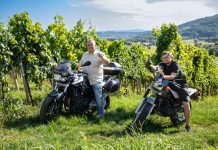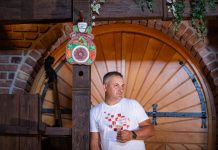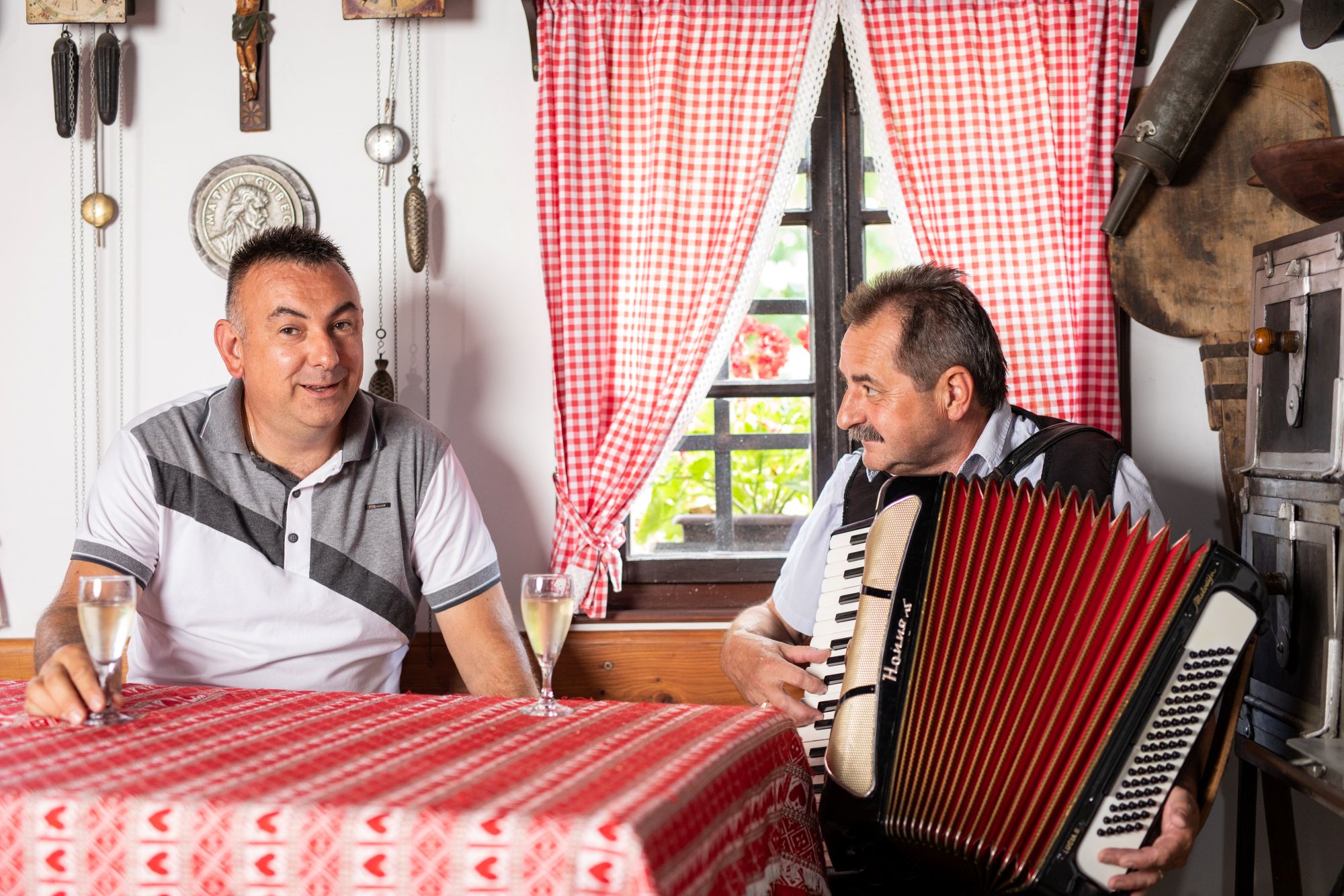
The story of Siniša Znika, a multiple champion at Vina Bedekovčine – Zagorje’s largest and oldest wine show – is the story of a modern-day Matija Gubec. To be fair, Siniša, who comes from Gornja Stubica, does not feel exploited and subjugated like his famous neighbour from centuries past. But a serf is a serf, whether he answers to the state or to Franjo Tahi, the notorious lord of Gubec’s time.
Everything we discussed also served, symbolically, as a reminder of the great Ambroz, better known as Matija Gubec, who once looked out through the window of his cottage in Hižakovec at the vineyards of Siniša’s distant ancestors.
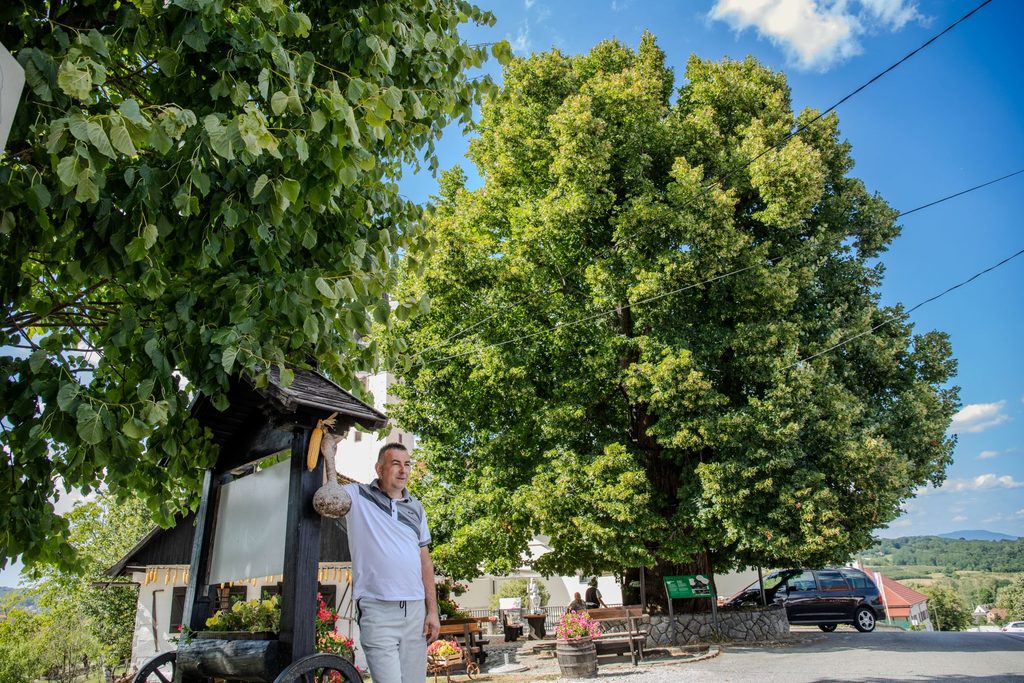
We met in the garden of the Pod lipom tavern, beneath Gubec’s linden tree, said to be the only living witness to the peasants’ uprising before the decisive battle at Stubica in 1573. Nearby, a little flag fluttered from a streetlight, bearing the words: “The revolt goes onnn!”
– You see, wherever you turn here, you can feel the spirit of the past, says Siniša, Zagorje’s “king of Sauvignon Blanc”.
The Pod lipom tavern and its owner, Božidar Sačer, are themselves part of that history – or that “better past”. Mladen Micak from Marija Bistrica, one of Zagorje’s finest makers of štrukli, who has lost count of his victories at Bedekovčina’s Štruklijada competition, says Božidar makes them better than he does.
– Štrukli are a wonderful thing. Although I’ve won both the champion’s title and silver, I marvel all over again every time I eat Božek Sačer’s. They’re twice as good as any others in Zagorje. They bring tears to my eyes, Mladen says.
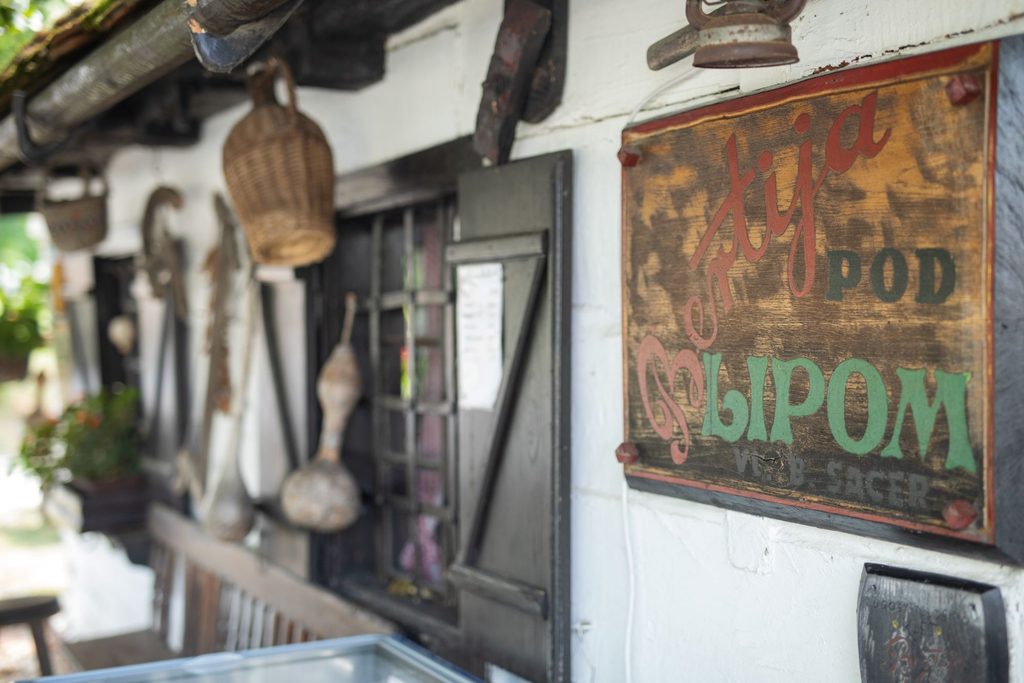
Božidar Sačer, a former musician who played the accordion, guitar, tamburica, keyboards and whatever else was needed, went into hospitality at his friends’ urging. In 1994, the “gentleman with the moustache”, as his friends describe him, bought the tavern, whose handmade roof tiles are covered in moss said to be 250 years old. In a short time, he turned it into a “three-in-one”: tavern, gallery and museum.
Besides being an essential stop for lovers of Zagorje cuisine, Pod lipom is a window into the region’s history. Autumn is celebrated there with an event devoted to fresh must and roasted chestnuts; the Peasants’ Revolt is remembered through a re-enactment of the uprising; and the life and achievements of the celebrated pilot Rudolf Perešin are commemorated. Ivica Šerfezi filmed his last music video there.
Inside the little building, which has protected cultural heritage status, stand around a hundred valuable antiques. Among them is the legendary wood-burning stove, used for cooking in winter and keeping the tavern warm. Over the years, Pod lipom has housed the Stubica district headquarters, a post office, stables, a tailor’s workshop, a souvenir shop, an artists’ workshop and an exhibition space where Ivan Lacković Croata showed his work. Before radio existed, public announcements were made in the courtyard, telling everyone who wanted to buy or sell what.
So when Siniša Znika says, almost reverently, that beneath Gubec’s linden “wherever you turn, you can feel the spirit of the past”, he is certainly not mistaken. His tone conveys a deep respect for everything that has happened in this place.
Against that backdrop, it seems particularly fitting that he holds most of his wine presentations here, beneath Gubec’s linden, accompanied by Božidar Sačer’s štrukli and his friend Mladen Micak, who brings the guests.
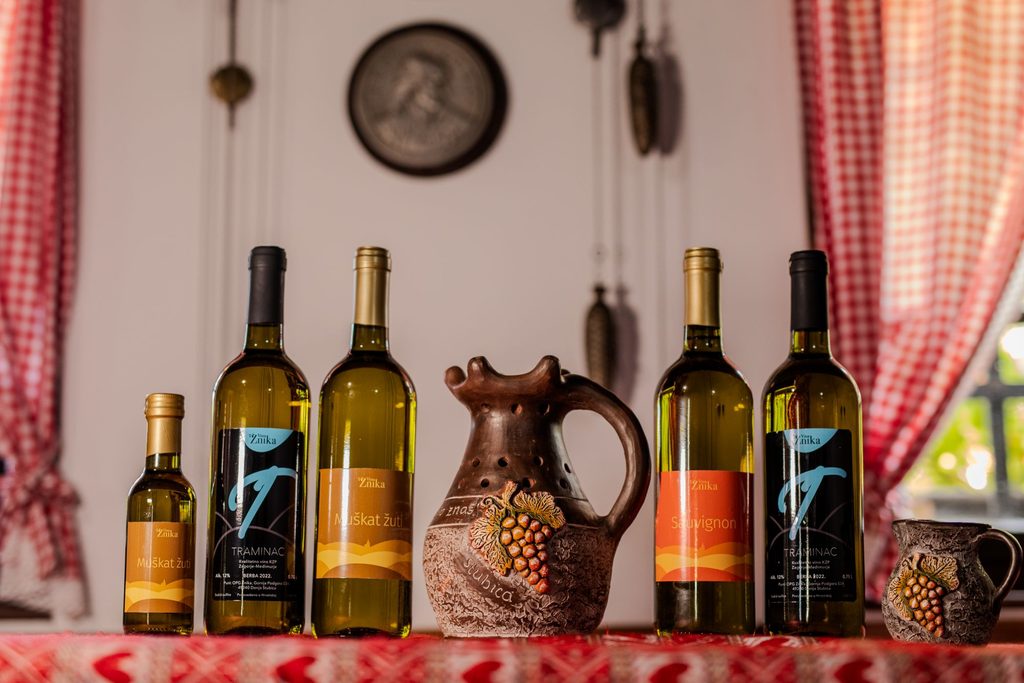
– Yes, that’s right. Mladen brings his group here to Božek’s place beneath Gubec’s linden. Božek prepares the štrukli, I bring my wines, and the tasting begins. Then Graševina, Sauvignon Blanc, Silvaner, Yellow Muscat and Traminer do most of the talking…
If you had to choose your most important wine, the one that brings in the most income, which would it be?
– I’ve specialised mainly in Graševina for gemišt. But I also have a special Graševina, which I’ve called Zthubycza…
What?
– Z T H U B Y C Z A. That’s how Stubica, the town where I was born, used to be written in official documents.
What makes Zthubycza special?
– It’s made with different yeasts, from slightly better grapes. We take a little more care at harvest, and the sugar levels are a little higher.
– Although my main business is making wine for gemišt, I can be proud of the quality of all my wines. For instance, in the past three years, my Sauvignon Blanc has twice won the champion’s title at Bedekovčina, Hrvatsko Zagorje’s largest wine fair.
Siniša does not produce much: just over ten thousand litres of wine from grapes grown on the 1.2 hectares of vineyard he owns. He buys some grapes, too, but even then, as he puts it, “there’s no comparison with the big wineries”.
Of all the winemakers I spoke to in Zagorje, Siniša Znika was the hardest to pin down for a meeting. Whenever we spoke, he was in the vineyard, getting ready to go to the vineyard, delivering wine to Zagreb’s taverns, or… I hardly dare imagine what life would be like if he had more land under vines!
When Siniša first became Zagorje’s wine champion at Bedekovčina, with his blend in 2015, he was working as a lathe operator at the Lendrec factory in Stubičke Toplice. Despite his daily duties among milling machines, lathes, grinders, CNC machines and metalworking equipment, he managed to get everything done in the vineyard. And, as the results show, the excellence of his finished wines regularly earned the highest awards.
How is it, Siniša, that you used to manage everything, yet now that you work entirely in the vineyard, you don’t have enough time?
– I’ll never forget that first champion’s title, because it was for a wine from the extraordinarily wet year of 2014. I spent more time in the vineyard than at home, while also working half the day as a lathe operator in the factory! But it worked out! After a year like that, you realise it all comes down to how you approach the vineyard. In the end, the vine gives you back exactly what you deserve.
But to repeat the question: how did you once manage everything in the vineyard while working at the factory, whereas now you struggle to keep up with the vineyard alone?
– My father was younger then, too. There were more hands to help. Because of his health problems, he can now only do some of the lighter vineyard jobs.
– Besides, I’m old-school. I was born and raised in a vineyard; the vineyard is everything to me. And it isn’t easy! There are fewer and fewer young people working in vineyards, and more and more businessmen who see wine as a good business opportunity. They’ve never owned vineyards or been interested in them. They’ve simply spotted a business! They pay managers, the managers find workers, and as far as the owners are concerned, they never have to set foot in a vineyard. I can’t afford that luxury. Everything in my vineyards depends on me, and nobody can take my place.
– Dad is getting on and his health isn’t as good, so most of my time is spoken for. The demands of the vineyard and cellar leave little room to step outside my routine. A year ago, when I left the factory, I agreed to become a slave to the vineyard. It’s now my only job, and it’s what I live on!
– I could no longer live on that wage, which, realistically, I could earn by selling wine anyway. And that was that. I made a clean break and became a slave to the vineyard.
– Winemaking is a job built on strong family roots, tradition and genes. You need everyone’s support to do it properly.
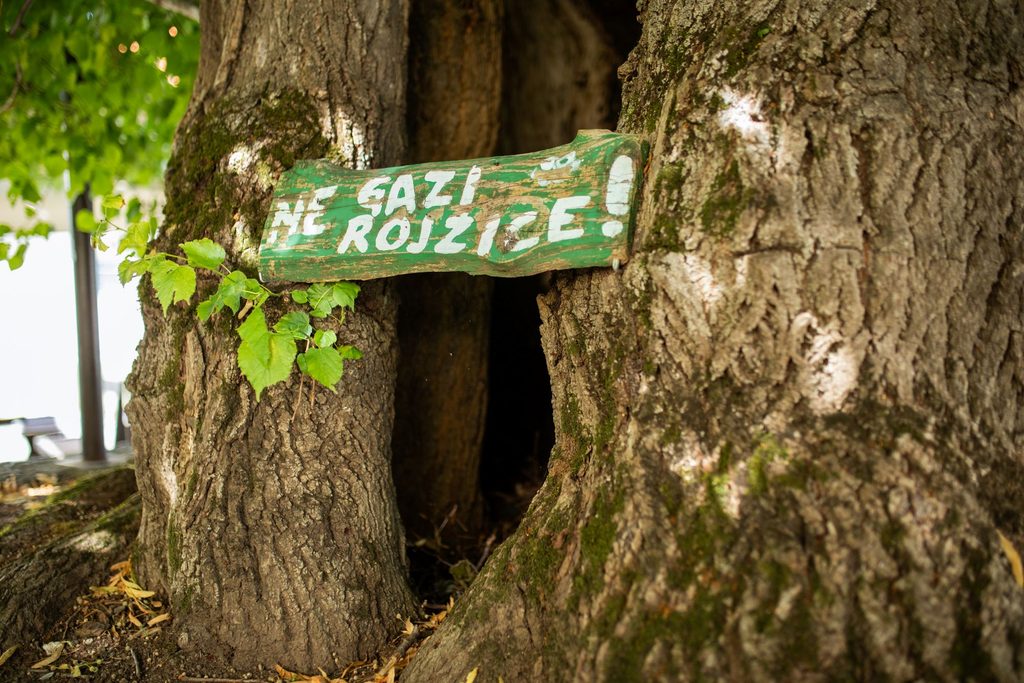
Siniša told me all this beneath Gubec’s linden, a tree that even iron restraints could not stop from growing despite its age. A few years ago, this natural wonder, nine metres tall with a trunk almost five metres in circumference and a mysterious hollow inside – which some “geniuses” once filled with concrete – broke the hoops that had encircled it since the 1960s.
It was as though Gubec’s linden wanted to announce that its time was not yet over and that it was still ready to grow. Perhaps even to reach thirty metres again, the height it stood on Palm Sunday, 6 April 1945, when wind and a storm broke its crown, leaving the tree just five metres tall.
Speaking symbolically, Siniša’s old cellar equipment still has plenty of life in it, too. His press, perhaps a hundred and fifty years old, remains functional, although he no longer uses it.
– I also have a barrel inscribed:
– “Cheers! Brothers Stjepan and Marko Znika.”
– My grandfather died in 1956, and that barrel is certainly a hundred years old. It has enormous sentimental value for me, because it reminds me of the grandfather I never met.
– When they used that barrel, they had a vineyard with three thousand vines, which was a great many at the time. One vineyard was in Hižakovec, and from it you can see Gubec’s cottage. Or, to turn it around, Gubec looked out from his cottage at our vineyard!
Like most Zagorje winemakers, Siniša credits the legendary Gerhard Schubert, a professor at the University of Zagreb’s Faculty of Agriculture, with helping him develop his winemaking.
– I like to say I’m a pupil of Gerhard Schubert. I completed his cellar-management course.
As for what to plant and which wines to make, Siniša learned a good deal while running a café-bar. That period taught him that the owner is the main driver of what people drink in an establishment.
– I supply one café-bar, for example, where the owner prefers spirits. When his friends arrive, they all follow his lead and get stuck into spirits. Another owner is always drinking gemišt, and the crowd around his bar follows suit. Which one do you think buys more wine from me?
– When I ran a café-bar, I drank škropec. When someone saw me, they’d order the same.
What is škropec?
– A decilitre of wine with a little splash of sparkling water.
Siniša’s friends belong to the Knights of the Golden Chalice association, the people “responsible” for staging the Peasants’ Revolt every February. Siniša, however, does not join them in the re-enactment. As someone who does everything himself at his winery, he has decided that, on those days when tens of thousands of people visit the Stubica area, it makes more financial sense to be at a stall, pouring and selling wine, gemišt or škropec.
– I’m sorry I don’t play a part in the Revolt, which, as you can see, goes on and turns this whole area into an open-air theatre. As I told you, you can feel the spirit of the past everywhere here.
We might add that Matija Gubec’s spirit has never remained confined to Zagorje. It is no coincidence that more streets in Croatia bear his name than anyone else’s. Vatroslav Mimica’s film about the Peasants’ Revolt brought together a distinguished cast from the former Yugoslavia, including Fabijan Šovagović, Velimir Bata Živojinović and Pavle Vujisić. Matija Gubec also inspired the rock opera Gubec-beg, while the great Klanjec-born sculptor Antun Augustinčić created a monument in his honour in Gornja Stubica, standing an impressive six and a half metres tall.