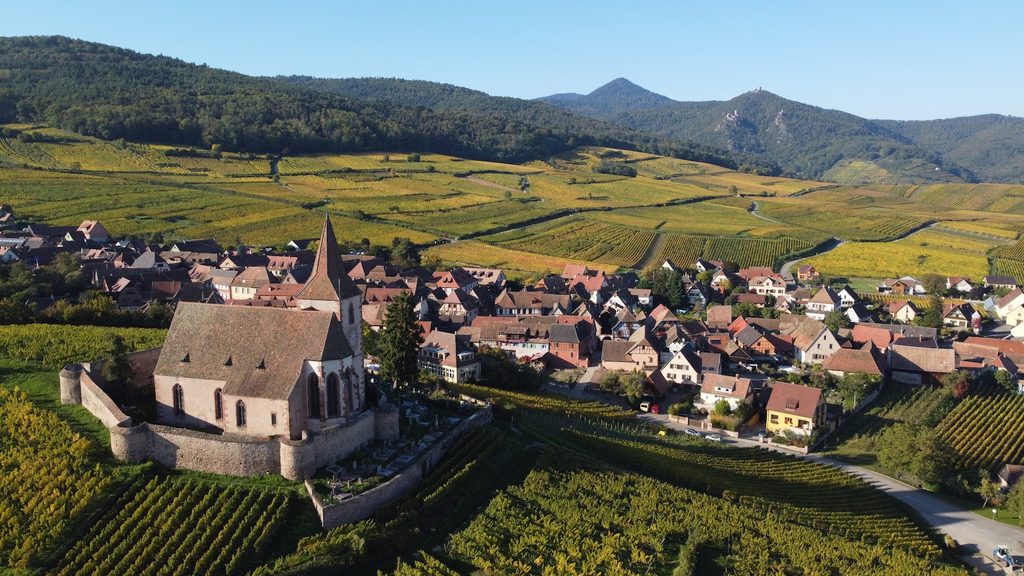
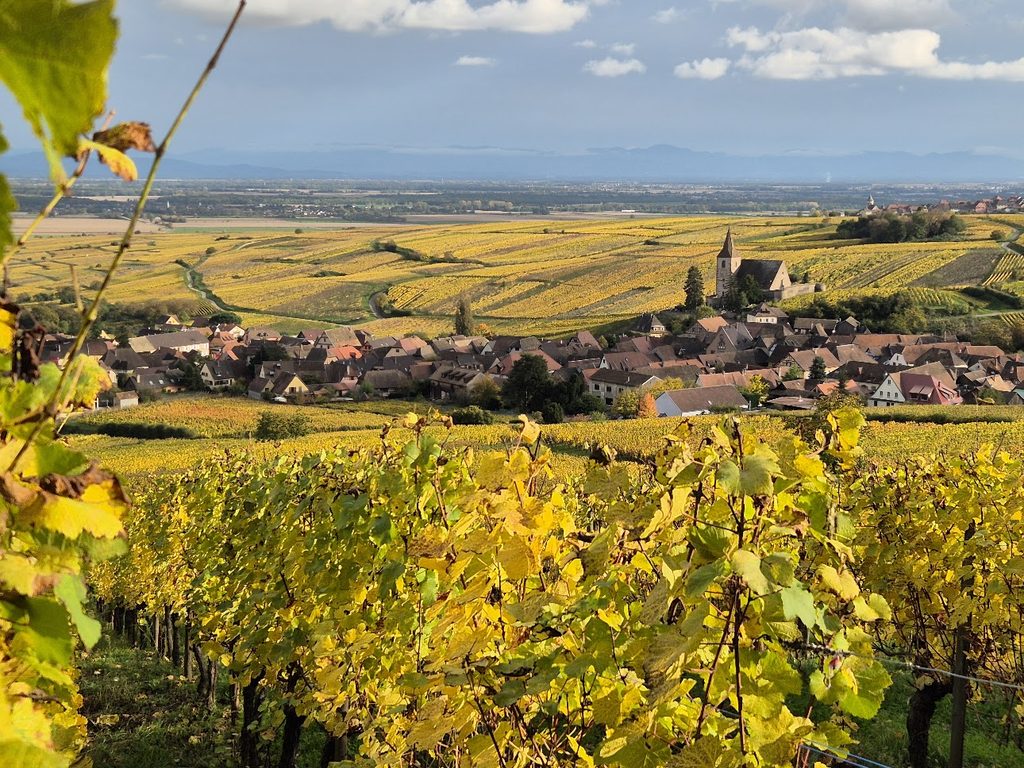
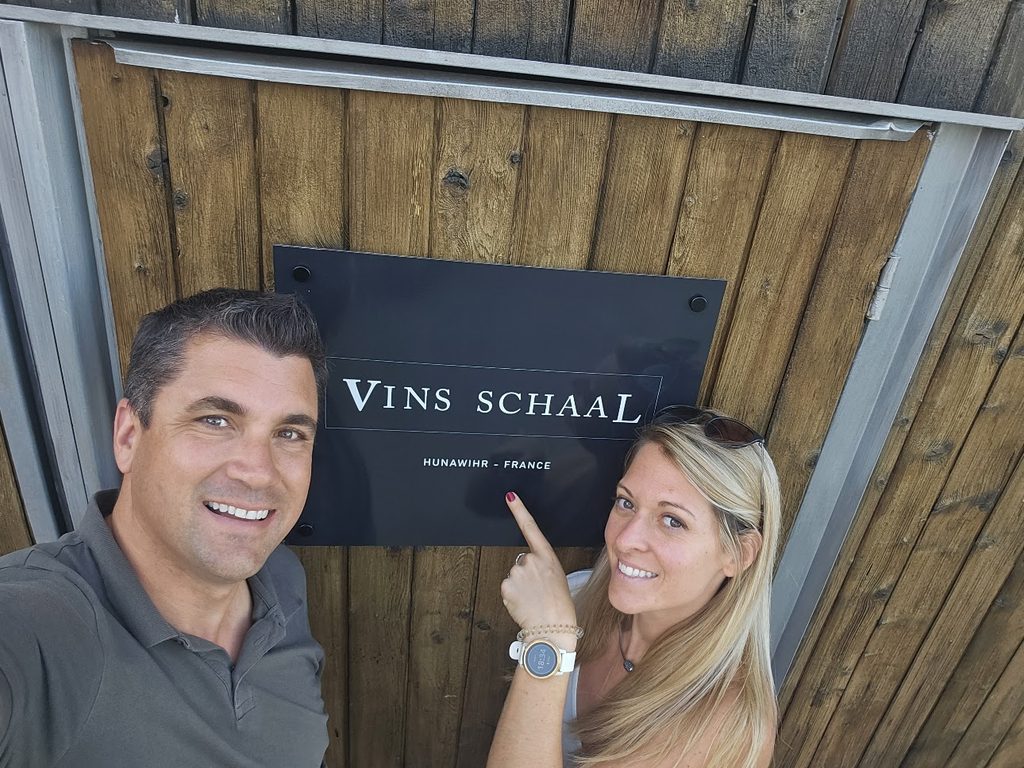
After visiting Julien Schaal in Hunawihr, I proposed a small adjustment to the geography of wine. We should stop describing his winery as the one beside the famous Clos Sainte Hune. It would be perfectly reasonable to say that Clos Sainte Hune was the vineyard beside the Schaal winery.
It was a joke, of course. But it was also a heartfelt compliment to wines that had given me much more to take away from Hunawihr than another address in my notebook. Julien had hardly chosen an unassuming neighbourhood: Clos Sainte Hune, within the Rosacker Grand Cru, is one of the great names in the world of Riesling. It takes something to stand out there. His wines did.
I tasted them again later in South Africa. The same precision and elegance, though the glasses held different grapes and different landscapes. In the meantime, we exchanged invitations and tried to find a weekend when Julien could bring his family to Croatia. Their calendar is far from straightforward. When your livelihood involves two harvests a year, on two hemispheres, a free date becomes a luxury in its own right.
Then Julien and Sophie sent me their answers to my questions. Among his memories of starting out in wine, her ambition to create perfumes and their meeting over Beaujolais Nouveau was a description of a morning unlike those in most winemaking families.
“When we’re in South Africa, we stay in a house halfway between Sophie’s cellar in the Swartland and mine in Elgin. So every morning, we each head off in different directions to our respective wineries!”
Their parents look after the children.
“We always bring them along to help while we’re working. Sophie and I spend the day making wine in completely different places, and in the evening we all come back together as a family. It’s quite an unusual way of organising family life, but it works really well for us. I think it’s a wonderful experience for the children and their grandparents.”
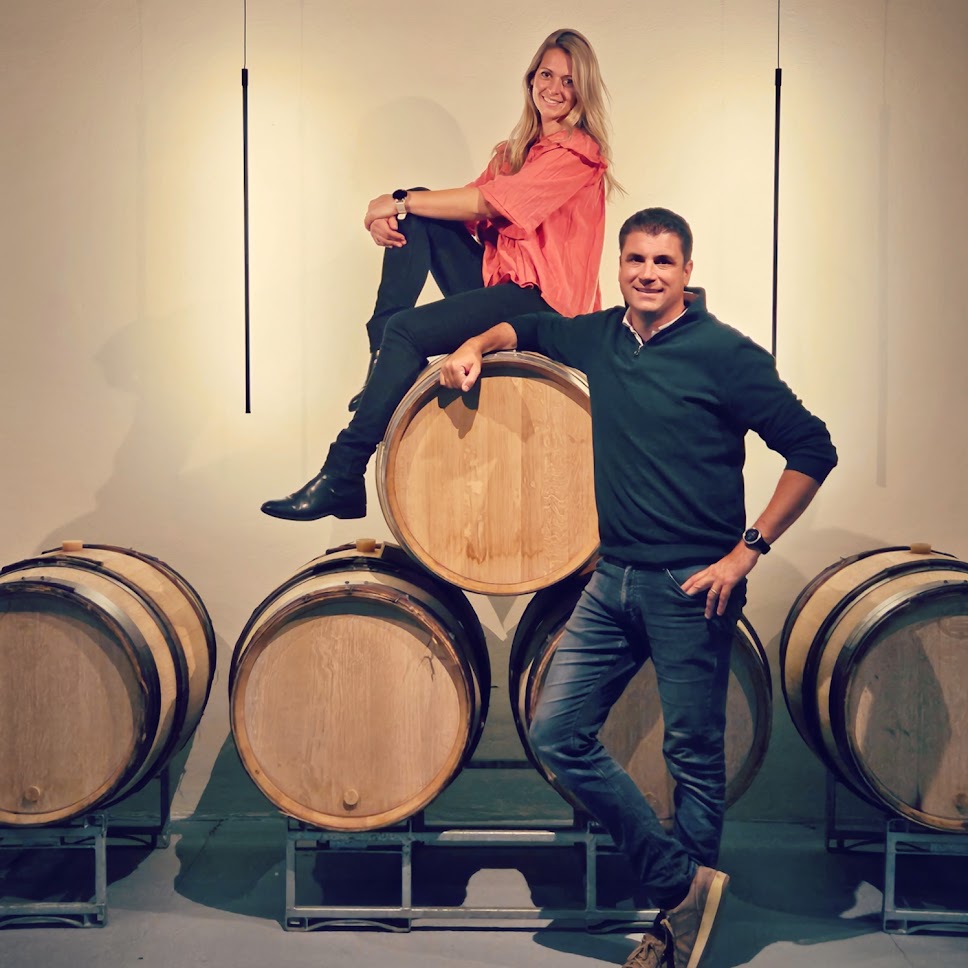
In Hunawihr, the arrangement is different. They share a cellar, work together and do almost everything themselves. Their family life moves between continents, while the wines carry two names. Some say Julien Schaal; others, Sophie Schaal. Both of them stand behind both signatures.
“We make all the decisions together, regardless of whose name appears on the bottle!”
They did not arrive at this arrangement by following some long-established plan. Julien wanted to be a sommelier. Sophie imagined a future in perfume. Each travelled to South Africa and came back with a different idea of what their life might become.
Julien grew up in a family with no background in winemaking. Wine was on the family table, as it is in so many French homes, but there was no vineyard behind the house for him to take over one day. During his hotel management studies, he became interested in choosing and buying wines for restaurants.
“I found it absolutely fascinating! After graduating, I decided to take an additional qualification in sommellerie. And that’s when I realised that my real passion wasn’t the hotel or restaurant business, but actually making wine myself.”
There was no single decisive bottle he could retrieve from memory and point to as the beginning of it all.
“It was more a fascination with the history of French wine, the traditions, the terroirs and the knowledge passed down from generation to generation. I think that’s what really made me fall in love with the world of wine.”
Before he had barrels of his own, however, there were plenty of other people’s bottles to serve. A job on the French Riviera promised the young sommelier precisely what he wanted: conversations with guests, unfamiliar wines to introduce, the pleasure of seeing someone try something on his recommendation that they would never have ordered themselves. It did not take reality long to dismantle that picture.
“I was really excited about advising customers and introducing them to lesser-known wines and hidden gems. But the reality was quite different. There was a large Russian clientele, particularly in fine dining restaurants, and wine choices were often driven more by prestige and reputation than by the sommelier’s recommendations.”
Dom Pérignon. The great names of Bordeaux. Then Dom Pérignon again.
“I still remember the endless bottles! Of course, these were fantastic wines, but I quickly realised that my role as a sommelier was rather limited in that environment.”
The wines were not the problem. What troubled him was how little room remained for the work that had attracted him in the first place. He wanted to help people discover wine, and increasingly he wanted to make it.
“I started questioning what I really wanted to do. I realised that what fascinated me most was understanding how wine was made and actually being part of the winemaking process. So I decided to change direction, and I was lucky enough to be accepted into the viticulture and winemaking school in Beaune.”
Many of his fellow students already had a future with a family name, a vineyard and a cellar address attached to it. Julien was one of the few without that inheritance. His girlfriend at the time, however, came from a family with vineyards in Alsace. Through them, he encountered the practical side of the profession.
“I’d already had the opportunity to discover what working in the vineyards and the cellar was really like. Those experiences only strengthened my passion and confirmed that this was exactly what I wanted to do.”
He worked for his former partner’s family in Alsace from 1999 to 2011. But his education also took him much further afield. One of the most important lessons awaited him in the southern Rhône, at Domaine du Vieux Télégraphe, with the Brunier family.
The 2002 vintage was so difficult that it could teach something a successful year might easily conceal: when to admit that a wine is not good enough for the name it is supposed to bear.
“The Brunier family gave me such a warm welcome. I was happy and proud to work with them. But 2002 was far from being the best vintage in Châteauneuf-du-Pape. An enormous amount of rain, over a hundred millimetres, fell right at the beginning of harvest. And afterwards there was no Mistral to dry the vineyards.”
Conditions were extremely difficult. The wine did not reach the standard they expected. They decided that there would be no wine under the Vieux Télégraphe label from that harvest; instead, they released Télégramme.
“It was one of the most valuable lessons I could have learned as a young winemaker. It taught me that you have to be absolutely uncompromising when it comes to quality. If you’re not three hundred per cent convinced that a wine deserves to carry your name and your label, then you simply shouldn’t bottle it under that name. That experience has stayed with me throughout my career.”
Through the Bruniers, he also found his way to Lebanon and the wine country of the Bekaa Valley. He remembers a warning from Mr Bourgui that later proved to be a promise.
“He told me, ‘You’re still young, and there will probably be many things you won’t fully understand about what you see and experience in Lebanon. But I can promise you one thing: this journey will stay with you for the rest of your life.’ And he was absolutely right!”
In Lebanon, he bought grapes from the Bekaa Valley, close to the Syrian border, and went to Damascus on Saturday nights to enjoy himself. Yet when he speaks about what he brought home from that journey, he dwells on the people he met and on life beyond the security he had grown accustomed to.
“I discovered an extraordinary country and met people whose kindness and generosity were unforgettable. That experience really shaped the way I see the world and gave me a lasting love for the Middle East, its food and its culture. We sometimes forget how lucky we are to live in countries that enjoy political stability and security. Lebanon showed me how extraordinary human beings can be, even when faced with incredibly difficult circumstances.”
South Africa won him over in a different way. He first went there in 2003, with little idea of what to expect, a few books read and an opportunity that had arisen unexpectedly.
“The moment I arrived, I fell in love with the place. The contrast with France was enormous. South Africa was going through a period of incredible transformation, with so much happening and changing. For me, it felt like discovering a completely new world, opening a new chapter in my life.”
His parents came to visit towards the end of his stay. One of the first things he told them was that he would be coming back.
“I think I knew almost immediately that this wouldn’t be a one-off experience. And more than twenty years later, that love is still just as strong.”
He worked at Bouchard Finlayson, met people and discovered how open relationships between winemakers could be. He grew particularly close to Gordon Newton Johnson. A dinner over steaks and a few brandies became part of the story of how Julien’s own wines began. His account of that evening involves persuading Gordon to join him on an adventure, but when I asked what Gordon had actually made possible, the answer was very clear.
“He offered me the chance to work alongside him in the cellar, and in return I would be allowed to use all his winemaking equipment and facilities to produce my own wine. For a young winemaker dreaming of making his own wines, it was an extraordinary opportunity, almost too good to be true!”
In 2005, he committed all his savings to that opportunity. Five thousand euros became grapes for his first vintage. He began with a few barrels of Chardonnay and Syrah.
“At that age, you have a certain amount of naivety and fearlessness, which is probably exactly what you need to start a new adventure. Those five thousand euros represented absolutely all my savings. I’ll never forget the look on my grandfather’s face when I told him I’d spent every last euro buying grapes in South Africa! Let’s just say he wasn’t entirely convinced it was the smartest investment I could have made!”
The biggest problem, it turned out, was not making the wine. With Gordon’s help, that was easier than setting up a company.
“As a French citizen trying to establish a business in South Africa, the administrative side was far from straightforward. Strangely enough, making the wine was probably the easiest part of the whole adventure. And once again, I have Gordon to thank for making that possible.”
His gratitude is more than a passing courtesy in these answers. He returns to it several times.
“I owe him a great deal. Without his generosity and trust, my journey as an independent winemaker might have been very different.”
Julien later wanted to buy his own farm in South Africa, plant vineyards and build a winery. Restrictions on subdividing existing farms pushed the cost beyond what he could afford. At the same time, he was building a business in Alsace. He had to decide where the money would go.
“Unfortunately, you can’t do everything at once! In the end, we decided to continue with our original model in South Africa, sourcing high-quality grapes from selected growers and renting cellar space equipped with all our own winemaking equipment. Interestingly, this South African experience became the foundation of our business model in Alsace. We applied exactly the same philosophy of sourcing exceptional grapes rather than owning vineyards.”
“The design and organisation of our winery in Alsace were directly inspired by everything I had learned and developed in South Africa. So South Africa didn’t just give me the opportunity to make my first wines. It also shaped our entire approach to winemaking, both there and in Alsace!”
He established his own Alsace winery in Saint-Hippolyte in 2011, focusing on Grand Cru wines. He did not wait until he could assemble enough land for the estate he had imagined. He chose a business he could develop by working with people who already owned vineyards.
Meanwhile, Sophie was completing her own journey towards wine. She grew up in Burgundy, not far from Chablis. In her family, wine accompanied gatherings around the table, but at first she imagined her future among aromas of a different kind.
“I wanted to work in the perfume industry as a perfumer, creating fragrances using my sense of smell. Since I already had a passion for wine, I decided to combine that fascination with aromas with my love of wine and study oenology at the University of Dijon.”
She went to South Africa in 2013 to gain experience and improve her English. On her return, she was supposed to take a job in a wine analysis laboratory in Burgundy. There was a perfectly clear and sensible plan.
“That was the plan, at least!” she adds.
She had met Julien before leaving for South Africa, in Beaune, on the third Thursday of November 2012. In France, that date needs no further explanation.
“It was Beaujolais Nouveau Day. So naturally, we had absolutely no choice but to order a bottle of Beaujolais Nouveau!”
He was immediately charmed by her personality, her enthusiasm and her excitement about the South Africa she had yet to discover.
“I think it’s quite funny that our story together started with a bottle of Beaujolais Nouveau. Not necessarily the most prestigious wine in Burgundy, but certainly one I’ll always remember!”
For a man who had left the Riviera weary of orders for prestigious labels, it was a lovely bottle with which to begin a love story.
Sophie did improve her English. But the laboratory in Burgundy no longer looked like her only possible future.
“The experience completely changed my life and my career plans. Instead of following the path I’d originally imagined, I moved to Alsace as soon as I returned. It’s amazing how one experience, which initially seemed like just another opportunity to discover the world, ended up changing the entire course of my life!”
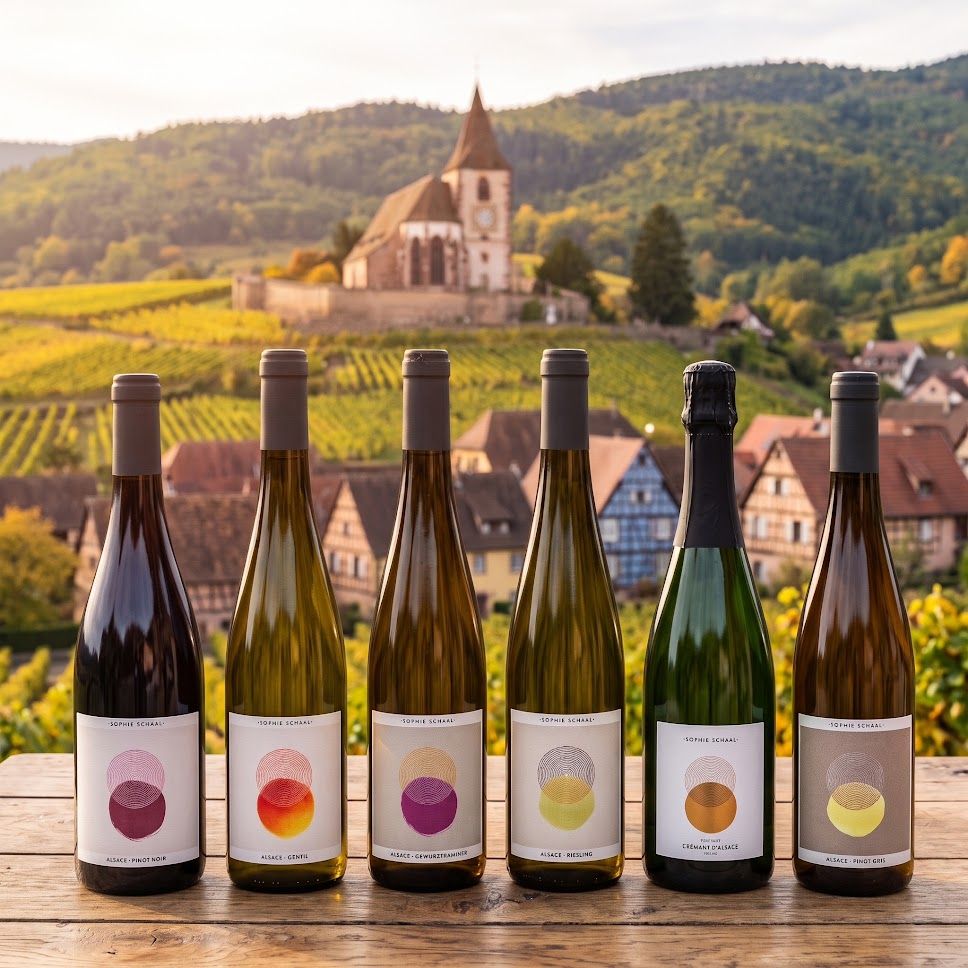
She joined Julien in Alsace in 2013. In time, she wanted to develop an Alsace range of her own. His name was already associated with Grand Cru sites. Together, they decided that the other Alsace wines would carry hers.
“It made much more sense to create a second range under Sophie’s name than to put everything under the Julien Schaal label. In reality, all the wines are made together, and we’re both equally involved in every aspect of the winemaking process. The differences are the terroirs, the appellations and the identity of each brand.”
The first vintage of Sophie Schaal’s Alsace wines was 2020. Having her own name on a label did not give her a supporting role in the other wines, any more than it made Julien a visitor to her decisions.
“We know each other extremely well, and we rarely have disagreements when it comes to the vineyards or the cellar. We’ve learned to discuss things openly, share our different points of view and explain our arguments. We give each other the freedom to experiment and try new ideas. But we never make a decision unless we’re both comfortable with it.”
I tried to draw out a good winemaking marital disagreement: a decision one of them had pushed through against the other’s wishes, only to be proved right. They offered me no such bottle.
“It’s a wine made by four hands. Every decision is shared and fully embraced by both of us. I think that’s what makes working together so enjoyable.”
In Alsace, Sophie devoted particular attention to Pinot Noir. As a Burgundian, she cared deeply about the variety, but she had to discover what kind of Pinot Noir she wanted to make in the place she now called home. Her first assumption sounded convincing enough: find old vines.
“I quickly realised that this wasn’t necessarily the best approach in Alsace. Many of those older vineyards had been planted with vine material that wasn’t originally selected with quality as the main priority. We ended up with large berries and big bunches, which weren’t what I was looking for.”
A ten- or twelve-year-old vineyard planted with carefully selected Burgundian clones could, it turned out, produce more interesting grapes. It took several vintages, tastings and changes in their choice of parcels.
“One thing has always been very clear to me: I want to make a true Alsace Pinot Noir. I love its beautiful, vibrant cherry character, and I think it’s something we should celebrate. I don’t want to copy Burgundy.”
One ambition still awaits her: a Pinot Noir from the Hengst Grand Cru.
“That would be a fantastic opportunity! But when you work by purchasing grapes, finding access to that kind of exceptional fruit certainly isn’t easy.”
That is one of the limits of their chosen model. Access to a particular site depends on the people who farm it and their decision about whom to entrust with the harvest. Relationships with growers therefore have a very tangible value.
“We’ve decided that all the grapes we use for our wines must come from organically farmed vineyards. That already sets strict requirements when selecting vineyards and growers. We discuss the harvest date together. It’s important that everyone understands what we’re trying to achieve with the wine and that we respect each other’s experience, knowledge and decisions.”
They are just as open about price.
“For us, it’s all about building long-term relationships. There’s very little point in negotiating aggressively to improve your margins for one vintage if it makes your grape supply more difficult or uncertain in the years to come. We want the grower to be happy to sell us their grapes and to have every reason to continue working with us.”
Julien also worries about the other side of cheap grapes in South Africa: if a vineyard does not earn enough, its owner has good reason to consider pulling out the vines and planting a more profitable crop, such as apples. Grape prices help determine whether a vineyard survives at all.
“I think we’re probably among the buyers paying some of the highest prices for grapes! But we’re also extremely demanding when it comes to quality, so I think that’s only fair. Great grapes come at a price. We’d much rather invest in quality and strong relationships than try to save a little money at the expense of either.”
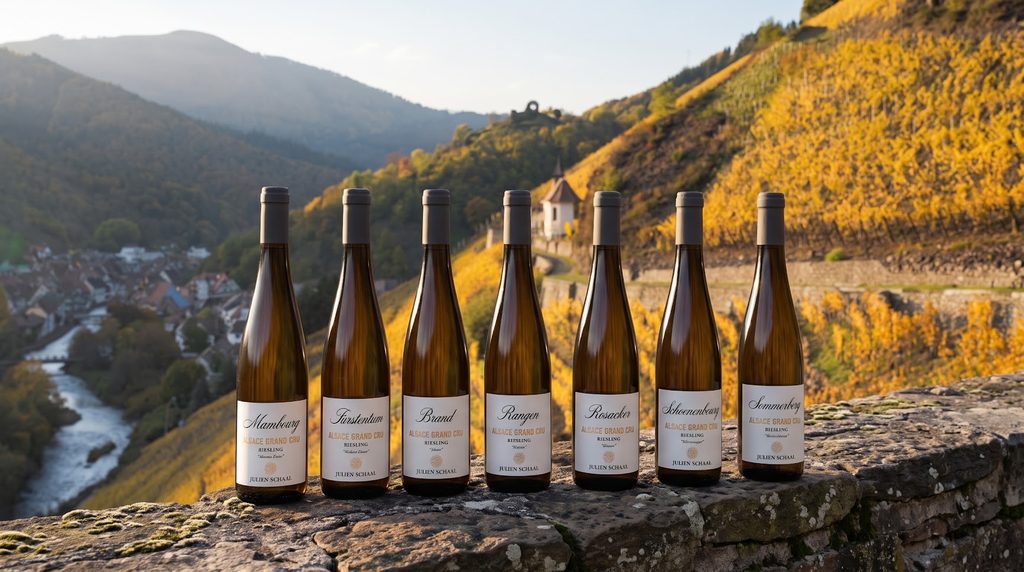
In the Alsace part of their world, Riesling provides a route through different geological foundations. Sandstone, schist, limestone, granite, volcanic rock, marl, gypsum: the names and descriptions of soils on Julien’s labels invite you to taste the wines side by side, looking for differences that have nothing to do with a change of grape variety.
“What I particularly love about the Alsace Grands Crus is the geological diversity and the opportunity to discover how each terroir gives a wine its own unique personality.”
I asked which site had surprised him most. He chose Sommerberg.
“It’s a granite terroir, with all the beautiful aromatic characteristics you’d expect from granite. But what makes it particularly fascinating is that, because of its geographical location, there’s also a limestone influence that brings incredible complexity to the palate. For me, it’s perhaps one of the most complex geological expressions among the sites we work with.”
They want to express all that diversity through dry wines. It is no casual commitment when ripeness, acidity and weather conditions change from year to year.
“The challenge is to make sure the grapes reach full ripeness while retaining a beautiful level of natural acidity. We don’t allow our Rieslings to undergo malolactic fermentation because we want to preserve their freshness, aromatic expression and natural acidity. We adapt our harvest dates to each vintage, but we never compromise on making dry wines. We don’t want residual sugar levels to fluctuate simply because the growing conditions have changed.”
They seek to balance acidity with texture rather than sweetness. Working with the fine lees and gentle stirring help give the wines body, but the crucial decision is made in the vineyard. Julien describes watching each parcel as harvest approaches with a comparison that makes sense even to someone who has never stood beside a wine press.
“Sometimes it’s almost like watching a pot of milk on the stove. You really can’t take your eyes off it for a moment!”
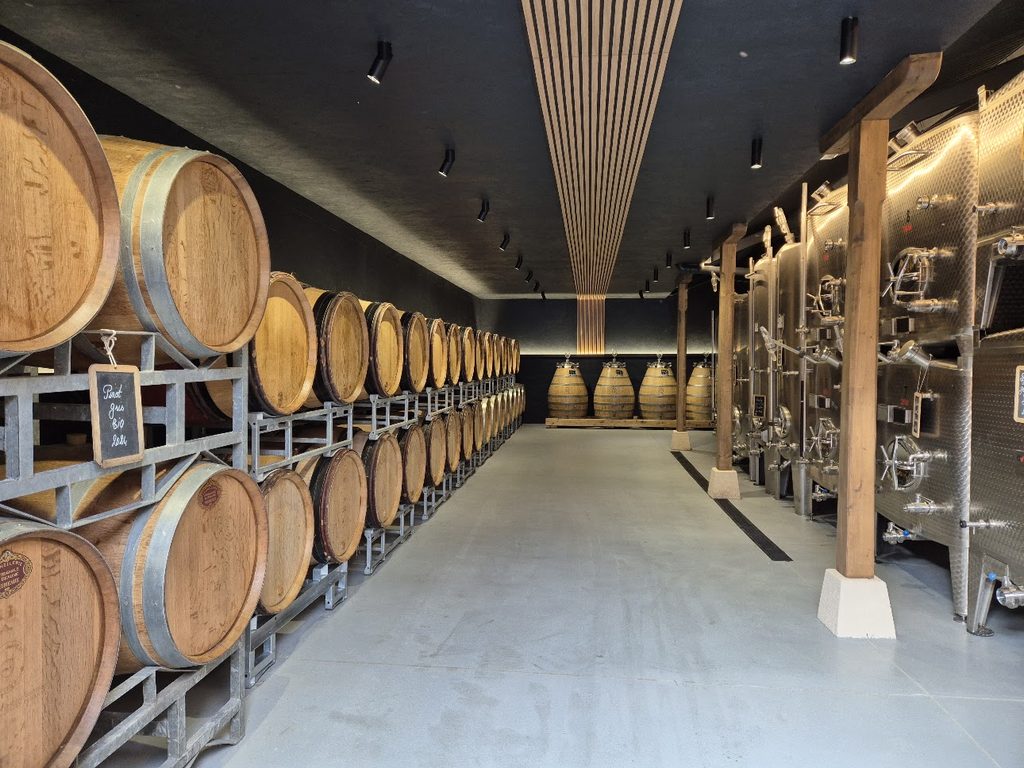
They established their new winery in Hunawihr in 2023. Its equipment includes egg-shaped concrete tanks shipped from South Africa. They cost less than buying them in Europe. South African experience had therefore reached Alsace in a very tangible, and decidedly heavy, form.
In South Africa, Julien seeks Chardonnay and Pinot Noir in cooler areas. Elgin, Walker Bay and Hemel-en-Aarde offer him different possibilities from those Sophie explores in the Swartland. His wines are made in the cellar at Paul Clüver, and his Mountain Vineyards Pinot Noir 2023 from Walker Bay was named Pinot Noir of the Year in the 2025 Platter’s Guide.
When I tasted his wines, their precision and elegance interested me far more than a list of awards. Still, it is good to know how far a name has travelled since it first filled a few barrels thanks to Gordon’s trust and savings that had left a grandfather unconvinced.
Sophie was drawn to a different southern landscape. The Swartland is warmer and drier, with old vineyards and bush vines growing without trellises.
“It’s almost another world compared to what we’re used to working with. That’s exactly what makes it so fascinating to me!”
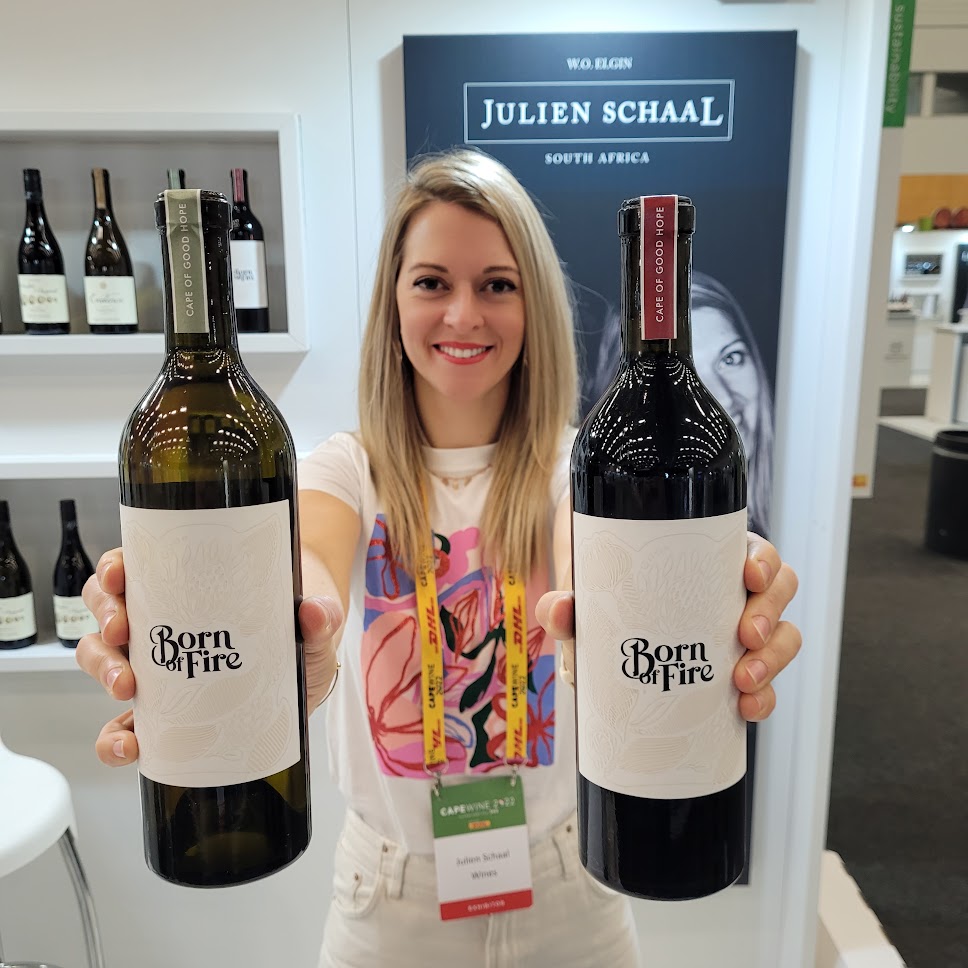
The first vintage of her South African wines to be released was 2021. The range is called Born of Fire. The name preserves her fascination with fynbos, the Cape’s plant life, in whose renewal fire plays an important role. For many of its plants, fire helps release seeds or stimulates germination. The label bears a pincushion flower from the protea family, which for her represents the resilience and richness of the Cape’s flora.
Sophie also connects her desire to work sustainably with motherhood. Thinking about what you leave behind has acquired a personal weight. In wine, that commitment meets an actual vineyard, its grapes, its farming practices and the people who look after it.
For Born of Fire, she makes Chenin Blanc and Syrah. The Chenin comes from a vineyard planted in 1986, with dry-farmed bush vines on the Swartland’s shale soils. They found it through a recommendation.
“That’s one of the great things about the South African wine industry. It’s a relatively small world, and pretty much everyone knows everyone! There’s a real sense of community among winemakers. People are very happy to share information and recommend interesting vineyards or special little spots they’ve discovered. And sometimes that’s exactly how you come across a truly exceptional parcel!”
Her own South African range gave her room to explore wines different from Julien’s.
“We realised how valuable it was to have two distinct identities, each with its own philosophy and style. I was particularly interested in the Swartland and in making wines with a very different personality from Julien’s range, which focuses on cooler areas. It allows us to explore different styles and gives each of us the freedom to express our own vision.”
Yet the freedom of two signatures does not diminish the work of those four hands. In Alsace, the physical effort makes that especially clear.
“There, it’s just the two of us doing absolutely everything, from collecting the grapes in the vineyards to all the work in the cellar. We have to be involved in every single step. In South Africa, we have more people helping us, particularly in the cellar. We spend more time organising and managing the teams.”
Two harvests mean more experience and more opportunities to learn, but also more moments when the schedule has to be put back together. Paul Clüver Jr particularly values Julien’s calm approach to difficulties and the phrase he has come to associate with him: “It is not a problem.”
I asked whether that applied at home too. They did not offer a list of occasions when the phrase had failed them.
“When you start from scratch and build a winemaking business in Alsace and South Africa, you have to be flexible and learn to deal with problems as they come. There’s always something unexpected happening. The most important thing is to take one challenge at a time, put things into perspective and remind yourself that there’s a solution to almost every problem.”
It sounds simple, but for them that sentence has repeatedly become work that needs doing. Grapes must be found, along with a grower, cellar space, money and people you can trust. Flights must be booked and childcare arranged. Every parcel needs checking at just the right moment, like milk about to boil over.
And then there must still be enough pleasure left for everyone to come together again in the evening.
“You can’t control everything,” Julien says, “but you can always control how you react to the challenges you face.”
Of everything they have told me, I find myself returning most fondly to the bottle with which their shared story began. Julien now makes Alsace Grand Cru Rieslings and South African wines that win major awards. Sophie has Burgundy, Alsace and old-vine Chenin from the Swartland behind her name. Both know how much work it takes for a wine to deserve its label.
But when Julien remembers meeting Sophie, he is perfectly happy with Beaujolais Nouveau. “Certainly a wine I’ll always remember!”