Rain was falling so heavily in Irig that I could barely make out the truck-choked town through the wet windscreen. Lights fractured across puddles, traffic crawled through the centre, and beside the traffic lights on the road in from Iriški Venac, a man waited on an old Tomos moped, looking as wet as though he had swum there.
Dragan T. Zarić began waving as soon as he saw me, showed me where to turn, then climbed onto his moped and led the way. He had neither gloves nor waterproofs, and rain streamed down his face without visibly affecting his mood. When I parked beside his Tomos, he briskly established the order of proceedings:
“First, let’s have a coffee and revive ourselves a little. Follow me.”
He was soaked through and chilled to the bone, but behaved as though the problem existed only in my head. When I asked whether he was cold, he answered calmly, almost surprised that I was concerned:
“You won’t hear me complaining, about rain or about life. People ask whether I’ve ever regretted getting involved in wine, and I tell them the same thing I’m telling you now, while you worry about whether I’m cold: at sixty-five, I no longer have anything to regret. This is my last adventure in life.”
That sentence brought together the humour of a man for whom wet shoes were insufficient reason for a bad mood and the seriousness of someone who had already started over several times. He had been a painter, gallery director, emigrant and film scenic artist. From Šid, by way of Bijeljina and Belgrade, he had reached Canada, then returned from Vancouver to a vineyard between the two Hopovo monasteries. The road to that vineyard had been neither straight nor planned, but Zarić’s life had never depended on neatly arranged signposts.
Perhaps that had been clearest long before wine, when he took art seriously enough to risk his freedom over an exhibition. At the centre of that episode was Mića Popović, a painter whose important works sometimes reached the public only after the authorities had tried to hide them.
“Do you know who Mića Popović is?” he asked me.
“Of course.”
“Well, in that enormous life of his, he had two exhibitions that were fully installed and then closed to the public. As an art student, I knew everything about them. One day, I was walking through Belgrade and spotted Mića Popović in the street. I stopped him, introduced myself, told him how much I admired him and invited him for coffee. ‘Of course,’ he said, and off we went to Kolarac.”
Zarić remembers every detail: the wooden seats, the steaming coffee and the disbelief of a young student talking to one of his artistic heroes. Some ten years later, he became director of the Milenko Atanacković Gallery in Bijeljina and called Popović again. He invited him to exhibit, and the painter remembered both him and their meeting at Kolarac.
When Dragan sent him the list of works he wanted to show, Popović realised that he had chosen precisely the paintings that had once caused him trouble with the authorities.
“He simply said: ‘Don’t, son. They’ll arrest you.’”
Zarić followed that advice about as closely as he would later heed warnings against making serious wine without an education in oenology. He borrowed the paintings from the Museum of Contemporary Art, installed the exhibition and sent footage of the opening to Emir Kusturica. Two days later, a brief message arrived:
“It’s arranged.”
The television evening news ran a report on the exhibition, including Popović’s painting of Josip Broz with the Dutch royal family, in which Tito too was portrayed as a king. Zarić remembers saying to himself:
“Zarić, you’ve done your bit. Now they can arrest you.”
He had not acquired that attitude towards authority in the gallery. He was born in Šid, the town of Sava Šumanović, whose winter landscapes he likes to compare with Bruegel’s. Naturally, he would never compare himself artistically with Šumanović, but he did find one family connection.
“I wouldn’t dare compare myself with Sava Šumanović, but we have something in common: both his father and mine were butchers.”
Childhood took him from Šid to Velika Plana, then Šabac and Bijeljina. In Belgrade, he initially enrolled in medicine and completed two years, but could never quite reconcile anatomy with his feverish reading of philosophy. The more he learned about the body, the more he was drawn to questions whose answers could not be found in an anatomical atlas.
The Academy of Fine Arts was a more natural choice. He graduated under Radenko Mišević, and the writer David Albahari was among his student friends. There, he learned that looking is not passive, and that an artist conveys both what stands before him and his way of seeing it. Many years later, he would carry that principle into wine. Before that, however, war would shatter his view of the world.
“I watched people look at me sideways simply because my wife is Bosniak and I’m a Serb. It was madness. There’s a Latin saying: Non est salus nisi in fuga-there is no salvation except in flight. I went to Canada. Had I been wiser, I would have left earlier.”
He arrived in Vancouver as a painter who described himself as a realist expressionist. He organised several exhibitions and tried to continue along the path he had begun at the Academy, but soon realised that galleries wanted him to adapt to the market. Most asked for smaller formats and lighter colours, something easier to sell and fit into someone’s living room.
“I refused to work to someone else’s dictates. So I withdrew from that world.”
His paintings were dense and dark, far removed from the decorative qualities gallery owners sought. Rather than adapt his own style to their wishes, he found work in which the client clearly defined the task but demanded exceptional skill in its execution. He entered the film industry and became a scenic artist.
“The first series I worked on was called Dead Man’s Gun. Later, I worked on more than a hundred films and television series, including the X-Men sequels, Fantastic Four and The Chronicles of Riddick. There’s a simple rule in that business: you’re only as good as your last job, and your last job is the one you’re doing today. You can’t relax, because if you aren’t completely serious and good at what you do, you won’t be there tomorrow.”
There was a logic to that apparently contradictory decision. As a gallery painter, he did not want anyone prescribing what he should feel or how he should express himself. In film, he accepted an assignment because he was selling his knowledge, craft and discipline. The film set became a place where he could serve someone else’s vision without betraying his own.
The work brought security and enough money to finance what would become the most expensive passion of his life. Wine appeared almost incidentally, through Zvonko Marković, a building caretaker and art lover whom he described as “some fellow from Avala”. After a long late-night discussion, Zvonko asked him:
“Zarić, would you like to make your own wine in my garage next year?”
Dragan agreed. He made his first wine in 2005, without a vineyard of his own or any clear intention of turning it into more than a new experience. A year later, he obtained outstanding grapes from California and made a decision that would reconnect him with the country he had left:
“If I’m going to take wine seriously, I’ll make it exclusively from my own vineyards.”
The decision to use his own grapes emerged from the same challenge that had drawn him to painting: creating something entirely personal from material found in nature. The difference was that he could control almost everything on canvas, while weather, soil and plant life continually demonstrated the limits of his power in the vineyard.
“In my paintings, I try to understand nature, history, my own life and the things around me. Painting and winemaking are similar in that respect because they’re deeply personal. Paul Klee has a book called The Thinking Eye. Everything we observe leaves a mark on us, and what we create depends on how we’ve seen the world. Wine is like that too. Every producer is individual; there’s no single standard. There is instinct, longing and an ember that drives you to continue.”
His experience as a painter helped him understand transitions and balance. On a palette, he could achieve the shade he wanted and determine a colour’s precise tonal value, but he knew that working across a large surface changed proportions, methods and the sense of measure. Wine, he maintained, was much the same: what mattered was the quality of the grapes and whether the person working with them knew what he was doing, whatever the size of the vessel.
“My motto is that you can make wine in a washbasin if you know what you’re doing. And to know what you’re doing, you have to learn, learn and keep learning.”
He studied obsessively. The two volumes of the Handbook of Enology became his wine Bible, which he constantly carried and read, trying to make up through study for everything he had not gained through formal education. Film had taught him that mistakes were expensive; wine taught him that some became visible only months or years later.
While he was studying oenology intensively, his friend from student days, the internationally renowned production designer Miljen “Kreka” Kljaković, invited him to Serbia to discuss the film St George Shoots the Dragon. Zarić visited proposed filming locations from Bela Crkva to Manjača, but what happened away from the film set would change his life more profoundly.
“On that job, I met Aleksandar Berček, and he brought me to Irig. He showed me a property, then introduced me to Miroslav Kovačević, and Miroslav showed me a vineyard between the two Hopovo monasteries. It took my breath away.”

A few weeks later, he agreed to buy the land from Franc Hercog. He arrived on the appointed day, paid every last dinar and acquired his own place beneath the Fruška Gora sky. A dilapidated little house stood on the plot, which he immediately declared a castle.
“I affectionately call it Château. It’s actually the only property in my name and the address registered on all my Serbian documents. A crumbling little house, but my castle.”
Through Rubin’s oenologist Radosav Cvetković and Professor Nebojša Marković, he began preparing the vineyard. On St George’s Day in 2009, he planted it with the best planting material he could buy at the time. Only when the work was finished and he saw thousands of young vines before him did he fully grasp what he had undertaken.
He described his fear in terms that leave little room for literary embellishment:
“When I saw what it all looked like, I thought my anal sphincters would burst with fright.”
The fear did not deter him. Instead, he began talking to the vines and giving them names, as though the vineyard might be less intimidating if he turned it into a collection of individual acquaintances. Thus, all 21,074 vines at his Hopovo site received a name, at least in principle.
“One is Mila, another Rosemary, then Savka, Ljubica, Željka… I’ve remembered as many as my age allows.”
He planted the vineyard on Fruška Gora but continued living and working in Vancouver. Money earned on film sets went into vines, equipment and maintaining the property, while he supervised much of the work from across the ocean. His workers regularly sent photographs, and no major operation took place without his approval.
“Winemakers in Irig sometimes tell their workers that Zarić looks after his vineyard better from Canada than they do from here. I receive photographs every few days. They do nothing without consulting me, and it all works.”
Distance allowed him little room for a casual approach. What he could not check daily with his own eyes, he tried to compensate for through meticulous planning, study and clear instructions. He maintains that this almost obsessive need to understand every operation saved him from serious mistakes.
“Everything in life is like that: you do something, and only afterwards understand why. The spark lit by Peter Brehm’s Napa Valley grapes never went out. That’s why I’m still learning. I can’t say I haven’t made mistakes, but knowledge saved me from many I might have made.”
If he were planting the vineyard again, he says, he would change one decision: he would plant only Pinot Noir. He sees his greatest challenge in that variety.
“Pinot Noir demands that you know how to guide the grapes. Everything lies in nuances, passages and transitions, and painting taught me that. That’s why I keep returning to it. It doesn’t let you hide anything.”
There have nevertheless been memorable mistakes, although the best-known happened outside the vineyard. Once, for his wife’s birthday, he bought her a bottle of Armagnac from the year she was born. Five days later, she discovered that little of her present remained.
“She said: ‘Dragan, shame on you! You bought me a present and drank it yourself.’”
His attempt to make amends was characteristically Zarić: instead of buying another bottle, he ordered vines of the varieties used to make Armagnac in Gascony-Ugni Blanc, Folle Blanche, Colombard and Clairette de Gascogne-and dedicated an entire vineyard to his wife. Today, he uses them to produce a wine spirit modelled on Armagnac, with little desire to turn it into a commercial product.
“I have spirits from 2012, 2013 and the years that followed. Every year, I produce between fifteen hundred and two thousand litres. I’ll probably never sell them seriously. I’ll leave them to my son; having them is enough for me.”
For him, Armagnac is eau-de-vie, the water of life, but wine remains a mystery. The spirit can wait for his son and for the years that will shape it, while each wine demands a fresh answer to the question that has followed Zarić since the Academy: how to draw something personal from nature without imposing something that was never there.
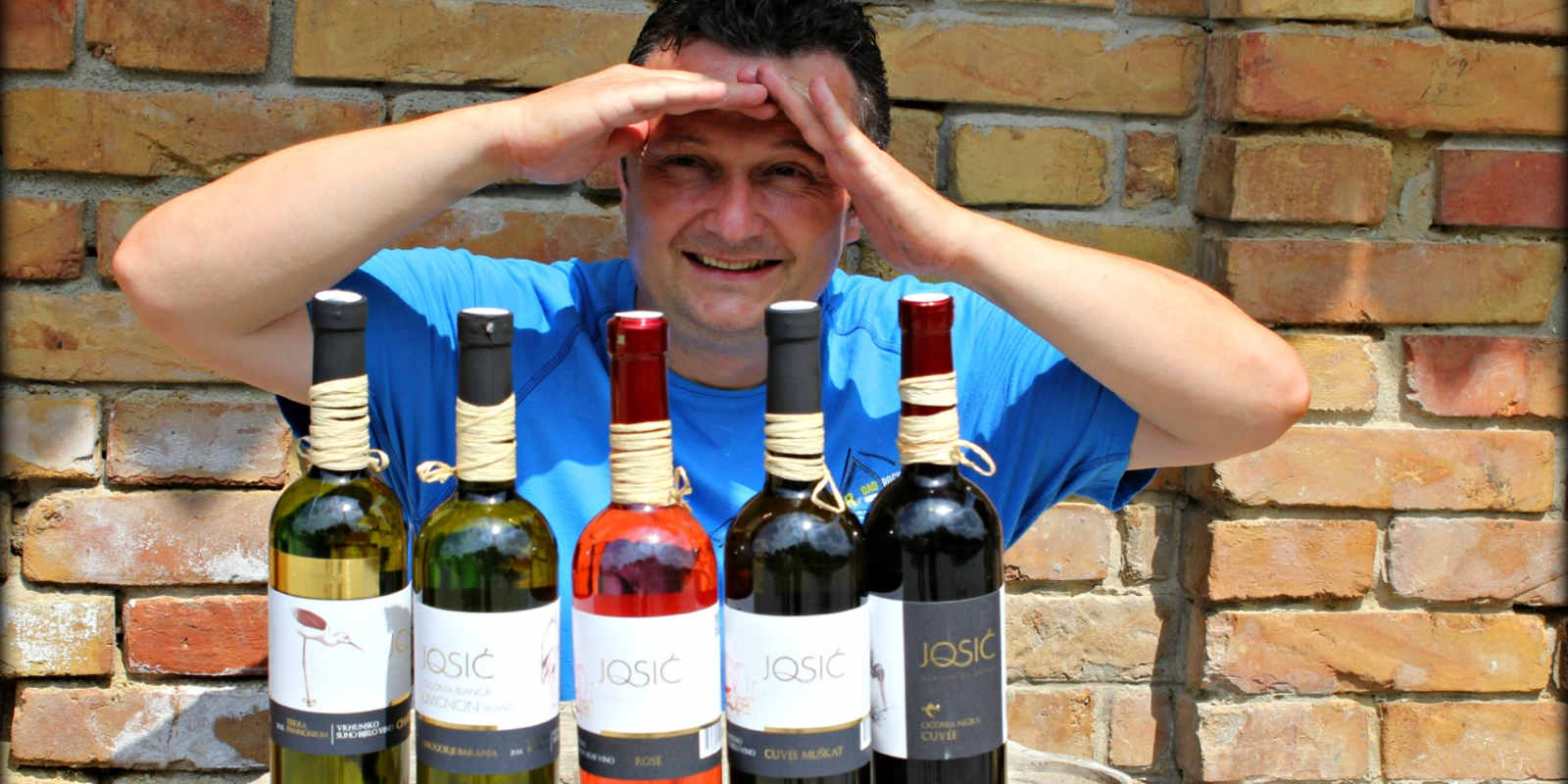
His wines bear names more suggestive of paintings, poems or chapters in a novel than a carefully assembled commercial portfolio. Joakim i Ana-Joachim and Anne-is a white blend; Prvi poljubac, or First Kiss, is a rosé. His reds include Jutro, meaning Morning, and Noći svetog Trifuna, Nights of St Tryphon, while the Pinot Noir Podne-Noon-is his most intimate wine. The names open a space for association, just as a painting need not tell viewers in advance what they should see.
Zarić asks tasters for more than politeness. Once, he invited several of us to say exactly what we thought of his wines. He submitted them to judgement without a safety net, with the same willingness to expose himself that he had once shown in a performance by Želimir Žilnik, walking naked through a vineyard before a film camera.
The Pinot Noirs needed time and decanting, but once they opened, they showed why Zarić would now give the entire vineyard over to that variety. The 2012 Merlot was the most balanced, warm and approachable, while the Cabernet Sauvignon Noći svetog Trifuna remained my personal favourite: a wine that lingered long after the sip.
That does not mean his wines are flawless or that every bottle fulfils everything he imagined. His story is all the more interesting because wine became a new medium for a man who had spent his life moving between worlds: from medicine to painting, from a gallery to a film set, from Yugoslavia to Canada and from Vancouver back towards Fruška Gora.
Although he lives thousands of kilometres away for much of the year, his relationship with the vineyard is far more involved than an investor’s occasional inspection of an asset. Every vine, every photograph sent to him and every decision about the work belongs to a daily life organised between two continents. Film work enables him to finance the vineyard, but the vineyard gives him a reason to return.
“All the money I earned in film went into maintaining this beast of a vineyard and winery. Someone might say it isn’t a particularly wise business model, but I didn’t begin this because I was looking for another job.”
That is why his claim that wine is his last adventure in life hardly sounds like the statement of someone preparing to settle down. In his case, “last” means large enough to hold everything he has learned: a painter’s feeling for nuance, a scenic artist’s discipline, an emigrant’s persistence and the stubbornness of a man who once exhibited banned paintings despite their creator’s warning that he might end up in prison.
Meanwhile, the rain in Irig showed no sign of stopping. The Tomos still stood there, wet and ready to carry its owner back to the vineyard between the two Hopovo monasteries, beside the crumbling little house he had declared a castle. Zarić was untroubled by the weather. After everything he had been through, a few litres of water on his clothes hardly merited complaint.
After all, surely a man who believes good wine can be made in a washbasin would not be frightened by a little rain.