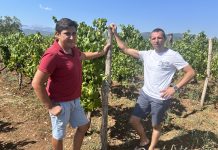
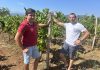
Father and son Dragutin and Darko Bratković will never glorify their role in restoring and revitalising Zagorje’s ‘better past’ – indeed, they will not even be pleased if you call them ‘keepers of the keys to wine history’. Yet whether they like it or not, whether they magnify or play down their role in returning Belina to the wine map of Zagorje and the whole world, the story of the ‘Casanova of Zagorje’, as Belina is affectionately known – Gouais Blanc or Heunisch Weiss, a parent of as many as eighty varieties worldwide, including Chardonnay, Furmint, Riesling and Blaufränkisch – would have been condemned to oblivion without them.
When we talk about Belina, Drago Bratković gradually relaxes and turns everything into a joke. For instance, he replies with a question of his own:
– Did you know we almost planted Bratkovina in our vineyards?
– You’re joking?!
– No.
– All right, why didn’t you do it, then?
– It would have been fun! I remember spending a long time trying to persuade my father to plant Bratkovina in our vineyards, but he always told me that everyone knows what gets planted in Zagorje – you can’t plant a Dalmatian variety among our hills.


– Since the climate has changed considerably, and Zagorje can finally achieve sufficiently high sugar levels alongside good acidity, I once mentioned the idea to Professor Edi Maletić. He was delighted, but said:
– You simply have to plant it!
Edi Maletić, a native of Korčula, has a special relationship with Bratkovina because, besides being a parent of Pošip – probably Dalmatia’s most important white variety – it is noted for its ability to accumulate acidity. Some might say:
– Bratkovina in Zagorje?! Where else would a tear belong but in an eye!
Darko, meanwhile, had something else in mind, something immediately apparent to both eye and ear when the variety’s name and his surname are mentioned.
Bratkovina would be a brilliant idea, if only because the people growing it would be called Bratković. Nomen est omen – the name is a sign!
Beyond the joke about Bratkovina and the reality of Belina, Dragutin and Darko also decided to involve the experts when choosing the ‘dark side’ of their vineyard varieties. These two guardians of tradition are the only people in Zagorje to have devoted themselves to Modra Kosovina – a variety that was once a hallmark of their region.
– With the arrival of phylloxera, Modra Kosovina almost disappeared, and it was never subsequently revived. We literally found just one vine in an old vineyard, and even its owner didn’t know what variety it was.
– The variety has great potential – its flavour is very similar to Pinot Noir, but with a somewhat deeper colour.
– Today we have around two thousand Modra Kosovina vines planted, which have yet to bear fruit.
Dragutin and Darko head Trgocentar, Zagorje’s largest retail chain, with around 130 shops, some seven hundred employees and an annual turnover exceeding seventy million euros. Trgocentar – a true economic giant of Zagorje!
That makes it particularly interesting to hear what connects people with such business credentials to wine.
– I’ve been in vineyards since I was little. My father and mother taught me everything. The vineyards are on the stretch between Sveti Križ and Bedekovčina. Then, in the 1980s, when my son was born, I planted my first, smaller vineyard – just for winemaking as a hobby. I planted the second when my grandson was born, and that one was already a little bigger. I thought I’d stop there; it was more than enough for recreational purposes. But it was love. I planted mixed varieties, without any grand plan, but with plenty of heart, says Dragutin, whose extensive business résumé also includes four years as president of the former Municipality of Zabok.
– When the Faculty of Agriculture and Krapina-Zagorje County launched a project to protect and restore indigenous varieties, they ran into a problem – they had no partner to produce grafted vines or plant vineyards. Then Slavko Merkaš, whom I’ve known all my life, came to me and persuaded me to get involved.
– How?
– Ha-ha-ha, he persuaded me…
At the time, whether by coincidence or not, Trgocentar began expanding beyond conventional retail for the first time.
– We were hiring agronomists and agricultural technicians – people who know how to work the land – and opened around twenty agricultural supply shops.
– At the same time, we were buying or taking ownership of several agricultural cooperatives in financial difficulty. Some of those cooperatives also grew vines and fruit and employed qualified specialists.
– And that is how it began. We bought a one-hectare plot for a mother-vine plantation – a mother block – the minimum area for production. In Zagorje, that is an enormous challenge.

– The second problem was finding a suitable location, and the third was that in Zagorje you can hardly find a plot that size in one piece. So we had to buy land from ten to twenty owners and consolidate it all.
– As a rule, ownership and legal issues on most of those plots were unresolved, so additional effort was needed to sort everything out. And last but not least, we had to pay people well, because they didn’t want to sell!
– One hectare of land cost us thirty thousand euros! At the time, a hectare in Slavonia wasn’t worth even five thousand.
– We bought the site and buildings in Mirkovec – a former manor house belonging to a castle estate – where we’re now fitting out accommodation and finishing the winery.
– We now have around ten hectares of vineyards, Dragutin says.
Darko, meanwhile, stresses that Trgocentar, operating since 1963, ‘had never had a pronounced production side before entering the wine story’.
– It all came down to buying cheaply and selling the same goods at a slightly higher price.
– In the meantime, we acquired the property of the Začretje agricultural cooperative and became members of the Krapina agricultural cooperative, which had apple orchards and sold apples. So we became producers ourselves and experienced, for the first time, the challenge of finding a market for our own goods.
– Trgocentar also began producing grafted vines, and today we can boast, for example, that in 2024 we sold five thousand grafted Grk vines to a winemaker on Korčula! – I hope everything we’re doing will also prove to be a good business decision, Darko says.

– Soon we’ll complete the whole chain: from producing grafted vines through vineyards, wine and accommodation to hospitality and selling wines and spirits in our own establishments – with trained people who already work in our agricultural supply shops.
– There probably won’t be fabulous profits, but people will have work and a secure income. For us, that matters just as much as profit. I believe this is the biggest agricultural project in Zagorje today!
– And it all began with our clearly expressed wish to bring Zagorje’s hills back to life.
For Darko, establishing the mother block, like the whole Belina story, was driven by pure enthusiasm from the outset. Naturally, as economists and sensible businesspeople, he and his father do care about ‘whether everything makes financial sense’, but they admit that ‘we’re a long way from recovering our investment’.
– Belina is Zagorje. It’s our identity, something once called sour wine, kiseliš. But that sourness didn’t come from the variety’s lack of quality. It came from people picking grapes early and not knowing any better cellar practices than those they used at the time.
– As a business, Trgocentar is present in every corner of the county, through its shops and agricultural supply stores, and actively participates in community life. So it’s no surprise that we were the ones approached to try carrying out the trial phase of the mother block. And because we act quickly as a company – as soon as we like an idea, we start putting it into practice – we immediately began looking for land on which to establish it.
– What prompted you to get involved?
– Love of wine. And, as one of Zagorje’s stronger companies, we wanted to leave something to the community.
– Our aim is to rescue Belina from oblivion and restore its place at the table – to get people drinking Zagorje wine again.
– We were literally drawn into the wine story. There was such a surge of passion among everyone involved – from Professor Edi Maletić and Slavko Merkaš to County Prefect Željko Kolar – that we couldn’t possibly refuse the invitation.
– First, a local winemaker from Začretje selected the old varieties that had been found, and we, on behalf of Trgocentar, established a proper Belina mother block. That was when we first saw clearly what kind of project this was.

– Wine production followed, and we learned through the first two harvests because we knew nothing about Belina – especially since we had to make wine from a newly planted vineyard, which was another unknown.
Darko describes himself and his father as rather ‘old-young’ – they think alike, and share a passion for vintage vehicles.
– We love old things and restoring them; we aren’t fans of ultra-modern things. We have a nostalgic relationship with the past – from houses and machines to customs. What could be more beautiful than bringing an old motorbike or car back from oblivion?!
– And Belina is really a project that brings an entire wine culture back from oblivion and revives a variety that had almost completely disappeared.
Seen through Darko’s vintage-vehicle eyes, ancient Belina thus became his Honda, which he ‘spent years tinkering with’ to get it running. And that 1979 Honda is the same age as Darko.
Father and son Bratković’s vintage garage also houses a 1952 Zirndorf and a 1968 Jaguar.
Darko did not stray far from that vintage view of the world when it came to ‘christening’ the winery and choosing a name that would finally distinguish it from Trgocentar. And so Trgocentar’s wine chapter acquired an identity of its own – it became Vitus Winery.
– Why Vitus? I asked Darko.
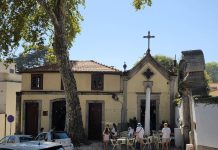
– The vineyards lie at around 350 metres above sea level, on sites overlooked by the chapel of Saint Vid – Vitus in Latin. Saint Vid: the one who sees everything. There’s the link to the winery’s name, Darko explains, adding:
– There’s also the symbolism of Vitis vinifera, the grapevine. And a personal note: my son is called Vito, Mladen’s daughter is Vita, and Edi Maletić’s grandson is also Vito. The winery simply had to be called Vitus, because the name tells the story of all of us who are part of this wine story.
And the story of Vitus Winery, of father and son Dragutin and Darko Bratković, would be unimaginable without their right-hand man – the legendary Zagorje oenologist Mladen Kantoci, originally from Pregrada.
Mladen, too, is happy to point out that his family has been growing vines and making wine for generations.
– It all began with my great-grandfather and grandfather, who did it on a smaller scale, and we continued the tradition. I can safely say that our presence in the cellar has been uninterrupted for decades. That love of wine grew into a desire for further education, so in 1992 I enrolled in winemaking studies.
– After graduating, I began working as a production specialist at the Sveti Križ Začretje agricultural cooperative, and then came to Trgocentar. With my arrival, Trgocentar began taking winemaking more seriously, particularly when the story of preserving Zagorje’s indigenous varieties began – an initiative chiefly driven by Professor Edi Maletić of the Faculty of Agriculture, Krapina-Zagorje County and, of course, Trgocentar.
Mladen humbly admits that at the time he knew almost nothing about Belina as a variety.
– Those Belina vines were present in the vineyards, but they were never particularly valued because they had never been handled properly in production. Belina’s potential was first pointed out to me when I came to Trgocentar.
– I embraced Belina as a challenge – professionally and personally – because everything connected with Zagorje is a challenge for me.
Mladen says that previously there had been no varietal Belina wines in Zagorje – Belina always ended up mixed with other, modern, introduced varieties in various blends.
– So it was a challenge for me to see what the variety could produce on its own in this climate, especially given its proven continuity in this area over the centuries.
– On the other hand, I knew that without seriously reducing Belina’s yields, we couldn’t achieve a quality that would satisfy modern consumers’ tastes.
– What have you learned about Belina?
– First of all, Belina needs a good vineyard site and the winemaker’s attention. Svetokriška Belina can accumulate more sugar, has stable acidity and improves in quality over time.
– Belina buds early and ripens moderately late. The key to success is reducing yields – without that, it would produce as much as five or six kilograms per vine.
– We aim for two kilograms, Mladen says.
– Leaf removal is also essential, to improve airflow around the bunches and help them ripen more evenly.

Everything that followed in the production of Belina filled Mladen with excitement, because:
– What we’re doing with Belina today is for the future, rather than the present.
Their ‘playing around’ with Belina led them to try working with partially dried berries too.
– Admittedly, the berries weren’t dried on the vine; we used ‘the Prošek principle’. We also experimented with late harvests, exploring the variety’s potential to the full.
– We’re learning more and more about Belina’s possibilities. I’m taking part in something important and historic! Mladen says with a smile.
By the end of 2025, Vitus Winery will thus be able to boast of having produced its first sparkling Belina, while another vintage made specifically for sparkling wine is still ageing.
– Belina has proved perfect for sparkling wines: acidity and extract levels are optimal, and the wine performs wonderfully in secondary fermentation. We make sparkling wines by the traditional method – with a second fermentation in the bottle.
– I say this from our experience with two vintages now ageing, Mladen explains.
The sparkling wine will be called Albuelis – the Latin name for the old Croatian Belina – symbolically completing the story of the return of a variety that shaped Zagorje’s landscape for centuries.
The wine’s name thus reflects what Vitus Winery and its people preserve – the connection between the past, tradition and the future of Zagorje winemaking.