A first edition of Stjepan Bulić’s Dalmatinska ampelografija, published in 1949, sits on a shelf at the Bačić winery. Its yellowed pages contain two observations that now read almost like a development plan for the winery, written long ago.
Describing Cetinka Bijela, Bulić notes that it produces a wine of moderate alcoholic strength, balanced acidity and a greenish colour, resembling a northern style of wine. He then concludes that its grapes are suitable for locally produced sparkling wine, although wine made solely from Cetinka was not available for sale anywhere at the time.
– Cetinka was neglected for a long time, perhaps because of old winemaking methods, poor hygiene and lower alcohol levels. It always ended up in blends with varieties that had more alcohol and greater body. Today, with temperature-controlled fermentation and modern technology, we can make a very attractive, fresh, citrusy wine from it, says Petar Bačić, known as Baćac.
In 2017, the Bačićs bottled Cetinka as a single-variety wine. Later, they used it to make Pjer, a traditional-method sparkling wine, while a brandy made from the same variety has been ageing in their cellar for ten years. A few pages before Cetinka, Bulić describes Bratkovina Bijela, whose wine, he writes, can keep for a long time. Much later, Petar measured an almost ideal balance of sugar and acidity in a few bunches found in old vineyards and reached a similar conclusion.
– That is why we planted two thousand Bratkovina vines on the Blato plain. The vineyard is still young, but my idea is to make a serious wine from it, one capable of ageing.
The old reference book is therefore more than a treasured family copy at the Bačić winery. Bulić recorded what Cetinka and Bratkovina might become, and today Petar is testing in the vineyard and cellar how right he was.
The winery is in Črnja Luka, not far from Blato, but before they became winemakers, the Bačićs were restaurateurs. Petar’s father Zlatko ran the Zlinje restaurant for almost thirty years in the interior of Korčula, far from the sea and the main tourist routes.
– In the 1980s and 1990s, tourism was much less developed than it is today, and the restaurant was in the middle of the island. It was not easy to draw guests to a place away from the sea, but my father served excellent food, worked a great deal with fish and was a tremendous enthusiast. Zlinje was open all year, even in winter.
A frequent visitor to Zlinje was Momčilo Popadić, a native of Blato, journalist, poet and one of Dalmatia’s most important lyricists, who wrote the words to songs such as “Oprosti mi, pape” and “Ča je život vengo fantažija”. His visits did not leave the restaurant with a famous song written at one of its tables, but they say something about the place Zlatko created: Zlinje was more than a restaurant in the island’s interior. It was a tavern where people sat, talked and lingered.
– Momčilo Popadić often came to Zlinje. He spent time here and was one of the people who belonged to that tavern. If you ask me what the restaurant was known for, then, besides my father’s food, it was also known for the people who gathered there, Petar says.
Zlatko’s tavern also held the first seed of the future winery. As a restaurateur, he was constantly in touch with winemakers, food and the wines being made on Korčula at the time. As early as the 1990s, he kept saying that Cetinka should be made into sparkling wine.
– Back then, there was hardly any sparkling wine, especially in Dalmatia, so the idea sounded rather unusual. But my father kept repeating it.
In 2006, Zlatko sold the restaurant and left the hospitality business. The family then began planting vineyards and making wine more seriously.
– I wanted to work in agriculture and viticulture because I love nature and being outdoors. My father left the restaurant business and laid the foundations that would allow me to become a winemaker one day.
Petar Bačić Baćac was born in 1992, so he was still a child when his father first spoke of sparkling wine made from Cetinka. He grew up with the land, vineyards and olive trees, in a family for whom farming was no occupation discovered in adulthood.
– When we went to a practical class at the agricultural secondary school in Kaštela and the teacher showed us how to prune an olive tree, I picked up the secateurs and a small saw and started pruning. I was fourteen. The teacher watched me, then told the other children, “You five go with Bačić, and he will show you how to prune an olive tree.”
Something similar happened during his winemaking studies in Poreč. Many of his fellow students came from cities and had previously had almost no contact with the land or manual work, while Petar already knew how to prune vines and recognise the jobs that needed doing in a vineyard. Education did not introduce him to viticulture; it enabled him to connect his family’s experience with modern winemaking.
When he returned to Blato after his studies, he was only twenty or twenty-one. Until then, a more experienced island winemaker had made the Bačićs’ wines, but Zlatko decided the time had come to hand production over to his son.
– My father thanked him and said I had trained for this and would now be making the wine. Other people told him, “Zlatko, you’re mad.” I was twenty-one, and he entrusted the entire production to me.
The winery had only a few labels at the time. Kalina was a white blend named after the area where the Bačićs’ ancestors had owned a small house and an olive grove around five centuries earlier. Kampijun was a red cuvée, named after the old term for a wine sample that merchants would request when they arrived on Korčula by ship to buy wine.
Petar was given more than the chance to carry on the family business: he also had the freedom to change it. Zlatko accepted the proposals made by his son and daughter Mirta, while his understanding of wine remained visible in the winery’s distinctive labels.
Designer Tonka Lujanac first listened to Zlatko’s descriptions of individual wines, then made compositions by hand from vines, leaves, branches, flowers and fruit. Photographs of those arrangements became labels whose colours and botanical details suggest what is inside the bottle.
– Nothing was drawn on a computer. All the labels came from arrangements made by hand, photographed and transferred to paper. When you look at them, they should give you an idea of the wine you can expect in the bottle.
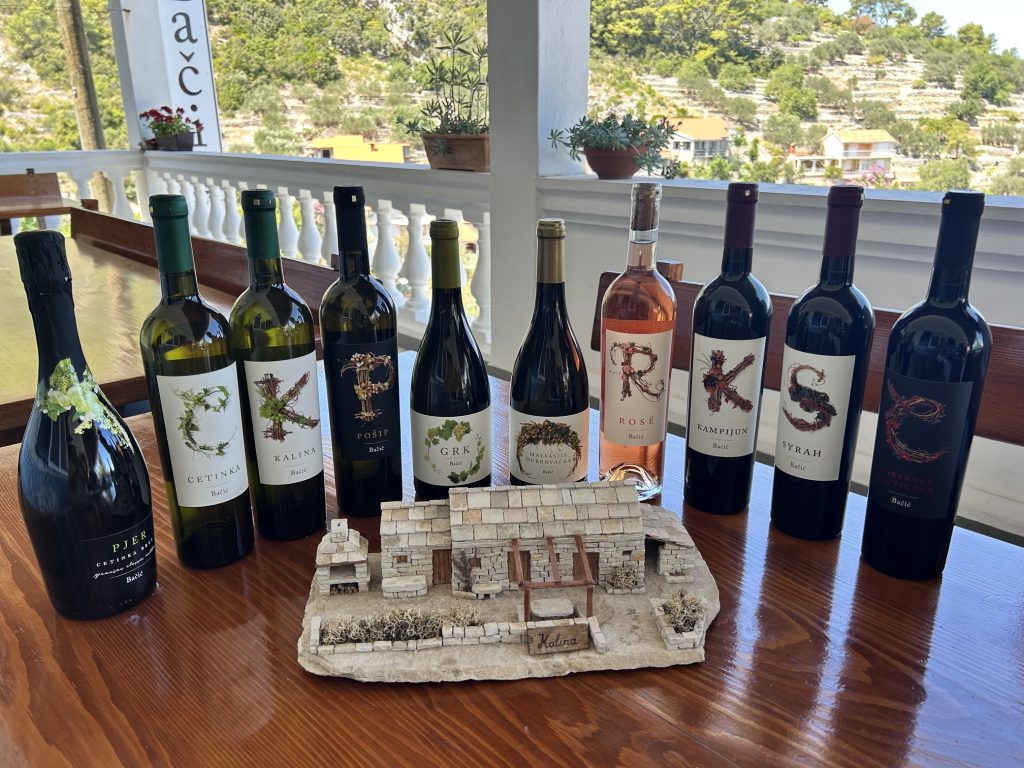
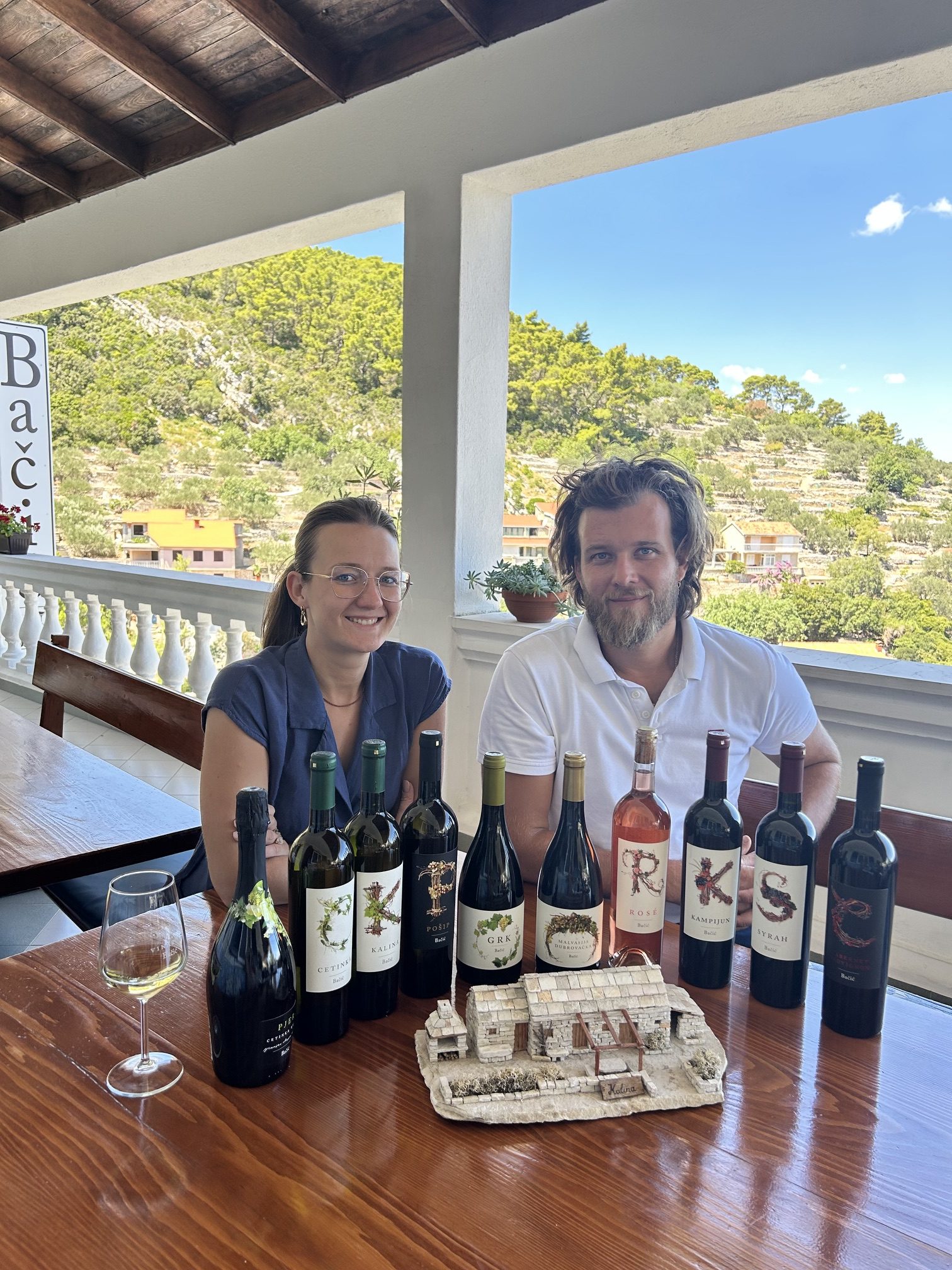
Today, alongside Cetinka Bačić, Pjer, Kalina and Kampijun, the labels include Pošip Bačić, Grk Bačić, Malvasija Dubrovačka, Syrah, Cabernet Sauvignon, Rosé and Prošek Bačić. Although the range shows that the winery does not rely on a single variety, Cetinka has become its most recognisable signature.
Petar does not want to call himself stubborn, because stubbornness implies being closed to other opinions. Persistence, however, he makes no attempt to deny.
– You have to be open-minded, but I am persistent. When I set myself a goal and make a decision, I pursue it with everything I have. Viticulture is the kind of work where enormous effort can vanish in an instant. I also fish, and many times we go out to sea and come back empty-handed. But that does not discourage us. Tomorrow, we try again.
The first serious test of that persistence awaited him in a variety almost everyone knew, but few considered important enough to put its name on a label.
Cetinka had never been an unfamiliar variety in Blato. It grew in vineyards and went into wines, but its name rarely left the island and appeared on labels even less often. Most commonly, it ended up in blends with varieties that contributed more alcohol and greater body.
– Cetinka was neglected because of the way wine used to be made. The grapes were picked later, acidity was lower, and without temperature control during fermentation, aromas were lost. The wines were heavier, more robust and often oxidised, so Cetinka could not show its best qualities.
Modern technology allowed the Bačićs to preserve its freshness, citrus character and acidity. Rather than trying to make a powerful wine of a kind it could not naturally produce, they chose to emphasise the very lightness for which it had once been undervalued.
– Cetinka does not need to pretend to be something it isn’t. Its value lies in freshness, acidity and drinkability. We can make a lovely summer wine from it that can be enjoyed without elaborate explanations.
When they bottled it as a single-variety wine in 2017, Petar recalls that no other winery was regularly offering it as a separately bottled varietal wine at the time. That same year, at a wine-and-oyster pairing competition in Dubrovnik, Cetinka Bačić was named the best wine to accompany shellfish.
– Afterwards, everyone was asking, “What variety is that? What is Cetinka?” Articles started appearing, and the variety began to get serious media attention. That was also when other people in our town started taking more interest.
A few years later, eleven producers gathered at a Cetinka showcase in Prigradica. Petar does not claim that the Bačićs alone deserve credit for its return, although they were among the pioneers of its modern revival.
– It is lovely to see all those people, especially the younger ones, making Cetinka and progressing. I do not see my colleagues as competitors. I would like us to become a recognised wine destination, and that can only happen if there are many of us.
After the still Cetinka Bačić came Pjer, a sparkling wine made by the traditional method, with a second fermentation in bottle. It did not emerge because sparkling wines had meanwhile become popular, but from Zlatko’s idea, which the family had waited almost three decades to realise.
– My father spent his whole life saying we should make sparkling wine from Cetinka. We are talking about the 1990s, when there was hardly any sparkling wine, particularly in Dalmatia. Later, I wanted to work in viticulture, he laid the foundations for me, and his wish finally came true.
The qualities that had long kept Cetinka in the shadow of more powerful varieties proved ideal for sparkling wine. Moderate alcohol and pronounced acidity, once considered shortcomings, became its greatest advantages. The name Pjer also belongs to the family story, since Petar is a recurring name among the Bačićs.
– It was not called Pjer by chance. We linked the name to Petar and our family tradition. We wanted to make a genuine Dalmatian sparkling wine from Cetinka, rather than simply a curiosity made from an indigenous variety.
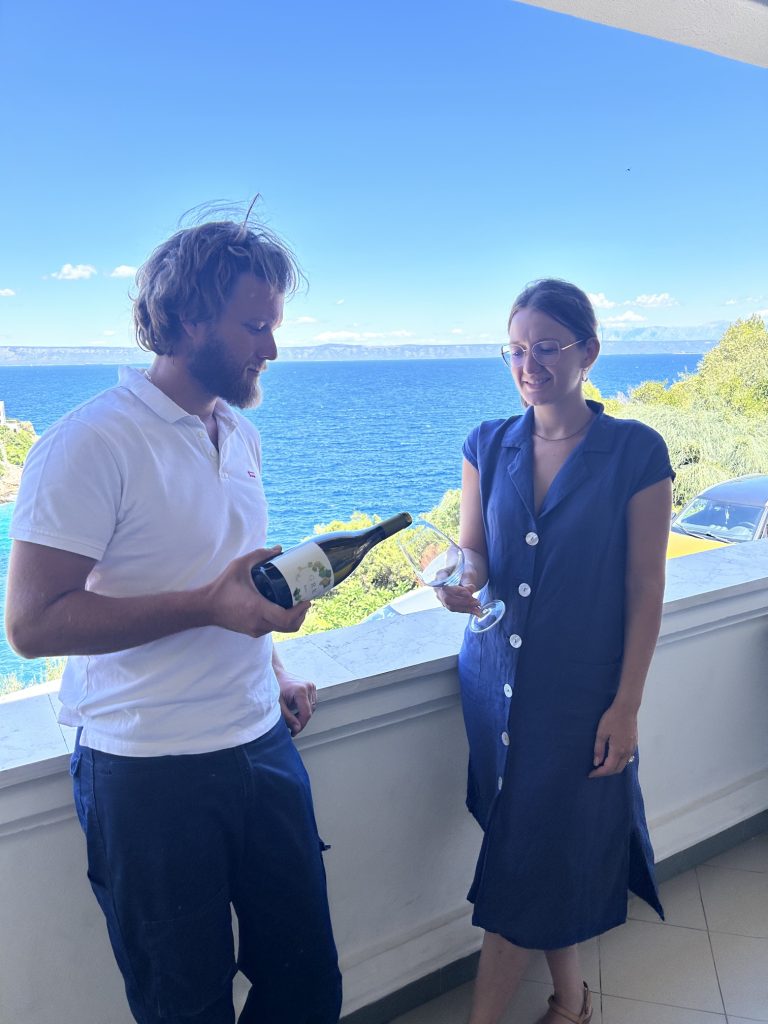
And so Bulić’s observation, written back in 1949, that Cetinka was suitable for locally produced sparkling wine, found its own bottle. A variety that had spent decades as an anonymous ingredient in blends acquired both a still and a sparkling expression at the same winery. In the cellar, however, its third transformation was already maturing.
Ten years ago, some Cetinka was distilled and put into acacia barrels, with almost no announcement that the Bačić cellar was developing a product of a kind that had not existed before. The brandy was triple-distilled, and today the Bačićs have around five hundred litres that they have no intention of releasing as a product to be sold in a hurry.
– It is an enthusiasm that has lasted ten years, quietly. You make something, put it away to age and wait. Only when it is ready can you begin talking about it.
They are preparing a special label and packaging for the brandy, since it is intended to become one of the products that will represent the winery over the long term. Its greatest value lies not simply in being made from a rare variety, but in the time that neither technology nor marketing can replace.
– Someone can distil Cetinka tomorrow, but they cannot have a ten-year-old brandy tomorrow. Those ten years actually have to pass.
When the spirit was put into barrels, Cetinka was only just emerging from anonymity, and the Bačićs could not have known how important it would become to their winery’s identity. Today, they make still wine, sparkling wine and brandy from it, but Petar did not want to reduce the entire winery permanently to a single variety.
He found the next overlooked possibility in a few bunches of Bratkovina from old Korčula vineyards.
– I measured sugar levels of roughly nineteen to twenty-two per cent and total acidity of around seven grams per litre. I had almost never found parameters like those in grapes. I immediately thought they could make a serious wine.
Bratkovina matters as more than another rare island variety. Along with Zlatarica Blatska, it is one of the parents of Pošip, now Korčula’s best-known white variety. While their “child” spread through Croatian vineyards, Bratkovina remained scattered through a small number of old plantings.
– I also considered Zlatarica Blatska, but it has a major problem with irregular yields. That is why I chose Bratkovina and planted two thousand vines on the Blato plain. The vineyard is about three years old, and my idea is to make a matured wine from it, perhaps using oak.
For Bratkovina, Bulić recorded must with eighteen to twenty per cent sugar and between seven and nine grams per litre of acidity, almost the same values Petar measured much later in an old vineyard. He also wrote that its wine could be kept for a long time.
– I did not plant it simply because it is old and rare. The parameters showed that it has real potential. Now we need to get to know the variety and see what it can produce in our vineyard.
Alongside Bratkovina, the Bačićs have also brought Malvasija Dubrovačka to the Blato plain. The vineyard is seven or eight years old and in full production, and they have been making Malvasija Dubrovačka under its own label for four or five vintages.
– It is not an island variety, but it is a variety from our county. It was rather neglected and made by only a few wineries, and I was sorry that a wine of such quality did not have a more prominent place on our wine scene. It has powerful aromas and body and easily reaches high alcohol levels, so our challenge was to preserve its character while still producing a fresh wine.
Petar does not see indigenous identity as a boundary drawn around his own village. Not everything he plants has to have originated in Blato, but it must belong to the wider area the winery belongs to, and there must be a reason for it to grow in that particular place.
Grk is a different story. Finding planting material for this Korčula variety was harder for the Bačićs than might be expected on an island that regards it as one of its most important wine symbols.
– Older people on the island were quite conservative. There was constant arguing about whose Pošip it was, whose Grk it was, and who had the taller bell tower. For a long time, the people of Lumbarda would not give anyone even a cane of Grk to let the variety spread a few kilometres further. We nevertheless managed to obtain it on the island and planted it three years ago.
Meanwhile, Grk began to be planted in Herzegovina, the Zadar hinterland and other parts of Croatia. Something similar happened with Pošip, which spread from Korčula through almost all of Dalmatia and into vineyards in continental Croatia too. Petar sees this as no theft of the island’s heritage, but as a consequence of keeping varieties confined within individual places for too long.
– Nobody stole our variety, because nobody could take our land away with them. But if we do not have enough Grk on the island, somebody else will. However proud we are of our own towns and villages, as an island we have to work together.
Planting material can travel, but Korčula’s soil, climate and vineyard sites do not travel with it. Yet the distinctive character of a place has little commercial value if there is not enough wine for customers to discover it.
– Individually, we cannot become a major wine story. I would like Korčula to be recognised as a wine island, and that can happen only if we have many good winemakers. I do not see my colleagues as competitors, because it is in all our interests for people to come here specifically for the wine.
There are now around forty small wineries on the island. About fifteen years ago, the Bačićs were among the first to offer organised tastings, while the large producers mostly sold wine in bulk. Today, the choice is much broader, but so is every family’s responsibility to present, distribute and sell its wine.
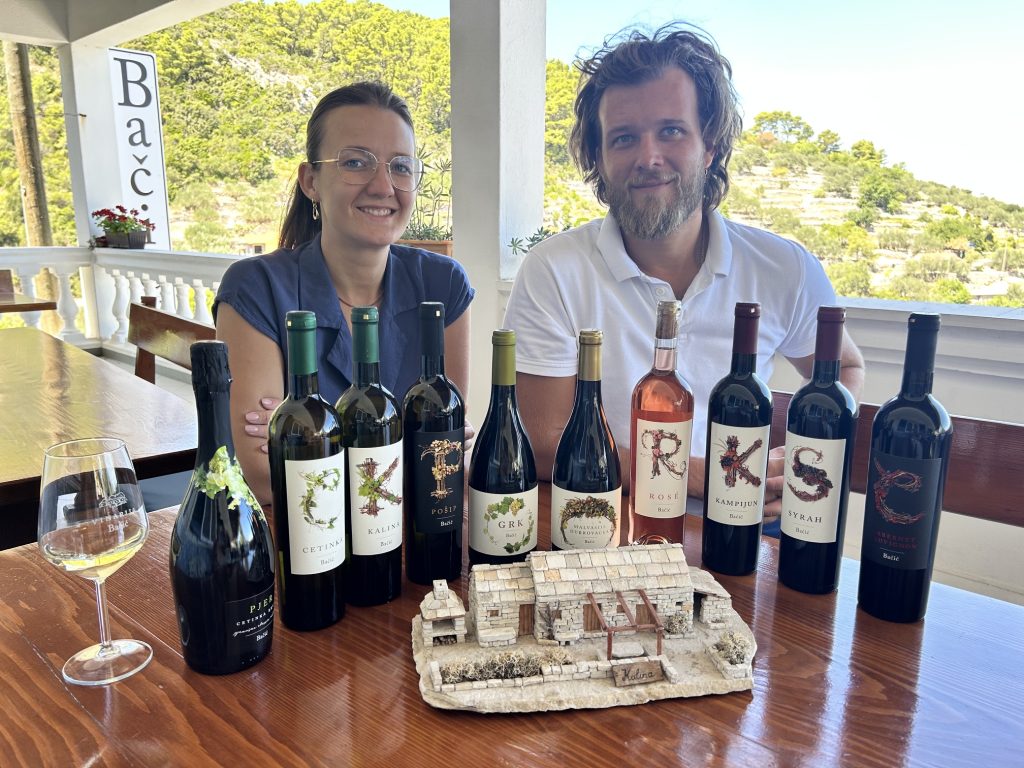
Korčula also has an advantage that is not easily measured by the number of labels. In Blato, young people have taken over vineyards and olive groves to a considerable extent, despite working in a field where drought, disease or a storm can wipe out months of effort.
– I think it is something we carry within us. For centuries, wine and olive oil production formed the basis of life on the island. We have taken wine to a higher level, so young people no longer see it simply as hard work, but also as a chance to make a living.
That is why Petar does not want old varieties to be preserved in just a handful of vineyards as evidence that they once existed. They need to be planted, bottled, and their planting material shared, even when part of their future success will take place beyond the communities that preserved them. The island can retain its claim to their story, but not the right to stop their lives from continuing.
On the Blato plain, two thousand young Bratkovina vines cannot yet provide a final answer to what kind of wine they will produce. Petar knows the basic parameters and what he wants to try, but does not claim in advance to have discovered Korčula’s next great wine story.
– The vineyard is still young. My idea is to make a serious wine that could age, perhaps using oak, but first we have to get to know the variety. We need to see how it behaves in our vineyard, what it gives us and which direction we can take with it.
A few bunches from old plantings were enough for him to recognise their potential, just as Cetinka had once been enough for his father Zlatko to start talking about a sparkling wine of a kind that barely existed in Dalmatia at the time. In both cases, years had to pass between the idea and its realisation.
Bulić’s Dalmatinska ampelografija still stands on the winery shelf. It says that Cetinka is suitable for locally produced sparkling wine and that Bratkovina wine is capable of ageing for a long time. The first claim can already be found in a bottle of Pjer, while the second is only beginning to take root on the Blato plain.
– I do not want to plant old varieties simply because they are old, but because I believe we can make good wines from them. Once I set myself a goal, I will persist until I see how far we can go.
Many decades ago, Bulić wrote down what Cetinka and Bratkovina might become. Today, the Bačićs are not trying to prove him right. They are simply carrying on where his sentence ended.