On Somló, there is no room for soft wines. Or for soft decisions.
Tamás Tornai stands in the vineyard like someone checking in on a conversation that has lasted a lifetime. Somló is quiet that morning, without dramatic light or postcard romance. The stone beneath our feet is hard, the soil dark, and the rows of Juhfark descend the slope with no desire to impress.
– This hill needs no help, he says almost in passing.
– It only asks you not to spoil it.
Today, Tornai works some seventy hectares scattered across the hill’s slopes. In the cellar below us, almost a million litres of wine pass through each year. By Somló’s standards, this is a large estate – but size has never offered protection here.
Tamás speaks of terroir not as a marketing word, but as a measure of responsibility.
– You can make a wine that everyone will like, he continues, but if you smooth it out too much, you can no longer tell where it comes from.
He pauses, picks up a piece of basalt and turns it in his hand.
– Somló is hard. If the wine is not at least a little hard, we have betrayed something.
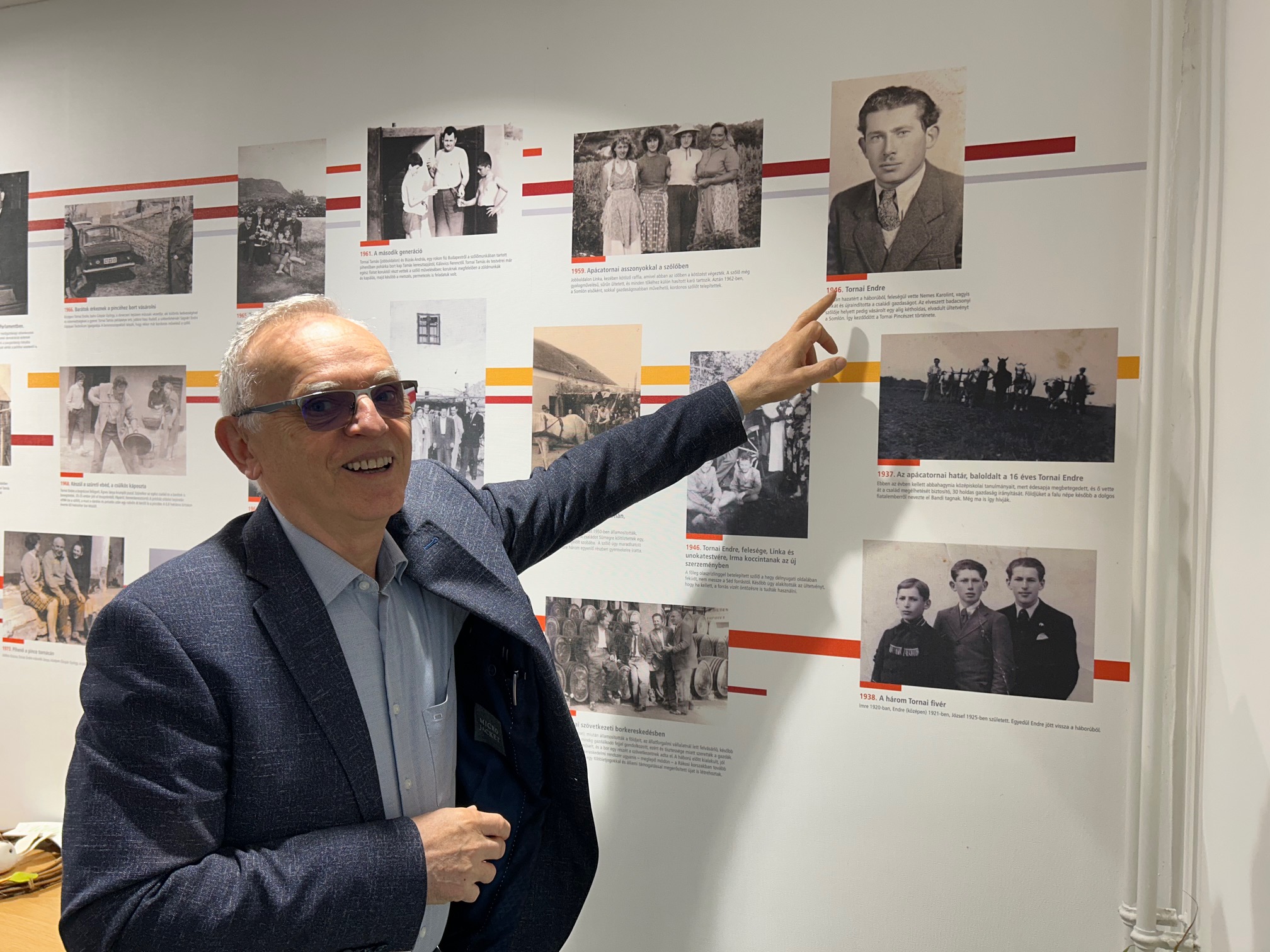
He is the second generation of a family that has worked on this hill since 1946. He grew up among barrels, listening to conversations about harvests that succeeded and those that did not. He did not choose Somló as a project; Somló was already there, a fact of life.
– My father always told me: wine must not lie, he recalls.
– If the vintage is not great, you cannot make it great. If it is, you must not spoil it.
Somló harbours no illusions of grandeur. The hill is small, its vineyard area limited, and few producers actually bottle and sell wine under their own names. Yet this confined space produces an identity stronger than that of many larger regions. Tamás knows this, but does not speak of it as an advantage.
– Here, you have nothing to hide behind, he says.
– The hill is always stronger than you. And it remembers.
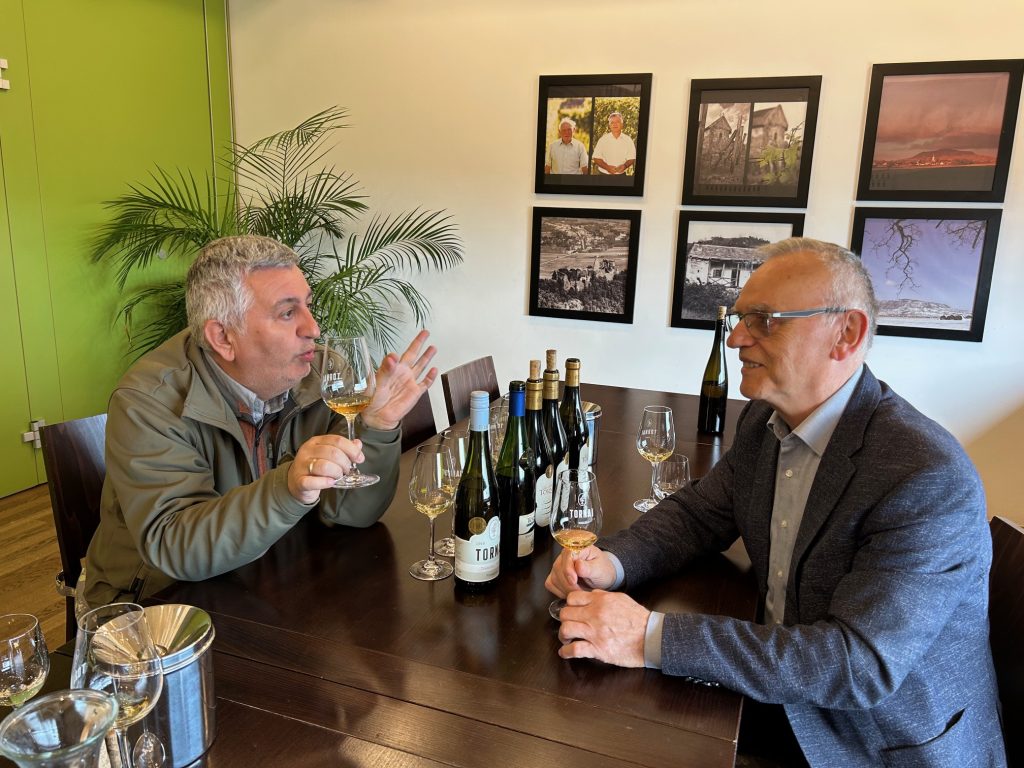
Možda je upravo ta svijest početak cijele priče. Ne želja za slavom, ni ambicija da se bude najveći, nego odluka da se ostane vjeran mjestu koPerhaps that awareness is where the whole story begins. Neither a desire for fame nor an ambition to be the biggest, but a decision to remain faithful to a place that does not forgive carelessness. Tornai does not try to drown out Somló. He tries to understand it.
Somló is not a landscape that captivates at first sight. There are no monumental expanses or dramatic valleys. A single dark, conical hill rises from the plain like a detached fragment of land. Its strength lies in that isolation. There is nothing to compare it with, nothing to hide behind. Everything is concentrated.
– Somló soon puts you in your place, says Tamás, his gaze travelling down the slope towards the plain. If you think you matter more than the hill, it will remind you that you do not.
The soil is layered and basaltic, threaded with ash and sediments from the ancient Pannonian Sea. Stone here is not a metaphor, but a reality beneath your feet. Roots seek out fissures, pushing through the hardness, and the vines never grow luxuriantly without reason. That struggle leaves its mark in the glass: tension, salinity, a vertical line.
Somló is a small region, but one of almost ascetic clarity. Its vineyards form a mosaic of tiny plots, and few producers bottle and sell wine under their own names. Here, word soon gets around about who has done what.
– On larger hills, you can disappear into the crowd. Here, you cannot. Every vintage is remembered.
That closeness is not always comfortable. Some years are harsh, bringing late frosts or dry summers. The wind can be an ally or an adversary. There is little room for corrections.
– Somló does not forgive neglect, he says quietly. But it rewards precision.
For Tornai, Somló is not a backdrop, but his destiny. The hill defines the limits, but also gives him his identity.
– We do not create Somló’s character. It is already there. Our job is to keep it clear.
In a world where terroir is often uttered as a slogan, on Somló it carries weight. Literally and metaphorically. That weight gives context to everything Tornai does.
If there is one variety through which this relationship is most clearly tested, it is Juhfark.
When Tamás speaks of it, his voice grows calmer still.
– It is the most honest wine we have.
He does not say the best-selling, the best-known or the most decorated. Honest.
Other varieties are grown on Somló, of course – Furmint, Hárslevelű, Traminer – but none asks the same questions as Juhfark.
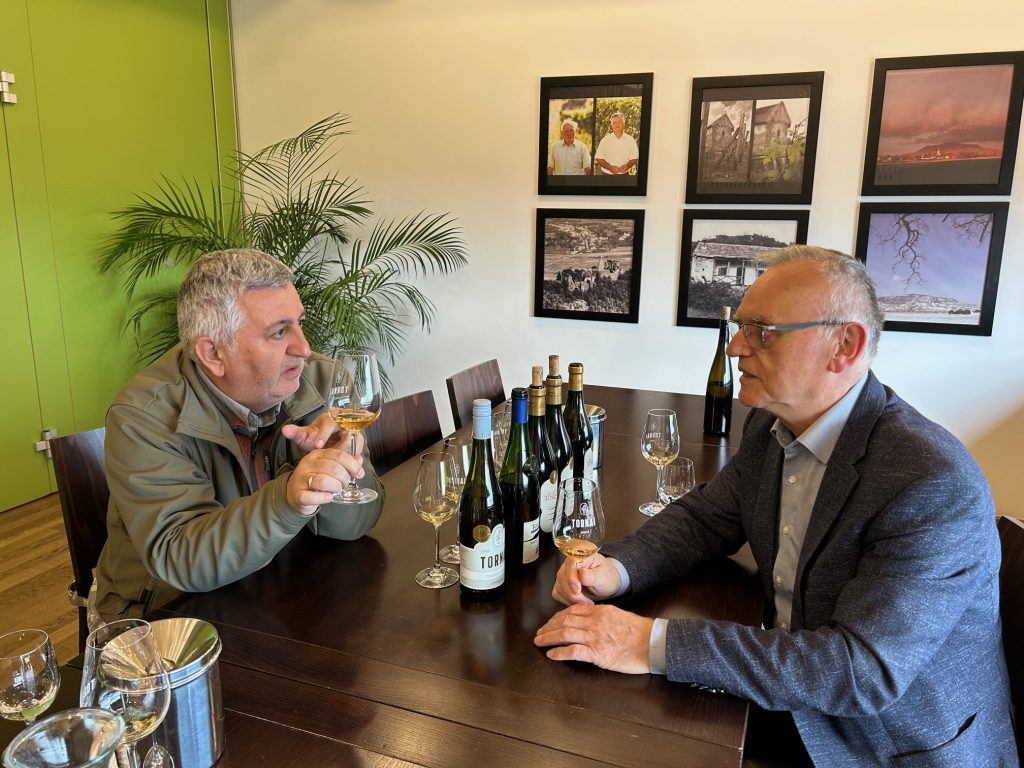
Juhfark na papiru djeluje gotovo anahrono. U vremenu aromatskih eksplozija i ranih, „pristupačnih” vina, on nudi suprotno: visoku kiselinu, On paper, Juhfark seems almost anachronistic. In an age of explosive aromas and young, “approachable” wines, it offers the opposite: high acidity, a restrained nose, slow development and a texture that does not court affection. Its name is evocative – “sheep’s tail”, after its long, cylindrical bunch – but there is nothing pastoral in the glass. This is a wine that does not seek to be charming.
– Juhfark hides nothing, says Tamás. If you make a mistake in the vineyard, it will show it. If you are patient, it will reward you. But it will not make your job easier.
– It is demanding both in the vineyard and in the cellar. Sensitive, it needs a great deal of attention and yields less than other varieties. If you look only at the numbers, it makes no sense.
– But if you look at the truth of the place, it makes more sense than anything else.
In the twentieth century, those very demands almost erased it from Hungary’s vineyards. Industrial winemaking had no patience for a variety that required discipline without offering an immediate reward. It survived where it had a natural reason to exist – on Somló, a hill whose structure is as hard as its acidity.
– You can try to soften Juhfark, says Tamás. You can pick it later, round it out with more oak. But then you risk losing its vertical line.
That expression returns often in our conversation. Here, verticality does not mean power, but tension. It is not about mass, but about the line that holds the wine upright.
When young, Juhfark can seem almost unapproachable. Its aromas are discreet, its texture firm, its finish long and saline. With age, that austerity turns into layers of complexity. Instead of dominating, the acidity becomes a supporting axis; the minerality deepens; the fruit recedes, making way for stone, dried apple and nutty notes.
– The best thing is when you open it too early, says Tamás with a faint smile. Then it reminds you that you are not in charge.
This is not a joke, but a philosophy. Juhfark does not accept the winemaker’s authority without putting it to the test. It tests patience, precision and restraint. In a world increasingly seeking instant pleasure, it remains a wine that asks for time. That is precisely why it becomes the winery’s moral backbone: the variety through which they test their willingness to remain faithful to Somló, even when another path would be easier.
The story of Tornai Winery begins long before Tamás, in a year that offered little encouragement to idealise the future: 1946.
Europe is still trying to put itself back together after the war, and in Hungary decisions are made with an eye not to the future, but to survival. Endre Tornai buys a small press and begins making wine on Somló. It was no romantic decision – the vineyard was a way to make a living.
A few years later, everything will be taken from them: land, cellar, tools. What remains is not property, but knowledge. And habit.
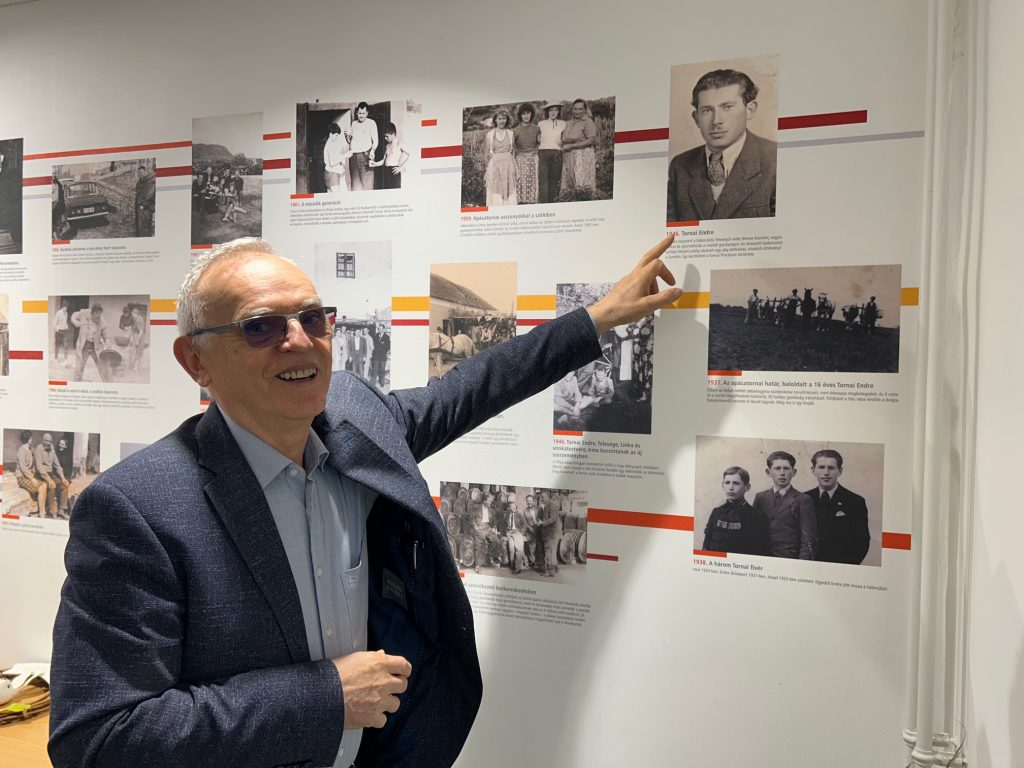
U tim godinama vino prestaje biti osobno. Završava u velikim sustavima, u anonimnim tankovima, bez imena. Endre Tornai ne prestaje In those years, wine ceases to be personal. It disappears into vast systems, into anonymous tanks, without a name. Endre Tornai keeps working. He does what he can. He holds on to what the system cannot take – his relationship with the hill.
– My father did not talk about terroir, says Tamás. He talked about work.
Collectivisation swept away many private holdings. The family lost its house and land, but its connection with Somló remained unbroken. In a system where grapes often ended up in the anonymous tanks of large cooperatives, a wine’s identity became an abstract notion. Yet Endre Tornai continued to work within the limits imposed on him, waiting for the moment when a name would mean something again.
That moment comes in 1982. Tornai becomes the first private winery on Somló to bottle and sell wine under its own name. Today, this sounds almost like an administrative matter, but in that context it was a decision: to emerge from anonymity and stand behind what was in the bottle.
– Putting your surname on a bottle meant taking responsibility, says Tamás. You could no longer hide behind the system.
That decision holds the foundation of today’s philosophy. The name on the label is not decoration, but an obligation. Every vintage becomes personal. Every failure remains on record. Every success, too. A family’s lineage is built not through rhetoric, but through continuity of work.
Tamás grew up watching that transition: from a time when wine had no face to a time when it acquired one again. When he took over the winery after the change in the political system, he inherited more than vineyards. He inherited the belief that identity cannot be bought; it has to be earned.
There is also a small museum within the cellar complex. Not as an attraction, but as a by-product of time. Old tools, documents, objects that survived political systems. Some still bear the marks of work. In the 1990s, under Professor Zsigmond Csom’s guidance, the collection was put in order without losing its rawness. It is not a space for visitors, but for memory.
– We are not the largest because we planned to be, says Tamás. We are the largest because we stayed.
There is no triumph in that sentence, only a fact. Generations changed, as did political systems, but the relationship with the hill remained the same. Somló was not a project, but a constant. From that constant, an estate slowly emerged that today bears the Tornai name without needing to explain it.
There are moments, however, when consistency ceases to be a comfortable word. The market changes faster than Juhfark matures. Consumers seek aroma, softness, immediacy. Reviews dwell on “approachability” and “charm”. Somló, at least in its most austere expression, offers something else.
– There were years when I wondered whether we were making a wine too demanding for these times, Tamás admits. You see what people want. You see the styles that are popular. And then you wonder whether perhaps you are simply being stubborn.
The doubt concerns not quality, but context. How far can you go in remaining faithful to a place without losing touch with the people who drink its wine? How much acidity, structure and slowness can you retain without ending up isolated?
– We could soften it, he says openly. We could pick a little later, leave more residual sugar, round it out with oak. It would be easier to drink. Perhaps it would sell faster, too.
He pauses.
– But then it would no longer be itself.
That tension between the market and identity is not a declaration, but a constant presence. It is not resolved by a single decision, but afresh with every harvest. Because compromise in wine rarely looks like betrayal – more often, it looks like adaptation. And adaptations are often reasonable.
– Sometimes the hardest thing is to do nothing, says Tamás. Not to intervene just because you can.
That sentence contains the entire inner struggle. Modern oenology offers tools for almost every correction. Technology can soften sharpness, accentuate fruit, conceal flaws. But every such intervention also changes character. The question is where to draw the line.
Tornai draws it where Somló begins. Yet that boundary does not mean closing the doors. Some of the production goes to markets with no connection to this hill. Sauvignon Blanc from Somló finds its way to New Zealand. But what defines the estate here does not change. If the wine loses its vertical line, if acidity becomes mere ornament, if minerality becomes decorative – the boundary has been crossed.
– I do not want a wine that everyone likes for the first five minutes, he says. I want a wine that stays with you after you have drunk it.
This is not romantic stubbornness, but a deliberate choice of risk. Consistency means accepting that not everyone will understand. But it also means believing that those who do understand will stay.
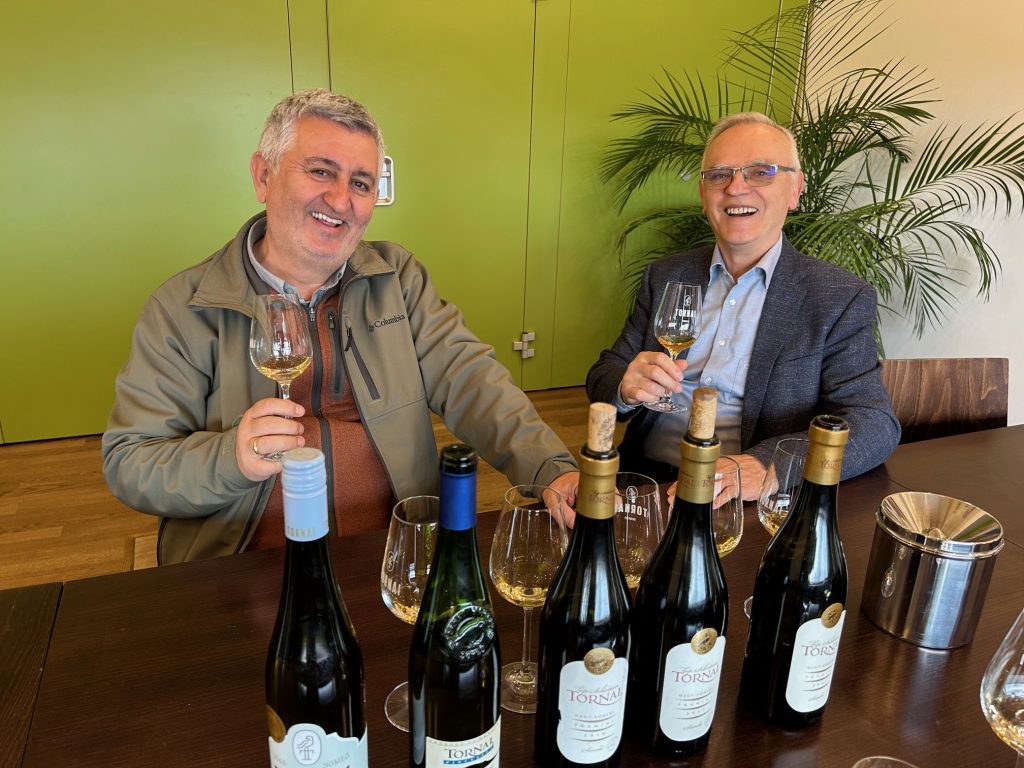
In the Tornai cellar, consistency becomes concrete decisions, quiet technical choices that may be invisible on the label but can be felt in the glass.
– Each site has its own temperament, says Tamás as we pass through rows of barrels. Our job is to listen to them.
The hierarchy of wines – from the fresher ranges to the Prémium and Top Selection wines – arose not as market segmentation, but as a way of reading the hill. The lower tiers are not “simpler versions”, but different cross-sections of the same place. In the Top Selection wines, concentration is greater, the sites more precisely defined, and ageing longer. But the underlying structure remains the same: verticality, minerality, acidity as the axis.
Time is the key tool. Juhfark does not tolerate haste. In its youth it can seem closed, almost severe.
– If you try to make it open up too early, you lose depth, Tamás explains.
Ageing, therefore, is not cosmetic, but a process of integration. With the years, the acidity does not diminish; it becomes integrated. The texture gains breadth without losing tension.
Technology is present, but does not dominate. Temperature control, carefully chosen oak, grape selection – all are tools, but none is an end in itself.
– I do not want people to taste the cellar, he says. I want them to taste the hill.
That is where the difference lies. In many modern wineries, the style is recognisable through the winemaker’s signature. In Tornai’s wines, it is recognisable through Somló. If anything stands out, it is the structure of the place, rather than the aesthetics of intervention.
This does not mean that the world fails to recognise it. Their wines have won international awards and high scores for years, but here those have never become the focus.
– Awards are lovely, says Tamás, but the wine has to stand on its own without them.
Even when they experiment – with sparkling wines or other indigenous varieties, for instance – the logic remains the same. The question is never “what is popular now?”, but “what makes sense here?” Csomorika, a rare variety almost forgotten elsewhere in the country, receives a new interpretation not because it is exotic, but because it belongs to the hill.
– We are not searching for novelties, says Tamás. We are searching for clarity.
There is no spectacle in that clarity. Only the patient alignment of decisions – in the vineyard, in the cellar and over time – so that the wine remains faithful to the place that created it.
The legend of the “wedding-night wine” has accompanied Somló for centuries. It was said to ensure a male heir, to heal, to carry almost magical power. The Habsburgs ordered it for family weddings, the aristocracy considered it special, and ordinary people attributed almost medicinal properties to it. Today, those stories sound like folklore, but something more serious lies behind them.
– I have never believed in myths, says Tamás. But I believe in symbolism.
When Béla Hamvas writes that Somló wine “does not indulge, but obliges”, he is speaking not of superstition, but of responsibility. In his interpretation, it is a wine of decision, of marriage, of an act that presupposes endurance. It is neither hedonistic nor lavish, nor a wine for entertainment. It is a wine that asks you to stand upright.
– Hamvas understood the hill, says Tamás. Not through analysis, but through feeling.
In that sense, Somló fits almost naturally into Hamvas’s thinking. The hill has weight, the wine has structure, and Tornai has made his choice. Three levels of the same idea. Wine is not an escape, but concentration. Not a moment, but continuity.
In an age when wines are often branded through stories of fun and ease, Somló wine remains serious. Not deliberately, but naturally. Tornai leaves it that way. He neither amplifies the myth nor denies it. He simply puts it in context: a wine drunk not to prove something, but to affirm something.
– If you open it at the right moment, says Tamás, you do not need a legend. Everything is already in the glass.
Evening comes quietly to Somló. Soft light settles over the plain, while the hill retains the day’s warmth a little longer. Few words remain in the vineyard, only the rustle of wind through the leaves and the stone that remembers footsteps.
Tamás opens a bottle of older Juhfark. Not ceremonially, but almost routinely. The wine is more golden than you would expect, its nose deeper, but still restrained. On the palate it is taut and calm at the same time. The acidity is still there, but now it supports rather than attacks. The minerality is quieter, but enduring.
– You see, he says after a brief silence, it always makes you wait. And then it shows you why that was necessary.
There is no triumph in that sentence, only confirmation. Confirmation that the decision made decades ago – to remain with a demanding variety, a hard hill, a style that does not seek universal approval – was no accident. It was deliberate.
In the darkness, Somló becomes a silhouette, but its presence does not disappear. The same is true of the wine. It does not shout, impose itself or try to impress. It remains.
Through the generations, Tornai could have chosen easier paths. It could have softened the structure, accentuated the fruit, followed trends that come and go. Instead, it chose slowness, verticality and discipline. It chose to make wine an expression of the place, rather than the other way round.
In the end, perhaps that is the only serious ambition a wine can have: not to be popular, but to be truthful. On Somló, truth tastes of stone, high acidity and quiet steadfastness.
– If you understand it, says Tamás as he closes the bottle, you need nothing more. The hill remains. So does the wine.