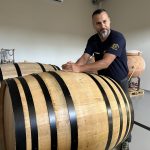
A man who drew up a contract for a wine that did not yet exist, adding a footnote that the bond would remain valid even in the event of the end of the world, probably could not have ended up anywhere other than a vineyard.
The document is titled Fictitious Wine. Everything is there: the location, Golo Brdo near Rovinjsko Selo; a southern aspect; red soil, stone, poor ground. One hundred vines. Fifty Teran, fifty Tannat. Planned maceration, ageing, one hundred bottles. Fifty have already been sold, in the form of a bond.
The buyer does not receive wine, but the right to wine that has yet to be made.
The text holds nothing back. It specifies the expected alcohol, structure and ageing potential, even a projected score. The wine, it says, should reach 97 points. The highest score a Croatian wine has ever received. Yet immediately below comes another tone: a warning about drought, hail, disease and birds. And finally, almost in passing, one more possibility: the end of the world.
In that event, the bond does not cease to be valid. Rights and obligations pass to survivors or descendants.

It is hard to say where irony ends in this text and seriousness begins. Harder still to decide whether it should be read as a joke, a conceptual artwork or a very precisely written plan. In Brajnović’s case, these things are inseparable.
He does not enter wine through a variety, technology or the market. He enters through an idea. Through a framework that already incorporates the possibility of failure, years of waiting and an almost biblical dimension of time. In that document, the wine does not yet exist, but it has already been written into being as a fact.
And that may be the most accurate beginning.
For Tomislav Brajnović, wine does not begin in the vineyard. It begins in the mind.
An artist by training and background, he worked for a long time in a field that has little in common with wine, at least at first glance. Installations, texts and interventions that often moved beyond the gallery into both public and personal space. The same thread kept returning in that work: the idea of an ending, of change, of the arrival of something that would overturn the existing order of things.
This was not a theme he “discovered” later. It came from his family background.
Since the age of ten, he has taken part in what he describes as a family mission: announcing the coming of God’s Kingdom and the time preceding it. His father, Marčelo Brajnović, plays a central role in this story, a man who devoted his entire life to that idea. In the 1990s, he raised a flag bearing the tetragrammaton, JHWH, on Golo Brdo, as a public, tangible act of faith and conviction.

Such things do not remain mere family anecdotes. They shape the way a person sees the world.
With Brajnović, that continuity is evident. There is no sudden turn, no moment when he “decided” to make wine as something separate from everything else. What he had done as an artist, speaking, acting, questioning, simply found a new medium.
In that sense, the vineyard appears as a continuation rather than an escape.
When he speaks of war, he does not necessarily mean history. When he speaks of renewal, he does not mean style. When he speaks of a reset, he does not mean marketing. These are all terms he used before they acquired a taste and a smell.
Perhaps, then, it is wrong even to ask when he began making wine.
The question assumes that wine is something new in his life. For him, it is not. Wine is simply another way to continue the same story, this time using soil, vines and a bottle as his medium.
The name Reset did not come from the vineyard.
It came from the moment when the wine needed a name, but also from a desire to give the word the weight it already carries outside wine. The digital world, politics, Davos, the “Great Reset”: a term repeated in recent years in contexts entirely unrelated to vines, grapes and harvests.
Brajnović took it up as a problem rather than a reference.
The idea of a “great reset”, as presented, implies a change that actually preserves existing power relations. A system that “resets” itself but remains the same. Progress that consumes resources without limit, war that merely changes form.
He agrees only in part.
A reset, he says, is necessary. But not that kind.
If there is to be one, it must be radical. It must mean returning to the beginning. To “factory settings”. To the nature of things. As a change in foundations, rather than a technical adjustment.
At that moment, the wine acquires its name.
Reset.
Not as a label intended to make a bottle memorable, but as a word intended to start a conversation. That is also why its appearance on the label is far removed from conventional design. The word is sprayed in silver paint through a stencil over existing images. Photographs cut from books: wars, armies, explosions, but also sacred art, religious motifs and history repeating itself in different forms.
None of it is there to be highlighted, but to be covered over.
The word Reset falls across the image like a stamp saying “cancelled”. A gesture of erasure. A sign that what lies underneath no longer holds in the same form.
That logic does not stop at the label. He expects the same of the wine: an undoing of what is taken for granted.
There is one person in this entire story without whom none of it would have looked the same.

Marinko Pavlović.
Everyone around him called him Maka. It was more than a nickname: it was a name that carried a way of life.
What he shared with Brajnović is difficult to describe as “collaboration”. Vineyards, wine, daily conversations, decisions made along the way, between rows of vines, between two glances at the sky. It was a relationship in which things were understood rather than fully explained.
Maka did not come to wine through a trend.
When he began working biodynamically, it was not a decision to follow a scene or seek a label to validate it. Radovan Šuman introduced him to the practice, but what grew out of it had no need for endorsement. He sought no certificate. He joined no system. He felt no need to prove anything.
One of his labels read: “made according to the laws of peaceful farming”.
For him, that was no turn of phrase.
It was the way he lived.
It was evident beyond the vineyard too. In the food he chose, the way he prepared it, the time he spent in nature, his trips to the sea, his climbs into the hills, his gathering of plants and herbs for tea. Everything was connected.
Ultimately, it took material form in the wine.
But only after he was gone did it become clear how much.
The vineyard remained. The cellar remained. The equipment remained. But the wine was no longer the same.
Not because someone did not know what needed doing, but because it became clear how much of that “what needed doing” had resided in him. In his rhythm, in decisions he never wrote down, in practices that were part of everyday life.
The grapes were not thinned in time. Leaves were not removed as he had removed them. The vines were not treated with the preparations he made himself. Everything he had done continually, without drawing attention to it, was suddenly absent.
The result showed in the grapes.
Less ripeness. Less concentration. Rot where the bunches touched.
At that moment, something often expressed as a general observation but rarely fully understood becomes clear: the most important thing in wine is the person.
Not as a creator signing his name, but as someone who constantly intervenes. Who watches, decides, responds. Who makes ten small moves every day that can never be made up for later.
With Maka, this had not seemed exceptional.
It became visible only when he was gone.
In Istria today, you can pass kilometres of vineyards without truly seeing a single one.
The rows are tidy, treatments regular, yields stable. Everything works. For Brajnović, that is precisely where a greater problem lies than in abandoned plots overgrown with grass and brambles.
Such vineyards, he says, produce wines that are indistinguishable.

Synthetic crop protection, artificial fertilisers, controlled processes, selected yeasts: everything leads towards a result that is reliable but interchangeable. A wine that could come from anywhere, and ultimately has no real connection to the place it comes from.
That is why abandoned vineyards do not frustrate him in the same way.
He sees something else in them.
A break.
A vineyard that is no longer cultivated ceases to be part of the system that shaped it. Without treatments, fertilisers or control, nature begins to restore its own processes. Grass grows, vines spread, fruiting canes reach away from the trunk, and there are more grapes, but they are smaller and more dilute.
Everything looks like decline, yet something else also happens during that period: a kind of recovery, a reset.
Nature tends to restore balance. The only question is how long a vineyard can remain in that state before it becomes impossible to reclaim.
From his own experience, he estimates a few years. Three, four, perhaps more. After that, bringing it back becomes increasingly difficult.
He has tried.
Of seven vineyards he found and whose owners he called, he immediately received permission to cultivate five. No contracts, no conditions. People had lost interest, but not their connection. They wanted to see the vineyard alive, even if someone else worked it.
He did not get the other two. One had already been earmarked for sale as building land. In the other case, the owner, who was seriously ill, was unsure what his family would say.
He passes that vineyard almost every day.
He watches its potential slowly disappear. And he knows that, with a little work, he could restore it.
Nor did he always succeed where he was given the chance.
He had to give up several vineyards. They were too neglected. Grass, weeds, brambles, trees: nature had taken them over faster than he could reclaim them. Without machinery or enough strength, it was an unequal struggle.
In all this, he also sees a wider picture.

Vineyards are disappearing along with the generation that worked them. Younger people see no point in them. The work is hard, earnings uncertain, the market saturated with cheap wines made according to the same model.
At the same time, a small scene of winemakers working differently is emerging. Naturally, with more risk and less certainty, but also higher prices and greater potential.
The difference between these two worlds is more than a method of production.
The difference is that some are trying to maintain what exists, while others are trying to start again.
For Brajnović, an abandoned vineyard is not an ending.
It is a place where the possibility of a beginning still exists.
If there is one place where all of this comes together in a single image, it is Golo Brdo.
One hundred vines were planted there in 2011. Not on ideal terrain, but in stone. Literally. An excavator, a jackhammer, a hole in the rocky ground. There is soil between the rocks, but not enough to give the vines any certainty. If you hit rock half a metre down, the vine dries out.
Some took root. Others did not.
Those that failed were replaced with new ones, and not always according to a plan. Whatever was available, whatever he happened to find: Trnjak, Cabernet Franc, perhaps Merlot. Today, even he is no longer sure exactly what grows there.
The original idea was simple. Two varieties: Teran and Tannat. A combination that, on paper, sounds like too much. Too much structure, too much tannin, too much of everything.
In the first year, it produced wine.
Two hundred millilitres.
It went through every stage: maceration, fermentation, racking. And ended up as two glasses of conceptual wine. At the time, he also considered calling it TNT, combining the varieties’ names in an allusion that needed no further explanation.
The name that finally stuck came later.
Armagedon.
Not as an effect, but as something already present in his language. He had previously made an exhibition titled “Creeping Armageddon”. The name simply moved across.

In time, it acquired sequels.
Armagedon 2.0, 3.0, 4.0…
At first, the numbers were a joke. A reference to digital versions, to the idea of an upgrade. When someone asked how many there would be, he said seven. Far enough away that there was no need to think seriously about the end.
This year, the label reads 7.0.
Meanwhile, the wine began to appear in quantities that could be called wine. Not large ones. Ten litres or so, then twenty. This year, 20.8 litres. After racking and tasting, around fifteen bottles remain.
And none is final.
There is always a reason to open one. To check where it is. What has changed. What else it might do.
There is nothing in this wine that could be called certain.
Teran and Tannat, a combination one expert had dismissed in advance as unbearable. Low alcohol. Unexpected softness. Aromas tending towards restraint rather than exuberance.
Yet it works.
As confirmation that theory is not the starting point here, rather than proof that theory is wrong.
On Golo Brdo, wine is not made because the conditions are ideal.
It is made despite their being anything but.
With Brajnović, a bottle is never neutral.
The label is not somewhere to write the wine’s name and perhaps draw something to make it recognisable. It is a surface on which the same story continues in another medium. It begins with cutting.
Books about history, art and wars. Old publications, inherited or found, often in German, with photographs carrying the weight of time: armies, generals, explosions, ships, aircraft, the dead, victors, the defeated. Alongside them, sacred art, religious scenes, iconography belonging to a different register but speaking of the same things.
These images are not preserved.
They are cut out.

For Brajnović, this is an extension rather than destruction. A cut-out image ceases to be part of a book and becomes part of a new whole. A collage organised in layers rather than a hierarchy.
A word appears across those layers.
Reset.
Sprayed through a stencil in silver paint over everything beneath it. Like a stamp. Like a cancellation. Like a gesture that interrupts the image rather than trying to explain it.
What matters is what that word does.
It does not highlight what lies beneath it. It does not affirm it. It does not invite an aesthetic reading of history. It does the opposite. Covers. Closes. Cancels.
That is why you may see Hitler, Mussolini, Tito, Stalin, American generals, queens, soldiers, scenes of war and scenes of religion on the label, but none of those figures is there to be admired. All are there to be erased.
In that sense, the label is not an illustration of the wine.
It is part of the same process.
The wine is called Reset because it is meant to reset expectations. The label does the same, on another level. It disrupts automatic looking. Introduces unease. Poses a question before the bottle is even opened.
And it almost always succeeds in one thing.
It starts a conversation.
For Brajnović, that is reason enough for it to exist.
Throughout all this, he says nothing about the wine itself for the longest time.
Not because it is absent, but because he does not see it as the beginning.
When asked about wine, he returns to everything that precedes it. To attitudes, decisions, relationships, work in the vineyard, the way the world is viewed. All of that, he says, is terroir. Not in the conventional sense of soil and climate, but as the totality of premises from which something emerges.
If those premises are good, the wine should be good too.
Within that framework, quantity loses its weight. One bottle can be enough to establish a concept. Just as neither “a lot” nor “a little” means anything if what exists has no real quality.
Yet when he begins speaking about a particular wine, he returns to one place.
Turnina, near Rovinj.

A vineyard that had long been neglected. Large, beside the road, visible, but unworked. At one point, he could not gain access to it. Probate proceedings, unresolved arrangements, waiting. Time passed. The grapes ripened without any control.
In early October, he went to have a look.
The grapes were ready. Loose bunches, ripe, healthy. Sweet. Something rarely seen in a vineyard no one tends.
He called again.
This time, he received permission.
He harvested only part of it. Some rows were off limits. Some of the grapes had spoiled. What he picked went into a single barrel.
The resulting wine was, in his words, almost ideal.
High alcohol. Full structure. And one thing he had not expected.
Juniper.
A flavour that appeared without intervention or addition. It returned the following year, then disappeared. Enough to intrigue him.
Later, he made boards from juniper wood. Took them to a cooper. Tried to bring back what had happened spontaneously.
Such details are no exception with him.
They are the way wine enters the story.
As the result of a series of decisions, coincidences and attempts to understand something, rather than a finished product that needs describing. That is why he speaks about it later, once it is already clear where it comes from.
And that is why wine, with Brajnović, is never just wine.
It is always a consequence.
Ultimately, wine arrives for Brajnović as something that happens along the way, rather than as the conclusion of something: the result of a series of decisions made long before the grapes were even picked. That is why he does not speak about it at the beginning or set it apart as a separate subject. When he talks about vineyards, Maka’s work, abandoned plots and the ideas behind the names and labels, he is already talking about wine, simply without needing to name it.
In that sense, wine occupies no privileged position. It serves as a test. If it appears as a “result” at all, it is a result that carries no certainty. There is no desire to repeat the same thing, to stabilise the taste, to achieve a recognisable continuity from year to year. On the contrary, every harvest brings the possibility that things will take an entirely different direction, and this is something to accept rather than control.
That is why wine, for him, does not function as a product intended to confirm an idea established in advance, but as a place where it becomes clear whether all the decisions preceding it made sense. If they did, the wine will show it. If they did not, it will show that too, with no possibility of putting things right afterwards.
Perhaps that is why Brajnović’s entire wine story always feels a little displaced.
In any event, either too early, before it can be defined, or too late for what is expected of it.
It is never where it is “supposed” to be.