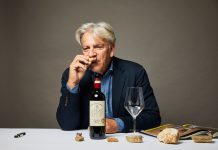
On the slopes above Mád, in the heart of Tokaj, where the morning mist lingers longer than elsewhere and the vines seem to grow more slowly and more solemnly, stands a project that at first glance looks like just another modern winery. Yet behind it is not a family with generations of winemaking tradition, but a man who built his career in the air – József Váradi, the founder and CEO of Wizz Air.
His winery is called Juliet Victor. It is named not after a hill, village or vineyard, but after his initials – J.V., rendered in the NATO phonetic alphabet. It is a telling detail. Váradi did not enter wine seeking an escape from the business world, but to continue that world in another form.
This is where the broader story begins. Over the past two decades, Hungary has emerged as an almost ideal example of a phenomenon in which successful people from different sectors – from banking and industry to music and sport – enter the wine business. Not as outside investors, but as owners, brand builders and, in some cases, active participants in production.
Hungary offers perfect ground for this: historic wine regions such as Tokaj, Villány, Szekszárd and Somló, an economy in transition that opened up space for new capital, and a scene flexible enough to welcome players without an inherited tradition. The result is a diverse map of projects revealing different motives – from straightforward business logic to a personal search for meaning.
Starting with the most visible examples, it is clear that some new owners come from the world of big capital and enter wine with the same mindset they bring to their other businesses.
Váradi is perhaps the clearest example. His Tokaj winery focuses on single-vineyard Furmints and the premium segment, with an explicitly international positioning. Everything is carefully considered: from its location in Mád, one of Tokaj’s most highly regarded areas, to branding that bears a personal imprint. This is not a hobby, but a project that fits the logic of global business.
A similar pattern can be seen in Sándor Csányi, one of the most powerful figures in Hungary’s economy. The long-serving head of OTP Bank and owner of the Bonafarm agribusiness group, Csányi entered wine in the late 1990s through the privatisation of the Teleki winery in Villány. Since then, he has built a system linking viticulture with the rest of agricultural production, drawing on logistics, distribution and capital on a scale small producers cannot reach.
For him, wine is not an isolated project, but part of a broader structure. Villány, known for its powerful red wines, becomes a platform for demonstrating how an industrial approach can work even in a sector so often romanticised.
Christian Sauska represents a different but equally ambitious model. He made his fortune in the United States and, on returning to Hungary, invested in two key regions – Tokaj and Villány. His wineries are characterised by modern design, advanced technology and a style of wine clearly aimed at the international market. Sauska makes no secret of his ambition: to create a globally recognisable brand rooted in Hungarian terroir but speaking a universal language.
In Eger, Nimród Kovács comes from media and advertising, but his approach to wine is equally considered. He focuses on varieties such as Chardonnay, Pinot Noir and Blaufränkisch, with an emphasis on terroir and storytelling. His wines are not merely products, but tools of communication – an extension of his experience in the industry where he built his career.
The Béres family, known for its pharmaceutical business, entered Tokaj in 2002. By purchasing vineyards around Erdőbénye and developing an estate of around 45 hectares, they built a project combining the region’s tradition with modern management. For them, wine is part of diversification – a long-term investment with both reputational and economic value.
This group also includes Lőrinc Mészáros, one of the country’s most controversial and powerful entrepreneurs, who has gained control of Tokaj projects such as Dereszla Group through various business structures. His entry into wine further supports the idea of vineyards as a space where capital, politics and symbolic status intertwine.
Across all these examples, the shared pattern is clear: wine as a continuation of business logic. Capital, expertise and organisation are transferred to the vineyard, and the aim is not merely to produce wine, but to establish a market position and build a brand. Here, wine becomes a sophisticated form of power – more discreet than industry or finance, but equally potent in symbolic terms.
Yet Hungary’s wine scene has not been transformed solely by the arrival of domestic elites. Alongside their emergence, another equally important process began in the early 1990s – the entry of foreign capital into major wine projects, particularly in Tokaj.
Unlike individual investors, who enter wine as an extension of a personal or business story, foreign capital arrives with a clear strategy: long-term positioning, international distribution and the reassessment of historic vineyard sites.
Tokaj, Hungary’s most recognisable wine region, becomes the centre of this interest. One of the earliest and most important investments takes place in 1992, when the French group AXA Millésimes acquires Disznókő – a move often regarded as the symbolic beginning of Tokaj’s return to the world wine map through Western investment.
Just a year later, in 1993, the Spanish icon Vega Sicilia establishes Oremus in Tolcsva, creating a Tokaj counterpart to one of Europe’s most prestigious wine names. Almost simultaneously, the Royal Tokaji Wine Company emerges, a project led by the British wine authority Hugh Johnson, bringing international investors and local growers together in one of the region’s first major joint ventures.
French capital is particularly prominent in the early years of the transition. Investment groups such as CFGVT and GAN acquire Château Pajzos and Château Megyer, while Michel Reybier, owner of Bordeaux’s Cos d’Estournel, later enters Tokaj by acquiring the historic Hétszőlő estate. A similar pattern can be seen at Château Dereszla, which comes under the control of French investors and the d’Aulan family after privatisation.
American investors also enter Tokaj, including Anthony Hwang, who acquires Királyudvar and develops it into one of the region’s key biodynamic estates. There are also hybrid models such as Arvay & Co., combining local expertise with foreign capital.
While some foreign investors entered Tokaj through large organisations and institutional capital, projects such as Királyudvar demonstrate a different model – one in which wine is not merely an investment, but an expression of a profound understanding of terroir. Hwang, also the owner of the legendary Domaine Huet in the Loire Valley, brings a biodynamic approach and a focus on precise, elegant wines to Tokaj, making Királyudvar one of the benchmarks of modern Tokaj.
More broadly, other institutional and corporate players are also present in Tokaj – including groups linked to AXA, GMF or CANA – further confirming that wine in Hungary is not merely a cultural category, but a serious asset class.
It is important to stress that the interest of global wine dynasties is not confined to Tokaj. The Italian Antinori family, one of the most influential in the wine world, invested in the Tüzkö winery in the Tolna wine region, demonstrating that Hungary as a whole – not just Tokaj – is becoming significant on the map of international investment.
Comparison with Hungary’s other major wine regions further highlights the distinctive nature of this process. While Tokaj became a magnet for foreign investors and international wine groups in the early 1990s, Villány developed along an almost opposite path – without any substantial influx of foreign capital.
Instead, domestic winemakers and entrepreneurs built its modern reputation. Names such as Gere, Bock, Tiffán and Polgár are the result not of outside investment, but of sustained work within the region itself, alongside gradual modernisation and improvements in quality. Even when larger operations emerge, such as those of Sándor Csányi or Christian Sauska, the capital is domestic or brought home by returning expatriates, rather than the conventional multinational investment that characterises Tokaj.
This difference is not merely structural, but symbolic. While Tokaj experienced its renaissance largely through the internationalisation of capital, Villány achieved it through the internationalisation of quality – gradually, from within, relying on its own people, varieties and style.
It is precisely this dual dynamic – domestic elites seeking identity and global capital seeking value – that makes the Hungarian model distinctive. Few wine scenes in Europe show so clearly how tradition, capital and strategy can meet in the same space.
Moving from corporate logic into the world of artists changes the picture considerably. Here, wine ceases to be primarily a business venture and becomes a personal space.
András Lovasi, frontman of the cult bands Kispál és a Borz and Kiscsillag, is behind LA Gardens in the Pécs region. It is not a conventional winery, but a hybrid of vineyard, garden, studio and events venue. Wines are made in small quantities and mostly sold directly, without entering broad distribution. The emphasis is not on the market, but on experience – on people who come, stay, listen to music and take part in something that is difficult to reduce to a standard wine story.
Levente Szörényi, a key figure in Hungarian music, planted a vineyard in Badacsony as early as the mid-1990s. Today, his family winery produces varieties such as Welschriesling, Juhfark and Chardonnay. More important than the range of varieties, however, is his personal involvement in vineyard work. Pruning, tying and seasonal tasks are not delegated. In his case, wine is quite literally physical labour, a way of returning to nature and to a rhythm unrelated to the music industry.
Dr Imre Csernus, a psychiatrist and author, is one of the co-owners of Almagyar-Érseki Szőlőbirtok in Eger. Their approach includes indigenous varieties and elements of natural winemaking, while the symbolism of the wines often carries a psychological dimension. The first cuvée was called “Lelkifröccs”, which might be translated as “a spritzer for the soul”. For Csernus, wine becomes almost a therapeutic medium – a reflection of inner processes, rather than merely a marketable product.
Unlike businesspeople, who enter wine to extend their control, artists enter it to relinquish at least some of that control. Their projects are often smaller, less scalable and less profit-oriented, but carry a strong personal signature.
The third group – athletes – is by far the least represented in Hungary, at least when it comes to actual ownership and vineyard work.
The reason is simple: sport and wine rest on completely opposite principles. Sport demands speed, results and constant measurability. Wine requires patience, waiting and acceptance of uncertainty.
This makes Attila Hajdu’s example particularly interesting. The former goalkeeper for Ferencváros and Hungary’s national team now runs a small family project near Balatonfüred. His winery, known as Fürjes Borászat, grew out of the idea of restoring a neglected estate and turning it into a working vineyard. What distinguishes him, however, is not the project’s size, but the way he participates in it.
Hajdu does not stand on the sidelines. He drives the tractor, works in the vineyard and takes part in production alongside the oenologist. In a story about famous people and wine, this is a rare example of genuine involvement – without intermediaries or distance.
Other examples, however, reveal a more superficial relationship. Pál Dárdai, a legend of Hertha Berlin and Hungary’s national team, is connected to wine through “Dárdai 8”, a cuvée from Fritz Pincészet in Szekszárd. This is a collaboration and a symbolic project, rather than ownership or actual participation in production. Such projects show how wine also functions here as a symbolic space – a place where a name crosses from one world into another, without necessarily requiring genuine involvement in production.
Elsewhere on the same scene are family wineries that have grown not through capital or acquisitions, but by redefining their own identity. In Szekszárd, one of the most interesting examples is the Heimann family, which has devoted much of its work to reviving Kadarka.
Rather than following the global trend towards international varieties, Heimann returns to a local grape that had been marginalised for decades and was often considered too unreliable for serious production. Through vineyard selection, yield control and a contemporary approach to vinification, their interpretation of Kadarka becomes an elegant, spicy wine with a clear identity.
A similar example, though in a different regional setting, comes from Somló, where wineries such as Tornai build their identity around Juhfark – one of Hungary’s most distinctive and authentic white varieties. On Somló’s volcanic soils, Juhfark produces mineral, structured wines of strong character, increasingly perceived as a pure expression of terroir rather than a curiosity.
Such projects show that Hungary’s wine scene is defined not only by capital, but also by a deliberate return to local varieties as the foundation of authenticity. If Tokaj experienced its renaissance through global interest, and Villány through quality and continuity, Szekszárd and Somló demonstrate a third path here – a return to their own varieties as a long-term strategy.
The question that arises is why this phenomenon appears at all – and why wine becomes the common denominator of such different careers.
The answer lies in the unique combination wine offers. Above all, this is an industry that operates in slow time. In a world where success is measured in quarters and seconds, a vineyard demands years and decades. For people accustomed to speed, that becomes a luxury in itself.
Secondly, wine requires taste – not merely aesthetic taste, but strategic judgement. Investing is not enough; one must understand terroir, style and the market. This is precisely why wine becomes a more sophisticated status symbol than most other forms of luxury.
Thirdly, wine offers the possibility of a legacy. Companies are sold, careers end, but the vineyard remains. Vines planted today will bear grapes for generations to come. This is a rare form of continuity in the modern world. That is why many of these projects – whether Tokaj Furmints or Szekszárd Kadarka – are conceived not as quick business moves, but as long-term, almost generational decisions.
Looking beyond Hungary makes it clear that this phenomenon is not isolated. Unlike Hungary, where these processes are already clearly visible and embodied in specific projects and names, elsewhere in the region they remain diffuse – present, but not fully formed. Croatia, Serbia and Slovenia also show signs of similar processes, though without the same concentration, visibility and systematic development found in Hungary.
In Croatia, wine is already deeply rooted in tradition and regional identity, so new capital does not create a new scene but builds on the existing one. Wine projects are often linked to tourism, place and experience, and less to building large organisations. In this context, wine appears as an extension of lifestyle and identity, rather than as a separate industrial platform.
Serbia shows stronger momentum in development and, in that sense, comes closest to the Hungarian model, though with a time lag. In many ways, it resembles Hungary ten or fifteen years ago: new investment in vineyards and wineries, stronger private brands and gradual positioning in the international market. Wine also acquires an additional function – it becomes a symbol of moving beyond “raw capitalism”, a way to translate business success into a more sophisticated, culturally expressed form.
Yet the scene is still consolidating, without the clearly defined elite already present in Hungary. Serbia therefore appears today as a place where this process is still taking shape – open, dynamic and unfinished.
Slovenia, on the other hand, represents an almost opposite model. There, wine is not a new investment or status category, but a continuous tradition dominated by family wineries. Capital from outside the wine sector rarely enters, because the scene is already defined by generational knowledge and stable production.
In Hungary, wine is no longer merely tradition – it has become the ultimate affirmation of success. Placed side by side, these examples make it clear that this story is not only about wine. It is about the moment when success ceases to be enough in itself. The moment when people who have already conquered their own worlds begin looking for something that cannot be conquered by the same methods.
The vineyard is precisely that place.
A place where money helps, but guarantees nothing.
Where knowledge matters, but is not absolute.
Where time cannot be accelerated.
In Hungary, that moment is particularly clear – almost a cross-section of a broader change. Within one country and a handful of wine regions, a process is concentrated that elsewhere is only beginning or unfolding more slowly.
Perhaps that is precisely why wine has become a kind of calling card for the successful. Not because it is the most profitable business, but because it is one of the few in which success cannot be fully controlled.
And perhaps that is why more and more of them eventually want a piece of land under vine.
Not because they need another business. But because they need something that will outlive them – and, at the same time, bring them back to the earth.