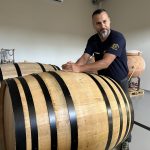
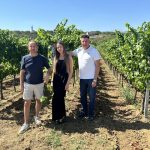
His knee is giving him trouble, but he refuses to give up. In fact, Tomislav Petrovečki often walks briskly through his vineyard on Petrovečki breg, between Križanče and Mirkovec near Sveti Križ Začretje. He is a trekker, and trekking is defined as “a physical activity involving movement on foot – walking, hiking or running – through a wide variety of natural terrain and vegetation, across mountains, hills, islands or plains, on marked or unmarked trails, without motorised or other means of transport apart from one’s own legs”.
Well, Tomislav actually does more CrossFit these days. But to explain that exercise system, which combines elements of other sports to produce athletes ready for anything and encompasses ten aspects of physical fitness – power, flexibility, strength, speed, coordination, agility, balance, accuracy, cardiovascular and respiratory endurance – you practically need a degree in kinesiology. And once you understand what it involves, you start thinking Tomislav must be Rambo, at the very least!

DaklTomislav has also brought the physical prowess of his friends from the Mala Erpenja Sports Society into his wine venture, in an activity that surely deserves an entry in a dictionary of unusual “sports”. How else would you describe the soil-stamping his friends from Tenja and Grabrovec demonstrated when he planted seven thousand vines?
– It’s true: after the vines had been planted by machine, the soil around them needed a little firming down. And who could be better prepared for that than my trekking friends? It gave them a good workout in conditions they were used to anyway, says Tomislav, who has taken over from the late, great Željko Žac Petrovečki, one of the pioneers and driving forces behind modern vineyard-scale winemaking in Zagorje. Žac died in 2021, aged sixty-four.
– The soil around each vine had to be pressed down, almost as though you were rolling it!
When Žac established that magnificent vineyard in 1995, planting sixty-five thousand vines of Graševina, Silvaner, Pinot Blanc, Pinot Gris, Chardonnay, Pinot Noir, Riesling, Yellow Muscat and Cabernet Sauvignon, it was rightly described as an adventure. At the time, it was Zagorje’s largest vineyard in a single block, covering almost ten hectares at an average elevation of 277 metres. To create such a large, continuous vineyard, Žac had to consolidate an astonishing 130 plots, negotiating individually with no fewer than 130 owners and buying their land.
As the distinguished wine writer Željko Suhadolnik wrote in his tribute, Žac “produced both varietal wines and blends, wines from regular harvests as well as delayed harvests, ranging from late-harvest wines to ice wines. And when he noticed growing demand for quality spirits, he ventured into fruit brandies and liqueurs, too.”
“In the blue skies above Zagorje, high in the heavens, another star dear to us now shines…” With those heartfelt words, Suhadolnik bade farewell to his namesake, “a great admirer of the noble drop, who recognised that wine’s potential as a source of wealth could and should extend far beyond simply sharing a drink with friends”.
Željko Žac Petrovečki once told Trsje, the wine supplement of Zagorski list, that wine was valued “for its flavour, its aroma, but also its sound – something only the real masters among restaurateurs knew how to recognise”. According to Žac, “if water had been added to the wine, if it had been doctored, the glass made a dull sound when you clinked it”.
– If the wine was pure, the glass would ring, Žac used to say.
Continuing the family business, Vina Petrovečki, Tomislav decided to radically change the vineyard’s varietal composition. Moving away from the predominantly introduced varieties, “which had passed their peak”, he turned towards tradition, aiming to restore the winery’s standing through Svetokriška Belina and Starohrvatska Belina.

– I find Starohrvatska Belina interesting and well suited to sparkling wine, while Svetokriška interests me because of its sugar levels. I’d never tasted wines like these before!
– In any case, both varieties produce light wines without excessive alcohol. They’re easy to drink and harmonious, with nothing sticking out. Quite simply, they’re ideal wines for Zagorje, wines that should sell very well, Tomislav says.
– Until recently, we had more than sixty thousand vines altogether. Over the past few years, I’ve grubbed up thirty-six thousand. Alongside those that remain, I’ve planted six thousand vines of Merlot and Yellow Muscat, and another seven thousand two hundred of Svetokriška Belina and Starohrvatska Belina.
Planting these two varieties also symbolically signalled Tomislav’s intention to return Vina Petrovečki to the top of Zagorje’s wine scene, where the winery once belonged.
After years of wandering, he seems finally to have embraced the family’s wine venture as his life’s challenge.
– I know there are plenty of easier jobs, but I’ve been doing this my whole life. How could I change now? I’ve been in the vineyard for as long as I can remember. I don’t know what else I could do. Perhaps it still feels a little strange working with fewer vines and making less wine, but it’s much easier and simpler.
Tomislav sums up his wandering years in one short sentence:
– I travelled around Europe and America, doing all sorts of things!
What sorts of things?
– In America, I worked with wine, and in Germany our second daughter was born. That was the happiest time for me. I looked after our child while my wife Martina finished her art and design studies in Dortmund.
– In America, I worked as a sommelier on a cruise ship sailing around the Caribbean. It was great: a suit and tie all day, an excellent salary. That was sixteen years ago.

– I came back from Germany to Sveti Križ Začretje in 2018. Dad called to say he couldn’t carry on any longer and wanted to retire.
According to Tomislav, Vina Petrovečki was then in serious difficulty.
– We’d released a lot of wine onto the market, but very few customers were settling their bills.
His own “migrations” to America and Germany, he says, also helped “stabilise the winery”.
After deciding to apply for funding through the wine-sector support programme known as the “Wine Envelope”, and eventually receiving approval for new vineyard planting, Tomislav became increasingly disappointed with the way state institutions treated winemakers. He says he has been “waiting for the approved funding since 2018, without a single euro reaching his account”.
– A lot of things have left a bitter taste since I began implementing the projects for which I’d applied for European funding. I can safely say that I’ve been forced to spend a considerable amount of time in court, trying to secure a favourable outcome.
– I planted that young vineyard of fourteen thousand vines under the EU funding programme. That’s one hillside.
– Fortunately, the other hillside has nothing to do with those funds!
– We used to produce more than a hundred thousand litres of wine. Today, I don’t go above forty thousand.
Tomislav likes to say that the winery has lost none of its original enthusiasm, and certainly has no shortage of good ideas. Just as his father Žac once surprised everyone with the scale of his vineyard, followed by rare wines such as an ice-harvest Cabernet Sauvignon – unusual far beyond Zagorje – Tomislav has added a new product to the range: Izabelanino!
– I think we’re the only distillery in the world making a liqueur from that variety.

Wine production from Izabela is prohibited in Croatia. The original account attributes this to the variety’s methanol content, describing methanol as a toxic substance that can damage vision, the kidneys and the liver.
Tomislav’s Izabelanino, like Grozaj’s Zweigeltino, is Zagorje’s answer to Istrian Teranino, the Teran-based liqueur that has become Croatia’s most popular liqueur over the past decade.
– In 2012, after seeing that the market was increasingly looking for local fruit brandies and liqueurs, Dad started making spirits, too. I decided to take that side of the business a little further.
And so Vina Petrovečki began building its new identity around spirits as well: Williams pear brandy, plum brandy, pelinkovac, apricot brandy…
– I buy most of the fruit in Slavonia and North Macedonia.
– My favourite is Williams pear brandy with honey!
Another interesting detail in the distilling chapter of the Vina Petrovečki story is that all the spirits labels were designed by Tomislav’s wife, Martina.