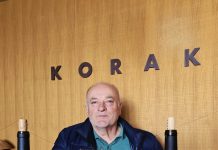
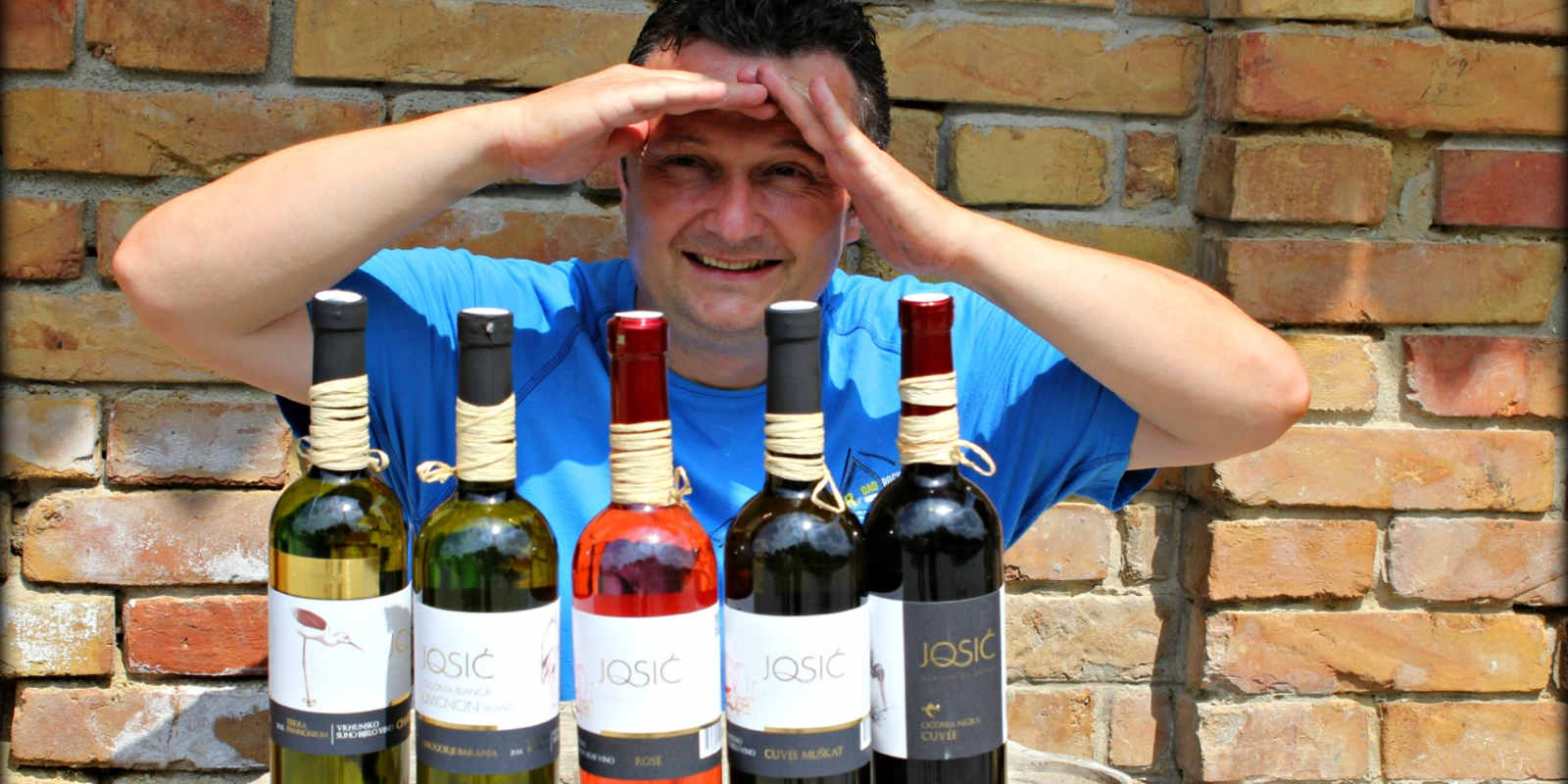
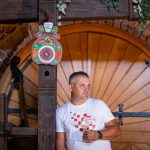
Ramazi Inaišvili has four instances of the letter “i” in his surname, although he managed to put only three on his front door. A Georgian, the grandson of a twice-decorated Hero of the Soviet Union, and one of the people who turned Chichateau from a garage pastime into a winery and took Erdevik from a neglected facility to Decanter Platinum, he was raising a glass of Momentum in September 2025-the Cabernet Sauvignon of his new employer, Jelena Ćuković of Veritas Winery.
Beside him, I waited impatiently for the Russian waitress, on her first day at work, finally to take our photograph so I could get stuck into a Karađorđe schnitzel of impressively serious proportions.
“Good luck against Markkanen tomorrow!”
The wish was directed at Georgia ahead of its match against Finland. Ramazi was already playing for a new wine team. Late the previous year, he had left Erdevik and Chichateau, two wineries he had helped build from the beginning, and joined the Ćuković family’s Veritas.
He did not claim it was a sensible decision. Quite the opposite.
“I’ve never made sensible decisions in my life, so I’m continuing the trend.”
For a man named Wine Personality of the Year only two years earlier, leaving two successful projects hardly seemed logical. Ramazi, however, had a logic of his own.
“I think I’ve reached an age with a motto: you exist as long as you create. It seems I can function only with new ideas. As though I need to step outside my comfort zone a little to progress.”
His happiest time, he said, had been while Chichateau and Erdevik were taking shape, when everyone learned from one another and the outcome was still uncertain. Once the child had grown up and found its own way, he decided to begin again. There was no quarrel, dramatic separation or rewriting of their shared history.
“They were my homes. Of course I’m sentimental, but there’s no pain, only satisfaction at a happy ending. I’m turning a new page and moving on.”
To understand what Ramazi left behind, we must return to Šišatovac, a village whose name had lived in popular culture long before appearing on wine labels.
The Serbian online slang dictionary Vukajlija contained the expression “Get lost-go to Šišatovac!”, popularised by the television series Noćna smena. It sent someone far enough away for the place’s name itself to sound like punishment. Then a winery appeared in Šišatovac.
And not just any winery.
Four friends-Đorđe Stojšić, Ramazi Inaišvili, Bojan Dodevski and Vladimir Čupić-called it Chichateau. The initial idea was Chateau Šišatovac, but it did not work, so they combined Šišatovac with the French château. Only later did they discover that chichateau was used in French slang to mock false prestige.
It suited them perfectly.
“For us, Chichateau is one big game,” Đorđe Stojšić would say.
Đorđe came from Srem, Ramazi from Georgia, Bojan from Macedonia, and Vladimir combined Serbian and Macedonian roots with an address in New Belgrade, which they called Vojvodina’s Hong Kong. Together, they looked like a team assembled on the principle that everyone must bring a different biography, accent and sense of humour.
Wine was not initially supposed to become a business.
Đorđe had returned from the United States with degrees in finance and philosophy from Wichita State University. He worked at Deloitte and Kinsley & Reed, served on the management board of Vojvođanska Banka and was a member of the Vojvodina Assembly. Increasingly, however, he escaped to Šišatovac, to his grandfather’s old house and vineyard.
“We had an underground cellar for barrels. When we calculated how much wine we drank in a year, we realised it would be cheaper to make our own.”
The vineyard still contained Prokupac, Crnoslav, Kamenka and Vranac planted in 1960. With help from a Dalmatian neighbour, they restored the vines and made small quantities of rosé for themselves. They planted a new vineyard in 2007, advised by Giorgio Clai, the Istrian winemaker whose garage approach appealed to them.

Ramazi became fully involved in 2012, when Fabula Mala reached the market. His route to wine had been circuitous. He founded Serbia’s first American football club, spent five years as its president, worked in sales and marketing for Heineken, Coca-Cola and other major companies, had children, and only then entered winemaking through his friends.
“Yes, I’m from Georgia, which is a wine country, but back then I knew nothing about wine!”
Whenever anyone travelled to Georgia, they brought him a bottle. Ramazi carefully put them away without opening them.
“I was waiting for a suitable occasion to taste them with a serious crowd.”
In Šišatovac, he had evidently found one.
Chichateau soon attracted attention far beyond people who knew its founders and understood why anyone might willingly move into a garage. The wines were serious, but the winery refused to behave that way.
Pink Punk helped most: a rosé in a bottle with a ceramic swing-top closure. Đorđe regularly corrected those who called it an old-fashioned soda bottle.
“It was originally used for olive oil.”
The bottle’s origins mattered little to buyers. Younger drinkers recognised the punk-pink design, while grandmothers saw something far more useful in the packaging.
“They love it because afterwards they keep tomato juice in it. Would Pink Punk have become so popular without that bottle? Not a chance!”
They began using it around 2012, long before reusable bottles became a fashionable sign of environmental awareness. Chichateau thus acquired two audiences: some bought rosé, others a future bottle for their homemade preserves.
The other labels did not emerge from market research either. On Fabula Mala, a blend of Cabernet Franc, Merlot and Cabernet Sauvignon, they crossed out 2012 and wrote in 2014.
“We had labels left over. We didn’t want to throw them away.”
When one year they made neither Fabula Mala nor Fabula Lagum, they used the same grapes to create Bambino Nero. The label, illustrated by Rastko Ćirić, featured a Black child-the same one who, in the television joke, was supposed to be sent away with “Get lost-go to Šišatovac!” Now he was arriving from Šišatovac in wine shops.
Customers asked whether they were on drugs.
“No. We’re mostly on wine.”
They did not commission names and labels from marketing agencies. The team gathered, tasted the wine and threw ideas around. They stuck trial labels on bottles, rejected them one after another and waited for what Ramazi called the click.
“In the end, everyone has to say: that’s it. The winemakers, the agronomist, marketing and sales. Our ideas always come from within because we have a vision that’s easy to bring to life afterwards.”
Đorđe and Ramazi brought different experiences to that house. Đorđe had left finance convinced he no longer wanted to inhabit its world.
“Excel doesn’t exist in winemaking. If you want to view everything through profit, the first twenty or thirty years will be difficult. My experience in finance helped me realise I didn’t want to live in that world.”
He called wine an oasis of common sense and a world of normal people. Ramazi brought what he had learned in large companies: sales, marketing, an understanding of customers and the knowledge that good wine would not find its own way to market.
One was escaping Excel; the other knew what could be read from it. Chichateau worked because neither tried to turn the other into himself.
Đorđe described himself as a committed terroirist and garagiste. To him, the garage meant a decision to draw the greatest possible potential from a small estate, rather than simply a room containing a few barrels.
“We’re garagistes, and we’ll remain garagistes. Once you become industrial, you lose character.”
He believed a winery worth millions could not compensate for a poor vineyard. If his grapes were better, he maintained, he could make a better wine in a garage than someone with the most expensive technology.
“Size doesn’t matter. What matters is getting the most from what you have.”
By 2022, Chichateau had seven hectares and produced approximately thirty thousand bottles annually. Chi Chardonnay 2016 was named Serbia’s best white wine for 2020 and received 95 points from Austria’s Falstaff. Pink Punk still sold fastest, after which the small quantities meant customers generally took whatever they could get.
The wines reached Germany, Switzerland, Sweden, Belgium, Croatia, Bosnia, Montenegro and even Bermuda, where, as they told it, a different seasonal rhythm gave rosé another selling season.
Despite that, they did not enter major international competitions.
“Our quantities are too small. It would be like the Sex Pistols performing at Eurovision. Completely pointless.”
Behind the wild labels, their approach to the vineyard grew increasingly rigorous. They used no herbicides, fertilised with manure for years and then began organic conversion. Đorđe welcomed anything that helped the soil and grapes, but had little patience for dogma.
“Anything is good if it makes the grapes better. But going back to the Middle Ages? If we don’t go backwards in medicine, why should we in agriculture?”
He did not see biodynamic horns and calendars as a route to great wine.
“A full moon is useful only if you need light to spray the vineyard at night and don’t want anyone to see you.”
He was far more serious about Probus. Working with the institute in Sremski Karlovci, they grafted it onto the less vigorous 420A rootstock brought from Sicily, rather than the usual Kober. Đorđe believed lower yields would produce more serious wine.
“Probus was the first local variety in which I recognised real potential.”
He described his own role more modestly. Tanja Đuričić oversaw winemaking, Milan Mojić tended the vineyard, and Đorđe was, as he put it, the officer in charge of looking out of the window. He suggested experiments with wild yeasts and accepted that they might fail.
“If it works, it works. If not, never mind. I go and distil rakija.”
Chichateau was small enough to allow such experiments, good enough for drinkers to take it seriously, and irreverent enough to mock that seriousness.
Then the team from the garage received an offer to take over a full-scale winery.
The offer came from someone who saw more in the garagistes than a charming group of enthusiasts. Aleksandar Kostić, son of entrepreneur Miodrag Kostić, asked whether Erdevik could become a profitable winery with credibility.
They could have answered with financial analysis, spreadsheets and projected returns. Instead, they explained that they could make wines he enjoyed drinking, but would need time.
They also had one condition.
“Creative freedom.”

A large winery thus ended up in the hands of people who described themselves as anarcho-liberals from a Šišatovac dugout. Đorđe believed an expensive building meant nothing to wine, Ramazi knew the market cared little for their beliefs unless the bottles sold, and Kostić gave them the opportunity to test how right they were.
They arrived at Erdevik in 2016. Its history began in 1826, when Italian nobleman Livio Odescalchi built a cellar there and brought Traminer to Srem, but what they found hardly resembled a historic monument awaiting restoration.
It looked like chaos.
“A technically neglected facility, neglected vineyards, hundreds of hectares under vine, but only sixteen hectares functioning. Everything else needed grubbing up.”
They had not arrived at an empty stage for free creation, but at a winery that had been producing wines since 2012 entirely unlike those they envisaged. They needed to begin with the vineyards, abandon purchased grapes and bulk wine, and direct the whole operation towards quality.
A crucial acquisition was a vineyard in Krčedin containing 170,000 vines, bought from former Serbian prime minister Zoran Živković. It included what they believed to be Fruška Gora’s first substantial Syrah planting. Živković had dreamed of becoming rich from wine and said he had never met a failed winemaker.
He had been very close to wealth, they joked-until he sold the vineyard to Kostić.
The vineyard was larger than the Vatican. Without it, Erdevik would not have had enough healthy grapes to begin its transformation. Big money might not make wine, but it could buy time, land and the chance to grub up a troubled inheritance gradually.
This was no undertaking for two heroes solving everything alone. Đorđe and Ramazi spoke of a team. Tanja Đuričić led production, Milan Mojić managed the vineyards, and Ivan Mihajlović and Dragoljub Beko were also involved. Đorđe contributed the wine concept and ideas, while Ramazi first took charge of Serbian sales, then moved towards foreign markets.
His first task was to persuade people who felt uneasy about wine, rather than wine specialists. Serbia had endured decades of poor industrial wines, while breweries used large marketing budgets to teach drinkers that beer could be enjoyed at any time and without ceremony.
Ramazi wanted wine to come down from formal dining tables and return to everyday life.
“We need to recruit new consumers and bring wine closer to them. People have to lose their nerves and understand that it’s a product like any other.”
His idea was simple, at least until he said it aloud.
“We’ll show Serbia that you can begin the day with a gentle rosé.”
At a winery where the day could begin with rosé, the labels had to be unexpected. Again, they hired no agency. They gathered, tasted, wrote down suggestions and attached trial labels to bottles. An idea had to survive Đorđe, Ramazi, the winemakers, agronomists, salespeople and the rest of the team.
“In the end, it has to click for everyone.”
They combined three varieties in Trianon. In Hungary, the name inevitably evoked the treaty through which the country lost two-thirds of its territory, prompting well-meaning letters explaining the history. In Subotica restaurants, some customers ordered a bottle but would not allow it to be opened.
“They told the waiter: ‘Don’t open it, I’m taking it home!’ And we kept explaining that the name had nothing to do with politics. We liked it because the wine contained three grapes.”
Naming a blend of Syrah, Cabernet Sauvignon and Merlot Trianon showed that the team preferred turning possible misunderstandings into conversation rather than caution. Asked whether it was a political provocation, they replied:
“We oppose fascism in all its forms.”
Tri Bele Koze, Tri Crvene Koze and Tri Roze Koze followed-Three White Goats, Three Red Goats and Three Pink Goats-wines intended for a wider audience and to dispel snobbery. Cabernet Sauvignon and Merlot became Marlon Delon, with a label drawn by Branislav Babić Kebra, frontman of the band Obojeni Program. Graševina became Geronimo, linking a local grape with Đorđe’s idea of Vojvodina’s Native Americans.
On social media, Đorđe used the name voivoindian and explained Vojvodina’s position through a historical-political theory of his own.
“Vojvodinians live in Serbia like Native Americans in America. They were allowed to make whisky and open casinos on reservations. We’re somewhere around there. We produce alcohol; all that’s left is to open a casino on the Sava.”
Then came Stifler’s Mom.
The varietal Syrah took its name from the mother of a character in American Pie, the ultimate screen woman who becomes increasingly desirable with age. The analogy with wine was obvious enough.
Asked whether they needed permission to use the name, they already had an answer.
“We have a friend called Stifler. The wine is dedicated to him and his mother.”
They heard that Jennifer Coolidge had tasted the wine and posted it on social media. They offered no further substantiation. A good name could attract attention and persuade someone to reach for a bottle for the first time.
But the second purchase was not about the label.
“The second time, they buy what’s inside the bottle.”
At Erdevik, wine was not the only thing with something to say. The winery opened Vinska Kuća, a restaurant whose walls displayed paintings by Ilija Bašičević Bosilj, from nearby Šid. His fantastical animals, flying people and strange creatures had once attracted Carlo Ponti, Max Ernst and Jean Dubuffet, but failed to earn the trust of part of the domestic art establishment.
In 1965, he had to demonstrate before a committee that he really painted his own pictures.
Half a century after his death, guests at the Erdevik restaurant had nothing to prove. They could sit among Ilija’s fantasies, eat Srem kulen and drink wines bearing goats, Native Americans, film mothers and French professors on their labels.
Ramazi described Erdevik as a gastronomic oasis of western Fruška Gora.
“There’s no confusion here. Pigs, kulen festivals, ham festivals and wine-it all comes together.”
A few houses away stood actress Mira Banjac’s birthplace, while the team liked to claim that Srem was the region’s last remaining free territory. Đorđe explained freedom through canals yet to be dug.
“If we connected the Bosut and the Danube, we’d be a continent bounded by the Danube, Sava and Bosut.”
In their vocabulary, freedom was both a local joke and a condition of production. They maintained that a corporately managed winery would never have produced what made Erdevik recognisable. Kostić gave them capital and time, but did not prescribe what the wines must be or what they could be called.
The first major result came from Omnibus Lector 2015, an oak-aged Chardonnay whose name evoked a teacher or professor. At Decanter in 2020, it received 97 points and Platinum, the first for a Serbian wine.
“Lector is the professor. It’s a Chardonnay that explains to everyone what Chardonnay should be.”
They did not, however, assign it an academic food pairing.
“It’s best with breaded brains and freshly cooked liver.”
For years, Đorđe had maintained that Fruška Gora offered exceptional conditions for Chardonnay. He found evidence where other winemakers seldom looked-in cement plants.
“There are six or seven Lafarge cement plants in Burgundy, and one in Beočin. People don’t say for nothing that whoever has a cement plant also has good Chardonnay.”
Behind the joke lay geology. Chardonnay likes limestone and alkaline soils, while the forest above the vineyard sent cool air downhill, helping preserve grape aromas during hot weather. Đorđe therefore counted Chardonnay, Cabernet Franc and Probus among Fruška Gora’s greatest opportunities.
Decanter Platinum showed that the team from the garage had been given the chance to run a full-scale winery and made a world-class wine. Three years later, Stifler’s Mom 2017 won gold, while the entry-level red Trianon 2018 received 94 points.
That score mattered particularly to Ramazi.
“Gold shines beautifully, but an entry-level red, a Bordeaux blend, reaching 94 points means a great deal for sales.”
There, the difference between the two men was clearest. Đorđe refused to enter Chichateau’s small-production wines in major competitions because it would be like the Sex Pistols appearing at Eurovision. At Erdevik, Ramazi understood how much a medal helped when speaking to a distributor who knew almost nothing about Serbia as a wine country.
“An award reduces prejudice. It helps professional buyers assess the wine, and ordinary customers narrow their choice among a million labels.”
But a medal merely opened the door. Ramazi did not believe exports meant selling a few pallets, then sitting back contentedly to await another order.
“Our winemakers export wine, receive the money and forget about everything. But that’s actually only the beginning.”
They spent five years finding the right Croatian importer. They visited Zagreb, Rijeka and Osijek, presented wines in hotels and restaurants and waited for a distributor genuinely committed to selling them. After enough time, drinkers no longer knew whether Erdevik’s wines were Croatian, Serbian or from somewhere else.
“We were everywhere. We broke down prejudices and realised we could compete on quality with anyone in the region.”
Rosa Nostra became one of the first Provence-style rosés widely available on the Croatian market. With Zadar’s Coral Wine, they submerged Grand Trianon in the Adriatic, then brought it back to Serbia and exported it under the name Dva Mora-Two Seas. The seas were the Adriatic and the Pannonian, although one survived only in geological and vinous memory.
They even managed to sell a Serbian Bordeaux blend in France.
“By their standards, Trianon isn’t cheap at all.”
By 2023, Erdevik exported between twenty and twenty-five per cent of production to approximately thirty markets. Its wines reached China, the United States, Canada, Russia, Scandinavia, Switzerland and the Caribbean. Ramazi studied each country’s habits, restaurants, sales channels and ways of drinking wine.
The Caribbean particularly wanted fresh whites and rosés.
“Why, I don’t know myself. But I plan to go and investigate.”
Grand Trianon became available through Vivino, while Erdevik and Chichateau entered Sweden’s state monopoly, Systembolaget, with more than six hundred shops. The offered quantities of Bellucci and Pink Punk sold within a month.
Ramazi nevertheless did not claim to have conquered the world through exports.
“We’ve ventured out, but we haven’t yet taken our first real step.”
He believed Serbia’s identity had to be established first, then Fruška Gora’s, and only afterwards that of individual wineries. He therefore saw competitors as more than rivals. Erdevik shared contacts with Deurić, Kovačević and Virtus, attended fairs alongside them and presented itself in New York as part of a wine region rather than a collection of feuding labels.
“As long as Serbia doesn’t produce enough quality wine even for its own market, we winemakers are colleagues rather than competitors.”
To him, wine was one of the few products leaving Serbia with its own name, label, country of origin and story about the place it came from.
“It can be a strategic product for presenting Serbia, its tourism, gastronomy and everything else we have.”
Ramazi built an audience beyond the places where Erdevik’s wines needed selling. In Sremska Mitrovica, the city where he had lived since 1987 and where he made his home with his wife and two children, he helped create Vinski Park. The event attracted growing numbers of wineries and visitors, directing some of the wine world’s attention towards Fruška Gora’s western slopes.
He was someone you regularly met at fairs, tastings and dinners, talking to distributors or standing beside a stall explaining why someone should taste a Serbian wine. Awards helped him, labels opened conversations, but nothing replaced being there.
“If you can’t sell wine in Serbia, you’d better not even try abroad. That’s the only thing I’m a hundred per cent sure of.”
At the end of 2023, Vino.rs named him Wine Personality of the Year. He received the recognition as one of the most recognisable faces of the team that had made Erdevik and Chichateau internationally visible brands, rather than as a winemaker or grower. Just when he seemed to have arrived at the place towards which he had been taking the wines for years, Ramazi began thinking about leaving.
A year later, he left both projects.
Đorđe remained at Chichateau, with the garage, vineyards and his conviction that enduring was the hardest thing. Asked whether he kept a collection of older vintages, he said he would invite Đorđe Čvarkov, the archivist character from the television series Državni posao, to establish it properly. Old bottles of Fabula Lagum and Fabula Mala nevertheless showed that behind the joke lay a serious desire for the wines to age.
“With wines, as with people in business, the hardest thing is to endure.”
Ramazi, meanwhile, believed he existed only as long as he created. His departure neither erased the years in Šišatovac and Erdevik nor turned their shared story into a dispute over credit.
“I’m very proud of the people I worked with and learned so much from. I think we’ll continue working together. It wasn’t a painful transition.”
He joined the Ćuković family’s Veritas in Sremski Karlovci. Once again, the connection was Tanja Đuričić, the winemaker with whom he had worked at Chichateau and Erdevik. He was attracted by potential not yet transformed into a recognisable brand.
“My happiest time at Erdevik and Chichateau was when we were building everything and learning from one another. The child has grown up and has its own path. At Veritas, there’s plenty of work waiting for us again.”
He planned new labels, a complete visual identity, greater exports and cellar experiments. His Georgian origins prompted questions about amphorae and amber wines, but Ramazi did not arrive with a ready-made recipe to impose on the winery. He believed in Tanja and the freedom to experiment.
“We’ll have a free hand to experiment with vineyards, varieties and wines. We’ll try to make Veritas a Fruška Gora brand and perhaps the leading wine estate in Sremski Karlovci.”
He had not abandoned Vinski Park either. He was considering changing its concept, but had no wish to close a chapter belonging to the city where he had grown up, founded an American football club, started a family and eventually become one of Serbian wine’s most recognisable figures.
His path led from one successful project towards fresh uncertainty, rather than from failure to success. Uncertainty was precisely what sustained him.
Đorđe had escaped finance for wine and concluded that Excel did not exist there. Ramazi brought knowledge from Coca-Cola and Heineken without which their wines might never have reached Sweden, China, America and the Caribbean. Đorđe believed size did not matter; Ramazi believed even a small wine country could find a large market. One stayed to endure; the other left to create again.
Then, in September 2025, we found ourselves facing Momentum and a Karađorđe schnitzel, waiting for the Russian waitress to press the shutter on our phone for the first time.
Ramazi might have lost an “i” from the name on his front door, but he had lost none of his old habits at the new winery. Once again, he was imagining labels, markets and the story a wine would tell before a customer tasted it. He was back at the beginning, where he felt most at home.
“You exist as long as you create.”
Đorđe would probably add that the hardest thing is to endure. Between those two sentences lay Chichateau, Erdevik and a friendship that had travelled from a garage to Decanter Platinum.