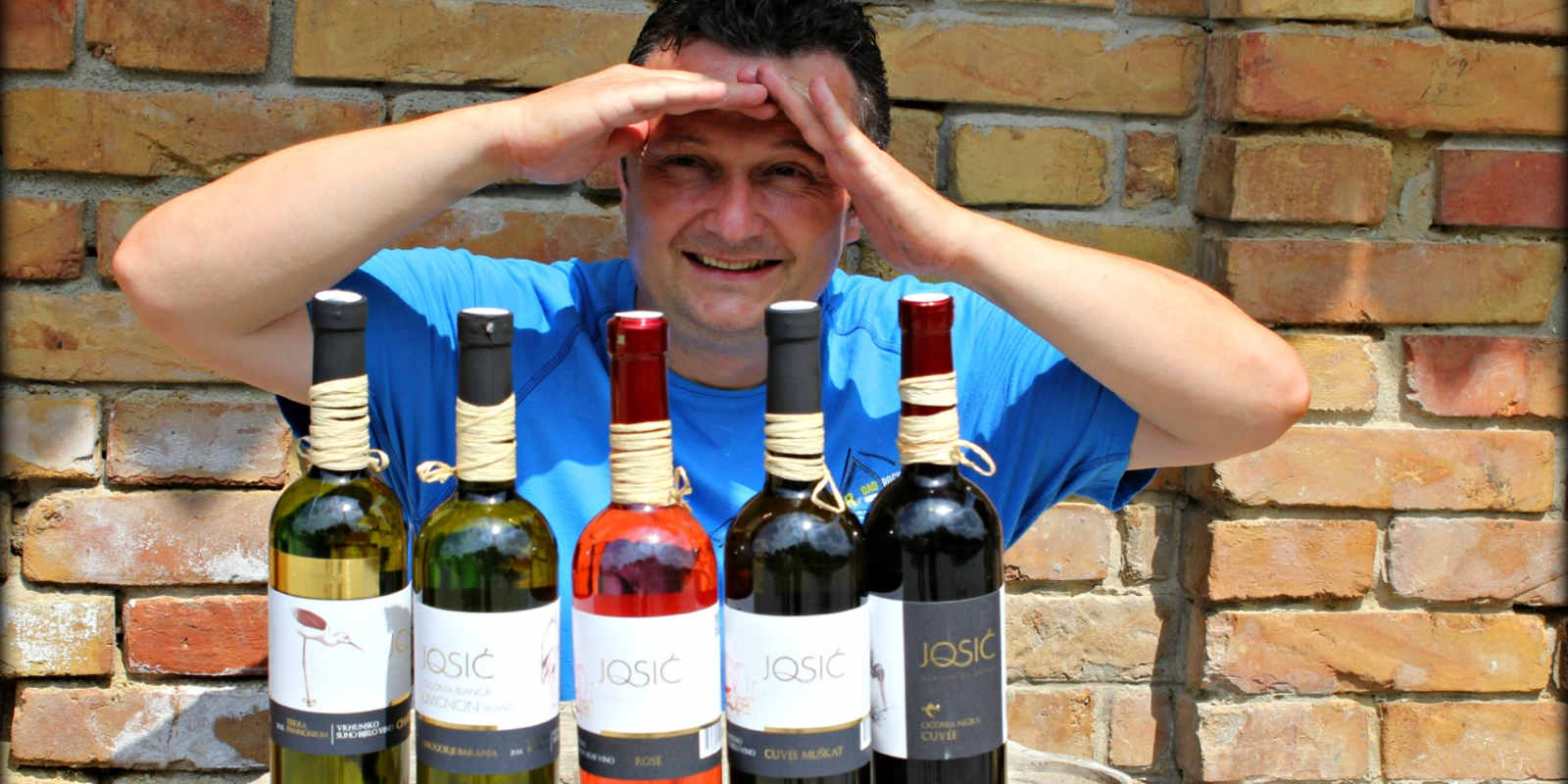
The National Class, says Aleksandar Vinčić, was “a madhouse”: you could have loaded all seventy-odd drivers into ten buses and taken them straight to a psychiatric ward, where they would probably have felt calmer than they did on the track. From that breeding ground of adrenaline, madness and courage emerged a man who, some twenty years later, would be behind some of Fruška Gora’s most ambitious Grašac wines, extensive nectarine orchards and modern blueberry production, a regional television channel and a network of radio stations-and, finally, a wine label bearing his own surname.
Although he first learned to drive on the edge, then to calculate coolly, and only afterwards to make wine seriously, his grandfather Gavra had summed up the essence of the whole story long before him:
“Good wine needs no concoctions.”
Aleksandar Vinčić, known as Vinča, was born in Šid, on flatlands without bends, yet fell in love with a discipline in which bends meant everything. During the 1970s and 1980s, the National Class was a Yugoslav motor racing obsession, more popular even than Formula One. When the celebrated Italian driver Valter Dona came to Belgrade’s Ušće circuit in 1971 and saw how people raced there, he reportedly concluded that even Italians were not that mad.
“The drivers in the powerful classes are cautious, some even timid, but these National Class drivers-they’re kamikazes. I’ve never seen anything like it.”
Vinča spent three years among those kamikazes. He drove a Yugo with around seventy horsepower and believed the world was his starting grid, until his very first race showed him how much narrower a track could be than his confidence.
“In the first lap, I overtook five or six drivers and thought: this is easy, I can even go around them on the outside. On my first attempt, I clipped the kerb, went onto the grass and rolled over. The car was wrecked, and I was full of adrenaline.”
The somersault strengthened his attachment to the track. The spectators thought he had done something spectacular; he thought he had merely learned his first lesson. Today, he describes the National Class as a departure of the human brain from reality, a world in which nothing else existed from April to September. The week began with washing clothes soaked in oil and sweat, followed by a visit to the garage to check on the engine the mechanic had started dismantling on Sunday. The rest passed in practice sessions, packing, races, breakdowns, repairs, arguments, embraces and occasional kisses with a wall. Winning was imperative, and another seventy-five equally mad people wanted it too.
Yet Vinča considers his greatest achievement from those years to be no particular result, but the realisation that nothing happens by itself.
“I came from a small town on the plain and suddenly found myself among people who already knew all sorts of things. The National Class gave me confidence and taught me that nothing comes without effort and hard work. That later became my principle in wine too: you can’t make good wine from bad grapes.”
Particularly important along that road was Nebojša Pavlović from Rača Kragujevačka, a philosophy teacher, headmaster and former racing driver who built racing cars in his own garage.
“At two in the afternoon, he would take off his shirt and tie, plunge his hands into oil and work late into the night, then go back to school the next morning. He taught me that enthusiasm is the essential driving force behind many things.”
Vinča’s racing career ended because of NATO’s bombing of Serbia.
“Fortunately for me,” he adds. “Because if that hadn’t happened, who knows whether I would ever have escaped that madhouse.”
He had to make a living from something, after all, and before the first Yugo there had been his father’s business: a car parts shop and repair workshop. Vinča would later say that he lived off his parents during those years, although it was really a family enterprise in which everyone worked hard. There was oil in the garage, farming around the house and wine in the cellar.
His grandfather had a vineyard and a cellar producing wine for family and friends, though with a fairly well-developed commercial instinct too. People arrived with demijohns, filled them with wine and brought back the empty containers, while any surplus was distilled into rakija, so nothing went to waste. His father Milan also had his own vineyard and cellar. Even many years later, Aleksandar would find it impossible to escape a family competition with neither judges nor scoreboards.
“When we gather for the slava, everyone brings his own wine, drinks only his own and insists that his is the real thing.”
The slava is the family’s celebration of its patron saint.
In time, his father’s workshop became too small for two men with similar energy, and Vinča began looking for another business. His attention settled on the media. At the time, Srem had one television channel, RTV M from Sremska Mitrovica, and several local radio stations. There was little glamour, but enough room for a man who first turns everything into a calculation to recognise an opportunity.
“I entered the media as a business, with no previous experience and no journalistic ambitions, but with very clear arithmetic. You calculate how many businesses your signal reaches, how many might advertise, how many never will and how many will never pay. Subtract your costs from a realistic figure, and you can see whether there’s a living in it. My calculations later proved conservative.”
He started with a few small cameras, one editing suite and rented premises. First came a local television channel for Šid, then expansion across Srem, with correspondent offices in Inđija, Ruma and Sremska Mitrovica. When the opportunity arose to obtain a regional broadcasting licence, he was ready. RTV M failed to renew its television licence and was left with radio alone, so Vinča acquired its radio station too. Then, step by step, he took over other stations across Srem, from Pećinci to Inđija, Ruma and Sremska Mitrovica.
“Later, we bought Delta Television in Novi Sad, which covers Bačka and part of Banat, and then some more radio stations. Today, I have around a hundred employees in the media business.”
He began applying what he had learned in the National Class-concentration, tactics and the ability to keep a cool head amid chaos-to an entirely different world. He was changing frequencies now rather than gears, but the need to spot an opening in time remained the same.
Another opportunity arose in 2007, when Serbia introduced regulations under which state-owned agricultural land was leased at auction. What looked to many like an administrative complication struck Vinča as a signal to start.
“I threw myself into it wholeheartedly.”
The result was a lease on two hundred hectares: half neglected vineyards, half arable land and ground on which they could begin afresh. The motivation was fruit growing as well as wine. They grubbed up old plantings with no future without sentiment, preserving those whose varieties made sense and which remained in good condition. On the cleared land, they established an extensive nectarine orchard, one of the most modern in Europe, irrigated from a nearby lake through five kilometres of pipes and a precisely monitored system.
Blueberries followed, grown in containers under polythene covers and fed through a computer-controlled system.
“It was an enormous investment, but that kind of precision suits me. The logic is the same as in a good television control room: everything needs its proper order, rhythm and input.”
Between the nectarines and blueberries, television news and advertisements, the vineyards remained. Some old plantings were preserved and other areas replanted, so the total vineyard area fluctuated over the years between forty and sixty hectares, depending on cycles of grubbing up and replanting. These were still vineyards within a broad agricultural enterprise, but a much more ambitious wine story was gradually emerging within them.
The building now occupied by Sremska Television, formerly a factory belonging to ŠIK, the Šid clothing manufacturer known for making Bogner jackets, also became home to Molovin Winery. Vinča took it over and developed it in partnership with his friend Zdravko Janjić, now deceased. A television station and a wine cellar under one roof might seem an unusual combination, but his explanation is entirely practical:
“When something is close to me, I can see what’s happening more clearly and keep better control of the business.”
Love, he says, is a variable. Once he preferred television; today he feels closer to the winery; tomorrow it may be different. Either way, the business has to function. Agronomists and engineers look after the orchards and vineyards, while he sets the direction and makes decisions. He owns half of Molovin, but at Vinčić Winery he is not content simply to be an owner.
“There, I’m both a winegrower and a cellar hand. I prune the vines and do whatever needs doing.”
However far ahead he looks, the family that started it all keeps reappearing in his story. Three cellars still exist in that world. Grandfather Gavra retains his vineyard, once a little over a hectare and now reduced to around 0.4 hectares, while his father Milan cultivates approximately a hectare and makes his own wine too. Each has his own rules, convictions and audience, even if that audience consists only of the family gathered around the slava table.
Grandfather Gavra reached almost a hundred, remaining mobile, driving a car and regularly ordering his grandson’s Grašac “to enjoy a little”.
“He called me recently and asked me to bring him a bottle of Grašac. I told him I’d sent him a whole case a few days earlier, and he simply said it had been drunk.”
To his grandfather, both son and grandson are chemists who put all sorts of things into wine. In his view, real wine is made without concoctions, from grapes and time alone. His father, meanwhile, is convinced that he makes the only natural wine, merely “touching it up a little” in the cellar. Aleksandar shows little mercy towards either family school.
“As far as I’m concerned, their wines are poor and technically faulty,” he says with a laugh.
That family hierarchy says much about his relationship with wine. He is the youngest in the pyramid, but the only one who decided to turn wine into a serious business, although he admits that in his youth he persistently fled anything connected with vineyards.
“As a kid, it was the worst thing imaginable. You’d go out the night before, get home at three, your head still ringing, and at six they’d wake you because the tractor had arrived and it was time to harvest. First at Grandad’s, then at Dad’s, carrying tubs, crates and buckets all day. I hated it. They dragged me into the vineyard, and I escaped into the National Class and the media.”
That is why he does not force his own children into the vine rows. He takes them to promotional events and other wineries, lets them carry glasses and introduces them first to the more enjoyable side of the business. He believes wine must attract a person before revealing how much work it demands.
“Let the bitter part come later. Wine has to win you over first.”
The turning point came in 2007, when he decided to build another profitable company alongside his media business. The winery was to become a serious commercial venture. The facility now housing both television and winery was built in 2010, marking the beginning of a professional approach to wine production.
Molovin’s wines were made in his tanks using shared infrastructure, and through that project an idea matured for a different winery: smaller, more ambitious and focused on fine wine. The question was how to draw the best out of a large agricultural operation and put his own surname on the label.
Before he found his answer in Grašac, there was the Vista Hill episode. The project he launched with Slobodan “Boba” Živojinović was intended to combine the glamour of Belgrade brands, serious wine and powerful marketing. Much attention went into labels, packaging and branding, while the wine came from Vinča’s vineyards and cellar. The partnership lasted three years. After it ended, Živojinović turned towards rosé, while Vinča decided to follow his own path towards Grašac and serious white wines.
“I drew a line under it, as though Vista Hill had never existed. We decided to enter the market as Vinčić Winery, fully aware that we were one of many new wineries and that people still needed to get to know us.”
Yet something happened during that partnership without which Vinčić Winery might never have taken its present direction. A tank of Grašac from the 2012 vintage remained in the cellar. The wine had been set aside, but Vinča and Zdravko Janjić could not agree on a name. They considered Graševina, Grašac, Italian Riesling and Inspiracija, but none seemed right, so the wine simply stayed in the tank.
Years passed before Igor Luković visited the cellar. Tasting older samples, he stopped beside the forgotten tank.
“What have you got in here?” he asked.
“Some Grašac. It’s good, but I don’t know who will recognise it.”
After tasting it, Luković left little room for doubt.
“You absolutely have to release this as a varietal Grašac. Whatever you do, don’t put it in a blend.”
They sent a sample to oenologist Vlada Nikolić, whose reaction was much the same:
“It’s superb. Where did you get this?”
That was how the thread began to unravel that would lead to Grand White Reserva. Under the Vista Hill project, the wine reached the market as White Reserve 2012. It would later become clear that this forgotten tank had illuminated the road Vinčić’s winery would take.
“We didn’t make a living from that wine. We gave away more than we sold, but it switched on the lights along a very long motorway, one that could take us far and high.”
The concept of Vinčić Winery, formally established in 2020, gradually emerged from his experiences with Molovin, Vista Hill and the media business. His interest lay in distinction: making only wines capable of reaching the highest standard, and only in years when the grapes could withstand rigorous selection, patient winemaking, ageing and the test of time.
“Great wine can only come from great grapes. Everything else is vanity.”
When he finally put his own surname on the label, Vinča says he entered a new National Class. He was no longer driving a Yugo, but the rules were not fundamentally different: concentration, persistence, a willingness to take risks and the knowledge that many others also wanted to win. His choice was Grašac, a variety long regarded as raw material for simple wines and spritzers, but which he believed could offer far more.
Proof arrived with Grašac 2020 from the Zaravan vineyard, which won a platinum medal and a Best in Show distinction at the Decanter World Wine Awards, becoming the first Serbian wine to receive that recognition. Vinčić released it at approximately €120, by far the highest price for a Serbian white wine. Before the first tastings, that prompted considerable scepticism and accusations of arrogance.
“When people from Lallemand visited us, Vladan Nikolić and his French oenologist colleague tasted the wine, and the Frenchman simply said we should be confident that the wine was no con and that it was worth the money. I tell people to take any white wine from anywhere in the world costing €120 that they can find in Serbia and put it beside our Grašac. If they still feel cheated, they’re welcome to come and we’ll refund their money.”
Such a wine, he believes, begins in the vineyard, where ninety per cent of what will eventually reach the bottle takes place. Zaravan lies right on the Croatian border, and its vines are more than half a century old. The topsoil is predominantly cool, clay-rich brown earth, long considered a disadvantage because it produced grapes with too little sugar and wines of nine or ten per cent alcohol, chiefly suitable for spritzers. Climate change turned that weakness into a strength.
“Our harvest starts seven to fifteen days later than in other areas. Once warming brought enough sunshine for the grapes to reach full ripeness, the cool soil allowed them to ripen slowly and completely.”
They picked the 2020 Grašac on 17 October, while the 2023 harvest did not finish until 25 October-exceptionally late for a white variety. Vinčić considers that extended ripening, together with crisp skins and fully ripe seeds tasting of roasted almonds, the foundation of a wine whose complexity cannot be created later through cellar interventions.
“During harvest, we all taste the berries, but we’re looking for more than aromas and juice. We examine the skins and seed ripeness, because maceration transfers the best of them into the wine. Afterwards, all that remains in the cellar is fine-tuning.”
The result, of course, is not one man’s work. Vinčić singles out Professor Marko Maličanin, the winemaking specialist who has worked with them for fourteen years and whom he considers almost part of the family; Mirko Opaček, head of viticulture, who has known these vineyards for half a century; and Brana Drakulić, responsible for vine protection for a decade. Together, they also propagate their own planting material. Vinča therefore sees the success of Grašac 2020 as confirmation of the whole team’s sustained work.
Over the past decade or so, Maličanin has also helped develop a research project involving a selected yeast strain of the genus Pichia, whose use allows wine to contain approximately one percentage point less alcohol than fermentation with conventional yeasts. The project began as a response to global warming, and Grašac, Vinčić says, benefited unexpectedly.
“Thanks to that yeast, we can obtain fully ripe Grašac with twelve per cent alcohol, a wine that remains light while offering much more pronounced fruit and elegance. Still, the most important thing is always the vineyard.”
The winery has approximately fifteen hectares of vineyards dedicated to wines bearing the Vinčić label, with expansion limited to a few more hectares. Alongside six hectares of Grašac at Zaravan, another three have been planted on an elevated plot once occupied by a Roman camp, an advance observation post for Sirmium, overlooking the entire Srem valley from Majevica to Fruška Gora. Other vineyards lie in Erdevik and Bikić Do, each site behaving differently and providing grapes for different styles.
Zaravan occupies a special place: an old vineyard they preserve almost like a relic.
“We won’t build anything there or disturb a single millimetre of the land. We’ll only renew the vines using our own planting material.”
Grašac has meanwhile become both the winery’s principal wine and an entire repertoire. It produces a lively, informal pét-nat; a traditional-method sparkling wine aged extensively on its lees; a late-harvest wine from 2017; a classic tank-aged varietal Grašac; a skin-contact wine from Georgian amphorae; and Grand Fru, fermented and aged in wood. Each reveals another side of a variety whose limits, Vinčić insists, remain far from fully explored.
Grand Fru has followed a particularly interesting course. Initially, many people complained that it had too much oak, including tasters associated with Decanter. Time, however, gradually changed the relationship between wine and barrel.
“Grašac is an exceptionally powerful variety: whatever you add, over time it eats it, absorbs it and turns it to its advantage. That happened with the oak too. When Grand Fru appeared, everyone said there was too much, but later the Grašac began swallowing it, the oak influence halved and the wine came together.”
Barrels were made specially for Grašac in France, and they tested different coopers and types of wood, including Slavonian oak. Vinčić stresses that micro-oxygenation is only part of the story; the barrel’s aromatic influence matters too. Overdo it, and the wine comes closer to the forest than the vineyard. Use too little wood, and the barrel loses its purpose.
They learned how dangerous a misjudgement of oak could be with their 2020 Pinot Noir. The wine was fruity, fragrant and promising, then the barrel swallowed it almost overnight. Although they used five-hundred-litre Radoux barrels, the aromas disappeared and they had to write off the vintage. For that reason, Vinčić has said for years that he has yet to “get” Pinot Noir the way he wants, despite planting two and a half hectares at the Gvozdenjak site in Erdevik, alongside an equal area of Grašac. Below the vineyard, towards Lake Moharač, another small plot has been reserved for future planting.
The first red wine bearing the Vinčić label should nevertheless be Pinot Noir, but only when they are certain that it meets the standard established by their Grašac. While he waits for that moment, the winery’s boldest venture has taken place in clay vessels brought from Georgia.
Grašac Amfora is made without added selected yeasts or sulphur, and without filtration. The 2019 vintage underwent nine months of maceration, followed by a year in a large wooden cask and another three years in bottle. Vinčić describes such a wine as the truth about the vineyard, because it offers no technical interventions behind which to conceal the quality of the grapes or the character of the terroir.
“Everything happens spontaneously and finishes naturally. There’s really no technology to hide behind. If the grapes and vineyard aren’t outstanding, the amphora will show it.”
Confirmation came in June 2025, when Grašac Amfora 2019 won the orange wine trophy at the international GROW du Monde competition. Vinčić admits that he had not expected the award, despite knowing how much effort and patience had gone into the wine.
“I knew it was good, full-bodied and rich in extract, but I wasn’t expecting a trophy. Nine months of maceration, a year in a large cask and three years in bottle represent an enormous amount of work. A wine like that proves the outstanding quality of the grapes and terroir.”
The first Amfora vintage, 2017, sold out completely, while the award-winning 2019 was released after its long rest in bottle. Next will come the 2021 vintage, also ageing before meeting its audience. Pleased with the results, they have acquired more Georgian vessels, with capacities ranging from five hundred to fifteen hundred litres, and plan to produce approximately five thousand litres of this wine each year.
“The only problem is that amphorae are handmade, so you never know their exact capacity. A vessel may hold a hundred or two hundred litres less than stated, or it may hold more. But what matters more to us is what happens inside, and afterwards we let the wine settle for at least three years.”
Even that, however, does not convince them that they have explored every face of the variety. Vinčić also speaks of a search for black Grašac, based on historical records and the possibility that its genetic material may still be hiding somewhere in the Danube basin.
“We don’t yet have Grašac as a red wine, but we’ve begun searching for that too. Historical material about black Grašac exists, and its genetic material may still be here, having simply lost its name and identity. We’ll do our best to find it, and perhaps one day we’ll have a red wine made from Grašac too.”
For Vinčić, a surname on a label is more than a marketing decision. Grandfather Gavra remembered his father Milan, grandfather Uroš and great-grandfather Veselin, allowing the family line to be traced through oral history to the early nineteenth century. Research in church registers took it another fifty years back, to Georgije Vinčić and 1771.
At the time, Molovin had no church, only a so-called church on wheels: a cart carrying a bell tower and cross would arrive in the village on Sundays, a priest would conduct a service, people would pray and the cart would continue on its way. Meanwhile, in Tovariševo, across the Danube near Bačka Palanka, a new church was being built on the orders of Empress Maria Theresa, making the old, smaller iconostasis redundant. The people of Molovin had no money to buy it, but they had wine, so an exchange of several thousand litres for the iconostasis was agreed.
Among the contributors recorded in the documents was Georgije Vinčić, who donated twenty akov of wine, approximately a thousand litres. The iconostasis was transported to Molovin on ox carts. Much later, it was identified as the work of the renowned painter Jovan Četirević Grabovan and is now protected as a cultural asset.
“When you discover that someone in your family was giving wine for an altar two and a half centuries ago, what goes on the label starts to matter rather more.”
The house in which Aleksandar was born offered little opportunity to escape the family past either. Built of adobe bricks, it had his bedroom above a brick-lined cellar some ten metres long, filled with barrels and vats.
“My wine pedigree is beyond question, whether I like it or not,” he laughs.
Grašac is no recent addition to that family story either. Grandfather Gavra, born in 1926, remembered the variety being called Grašac or Grašica bijela, although the name Italian Riesling was already spreading. He also remembered Grašac being used at the Pajzoš cellar, on the Croatian side of the Danube, to make wine for the Yugoslav president’s office. It was both a variety for great wines and a source of everyday spritzers, frequently overcropped to obtain as many grapes as possible, make wine quickly and drink it even faster.
“In our house, wine never lasted until Easter. You pressed it, racked it, drank it with friends, and that was that.”
Vinčić believes the socialist idea that everything should be available to everyone had a noble foundation, but in wine it largely resulted in millions of litres from agricultural combines that offered little cause for pride. Private winemaking scarcely existed, and people in winegrowing areas remained tied to old habits and techniques.
“I don’t want to invent history or wines that never existed. My father and grandfather are here, the terroir and vineyards are here, our wines are here. I think that’s quite enough.”
That is precisely why he insists on the name Grašac. He regards Graševina, Italian Riesling, Laški Rizling and Olaszrizling as synonyms for the same variety, whose planting material spread for decades from Sremski Karlovci towards Croatia, Hungary, Austria and Romania. As chairman of the Grašac Committee within the Srem–Fruška Gora association, his aim is neither to erase local names nor to dictate what others put on their labels.
“If Ivana Šijački’s father always called the variety Italian Riesling, and she makes excellent wine under that name, why should it bother anyone? They’re all synonyms for the same variety.”
They pay particular attention to the old planting material at Zaravan. Professor Cindrić once maintained an experimental vineyard in the area, studying Grašac alongside Sila, Neoplanta, Panonija, Petra and other varieties. Material for the SK 54 clone was also taken from it, although Vinčić maintains that the Grašac in Zaravan’s old plantings differs considerably in aroma from the widely planted clone of today. That is why they renew the old vines using their own planting material, preserving what they consider the site’s unique character.
Research by Professor Vlada Puškaš gives him further confidence, showing that Grašac can contain high levels of particular aromatic compounds and accumulate substantial extract under suitable conditions.
“That is crucial. If a variety can produce concentration, it can also produce great wines in very different styles.”
He sees that adaptability as one of Serbian wine’s greatest export strengths. He is convinced that any producer who approaches Grašac as a great variety, rather than undemanding raw material for simple wine, will be amply rewarded. He views international competitions such as GROW du Monde as a way to raise the variety’s profile as a whole, increase sales and enable producers to invest in new vineyards and technology.
“Grašac is advancing in great strides. It’s realistic to expect sales to grow, and those who give it enough attention will be able to reinvest their earnings in vineyards and production.”
Although Serbia has seen intensive vineyard planting over the past fifteen years or so, Vinčić believes the real improvement in quality is still to come. Many vineyards were established without a coherent plan, but the vines are now maturing, growers are gaining experience and wineries are defining more clearly what they want to produce. Amid a sea of projects often funded by capital from Belgrade, his ambition is to be consistent and recognisable.
“Vinčić Winery is not my toy. Too much effort and sweat have gone into it, although the project hasn’t yet come to life as fully as it could. It functions and it works, but you can’t simply put premium wines in front of people and say: here you are.”
Alongside the vineyards, they are therefore developing a place where those wines can be explained and experienced. The tasting room in Šid is being enlarged to accommodate around fifty guests, a new winery is being built and a small hotel is under consideration. Vinčić wants wine to have a life beyond a shelf or a price list, especially when it has taken years to make.
“When wines are released, they need somewhere they can be drunk at leisure, explained and understood.”
In this new National Class, the racing cars are called Grašac, Prokupac, Smederevka and Pinot Noir rather than Yugo. Behind the wheel sit people willing to risk time, money and their nerves for a single label. Vinčić has defined his own racing line quite clearly: Grašac and Pinot Noir, but only in years when the vineyard produces grapes worthy of a wine bearing his surname.
“We don’t want to make wine at any cost. If we don’t have good grapes, there won’t be any Vinčić wine.”
When one finally tries to add up the racing and media, orchards and vineyards, Molovin and Vista Hill, Grand Fru and Amfora, and major international awards, the whole story seems to call for a manifesto or a business plan for the next twenty years. Aleksandar Vinčić, however, prefers to return to Grandfather Gavra: the man who calls him a chemist for supposedly putting all sorts of things into wine, then telephones to hurry him along with more Grašac because the previous case has already been drunk.
Asked what advantage he has among Serbia’s growing number of wineries, he again connects the vineyard with the track where he learned that confidence without work usually ends at the first kerb.
“Perhaps my advantage is that I don’t look for shortcuts. Racing taught me that nothing comes for free, the vineyard that there are no miracles, and the cellar that there is no magic. There is only work.”
His answer is just as simple when asked what the next Grand Fru will be like, whether Grašac will acquire another style and whether he dreams of further awards.
“I’m not planning anything spectacular. We need to look after the vineyard properly, make a clean wine and make sure Grandad doesn’t say we’ve been adding things again. If we manage that, it’s enough for me.”
After all the family arguments at the cellar door, Vinča thus returns to a sentence that has survived three generations, changes in the variety’s name, agricultural combines, privatisations, new technologies, amphorae and French barrels:
“Good wine needs no concoctions.” His grandfather’s methods may be simpler than his own, but on one thing they agree: it takes good grapes, plenty of work and someone who knows when to stop-and when to go.