Climate change and the scourge of flavescence dorée, the disease known locally as golden grapevine yellows, have forced winemakers in Hrvatsko Zagorje to reconsider the varieties in their vineyards and replace some with German-bred crosses resistant to most common fungal diseases and suitable for organic cultivation.
Recently, at Pupitres, Jelena Šimić Valentić’s popular boutique of wine culture in Zagreb, Edi Maletić, a professor at the University of Zagreb’s Faculty of Agriculture, gave a lecture on disease-resistant grape varieties and their wines. He introduced the audience to innovative solutions that “represent the future of viticulture, particularly in the context of climate change and reducing pesticide use”.
The wines tasted were made from Johanniter, Solaris, Sauvignon Ritos, Sauvignon Gris, Cabernet Cortis and Cabernet Volos. The producers serving as “guinea pigs” for the Faculty of Agriculture were Galić and Krauthaker from Kutjevo, and Janko Orsag from Zlatar in Zagorje. In 2020, the faculty had launched a breeding programme at its Jazbina experimental vineyard, planting twenty-two PIWI varieties – Pilzwiderstandsfähige Rebsorten, or fungus-resistant grape varieties.
The successes of the Orsag winery slipped somewhat under the media radar. Of those three wineries, it was the only one to bottle and label the resulting wines, some of which earned gold medals at competitions.
Robert Zdolc, an “organic winemaker from the heart of Zagorje”, is seriously considering planting less disease-sensitive varieties in his “vineyards with a view” in Plemenšćina, an idyllic winegrowing area on the road between Pregrada and Đurmanec. Alongside Tomislav Bolfan, Robert is the only Zagorje winemaker with organic viticulture certification.
– Organic growing has another side to it. When the year is good, it’s good for us organic producers, too. Like 2022. But 2023 and 2024 were the complete opposite: there was plenty of rain, and it fell when we least needed it. Conventional producers can step in with systemic treatments and save their vines. Across those two years combined, we organic producers harvested less than we did in 2022 alone! Your volume suffers, and even if you want to buy grapes, where do you find them, and from whom? And we haven’t even touched on hail or other natural disasters such as frost, which we didn’t actually have in either of those years.
– Then there’s golden grapevine yellows, which has recently begun attacking our area, previously spared. I’ve grubbed up part of a vineyard, around five hundred vines.
Has all that shaken your resolve?
– After the very good harvest of 2022 came two very bad years. They didn’t make me give up, but they certainly shook me! You start questioning yourself because you can no longer see the point. Where does it end? That disease will eventually pass, but will it devastate everything first, or will something remain?
– We’re aware of climate change and have been forced to consider planting less sensitive varieties. In doing so, we take the risk that our wines will no longer be what people have become accustomed to.
Robert currently grows Graševina – labelled “Rizling” on his bottles – Sauvignon Blanc, Pinot Gris, Merlot, Frankovka, Zweigelt and Štajerska Belina. In his experience, Pinot Gris and Zweigelt have proved the most vulnerable varieties, “mercilessly attacked by golden grapevine yellows”, while Graševina has shown the greatest resilience.
Despite all these difficulties, Robert intends to expand his vineyards.

– Our first plantings date from 2004, when we put in around a thousand Sauvignon Blanc vines as a trial. That worked very well. We increased our plantings in 2015 with Sauvignon Blanc and Graševina, and only recently began with red varieties such as Merlot, Zweigelt and Frankovka.
– My vineyard isn’t large, around eleven thousand vines, and I intend to expand it to roughly twenty thousand. The problem is consolidating small plots, which are difficult to buy, bring together and put into use. The town of Pregrada owns some land, so perhaps we could lease it.
Robert became more seriously involved in wine in 2008, “at a time when gemišt dominated Zagorje”.
– But we shouldn’t look down on gemišt, especially in summer. I enjoy a glass myself, and I’m not ashamed of it. We do insist, though, that the wine must also be good when drunk on its own!
His vineyards lie “on the hills of Zagorje, where the writer Janko Leskovar also grew grapes”. The first vines were planted in 1921 by Robert’s great-grandfather, who was born in the same year that Leskovar’s novel Propali dvori appeared.
“To come here, open the vineyard cottage door, then sit at the threshold, where the view stretches over hundreds of Zagorje hills, on upturned little wooden tubs; bring out cheese and bread, and pour fresh, sparkling wine into the glasses… pure and pleasant.”
Robert gives this passage from Propali dvori pride of place on his website, seeking to show the deep bond between the people of Zagorje and wine, including figures as distinguished as Janko Leskovar, the Croatian writer born in nearby Valentinovo, where he also died.
“Wine and our hills have always been friends,” runs a popular local rhyme adopted by Krapina-Zagorje County as the slogan for its “Vineyards with a View” event. Beyond celebrating the landscape’s beauty, the event also draws attention to the fossilised leaf of Vitis teutonica discovered in Radoboj, estimated to be around twelve million years old and displayed in the nearby Radboa Museum.

Plemenšćina itself, the site of Robert’s vineyards, with views stretching to Kumrovec, Bistrica ob Sutli, Krapina and Sljeme, takes its name from the noble grape varieties that have always performed so well there.
Robert’s wine cellar is among the most beautiful in Zagorje. With verses adorning its interior walls, it could also be described as a museum of the region’s wine poetry. As soon as you enter the main tasting room, you are greeted by the words of the well-known song “Dobro mi došel, prijatel” – “Welcome, My Friend” – carved into wood. Vice Vukov sang it at the Kajkavian Song Festival in Krapina in 1970. Its lyrics were written by Rijeka-born Viki Glovacki and set to music by Vilibald Čaklec.
Welcome, my friend, to this old Zagorje home.
Make yourself at home, as in your own house; here you are with a friend.
This house may be old, but it still stands,
You cannot bring this roof down; it fears nothing.
Whatever you wish for in this house, my heart will give you.
The people of Zagorje are friends of old – the whole world knows it today.
Welcome, my friend, to this humble Zagorje home.
Make yourself at home, as in your own house; here you are with a friend.
Whatever you wish for in this house, my heart will give you;
The whole world already knows that Zagorje people are true friends.
This house may be old, but it still stands,
You cannot bring this roof down; it fears nothing.
A man of Zagorje will always be the first to give his life for friendship,
To the very last drop of blood – and never regret it.
Enter the cellar where the wines mature, and there is poetry again, verses engraved across three walls. This time they are from Ivan Goran Kovačić’s poem “Wine”:
Alone before the vineyard cottage, beside the vines I stand:
I offer myself a glass brimming with wine!
Since there is still room on the walls, and no shortage of Croatian poets who have celebrated wine, I suggest that Robert might also find space for Antun Mihanović, who died in nearby Novi Dvori outside Klanjec, and his “Lijepa naša”:
Great hills, great people –
That is our homeland!
Or perhaps for August Šenoa, who spent his last holiday with his son Milan in Zagorje before his untimely death at forty-three. He visited Antun Mihanović’s grave, climbed to Cesargrad and walked through Zelenjak to Tuhelj, then through Pregrada to Novi Tabor:
…Croatia is a land of abundance,
A witness to our hospitality…
However much Robert Zdolc deserves recognition for his investments in the winery and vineyards, and for the enormous effort he has put into promoting both his wines and his region, winegrowing and winemaking remain his second occupation. First and foremost, he is a mechanical engineer who earns the family’s main income at Vetropack, the giant glassworks in Hum na Sutli and one of the region’s largest bottle manufacturers, employing more people than the settlement itself has residents.

Robert works in sales, providing technical support and developing new bottles. His job at Vetropack was his first after completing his studies.
Wine, however, remains his first love, dating back to the boyhood days when he helped his grandfather and father.
– I was born with it, I live with it, and I’ll die with it!
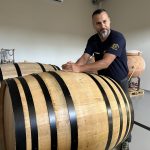
Robert is one of the few Zagorje winemakers who keeps wooden barrels in his cellar – not barriques, but old wooden barrels – because he wants “a small amount of micro-oxygenation as the wine matures after fermentation”.
– Wooden barrels give me that. Afterwards, the wine goes back into stainless steel, then into bottles.
Like almost every winemaker in Zagorje, Robert readily acknowledges the crucial role Professor Gerhard Schubert played in his development.
– Around twenty years ago, I realised we needed to move beyond the classic Zagorje blends for gemišt, which weren’t bad wines in themselves. The late Gerhard Schubert gave me the greatest encouragement. He always stressed that Zagorje had the vineyard sites to develop and produce outstanding wines. When I think of how generously he gave his time to anyone needing help or advice, he deserves to have at least one wine made in his honour!
One of Robert’s wines already honours someone close to him. Rizling! Not Laški Rizling, not Graševina, simply Rizling. And Grandma Ljubica is to “blame” for it all…
– When we were planting the vineyard, Grandma asked me which variety we were putting in.
– “Oh, Rizling? Why didn’t you say so straight away?” she replied.
– Grandma didn’t know what Graševina was. To her, it had always been Rizling! That’s why I put “Rizling” on the label: I wanted to bring back the spirit of earlier times and our ancestors. We know, of course, that Laški Rizling, one of the synonyms for Graševina, has nothing to do with Riesling…
– Besides tradition and nostalgia, putting Rizling on the label clearly distinguishes Zagorje’s Graševina from those made in eastern Croatia, which are completely different from ours.
Alongside Grandma Ljubica, Robert always mentions his father Josip when talking about the winery’s growth. Twenty years ago, while they were standing in the cellar, his father said:
– Tourists will come here!
– He had a vision, and now it’s beginning to come true.
Thanks to that vision, realised through modern winery equipment, a tasting room and organised tastings, Robert now sells most of his wine directly from the estate.
– Dad was right. Wine tourism is rapidly finding its way to Zagorje’s vineyard cottages. We can feel it in the growing numbers of visitors to our wineries. Zagorje’s wines are no longer enjoyed only by the people of Zagorje. Wine tourism has brought us to the point where we can say:
– Wine for everyone, not just the people of Zagorje!