– No credit in this house. We have tried trusting promises before: we lost both the money and the customer.
So reads a brown ceramic plate decorated with white flowers, hanging in Capela Incomum, a wine bar in the heart of Porto. The message is useful from the moment you enter: faith is welcome here, but credit is not.
Capela Incomum means Unusual Chapel in Portuguese, and it is difficult to imagine a more fitting name. It is indeed a chapel, but today it gathers wine lovers rather than worshippers, while tastings have replaced Mass before the former altar. Its unusual character, then, takes little finding.
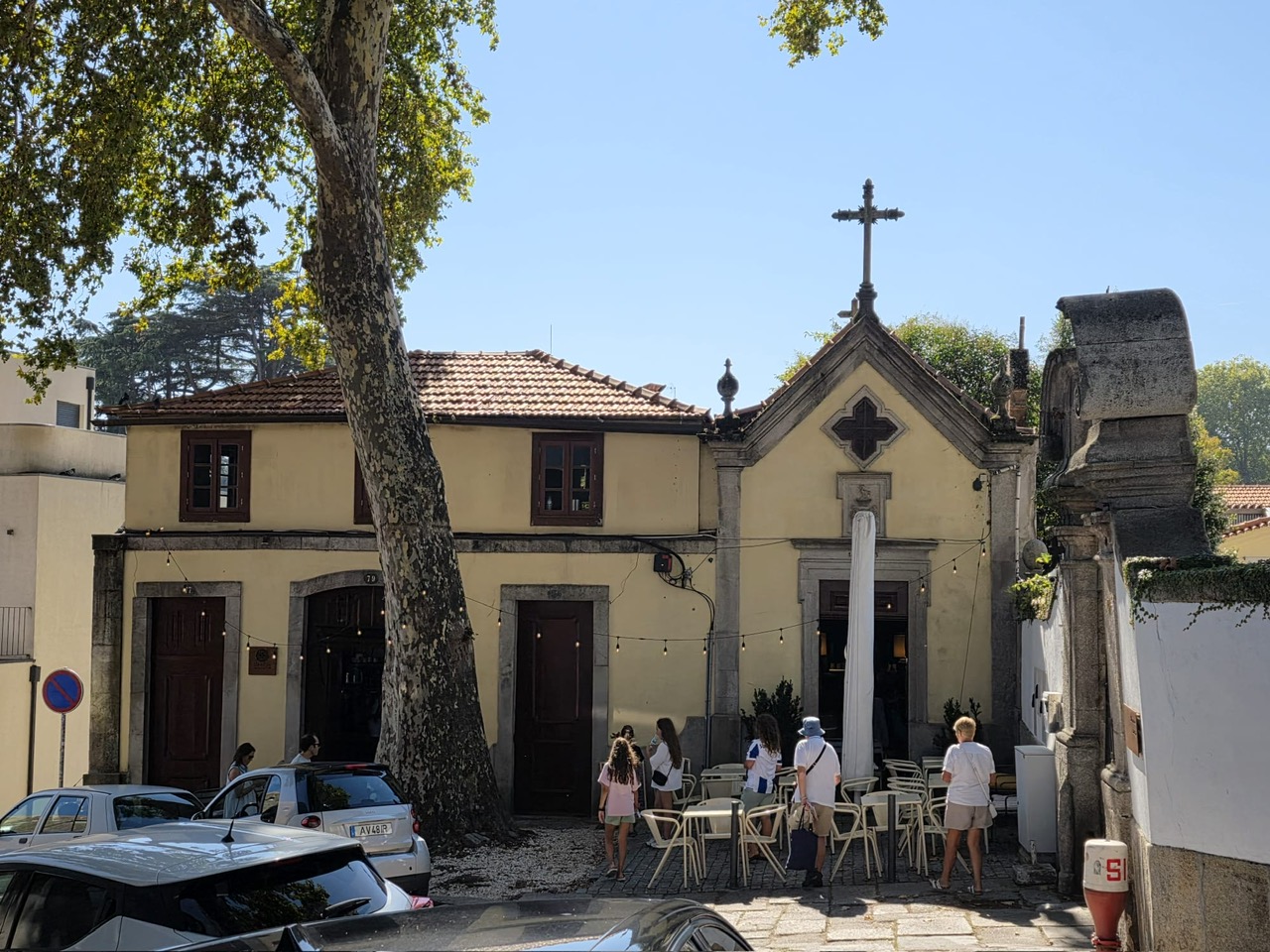
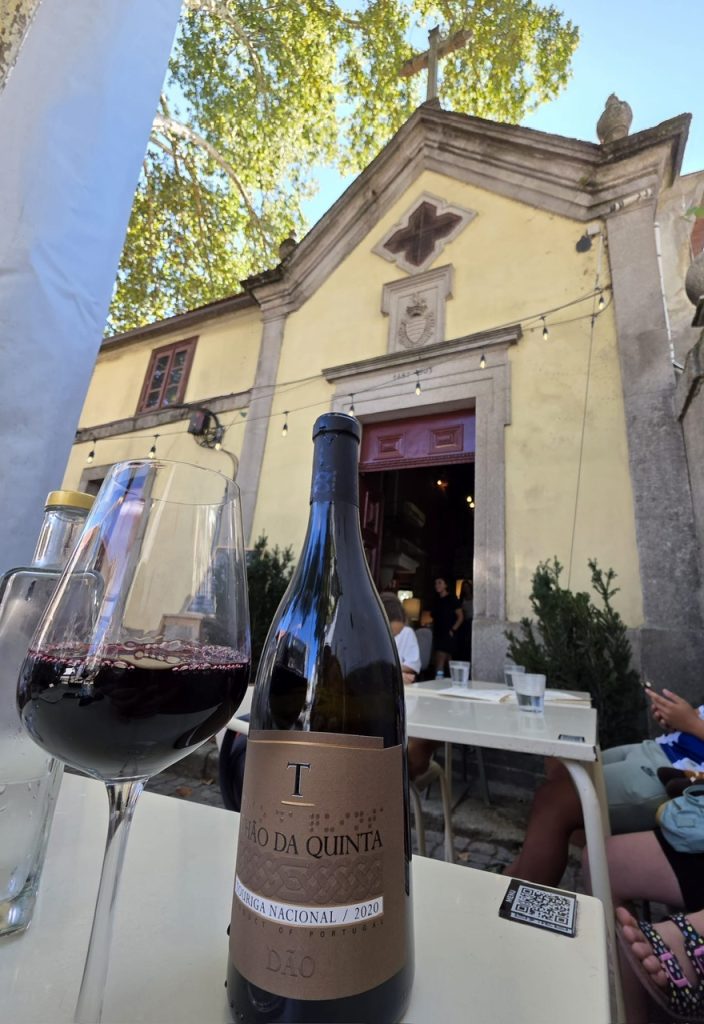
You do not arrive at Capela Incomum to find an imposing church façade that stops you in your tracks. It is tucked away on a small square between Jardim do Carregal and Rua de Cedofeita, among modest, pale-yellow buildings framed in granite. Without the stone cross crowning the façade, the coat of arms above the door and the date carved into the lintel, you could easily walk past. Outside the entrance, tables and white chairs crowd beneath an enormous plane tree, strings of light bulbs stretch across the façade, and wine glasses on the terrace suggest that more than spiritual refreshment is now offered behind the church doors. The dates on the façade also tell a different story from the one repeated in many tourist accounts. The chapel was not built in the nineteenth century. It was founded in 1487 and restored in 1903 by Maria Angélica Ferreira Girão, Viscountess of Vilarinho de São Romão. A metal plaque on the stone wall records this, while another commemorates 16 December 1956, when the chapel hosted one of the celebrations marking twenty-five years since the graduation of the final class of the University of Porto’s Faculty of Arts.
Religious services have not been held here for more than half a century, but the chapel has not lost its devoted following. Only the rituals and the arrangement of saints have changed.
In this, Capela Incomum is not alone. Across Europe, churches and chapels that have lost their congregations are finding new lives as libraries, concert halls, hotels, restaurants and bars. Such conversions are more than a fashionable architectural game: they are often the only way to prevent old buildings from remaining locked and falling into decay. The difference lies in restraint and taste. A new use can erase a place’s memory, but it can also preserve it. Capela Incomum belongs to the latter kind.
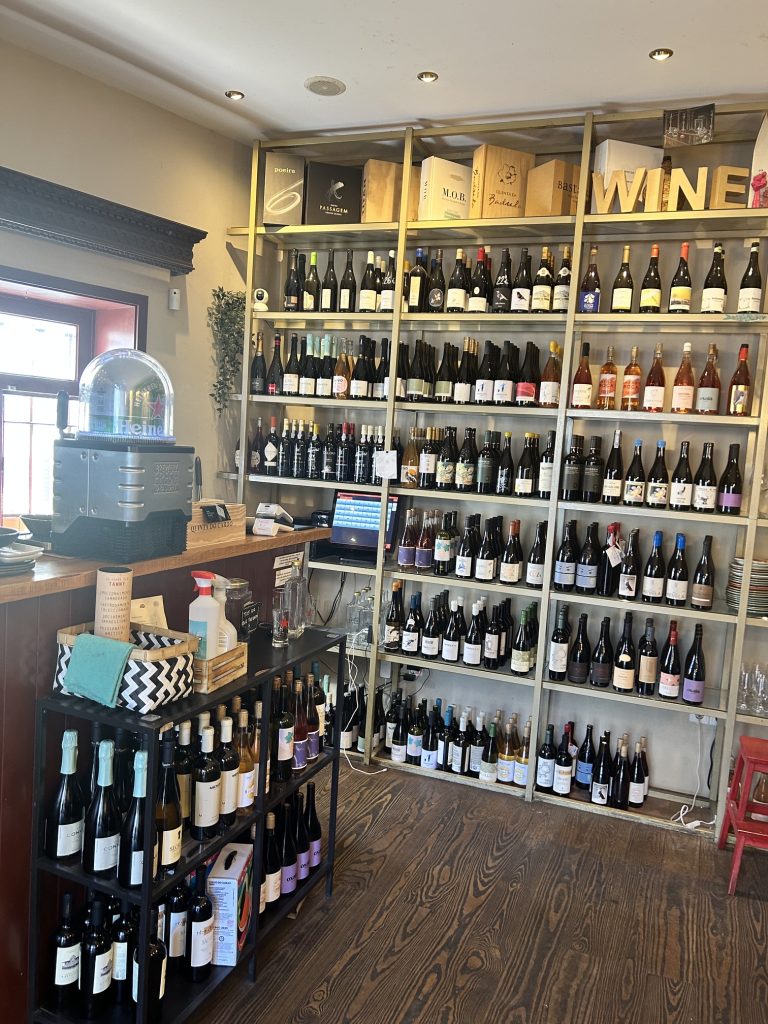
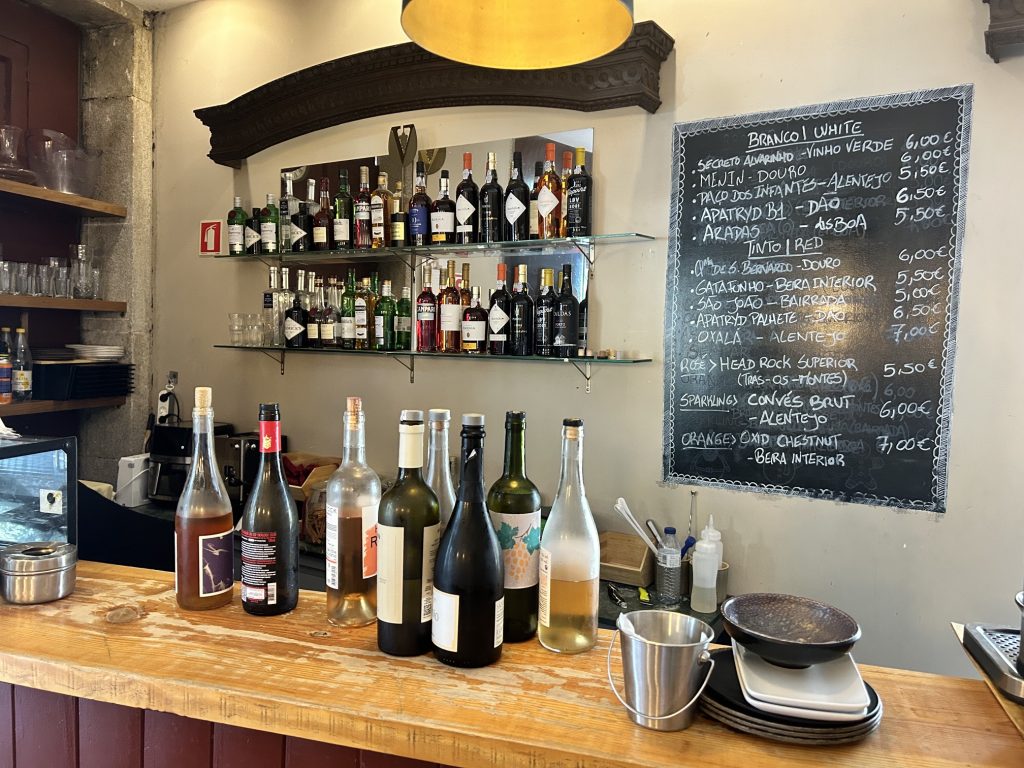
As soon as you enter the brighter front section of the bar, your gaze settles on shelves filled with bottles. Dozens of Portuguese wines stand in rows stretching almost from floor to ceiling, while wooden letters above them clarify what is already obvious: WINE. There are white, red, rosé, orange and sparkling wines from across Portugal. Behind the counter, bottles await their next service, and the wines available by the glass are written in chalk on a blackboard. In place of psalm numbers, each wine is accompanied by its region and price.
On my table, in the shade of the plane tree and directly opposite the chapel’s open doors, stood a bottle of Chão da Quinta Touriga Nacional 2020 from Dão. The scene had its own small iconography: a cross above the door, red wine in the glass, and the carved dates 1487–1903 between them. It would be difficult to find a more appropriate place to taste a grape variety that enjoys something close to sacred national status in Portugal.
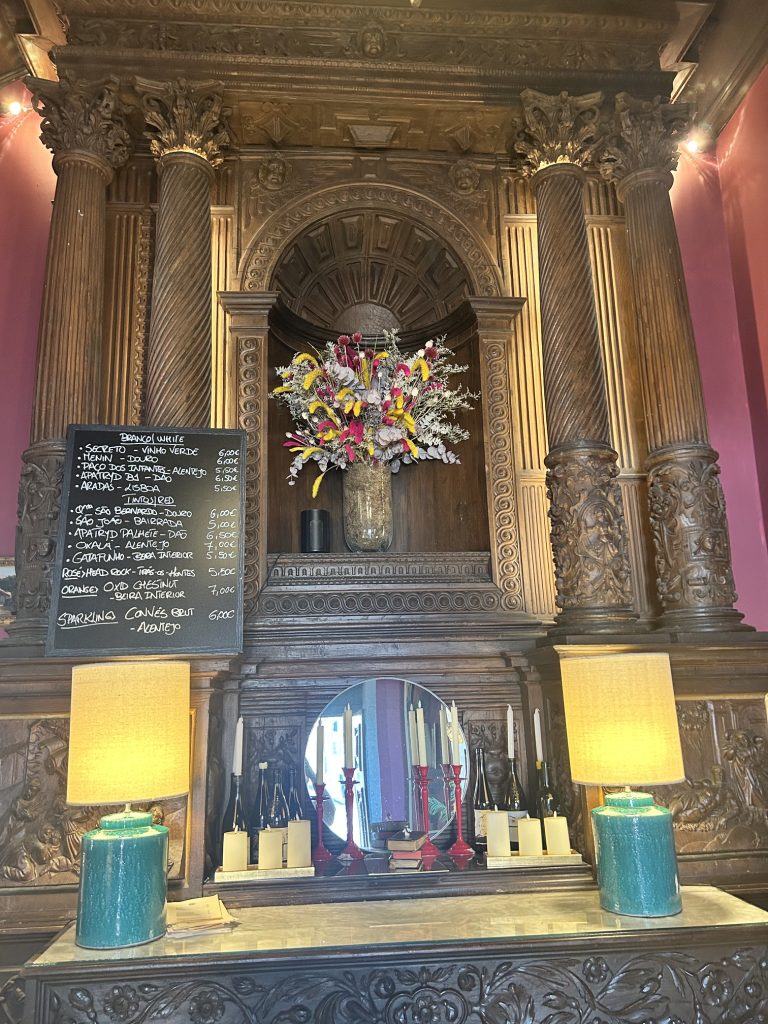
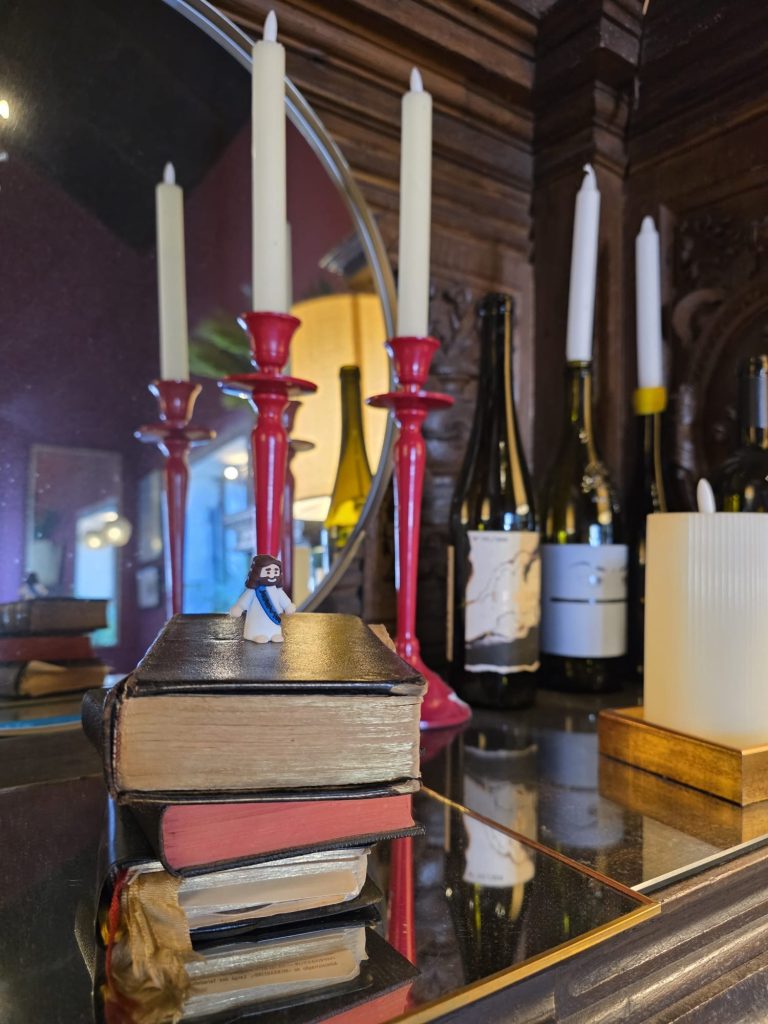
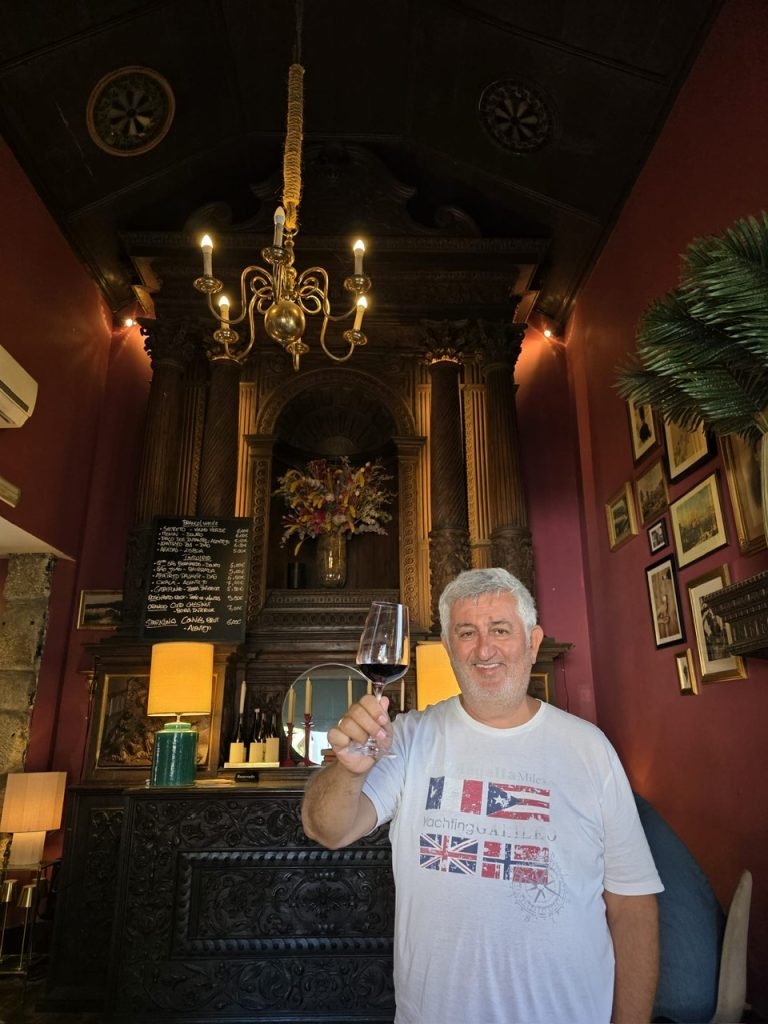
The true passage from the profane to the sacred, or perhaps the other way around, takes place a few steps further in. From the bright bar, you enter a narrow chapel with dark-red walls and a high wooden ceiling. The room is small, but its height lends it an unexpected solemnity. An antique chandelier hangs overhead, and the former altar dominates the far end, framed by a monumental dark-wood structure with twisted columns, reliefs and arches. Where you might expect a saint’s statue stands a large vase of colourful flowers. Beneath it are a mirror, candles, wine bottles, tall red candlesticks and – lest the whole thing become too solemn – a tiny figurine resting on a pile of old books.
Beside the altar structure leans a board listing the current wines by the glass. Vinho Verde, Douro, Dão, Bairrada, Alentejo, Lisboa and Beira Interior have taken the places once occupied by the church calendar. Here, the choice is no longer between morning and evening Mass, but between white, red, rosé, orange and sparkling wine.
Tables have replaced the pews, but the old space has neither been covered up nor disguised. Francisca Lobão, the interior designer who conceived Capela Incomum, made no attempt to hide what this building had been. Instead, she preserved its drama and allowed its new purpose to converse with the old walls. When she discovered the abandoned space, she initially intended to turn it into a studio for her interior-design work. The chapel, however, changed her plans.
Before opening the wine bar, she even approached the Bishop of Porto to check whether her idea might be sacrilegious. Her argument was a reasonable one: wine had, after all, been part of Christian worship for centuries. When approval arrived from the bishop’s office, Francisca followed her intuition and gave the chapel a new life.
She was not content for the old space to serve merely as an attractive backdrop for photographs. Capela Incomum was conceived as a place to discover Portuguese wine as well as drink it. Alongside it come cheeses, cured meats, roasted sausage and other Portuguese bites. Occasional fado performances before the altar lend the scene something of a Mass, a film and an evening it would be impolite to rush.
Although it is close to one of Porto’s liveliest nightlife areas, Francisca never wanted another bar with a dance floor and music that makes conversation redundant. Capela Incomum has remained small, intimate and slightly mysterious. When the weather warms, tables move beneath the vast canopy of the plane tree, while the stone cross on the façade watches over bottles, glasses and guests stretching out the evening for as long as they can.
The chapel, then, has been deconsecrated, but it has not been left without a god. Bacchus has simply stepped up to the altar.
And judging by the ceramic plate, he introduced the house rules immediately: you may put your faith in wine, but you cannot buy it on faith alone.