Aszú je najskuplji proces proizvodnje vina na svijetu. A desetljećima je bio jedno od najjeftinijih velikih vina Europe. U tom paradoksu skriva Aszú is the most expensive winemaking process in the world. Yet for decades it produced some of Europe’s least expensive great wines. In that paradox lies the fate of Tokaj, and the career of a man who refused to accept that greatness should come cheap. István Szepsy did more than preserve a tradition. He had to redefine it so that it could survive.
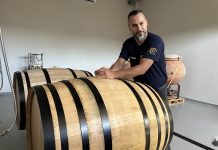
In the Szepsy family cellar, there are bottles that will never reach the market. They have no export label, no distribution plan, no price.
– In most years, we make various experimental wines that we never release, says István Szepsy Jr. They are always for friends and family.
In a world where great winemakers are described as institutions, legends and global icons, this detail brings the story back to a human scale: a table, a few glasses and a wine made for trust rather than the market. Before the brand, the international acclaim and the weight of history, there is a circle of people tasting something born of curiosity or doubt. Perhaps it is in those unreleased bottles that we begin to understand a family that has shaped the history of Tokaj, and with it the history of wine.
Perhaps this quiet family practice also explains why the name Szepsy has never been merely a mark of origin in Tokaj. It is an obligation.

Ime Szepsy u Tokaju ne znači samo prezime. Obiteljska loza vinogradara i vinara proteže se kroz šesnaest generacija, sve do 17. stoljeća, The Szepsy name is more than a surname here. Sixteen generations of the family have grown grapes and made wine, a lineage stretching back to the seventeenth century, when their ancestor Laczko Máté Szepsy first wrote down the method for making Tokaji Aszú. For centuries, the wine symbolised power, diplomacy and luxury: a gift to emperors, a tool of politics and a source of pride for a small country.
But Tokaj’s history has never followed a straight line. The same vineyards that once supplied royal cellars lived through phylloxera, wars, the Treaty of Trianon and decades of communism, when Aszú went from a pinnacle of wine to a category. To carry the name Szepsy in that setting is to inherit both the glory and the ruins.
What was it like growing up beside a father whose name already meant so much? Did it inspire rebellion, or a sense of responsibility?
– First and foremost, he is my father. Only after that is he a winemaker, says István Jr.
That simple sentence contains an entire order of values. Responsibility seems to have outweighed rebellion. Still, he admits that he finds it hard to accept things as they are, a trait that did lead to a measure of rebellion a few years ago. Nothing spectacular or public, but enough to show that inheritance is not the same as obedience.
There was no ceremonial handover in the Szepsy family. No day on which his father said: Now it is time. Take over.
Then, in 2019, his father had a stroke. Everything accelerated before anyone was ready.
In the vineyard, however, hierarchies do not change easily.
– My father is still the boss.
That “still” carries the weight of an entire region. Tokaj is more than a geographical designation. It is a place where history keeps returning to the same question: can lost greatness be rebuilt?
To be a Szepsy is to live between myth and reality, without allowing either to swallow the other.
And so, in the cellar, there are still wines that will never be sold.

Tokaj is more than a wine region. It is a geological and historical phenomenon. Its vineyards spread across the slopes of more than four hundred extinct volcanoes, over soils rich in zeolite, quartz and clay. The geology can change within a few dozen metres. Vineyards that nearly touch can produce wines so different that they seem to come from separate countries. In Tokaj, terroir is no poetic flourish. It is central to the argument.
Yet Tokaj’s fate has never been shaped by nature alone. Politics shaped it too.
Before phylloxera, Hungary’s wine production was comparable to France’s. Tokaji Aszú was a jewel of the European courts, financing political ambitions and symbolising the country’s cultural identity. Then came the ruptures: phylloxera, wars, Trianon and communism. Collectivisation destroyed aristocratic estates and then peasant holdings. Mass production, driven by volume, all but erased the idea of origin and quality. Tokaj survived, but it lost its hierarchy of value.
István Szepsy was very young when he lost his father. After his studies, he briefly escaped to Paris, thinking he might leave Hungary for good. On his third night there, he dreamed only of Tokaj. He came home. For years he worked within a system that had little room for individual excellence, waiting for the opportunity to build his own estate after 1990.
Then he understood something that sounds simple but was revolutionary in Tokaj: quality could not be compromised. He began to restrict yields drastically, far beyond what was customary at the time. In the early years, people mocked him. The wine told a different story. At a series of tastings in the early 1990s, one wine stood apart from dozens of Aszús. It was different, more powerful, more precise. For some, that was the moment Tokaj began to wake from a long sleep.
From then on, Tokaj was no longer simply an inheritance. It was a decision.
And nowhere was that decision clearer than in the wine that had defined the region for centuries.
Aszú.

Aszú is not merely a style of wine. It is an extreme undertaking. Every berry affected by noble rot is picked by hand, one by one, often over several passes through the vineyard. Yields are tiny, the risks immense, and time is part of the process, from maceration to years of ageing in cellars carved into volcanic rock.
Technically, it is among the most demanding processes in wine. Economically, for decades, it made little sense.
In a system that rewarded volume, such a wine had no future. Its style was diluted, its price compromised and its place in the quality hierarchy lost. Szepsy decided that had to end.
The process is slow, costly and unpredictable. Not every year yields enough botrytised grapes. Some vintages must simply be skipped. A new vineyard needs around twenty years even to reach full maturity. By comparison, most other wine styles seem almost straightforward.
Few wines in the world demand so much labour, risk and time, yet for decades Aszú was undervalued. Global tastes have turned away from sweet wines. Many consumers no longer distinguish between a naturally sweet wine and one whose sweetness has been enhanced by technological means. The region’s greatest symbol became its weakness in the marketplace.
Szepsy never abandoned Aszú. He redefined it. He tightened the criteria, deepened the selection and began to think about Aszú from individual vineyards as a rare work of art. His 2017 Aszús from Szent Tamás and Betsek are now discussed as masterpieces, wines capable of lasting eighty or a hundred years.
Yet even wines like these cannot exist outside the realities of the market.
That is why Szepsy’s story is one of both idealism and pragmatism. He believes there is no limit to quality, but knows that without a viable business model there can be no vineyards, no family enterprise and no future.
Aszú remained his vertical axis. But he had to widen the horizon.

Furmint je stoljećima bio baza za Aszú — nosiva sorta, sirovina, alat. Malo tko ga je doživljavao kao vino koje može stajati samo za sebe. For centuries, Furmint was the foundation of Aszú: a supporting variety, a raw material, a tool. Few regarded it as a wine that could stand on its own. The depth of that perception became clear in 2004. When Szepsy tried to organise a kind of “world championship” of Furmint, he set out to gather dry examples from across the region. He could find no more than twenty-five in the whole of Tokaj.
In a region that now speaks of dry Furmint as its future, the wine scarcely existed at the start of the 2000s.
Szepsy saw something else in it: a precise instrument for reading terroir.
Tokaj had been defined by sweet wines for centuries. Relying on Aszú alone meant risking its survival.
István Szepsy faced that prospect as a realist rather than a romantic. He admitted what many were reluctant to say: without dry wines, we cannot survive financially. For a long time, he says, he did not even drink them. They seemed too acidic, and he did not believe in them. Gradually, something changed.
– I don’t yet know the ideal style, he once said. I only know the direction.
That sentence captures his method. He did not begin making dry Furmint to follow a trend. He began in order to understand his vineyards.
Once dry wine entered his thinking, the sites began to reveal themselves in a new way. Furmint, the variety that produces both the base wine for Aszú and the Aszú berries themselves, proved remarkably responsive to Tokaj’s geological diversity.
Szepsy began vinifying individual sites separately. Names such as Szent Tamás, Úrágya and Urbán ceased to be mere entries on a cadastral map and became identities in the glass. Numbers on the labels identified particular sections of vineyard. Even the barrels came from the forests of the nearby Zemplén Mountains, because the wood, too, had to belong to the same geographical story.
The results surprised even experienced tasters. In one blind tasting that compared his single-vineyard Furmints with white Burgundies from the Côte d’Or, the Tokaj wines expressed their origins more clearly and precisely. It was a discovery: Tokaj could speak as distinctly as Burgundy, though in a different language.
Dry Furmints such as Szent Tamás and Úrágya did not copy other regions. They were powerful and mineral, with high acidity that cleansed the palate and prolonged the flavour. They had depth and concentration without heaviness. Their identity was clear: this was Furmint, a variety that reveals rather than imitates.
That shift changed the way the entire region was seen. Tokaj was no longer only a historic symbol of sweet wine; it became a place for exploring terroir. Furmint became the most precise language through which Tokaj could speak about itself.
Paradoxically, dry Furmint made it possible to look at Aszú with renewed ambition. If terroir could be expressed precisely in a dry wine, could it also be expressed with equal precision in Aszú? Could this historic style rise to the level of interpretations from individual sites?
Szepsy understood that a guardian of tradition must not become its prisoner.

In that quiet revolution, Tokaj began to find a new voice. Szepsy also came to understand that the decisive difference was made in the vineyard, not the cellar.
In Tokaj, terroir is a word with physical weight. Zeolite, tuff, quartz, clay: mineral structures arranged like an archive in stone. Every vineyard, every parcel, stands on a different geological script.
Szepsy did not romanticise that diversity. He mapped it.
At a time when many treated Furmint as a variety with a single purpose, to provide the base for Aszú, he began to investigate it systematically. He moved from mass selection to increasingly precise selection of clones and bunches. He documented more than three hundred genetic variations of Furmint. That figure is a tool for working with greater precision.
For Szepsy, great wine does not begin in the cellar. It begins with the decision not to take too much.
For years, the regional average yield was around nine tonnes per hectare. For his dry wines, yields are kept below three tonnes. For Aszú, they can be as low as 0.4 tonnes per hectare. Economists may not like those figures, but terroir recognises them.
The work goes beyond thinning the crop. The “wings” of grape bunches are cut away, removing parts that might lessen concentration. It is done for precision. If a parcel has a personality, he wants that personality to come through clearly.
Such intervention has an almost ascetic quality. He adds nothing unnecessary; he takes away what gets in the way. He does not force; he waits. Some vintages are skipped. Some ideas take decades to mature.
Then comes a sentence that might sound mystical from someone else, but does not feel like a pose when Szepsy says it:
– Everything is resonance. If you dig down to the heart of matter, you will find only waves of resonance. The most important resonance of all is the resonance of human love.
For him, terroir is not merely a geological phenomenon. It carries a moral responsibility. Protecting authenticity is therefore more than a bureaucratic project; it is a way to define clearly what Tokaj is.
In this context, dry Furmint is more than a response to the market. It is an instrument of precision, a path towards understanding sites such as Szent Tamás, whose layered zeolite structures give remarkable depth, or Úrágya, with its more forceful mineral character. Urbán, the most long-lived of them, asks for time and patience, much like the ideas that shape it.

Možda je upravo zato, kada je István Szepsy mlađi govorio o vinu koje mu je promijenilo život — Urban Furmint 2006 — spomenuo dubinu i Perhaps that is why, when István Szepsy Jr. spoke of the wine that had changed his life, the 2006 Urbán Furmint, he described a depth and complexity he had never experienced before. It was more than quality in a technical sense. It was a moment of recognition: terroir as lived experience.
Perhaps it is through that experience that Tokaj has found its measure again.
As Szepsy deepened his relationship with the vineyards, the world began to notice. Yet the greatest recognition arrived almost quietly, without fanfare or aggressive marketing.
Writing about Hungarian wines in the Financial Times in 2010, Jancis Robinson singled out one name without hesitation. She suggested that the word “genius” might not be too much for the modest Mr Szepsy. She drew particular attention to his dry wines from individual sites, suggesting that Tokaj could stand beside the world’s greatest white wines. That was no small comparison.
Recognition also came from within the highest ranks of the wine world.
In 2013, at Villa d’Este on Lake Como, István Szepsy received the Les Seigneurs du Vin award from a group of some of the world’s most respected winemakers. Among those who supported the recognition were Aubert de Villaine of Domaine de la Romanée-Conti, Egon Müller, Angelo Gaja, Alain Vauthier of Château Ausone and Pablo Álvarez of Vega Sicilia. Their statement argued that wine was more than a commodity: it carried historical and cultural meaning, and protecting it was an act of responsibility.
For a man who had spent much of his life resisting the trivialisation of his region, the award was a symbolic affirmation.
In Hungary, Szepsy has received almost every major honour, from Winemaker of Winemakers to lifetime achievement awards. His wines now appear on some of the world’s most demanding wine lists. Sommeliers call him an ambassador for Hungarian wine; some describe him as the undisputed leader of Tokaj’s renaissance.
Yet there is little glamour in the way he works.
Szepsy gradually stepped back from public roles and collective initiatives to turn his energy towards the vineyards. Awards did not change his principles. They did not speed up the process, increase yields or relax his standards.
If anything, they made him more cautious.
International recognition does not solve Tokaj’s fundamental paradox: how to sustain exceptional quality in a region still grappling with economic reality and global tastes that do not always favour complex wines.
Seen that way, international standing is a consequence of his work. It confirms that the slow, precise and sometimes stubborn path he chose makes sense beyond Hungary.
Perhaps the most striking thing is the absence of triumphalism in what he says. He does not speak like a victor.
– The pursuit of quality is a way of life, every day, he once said.
It is a discipline.
In a wine world where reputations can be built faster than grapes ripen, he has remained slow. That is part of why he is taken seriously.
If Aszú is Tokaj’s vertical axis, Furmint is its lever. It is a project as well as a grape variety.
When István Szepsy Jr. speaks about the region’s future, he is precise, almost like an engineer. The problem, he says, is not only the market. It is identity. Tokaj still lacks a strong, clearly defined brand. Its styles are too broad, rules have been relaxed, and the hierarchy of quality is not sharp enough to justify higher prices, without which the region cannot survive.
That is why Mád Kör was founded. Winemakers from the village of Mád decided to set stricter standards than the law requires. Their aim is to define clearly what a wine from this place must be if it is to bear its name.
The proposed system includes designations such as MOC (Mád Origin Control) and MDOC (Mád Dűlő Origin Control), where dűlő denotes a vineyard site. That word carries weight. Origin must take precedence over style. A wine must express the character, acidity and structure of a particular parcel, or it should not carry its name.
That requires low yields, strict controls, precision and financial risk.
In this strategy, Furmint is not the region’s ultimate wine: Aszú and Eszencia still hold that place. But it can lead the way. It can be the first wine through which the world rediscovers Tokaj. If Furmint is clearly defined and positioned as a variety that expresses terroir, Aszú, too, may reclaim its place among truly luxurious wines rather than being sold at a compromised price.
But time is passing.
Furmint is now planted beyond Hungary: in Austria and Slovenia, even in California and South Africa. In some countries, marketing is better organised and more assertive. There is a real possibility that Furmint will become a global variety before Tokaj has firmly established its own identity around it.
For Szepsy Jr., this is a matter of responsibility. If the work of protecting origin remains unfinished, what has been so painstakingly rebuilt may be diluted. Relaxed rules, simplified categories and the removal of puttonyos designations may make wines easier to sell in the short term, but could weaken the perception of their value over time.
The continuity between father and son is visible in this tension between tradition and the market. Both believe Tokaj cannot compete on volume. It can compete only through what makes it unique. And without clear boundaries, uniqueness quickly becomes a vague message.
That is why Furmint is a project. It is a tool for repositioning an entire region, a bridge between the contemporary market and historic greatness.
If that succeeds, Tokaj will need no comparisons. It will be neither “the Hungarian Burgundy” nor “the Eastern European Sauternes”. It will simply be Tokaj.
In a family that has worked the same soil for sixteen generations, time is measured in patience rather than seasons. A vineyard asks for decades. Aszú asks for centuries. And a name, if you want to keep its meaning intact, asks for discipline.
I asked István Szepsy Jr. whether he would make the same wines if he had to start again today, without the weight of his surname.
His answer was simple:
– Yes.
No explanation. No hesitation.
That “yes” may be the quietest proof that an inheritance is not a burden. It is a decision.
He says his father gave him guidance on preparing for real life and its larger challenges, though he understood it only later. Some lessons, like some wines, need time.
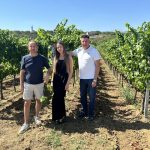
There are no grand gestures in Tokaj, no formal moment of succession. His father is still the boss in the vineyard. His son makes most of the decisions. His daughter is formally the managing director. The system works without ceremony, but everyone knows their role.
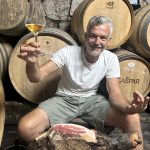
There is a photograph of the elder Szepsy sitting in an armchair in the middle of a vineyard, a glass of wine in his hand, with a motorcycle parked among the rows behind him. It does not look staged. It looks as though the vineyard were his living room. The photograph is playful, yet serious too: it shows the quiet assurance of a man who knows where he belongs. His son ended a presentation in Zagreb with that image, as though all that had been said about terroir and discipline could ultimately fit into one simple scene: a man, a vine and a glass.

Then comes the question that hangs somewhere in the air of every family business. Has he ever wanted to leave wine behind, become someone else, live outside its history and expectations?
The answer is brief.
– Not yet.
There is no drama in those two words. No vow, no finality. Only a continuation.
Perhaps that is the most accurate description of the Szepsys and of Tokaj: an unfinished story that endures. The work goes on in the vineyard, in the cellar and in bottles someone will open fifty or a hundred years from now.
And somewhere among them, there will still be a few bottles that were never meant for the market.
Only for the table. And for trust.