There are people who do a job.
There are people who turn their job into their destiny.
And then there is Mato Violić Matuško – a man who has turned wine into character, a cellar into a stage, Pelješac into a miniature state, and his own life into one long, uninterrupted toast.
You cannot describe him in bureaucratic terms.
You have to let him describe himself.
And he does it the way he lives – with the brakes off:
– If I weren’t doing the job I do, I’d pay to do it!
That one sentence contains everything: hedonism, work, passion, confidence, and that rare, almost forgotten breed of people who do not whine about life but bite into it like a crusty loaf of Pelješac bread and wash it down with Dingač.
Matuško is not a man for rear-view mirrors.
That is no pose. It is his worldview.
– My only virtue is that I’ve never looked back.
– In business too, what’s done is done. There’s only the future – always onwards!
– Even when I ride a motorbike, I don’t look in the rear-view mirror!
Only a fool or a winner could say that.
In Mato’s case, fortunately for the legend, it is the latter.
He belongs to that old Dalmatian lineage of people who believe a man is measured not by what he says about himself, but by what he has built out of stone, soil and risk. And Mato has built a great deal: a cellar, a label, a name, a market, a network and a myth. None of it came from playing safe.
– The first day after I left Dingač Winery, I invested every bit of money I had in my pocket, 5,400 German marks, in a Honda Transalp and a wine glass.
That is not an investment strategy.
It is a manifesto.
Because only a man of a particular breed could buy a motorbike and a glass before a pump, tanks and a van, then later say it as though he were describing the most normal thing in the world:
– For me, that was the most important investment.
– So I got on the bike, put the glass in my pocket, and started buying and selling wine!

Somewhere here, Mato begins to emerge as a literary character: not a winemaker in a white coat, but a Pelješac dandy of destiny, a man with a glass in his pocket, octane in his blood, and the clear knowledge that nobody will save him but himself.
He offers his own explanation, almost scientific, just in his own way:
– It’s all genotype, you see.
– We’ve got octane in our blood.
For him, genotype is not biology.
It is a justification for living at full tilt.
That is why Mato’s motorbikes are an extension of his personality rather than a luxury:
– I don’t regret for a second spending so much on motorbikes, or on cars either, because I don’t own a car with less than four hundred horsepower.
– That’s the money I’ve most enjoyed spending!
– I’m not interested in what I’m wearing, whether my clothes are designer labels, or what my sunglasses are like. But I love power, the strength of an engine.
There he is: no false modesty, no pretence, no drawing-room restraint.
Matuško does not play the ascetic.
He openly admits that he loves power, speed, the sound of an engine, momentum, a sip and a victory. And that is precisely why he is convincing. Because behind that pleasure stands a man who has paid for it all through risks of his own.
And when he talks about money, he talks like someone who respects it only because he knows how hard it is to earn:
– I’ve never taken out a loan in my life.
– I work with what I’ve got, and when I haven’t got it, I pull the handbrake.
– But when I have it, I spend!
– No bank clerk has ever earned her salary out of me.
It is almost an epigram of a Mediterranean capitalism: raw, witty, self-made, unversed in corporate courtesy, yet lethally precise. Mato believes in the bottle, the barrel, the guest and his own cellar. In what he can see and what he has built himself. He has no faith in the bank.
And so his most dangerous sentence sounds like an imperial proclamation:
– Nobody can touch me any more. I’m the emperor!
It is more than mere boasting. It is the cry of a man who has realised that the greatest freedom in business arrives when you complete the circle:
– In that case, every bottle of wine sold is mine, every lunch sold is mine, every bed sold is mine.
A winemaker is speaking, but so is a merchant.
And he does not hide from that word; he simply translates it in his own way:
– I like selling what I make. I sell only my own products, and I’m good at it!
Of course, Mato learned long ago that success in small wine communities always has another side: doubt, suspicion, and people who would sooner believe in a trick than in hard work.
On Pelješac, where news travels faster than the bora wind, there will always be someone who says Mato is a merchant first and a winemaker second. He does not respond with wounded pride. He responds with humour.
With Mato, however, it is always hard to know where a serious answer ends and a joke begins. Two years ago, I was surprised to see Grk among his wines. I mentioned it in conversation, and Mato immediately fired off one of his stories.
He told me how, one August, a restaurateur called his friend Frano Milina Bire and asked for two cases of Grk. Bire calmly replied that he had none, and might perhaps be able to give him a few bottles.
– You see, Mato told me, then that same fellow called me. And I said: why are you only asking for two? I can give you twenty cases of Grk.
And then, naturally, came his definition of the label:
– Do you know what GRK means on my labels? Graševina, Rukatac, Kujundžuša.
It is his little Pelješac joke at the expense of all those who think they have uncovered some great secret.
And when people complain that he lives too well for a winemaker, Mato simply shrugs and answers with a question:
– Where have you ever seen two Maseratis parked in an honest winemaker’s yard?!
There is more irony than defence in that sentence. Mato is not trying to justify himself – he is actually taking the piss out of the accusation. As if to say: if you already think I’m a swindler, at least make it a good story.
And perhaps that is the key to his character.
Matuško has never tried to be the patron saint of Pelješac viticulture. He has no problem with people seeing him as a merchant, a gambler or a man who likes to live large. But there is one thing he will surrender to no one:
wine.
Because behind all the jokes, motorbikes, restaurants, cellars and legends lies a simple fact – the wine must prove itself in the glass.
And Mato is one of the rare people who understand that wine without a story, without presentation, without a market and without someone who knows how to put it in front of a guest remains mere liquid in a bottle. That is why he says:
– Wines need presentation. The better you present them, the better you’ll sell them.
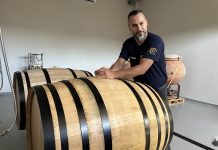
But here is the crucial point: Matuško sells more than wine. He sells experiences, directs the entrance, designs underground scenery; he is a man who has turned his cellar into an almost mythical space. His cellar is no warehouse. It is an underground republic of wine. A labyrinth of barrels, vaults, archives and ambition. A place where local stubbornness has joined forces with an instinct for tourism and an entrepreneurial hunger.
And yet none of it would count for much if there were no goods behind the scenery. For all the theatre, Mato never forgets the first thing:
– I’ll always say I’m first and foremost a winemaker.

That matters.
Because he may have a Maserati, a cellar, speedboats, restaurants, bars, plans for Tuscany, and amphorae from Georgia and Bosnia, but at the centre of it all remains a man whose credentials are his wine. When the wine is good, Mato is great. When it is not, everything else is decoration.
And he speaks of quality with the kind of self-assurance that always sounds like a provocation in the Balkans, yet is often simply the naked truth:
– I’ve received international recognition for the quality of my wines.
– I can say I’m not all that surprised, because these wines had already been endorsed by the market.
He knows what has value.
And he does not ask anyone else’s permission to believe in his own bottles.
His statement about the market is even stronger:
– Wine, like everything else, has to seek out its buyer.
That is Mato in a single formula: no waiting, no provincial lamenting, no mystique of the unrecognised genius. There is going out into the market, finding the buyer, pushing, presenting, taking risks. Anyone who stays home waiting for the world to discover them gets nowhere with Mato.
He is fiercer still when he talks about those who do not make a good living from wine:
– You can earn good money from wine in Croatia if you’re professional and hardworking!
Mato maintains that colleagues who do not live so well from wine simply do not work!
Harsh? Yes.
Exaggerated? Perhaps.
Authentic? Completely.
Because Mato is not a man of nuance.
He is a man of full throttle.
With him, everything goes all the way: either you work or you do not, either you ride or you stand still, either you build or you philosophise.
And when he does have a philosophy, he expresses it better than many marketing theorists:
– Wine isn’t toothpaste. You can’t achieve something with a mass campaign.
– The only real promotion for wine is when one wine lover tells another: yesterday, or the day before, I drank an excellent wine.
Here speaks a man who understands that great wines are sold through whispers among those in the know, rather than shouting. Suddenly Mato steps outside the stereotype of the bohemian and reveals his most dangerous trait: the instinct of a serious market thinker.
But he is more than a man of the present. Mato also loves history – provided he can turn it into a spectacle. That is why his amphorae are no museum souvenirs, but another way to turn an old story into a new victory.
– I decided to ‘plant’ two Georgian amphorae.
– In other words, to make wine the way it was made long ago, when there was no concrete, plastic, wood or stainless steel…
– In my humble opinion, the whole thing turned out quite well.
Even when Mato plays at modesty, you can sense that he can hardly wait to tell you how good it really is. And why not? Mato was not born for restraint. He was born for a statement, for an effect, for a memorable sentence that rings like a glass striking stone.
That is why he can come out with gems like this:
– The sparkling wine went down brilliantly, but I mostly drink it myself with friends.
That is the bohemian excess without which it would all be merely successful, rather than legendary.
And he is legendary when he speaks of his own place in the world, too:
– Tuscany is the most intriguing prospect for me, and it means prestige around the world.
– In global terms, Croatia is merely a good wine region.
– Croatia could have established its place on the world wine map, but our failings meant that opportunity was missed.
Here Mato speaks as a man who has outgrown the local horizon. Pelješac is now his base rather than his boundary. He wants to be more than a Pelješac winemaker. He wants to be a winemaker who sets out from Pelješac to conquer Tuscany.
After all, he showed long ago that geography does not constrain him: to secure top-quality grapes for white wines, he also bought a vineyard in Ilok, deep in the Slavonian wine country, far from the stone of Pelješac and Plavac Mali. Pelješac stone for reds, Slavonian soil for whites – Mato plays across the whole map of Croatia. And perhaps that is the most quintessentially Mato thing of all: always farther, always bigger, always more expensive, always more dangerous.
And yet, despite all those plans, medals, cellars, amphorae, investments and markets, his truest portrait still lies in the contrast between glass and motorbike, between Dingač and Suzuki, between the cellar and the open road.

Mato Violić Matuško is no aristocrat of wine in the French sense.
He has neither the polish of a laboratory nor the breeding of a drawing room.
He is a Dalmatian baron of his own will.
A man more likely to say ‘I’m the emperor’ than ‘I’m grateful for the market’s confidence’.
A man more likely to buy a motorbike than a tie.
A man who knows wine is a business, but refuses to let that business become boring.
That is why the best place to close his portrait may be precisely where it began – with a sentence that sounds like a toast, a business credo and an autobiography all at once:
– If I weren’t doing the job I do, I’d pay to do it, that’s how beautiful, rich and fulfilling it is.
And then, of course, comes the final Matuško twist, without which he would not be himself:
– And you can get nicely drunk on it, too.
And there ends every attempt to embellish him.
Because Mato needs no embellishment.
He is already a fully formed character:
Pelješac’s Apollo with the taste of Dingač, the soul of a bohemian, the reflexes of a merchant and the throttle of a motorcyclist.
A man who does not look back.
A man who does not beg the market.
A man who makes wine a culture of living rather than a culture of distance.
He does not smell of a library.
He smells of barrels, petrol, salt and money earned without loans.
And that is precisely why he remains what so few become:
more than a winemaker – a phenomenon.