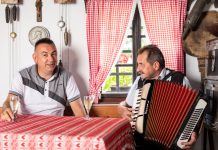
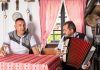
The Sever family from Klanjec may well be the only people in Zagorje who had good reason to hope that Jankec would miss his train – a playful reference to a familiar local song. Zvonko Sever, a pioneer of modern winemaking in Zagorje, remembers why: until 1986, when he finally closed its doors, his father ran a highly successful tavern at the local railway station.
– When he was working, he was already behind the bar at 4.20 in the morning!
The railway still follows the same route, but trains have long since stopped connecting Imeno and Kumrovec with Savski Marof. Built in 1956, with the section from Kumrovec to the national border completed in 1969, the thirty-eight-kilometre single-track line follows the border river Sutla and crosses into Slovenia at several points. It has been awaiting revival ever since it closed to traffic in 2000.
Was the tavern really that successful? I ask Zvonko.
– Yes, it brought in an enormous amount of money. People ate and drank with abandon. Just think: that one establishment sold a hundred and twenty hectolitres of white wine a year! People had money, there wasn’t much else to do, and they spent a great deal on wine. Dad earned the money in that tavern, which also served food, to build these two houses where we live and work today. When he sold the whole business, he put me, my wife and our children in one house, and himself and Mum in the other.
Zvonko recalls that his hardworking father, while running the tavern at Klanjec station, also traded in grafted vines. He sourced them from Velika Drenova in Serbia, then a giant of Yugoslav vine nursery production. Although he had completed only four years of primary school, he had a remarkable head for business and sometimes sold as many as fifty thousand grafted vines a year.
At the same time, the Severs tended their two original vineyards and sold wine to Ventek in Zelenjak.

– Around 1990, I suggested to my father that we expand, so we bought another vineyard. With the wines from those vineyards, we swept the board in Bedekovčina and became Zagorje’s first wine champions! I was also the one who brought Gerhard Schubert to Zagorje. He was exceptionally good at reaching people and did a great deal for the region, because he was the first to understand who we were: we had plenty of vineyards, but we didn’t know how to make wine. Perhaps we didn’t quite fit that stereotype, because our father was an excellent cellar master. You had to know what you were doing to keep a hundred and twenty hectolitres of wine in wooden barrels – there was no stainless steel back then. I learned a great deal from Dad, and Schubert added his knowledge of hygiene, yeasts, settling…
He also remembers how Schubert encouraged growers to grub up old hybrids such as Izabela and Direktori, joking that he would personally pay to have the axe sharpened for anyone who did.
Zvonko took the champion’s title at roughly the first ten editions of the wine festival in Bedekovčina. His greatest successes came with Pinot Gris: he had only just planted the variety when his first wines from it began winning top honours.
– When I proudly told Dad about the title, he snapped that it was all bloody useless! He wanted me to carry on making those blended wines for gemišt, in larger quantities. But, unusually for the time, I was planting vineyards devoted almost entirely to individual varieties, with only a few varieties overall. Dad threw up his hands in despair!
His father’s vision was different. The wines he made sold well in the tavern and on the wider market.
– But nobody makes or wants those wines any more. People’s needs have changed, quality matters more, and those customers no longer exist either…
Meanwhile, stainless-steel tanks, presses and equipment that had previously been unavailable began appearing. Zvonko’s transformation of the winery from a producer of wine for gemišt – wine mixed with sparkling water – into a maker of outstanding Pinot Gris did not pass without suspicion.
– That Pinot Gris was such a surprise that a rumour spread that we didn’t have any in the vineyard at all, and that nobody knew where the wine we were passing off as Pinot Gris came from! Then all those sceptics came with Gerhard Schubert to inspect the vineyard and cellar. Once I’d proved them wrong, they apologised publicly.
– We held nothing against anyone. In fact, we were pleased that it showed, even in that way, how much Zagorje people wanted competition. I was even happier when our dear friend Nenad Posavec decided to take his own winemaking seriously because of the impression our champion Pinot Gris had made on him.

Zvonko remembers the revival of winemaking in Zagorje, when Professor Schubert led tastings attended by more than two hundred people.
– People queued while everyone was poured a glass! The associations had fifty or sixty winemakers each. Zagorje had by far the largest number of winemakers in Croatia. Admittedly, their vineyards were small: everyone had three hundred to five hundred vines and called themselves a winemaker. When we started, we had two vineyards around the house, half a hectare altogether. Dad was still selling vines, and as interest in wine grew, we began buying grapes and must and expanding our vineyards. I increased our holdings to seven plots, and now Filip has added another vineyard and rented two more, bringing us to around four hectares.
Zvonko’s son Filip, still a boy at the time, clearly remembers when “a great many winemakers, including people still in the business today, came to Zvonko for advice and an expert opinion”.
– Zagorje took off in his time. The mix of varieties began to change. It was an enormous leap from nothing to something!
Zvonko calls it a complete turnaround.
– Zagorje did a Tsukahara – a double somersault with a twist!
With that gymnastics term, he describes the transition from blended wines for gemišt, sold in fifty-four-litre glass demijohns, to varietal wines in fine bottles.
Then something very characteristic of Zagorje happened, neatly summed up as:
– There’s no way Štef’s having better wine than me!
– That’s what drives people here: healthy competition. We stood out with quality varietal wines, and that pulled others along. They said: “I want to do that, too!”
The first wine fairs in Zagorje provided further encouragement, including Bedekovčina, which began as a wine exhibition “with little wooden barrels where people could drink and get thoroughly sozzled”.
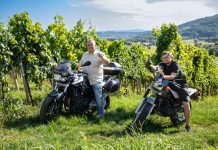
Filip, who has formally run the Sever winery with his brother Jakov for the past decade or so, believes Zagorje has since come of age.
– There are now many major winemakers, but the Sever winery and my father Zvonko have remained synonymous with the beginnings of serious winemaking in Zagorje.

Despite the generational change, Zvonko is still the chief authority at the winery.
– He’s been here for more than forty years, and his judgement carries real weight. Besides, Dad still looks after part of the vineyards, so Jakov and I can hardly claim all the credit.
It was Zvonko who steered Filip towards wine.
– Enrolling at the Faculty of Agriculture was the logical choice. More importantly, though, I was interested in the whole thing. Just as Grandpa instilled a love of the vineyard in my father, Dad passed his love of winemaking on to me.
Zvonko’s courage and Filip’s willingness to innovate have resulted in a broad range of labels: the Sever winery now makes no fewer than twelve different wines.
– That’s actually what keeps us going! We have a shelf of bottles with something to suit every pocket.
Back in 1996, they decided to leave part of their Graševina vineyard unharvested until the cold winter days arrived and attempt an ice harvest. It was unusual for Zagorje, especially given the decision to sacrifice a guaranteed quantity of light wine for the uncertainty of a special-harvest wine.
– I had a vision, says Zvonko.
– Across the Sutla, in Bizeljsko, several winemakers were doing it, including Bojan Berković. That’s where I learned about special-harvest wines, and every time I turned up at competitions, I beat them! Their winegrowing area is ten or twenty times larger than ours, but I achieved consistently high quality with light, fresh wines, and later with late-harvest and ice wines, too. We’ve carried out eight ice harvests!
However far his vision drove him forward, Zagorje remained Zagorje. It was only a matter of time before its winemakers jointly introduced a wine recalling the easy drinking of the region’s past. And so the time came for “Zagorski bregi” – “The Hills of Zagorje” – a blend that each participating winery makes from its own varieties.
– All right, Zagorski bregi is different from those old sour wines for gemišt. But structurally, it’s a classic Zagorje wine: good quality, and certainly not just for mixing with sparkling water. We don’t want to abandon tradition, but these wines are a step or two higher in quality. Ultimately, that’s what people want today: something authentic. Nobody comes to Zagorje to drink Chardonnay!
“Zagorski bregi” is, in effect, a label through which Zagorje’s winemakers express what their region is.
And what is that?
– A wine you can drink with any dish, enjoy more than a glass of, and still expect quality from. It needs Graševina, Riesling and Sauvignon Blanc, all together in the bottle, with a lovely aroma as well. Recently, people have been trying to make Belina into that sort of wine for all of Zagorje, but it still has some way to go before it becomes our signature.

Is that why you embraced Sokol?
– Exactly. Our sites in Klanjec are Zagorje’s grand cru, and nothing less than a Mercedes belongs there. There’s no room for generic, mass-market wines!
The story of Sokol, Klanjec’s pride, was revived at the urging of Faculty of Agriculture professors Edi Maletić and Darko Preiner. Around twenty years ago, at a meeting with Zagorje winemakers, they asked anyone growing an indigenous variety to report it.
– I’d already started with Sokol a few years earlier. It came about through our local priest, Father Velimir Tomašković, who told me he “had Sokol”. At first, I said nothing because I didn’t know what he meant. Then one day he called me into his cellar, complaining that he couldn’t get a decent wine. He had wooden barrels several hundred years old, and all his wines were vinegary. I told him to throw those barrels out and never put anything into them again, because they were doomed to produce nothing but vinegar.
– Then he bought new stainless-steel vessels from the local barrel maker, and straight away that wine won a gold medal under Schubert’s judging. As a reward, he brought me cuttings. I propagated them, and that was the beginning. The best vine had just two or three bunches.
The Faculty of Agriculture’s initiative followed, confirming Sokol’s status as an indigenous variety.
– We took cuttings from the better vines and grafted them, and then you have to wait three years. Eventually, we increased the yield to five or six bunches per vine, which is certainly not excessive. Sokol produces exceptional quality.
From that period, Zvonko particularly remembers a call from local photographer Slavko Zamuda, who wanted to show him something.
– He took me to the church vineyard up on the hill and its little tool shed.
– “Go and see what’s in there,” he said.
– Nobody had ever been inside that little building, because the man the state had allocated it to in 1948 had bricked everything up. When I entered, there was quite a sight waiting for me: the entire ceiling was painted with scenes of winemaking, from working the land and pruning to barrels marked “2,500 litres – Sokol”, and a bottle bearing the same inscription.
Taking the painted bottle as his model, Zvonko commissioned special bottles used exclusively for wine made from Sokol.
Several other families in Klanjec still have Sokol in their old vineyards, but only the Sever and Petrišić families make wine from it, working together. The entire crop from their vineyards is harvested and vinified jointly to obtain a more substantial quantity. Sokol also grows in the vineyards of the Broz, Lovrek and Posavec families, although there is no indication that they will join the shared harvest.
Zvonko considers saving Sokol one of the greatest achievements of his life, especially given that, despite attempts to grow it elsewhere in Zagorje, the variety “refused to be taken over the hill”.
– Sokol won’t leave this place – or us!