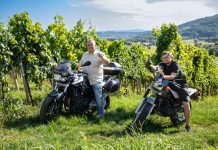
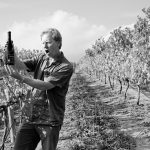
Miodrag Bjelica has moved out of the garage, but he has not left the garage behind.
Standing outside his new winery on Banstol, opened in June 2025, that sounds like a neat turn of phrase. Before us is no makeshift cellar, but a substantial winery building, a world away from the space where, some fifteen years earlier, a car had to be evicted to make room for his first winemaking vessels.
Except that Miodrag has physical proof he has not renounced his garage identity.
“Didn’t you notice the roller door? You enter the winery through a garage door. This is really just a slightly enlarged garage,” he laughs.
The first was at the family home in Kamenjar, Novi Sad. The car really did have to move out so the tanks and barrels could move in. Nearby were the restaurants Petlov Salaš and Kod Bate Pežoa, while behind those garage doors wines were taking shape unlike anything previously made on Fruška Gora, with names and labels that seemed to have wandered in from another world.
When I first visited him there, I described him as a remarkable newcomer to wine and a unique garage winemaker whose first four wines—Saga, red Graffiti, Graffiti rosé and Babaroga—had attracted attention almost overnight. He, however, was genuinely surprised anyone had found him.
“How did you hear about me? I’m nowhere!”
This was neither false modesty nor the coyness of a man hoping journalists would contradict him. His wine venture, he explained, afforded him the luxury of not having to court anyone.

“I make so little wine that I’m not even interested in shops, and I haven’t a single bottle left from the previous vintage. The wines I want to make don’t belong to the world of tamburica music and whole oxen roasting on spits.”
More than a decade later, there is much more space, but still not enough wine for everyone who wants it. Nor is Miodrag Bjelica much easier to find in the media. There is scarcely any need for that now. Babaroga has taken over as his public identity: a Chardonnay that became famous before it even reached the market.
Before Babaroga, however, something even less likely had to emerge: a winemaker made from a man who knew almost nothing about vineyards but already held very firm opinions about them.
When speaking of his wine background, he would first joke that his only connection with vines was having been born in Loznica—a town whose name contains the Serbian word for vine. The family history did contain another, finer thread. His parents came from Ljubinje, and his earliest memories of grapes were from Dubrave, the plateau near Stolac where the family had vineyards.
“I still remember the Žilavka from a seventy-five-year-old vineyard. Pure oil!”
These encounters were passed down through the family almost mechanically, as work that simply had to be done, but they never developed into a grand winemaking tradition.
“I don’t have a three-hundred-year-old story or a crown on my label. I simply turned over a new leaf and started from scratch. Without the burden of tradition, I could do what felt right to me.”
Before turning that leaf, he graduated in mechanical engineering, established himself professionally in Belgrade and built a career in marketing and design. Among the products he knew how to sell were computer mouse mats, which now seems rather remote preparation for a man who would later discuss Chardonnay clones, dry-ageing meat and whether atmospheric pressure could be judged by how well a fireplace draws.
At some point, he had had enough of Belgrade, the corporate world and the discipline that makes a business more efficient while gradually squeezing unpredictability out of a person’s life.
“When you work in management, you try to be disciplined and stay within the prescribed boundaries. That’s good for business, but it kills creativity. I got out of that, and now I deliberately let things run wild.”
That unruliness did not immediately turn into wine. First, he became a more serious wine drinker, then a cook whose fish stews, dishes slow-cooked under a baking bell, oxtails, carp roasted on forked branches and homemade kulen drew eager visitors to the terrace of his Kamenjar home.
He could not stand the word “hedonism”. It seemed overused, pretentious and insufficiently precise for something as simple as good food, good wine and people worth sharing them with. Besides, some truths only become clear when you grow into them.
“In time, you realise food and wine matter more than certain other things. That’s how I discovered that an appreciation of meat aspic comes with age.”
Wine came with age too, but also with concern for the years still ahead.
“At one point, I became afraid I wouldn’t have good wine to drink in my old age, so I decided to make sure I would.”
The joke was good enough to repeat for years, but the decision was entirely serious. He moved to Novi Sad, bought land in Čortanovci and decided to plant his own vineyard. He knew almost nothing about agriculture. That did not prevent him from already knowing how he thought it ought to be practised.
He bought the land, prepared it and planted his first vines. The young plants took root, the rows were tidy, and the newly minted winegrower, pleased with the scene he was leaving behind, went to Greece for a month.
When he returned, the vineyard had disappeared.
“I look around: weeds everywhere, pheasants flying, rabbits breeding… Only then did we dig the vineyard out, and I realised I knew absolutely nothing about agriculture. I didn’t even know what a weed was.”
Ignorance did not stop him having very clear ideas. He did not want to fertilise or irrigate the vineyard, although he had yet to learn how to maintain it at all. In his beginner’s imagination, a good vineyard should not resemble a shop display, every blade of grass removed and every vine trimmed to the same pattern.
“I’ve never drunk a great wine from a beautiful, immaculately groomed vineyard. For something truly good, you need a particular site, the right variety, the appropriate clone and training system. I learned everything as I went along, but somehow I already had an opinion about it all.”
Fortunately, he had enough sense to realise that opinions alone would not save his vines from weeds, pheasants and rabbits. He went to the Faculty of Agriculture in Novi Sad, sought out Professor Nada Korać and bought books on viticulture. She also gave him advice that would guide his later search for sites: look for land where wild grapevines grow, because there had probably once been a vineyard there.
He bought his first land at Srednji Breg in Čortanovci. Later, he added Veliki Vrhovi on Banstol. In Čortanovci, he planted Sauvignon Blanc, Sémillon, Merlot and Marselan; at Veliki Vrhovi, Chardonnay. He began with four hectares and now has six, divided between the two sites.
Not every choice has aged equally well.

“Knowing what I know now, I certainly wouldn’t plant Sémillon. I didn’t like it much even at the beginning, and I gave it my best plot.”
That was not the only price he paid for learning. In the first year, he dried Traminer grapes on the terrace, only to distil them into brandy in the end. He also tried making a Cognac-style brandy that, by his own assessment, resembled nothing in particular. He worked with indigenous yeasts, testing ideas that sometimes ended in wine and sometimes in another lesson about what not to repeat.
While he fell out with certain varieties, Marselan increasingly won him over. He was drawn to its wildness, rough edges and ability to retain high acidity regardless of sugar levels. He wondered why the world market had no great, expensive wine from a variety he liked more each time he tasted it. When people explained that something else would be a safer choice for Fruška Gora, it only strengthened his determination to plant it.
He did not, however, leave Marselan entirely unsupervised. In the blend, he gave it a calmer, more polished companion.
“Merlot is there to put a tie on Marselan.”
Two important reds would eventually emerge from that partnership: Graffiti and the special selection Crna Babaroga. But before Marselan acquired its tie, Bjelica needed confirmation that the weed-choked vineyard, Professor Korać’s books and all those costly beginner’s lessons were leading somewhere. It came with his very first wines. From Vienna, no less.
Saga 2012, Graffiti rosé 2012 and red Graffiti 2011 went to AWC Vienna in 2013. All three won silver medals.
It was an unusually convincing debut for a winery almost nobody had heard of. These were effectively the first vintages from newly planted vineyards, but Miodrag had not submitted them. His winemaker at the time, Srđan Lukajić, had entered them in Vienna. A friend of Bjelica’s, he ensured that the creative whirlwind in the cellar did not compromise the wines’ soundness.
“I was lucky Srđan was my friend. He made sure the wines were completely sound, and even then I thought he belonged to a new generation of winemakers capable of doing a great deal to restore Serbian wine to its rightful place.”
Three silvers brought the first articles and the question winemakers usually face as soon as success arrives: would he now increase production?
Bjelica did not understand why three medals should have to result in bigger tanks.
“Expansion wasn’t my priority. First, I wanted to make really good wines. When you spread yourself too thin, it’s hard to nurture a good wine. My wife already thought I spent more time with the wines than with the children, which, of course, wasn’t true.”

The three silvers did not change his attitude towards competitions. He never submitted his wines himself, nor did he like the idea of drinking according to points, medals or a rating found in an app. Once again, an explanation lay close to home.
“My German shepherd was a Balkan champion, and I never hung a medal around his neck. Hanging them on wine seems a bit pointless too.”
For him, wine was never the same from one day to the next anyway. It depended on the moment, mood, food, company and even atmospheric pressure. Before a more serious tasting, they would check how well the fireplace was drawing. For Miodrag, a strong draw signalled low pressure, when, he said, the wine’s aromas became more pronounced. Alongside heating the house, the Kamenjar fireplace thus spent some time serving as a domestic weather station for wine.
In those early years, Bjelica wanted to make two entirely different whites. One fresh, aromatic and racy; the other full-bodied, serious and capable of ageing. The first became Saga, Sauvignon Blanc with a smaller proportion of Sémillon. For the second, he planted two American Chardonnay clones at Veliki Vrhovi, fermented the wine in wood and left it on its lees.
That wine did not yet have a finished label, but it had a name.
They did not find it at a meeting with designers, through market analysis or after days searching for a word that would sound good in foreign languages. They found it at a neighbour’s house, where they had been invited to try some freshly distilled brandy. After a few sips, they exclaimed almost simultaneously:
“Whoa, this is a real babaroga!”
Among their friends, the word already meant something exceptionally good, powerful and out of the ordinary. The Chardonnay was approaching bottling, and the name suited it better than anything they could have invented. A mythical creature once used to frighten children became the name of his most serious wine.
Even before reaching the market, Babaroga showed that its story would be anything but ordinary.
After the catastrophic floods of May 2014, a charity auction of Serbian wines was held at Belgrade’s Riznica Vina wine shop. The proceeds went to those affected, and the evening’s highest price, 17,000 dinars, was paid for a bottle of Bjelica’s Chardonnay.
A wine not yet released already had its first collector. Babaroga became famous before almost anyone had tasted it.
The name came from a neighbour’s brandy, but in the cellar of the family home, Babaroga soon acquired a family story of its own.
Once Miodrag had arranged the barrels in the garage and cellar, his elder daughter Katarina tried to scare her younger sister Marija away from going downstairs, telling her that Babaroga lived in the dark. Marija was not intimidated.
“I know. That’s where the wine is!”

The first proposed label featured three little girls. Miodrag asked the young artist Ivica Stevanović to remove one: the label had to show two, Katarina and Marija. The wine thus acquired its own mythology, in which Babaroga no longer devoured naughty children but watched over them in the cellar of the family home.
In a small accompanying booklet, he presented her as a high-ranking South Slavic witch, entrusted for centuries with the education of disobedient children. The children had long since seen through her, but in slang her name had survived as a term for something exceptionally good.
This Babaroga was not supposed to look polished. Stevanović’s illustration was threatening, grotesque and funny all at once, distinctive enough to make the bottle impossible to confuse with another. To some, she recalled Jack Nicholson as the Joker; to others, a witch laughing at her own reputation. On Murter, where the wine has been sold and drunk for years, foreign visitors dubbed her Frau mit Frisuren, presumably mistaking the horn on her head for an unusual hair bun.
Bjelica did not need to explain how the label represented terroir, family tradition or the house style. It caught the eye; the wine had to justify everything it promised. Babaroga gradually established itself as one of Serbia’s cult Chardonnays, reaching Croatian and Italian restaurants, including Monte in Rovinj, Croatia’s first Michelin-starred restaurant, and becoming better known than the man who made it.
Nor did Babaroga stop at Chardonnay. The same character found a place on a traditional-method sparkling wine that spends nine years ageing in bottle before release.
Three years after Miodrag began making wine, Jovica Urošević joined him as winemaker. Their collaboration brought new wines, special selections and ideas often far removed from standard winemaking formulas. Among the wines they developed together was a red version of Babaroga.
Many people who had heard of Babaroga but never tasted it assumed from the name that it was a red wine. A friend suggested using the Chardonnay’s recognition to create a red counterpart. In years when the grapes were good enough, Jovica and Miodrag selected the finest barrels of Merlot and Marselan, making between two thousand and two and a half thousand bottles of a special selection.
If the Chardonnay was Babaroga, the new wine could only be called Crna Babaroga—Black Babaroga.
When he began building the new winery on Banstol, its much larger scale might have suggested that his production ambitions had grown with it. Miodrag immediately dismissed such expectations. He had neither the time nor the desire to turn a garage winery into an industrial operation with several extra zeroes.
Today, he farms six hectares and bottles around thirty thousand bottles a year. Chardonnay grows on Banstol, while Sauvignon Blanc, Sémillon, Merlot and Marselan are planted in Čortanovci. He buys Grašac for his sparkling wine from partner growers. His wines are exported to Croatia, Italy, Switzerland, Montenegro, Bosnia and Herzegovina, and the Czech Republic. Depending on the vintage, some have travelled as far as China and Bermuda.

Demand exceeds supply, so he is considering working with growers willing to plant the same varieties and clones. That is as far as he is prepared to expand production: enough to reach a few more markets, but not so far that the wines cease to be his.
At the base of the new building are spacious rooms housing stainless-steel tanks and barrels. Above them is a restaurant seating around sixty, while a semicircular terrace opening towards the vineyards accommodates another eighty guests. There are also eight rooms for those who, over wine, food and views of Fruška Gora, lose track of time—or no longer wish to find it.
Ivica Stevanović drew Crna Babaroga. Miodrag later displayed his sketches, from the earliest proposals to the final labels, on a wall of the new winery. Visitors can now trace how a mythical creature from a Chardonnay bottle gradually took possession of the entire place.
The Banstol winery, however, has become more than a bigger garage. It has become a museum of Babaroga’s rise. And, as every serious mythical creature needs a realm of its own, she finally acquired her own cave. A strict one, at that.
The restaurant, naturally, could not simply be called Bjelica.
Miodrag found its name in a poem by Ljubivoje Ršumović about a forbidding cave inhabited by Baba Roga. Babaroga now had an address, and Pećina Stroga—the Strict Cave—became an extension of the world that had begun on the label.
Although the name evokes darkness, the restaurant is bright, open and facing the vineyards. Guests are also offered “free hi-fi”: the chance to listen to good music rather than stare at their phones at the table. Through an aquarium, there is a view into the kitchen, where chef Milan Aleksić works to put Bjelica’s vision of food into practice.
When they were discussing working together, the owner gave him fair warning:
“You’ll have more trouble with me than I will with you.”
Milan Aleksić arrived with two decades of cooking experience gained at home and abroad. Bjelica had no intention of dictating recipes, but neither did he want a few colourful brushstrokes of sauce on a large plate, followed by an explanation of what they meant.
“I don’t like art on a plate. I feel cheated, and most of the time it doesn’t even taste good. What matters is that nobody has to explain why what I’m eating is good. An empty plate is enough.”

Beef tongue, oxtail croquettes, cheek, lamb tartare, aged meat and homemade breads arrive at the table. If Miodrag finds good fish, date mussels or truffles, they will appear on the menu regardless of which culinary category they belong to.
“I make wines I like to drink and serve food I like to eat. To me, it’s the same as the music I like to listen to. It all has to make sense, rather than hide behind meaningless phrases.”
The restaurant serves only Bjelica wines, almost all available by the glass. Yet guests who have bought a bottle elsewhere and want to drink it with lunch are welcome to bring it. A man who refuses to let an app decide whether his wine is good will not deny his guests the same freedom of judgement.
Pećina Stroga was not conceived as a commercial appendage to the winery. It is an enlarged version of the terrace at his Kamenjar home: a place where people gather, share food and wine, listen to music and, when necessary, stay the night. The garage has expanded enough to accommodate Bjelica’s entire way of life.
Between cellar and restaurant, the winery walls become a gallery. There are no diplomas, medals or competition photographs, but sketches by Ivica Stevanović and photographs of murals that have appeared on Bjelica’s wine labels over the years.
Babaroga acquired a permanent face, but Graffiti was conceived as an exhibition changing with each vintage. Works by different artists appeared on the red and rosé labels, while the one constant was an inscription attributed to one of Pompeii’s oldest graffiti:
“We’ve caught you out, landlord: you drink the good wine and give us the watered-down stuff!”
Miodrag was drawn to the paradox of graffiti art: the works were free and accessible to everyone, while their creators often worked illegally, risking prosecution, and the murals themselves could disappear beneath a new façade, someone else’s graffiti or the first coat of paint.
“If I can’t preserve the mural, I can preserve it on a bottle.”
The staircase of the new winery therefore offers a small history of Serbia’s graffiti scene, carried from the city into the cellar, and from the cellar to the table.
One label emerged not from a mural, but from an unexpected response from Spain. Some Spaniards whose attention had been caught by the Babaroga illustration asked permission to publish it on their website. Miodrag readily agreed, and alongside the label they published an article about the wine titled The Charm of Evil.
That inspired the name Evil for a Merlot rosé. On the label, the word acquired its own reflection: read backwards, Evil became Live. It was Bjelica’s visual take on the Serbian expression zlo i naopako—roughly, “evil and upside down”.
Sometimes a story begins with brandy at a neighbour’s house, sometimes with a child’s fear of the cellar, sometimes with a Spanish headline, and sometimes it simmers for months on Jovica Urošević’s “wine stove”.
That was how the two Lutka wines came about: a white and a red liqueur-style dessert wine. The white was based on Saga, the red on Graffiti. The initial idea was somewhat similar to Istrian Teranino, but Miodrag and Jovica were not content with a ready-made recipe. For months, they added ingredients and adjusted proportions until they found what they wanted: more citrus in the white, recalling a Cmok ice lolly, and more cinnamon and cloves in the red.
“To be honest, I don’t like Bermet or sweet wines. But with the Lutkas, I sometimes forget I don’t like them.”
They almost completed the wine range Miodrag had envisaged for the restaurant. He had a rosé, Sauvignon Blanc with Sémillon, a serious Chardonnay, two reds, an expensive sparkling Babaroga and two dessert Lutkas. All that was missing was a lighter aperitif sparkling wine to begin lunch, more affordable than the sparkling Babaroga.
They made it from Grašac using the traditional method and kept it on its lees for two years. Initially, it was to be called Perla, after the bubbles beading in the glass.
Then, one day, Bijelo Dugme began playing on the terrace. And Miodrag Bjelica changed his mind again.
From the Banstol terrace, the view stretched towards the Chardonnay vineyard, while Bijelo Dugme’s Pristao sam, biću sve što hoće played through the speakers. Its lyrics were written by Duško Trifunović, the poet who spent his final years in Novi Sad and was buried in Sremski Karlovci.
Miodrag listened until the line in which Trifunović says that nothing will be named after him.
“Oh yes, it will!” he said.
At that moment, Perla ceased to exist, and the sparkling wine became Duško.
Yet a name on the label could never remain merely a name. Above the letter “š”, a black dot appeared in place of the usual caron, inspired by another line from the same song, in which the poet says that, after everything, only a black dot will remain.
Guests begin lunch at Pećina Stroga with it, and some, Miodrag says, stay with it until the end, never moving on to another wine.
Today, you enter the new winery through a roller door, as though Miodrag wants to leave everyone proof that he has not disowned his beginnings. Behind it is a serious cellar, above it a restaurant, before it the vineyards, and somewhere nearby there is always a bicycle, ready for him to ride towards Fruška Gora’s summits or Irig as soon as the conversation ends.
In the glass, the sparkling wine remains, with its black dot above the “š”.
Duško Trifunović was wrong. Something does bear his name after all.