Gordan Bašić sat before Bishop Đuro Gašparević, unsure how to begin. He had come with an unusual request: he wanted to take over the abandoned, almost entirely ruined Church of St Rudolf in Banoštor, restore it and turn it into a Centre for the Study of Wine Culture.
The friend who had brought him to the bishop tried to encourage him.
“Go on, tell him!”
Gordan took a breath and explained, all in one go, who he was, what he wanted to do and how he intended to preserve the sacred character of a space that might one day host concerts, plays, exhibitions, lectures, wine competitions and tastings.
The bishop listened. He liked the idea, but the decision was not his to make. An undertaking of that kind required permission from the Vatican.
Some time passed. Gordan had begun to think nothing would come of it when Bishop Gašparević called.
“I’ve received permission from the Vatican. Would you like to come to me, or shall I come to you?”
They drew up a 99-year lease. It contained a clause you will not find in many rental agreements: the rent was to be paid in wine.
The agreement was signed, but by 2026 restoration had still not begun. In the meantime, plans had been announced for a river cruise berth in Banoštor, giving the future centre another potential role: becoming one of the gateways to wine tourism on Fruška Gora.
The plans include concerts, plays, exhibitions, lectures, wine competitions, tastings and fairs, as well as a Fruška Gora Wine Archive. The abandoned church would thus become more than another attractive backdrop for wine events: it would be a place where the region’s wine history could be preserved.
It had all begun rather innocently. Gordan’s friend, the sculptor Miša Cvetičanin, was spending time with him at the winery, looking at the church tower some thirty metres away.
“What are we going to do with the church?” he asked.
“What makes you think we can do anything with a church?”
“It would be wonderful!”

After the Second World War, the Church of St Rudolf gradually fell into ruin. The parish seat was moved to Čerević, the cross was removed from the tower and taken to Vinkovci, and the building lost its roof, leaving it exposed to the weather and vandals.
Most people would probably have concluded that nothing could be done with it. Gordan Bašić went to ask the bishop whether he could rent it.
That episode perhaps best illustrates how his mind works. Where others see a ruin, he sees a possible project. He does not have to know immediately how he will accomplish it. It is enough to believe it is worth starting.
He became a winemaker in much the same way.
Gordan and his brother Pavle did not come to Banoštor looking for a winery. There, they met Jovo Ačanski, the director of the agricultural cooperative, from whom they bought some grapes to distil into brandy, make a grape spirit or perhaps a little wine. As Gordan puts it, nothing serious.
Then the cooperative ran into trouble. The brothers decided to help Jovo, and their assistance ended with them taking over the cooperative, Jovo coming to work for them, and the entire cooperative complex becoming the foundation of the future Fruškogorski Vinogradi winery.
The complex included around a hundred hectares of vineyards.
To two Novi Sad entrepreneurs accustomed to turning things into figures first, those hundred hectares did not initially look particularly daunting.
“We carried out some analyses and, as complete novices in grape growing, took it on. Pavle and I have always been willing to bite off a big mouthful, chew it slowly and make something of it. We very quickly realised just how big an undertaking this was.”
In their first year, they did not even make wine. They sold their grapes to Navip Fruškogorac, which went bankrupt the following year. They never received payment.
It was their first expensive lesson in wine. They realised how much they did not know, but also that they could no longer afford to depend on someone else. For their first vineyard plantings, they sought help from Professor Petar Cindrić, while Jovan Popov provided their earliest winemaking advice. Later, they also engaged Thierry Haberer, an oenologist from Corsica and an associate of Michel Rolland. His arrival was intended to demonstrate that winegrowing and winemaking were a long-term commitment for the Bašić brothers, rather than another passing business venture.

Even so, they did not make their first Chardonnay in their own cellar. Jovan Popov was also working for the Do Kraja Sveta winery in Kovilj at the time and suggested making it there. The brothers agreed with the winery’s owners that they would pay for production and bottling.
Except that nothing turned out as agreed.
“The Chardonnay wasn’t kept in stainless-steel tanks inside the winery, but in some sort of plastic barrel outdoors. I have no idea what happened to it along the way. We produced around two thousand bottles, took the wine to the Agricultural Fair in 2004 and, through no fault of our own, won gold.”
The gold medal did not convince them they were doing things right. It convinced them they needed to build their own winery.
The only question was where: in the vineyard or in Banoštor?
The village had an old cooperative cellar that, under an existing agreement, all Banoštor winemakers were entitled to use. It was so neglected that it had begun to collapse. Gordan brought the winemakers together and explained that he had no intention of challenging their rights, but the cellar needed restoring. If they wanted to continue using it, they would have to contribute to the work. Otherwise, they could agree to terminate their contracts.
The winemakers relinquished their rights to use the cellar. The Bašić brothers took it over, restored it and established their first winery there.
Quet was born in 2008. The brothers held a competition for the brand name and visual identity. From around thirty proposals, they drew up a shortlist, spoke to the creators and awarded the winning agency €1,500.
Quet was the name of the first Celtic settlement in the Banoštor area. It appeared in historical sources in several forms—Quet, Kvet, Kve or Q—and offered the Bašić brothers exactly what they were seeking: a name connecting the wine to its place and history.
Quet remained the Fruškogorski Vinogradi brand for higher-quality varietal wines. Under that name, they launched Chardonnay, Welschriesling, Pinot Noir, Pinot Blanc, Merlot and Sauvignon Blanc.
Their business philosophy had been simple from the outset:
“Good wine doesn’t have to be expensive.”
Later, they introduced Fruškać, the winery’s entry-level range, comprising a white blend, a red blend and a rosé. At the other end of the portfolio is the premium Tri Sunca range, launched with a late-harvest Traminer.
When we spoke in 2022, Gordan said at least two more wines would join it.
Winemaking, however, is only one of the Bašić brothers’ businesses.
Gordan was born in Titel, near the confluence of the Tisza and the Danube, and spent the first few years of his life there. To his childhood eyes, Slankamen, with its steep, high loess bank, seemed like the end of the world. Later, that very edge of Fruška Gora would become the centre of his wine world.
He graduated in electrical engineering in Novi Sad and began working in industrial automation. He installed electronics and sensors in factories, worked on conveyor systems in sugar refineries and automated animal-feed mixing plants.

“I’ve never worked for anyone but myself!”
Then came the 1990s and hyperinflation. Money, he says, was losing value every fifteen minutes. Companies they worked with could not pay them in cash, so they settled accounts through barter. They took cement from the cement works in Beočin and whatever other businesses could offer. Unlike money, goods retained some value.
They began trading those goods. As the trading business grew, they established companies in different sectors. When we spoke in 2022, they owned Tandem Financials, a securities brokerage, and Tandem Premium, an insurance brokerage.
They also built an apartment building in central Novi Sad, although, as Gordan stresses, they had never planned to become property developers. It grew out of the expansion of their business premises and remained their only construction project.
Wine also made him one of Fruška Gora’s most visible figures.
For six years, he served without pay as head of the Srem–Fruška Gora Association of Winegrowers and Winemakers. By the end of October 2022, when this story was taking shape, the association had grown from around fifty members to 107 wineries.
His friend, the sculptor Miša Cvetičanin, thought Gordan might one day deserve a bronze statue for everything he had done, preferably on horseback. Friends can be forgiven the occasional exaggeration, but a great deal did happen during Bašić’s tenure.
Gordan nevertheless rejects the suggestion that all the achievements were his. The association, he says, is a team, and he is simply its most visible member, willing to invest his own time.
The first important move was hiring a professional secretary.
“If we hadn’t insisted on that, none of what followed would have happened.”
The next major undertaking was securing protected geographical origin status. Some winemakers feared that someone would constantly be inspecting their vineyards and cellars, checking every procedure and, as Gordan puts it, breathing down their necks. They had to be persuaded that the aim was to control the quality of wine reaching the market, rather than police their work.
The association established cooperation with the faculties of Technology and Agriculture, organised workshops and training, and worked with Vojvodina’s provincial administration regardless of who was in power or headed the departments responsible for agriculture, tourism and higher education.
One tangible result was the acquisition of a wine analyser. The provincial administration funded the purchase, but the association had no laboratory of its own. They found a solution at the Faculty of Agriculture in Sremski Karlovci. The analyser was installed at the faculty, and association members could have their wines analysed at a discounted price of three euros. The nearest comparable laboratory analysis, in Szeged, cost five times as much.
This made laboratory analysis accessible to smaller winemakers too, and cooperation ceased to be an abstract notion of solidarity. Members could see exactly what they were gaining: knowledge, confidence, quality control and lower costs.
“The association exists so that each of us can be better tomorrow than we were yesterday.”
His regard for things worth preserving extends beyond the winery.
You need only step inside the Bašić brothers’ business headquarters on Miroslava Antića Street in Novi Sad. Paintings are everywhere.
“I can’t hide my love of painting. I love a good painting. I’m surrounded by them both at home and at work, but we’ve never bought them merely as decoration. Every painting I buy has to move me.”
His relationship with art comes from his family. His maternal grandmother was a photographer. She had a photography studio in Titel, had trained in Vienna and, before colour photography, coloured photographs by hand.
Gordan’s mother Silvia inherited that artistic inclination, although she did not paint for a long time. Then, one day, she simply began. Gordan asked his friend Danilo Vuksanović, a curator at the Gallery of Matica Srpska, to look at her work.
“Madam, you paint exceptionally well!” he told her.
He helped her put on an exhibition at the Cultural Centre of Novi Sad.

The first painting Gordan bought was by Radivoj Berbakov, a painter from Kikinda in Banat who worked outdoors rather than in a studio. It depicted an old man ploughing a field with horses.
“It took me back to my childhood. Its energy bowled me over.”
The Bašić brothers have supported the Gallery of Matica Srpska for years. To mark its 175th anniversary, they also arranged two special wines, a white and a red, produced at Fruškogorski Vinogradi with gallery labels.
His family connected him to art. His father connected him to motorcycles.
He was four when, while visiting his mother’s relatives in Mol, his father first sat him on a motorcycle and let him ride while running behind him. Later, when Gordan wanted his first Tomos, his father made him work all summer at the Novi Sad oil refinery.
In the end, he did not make him pay for the bike. He had simply wanted to see how much his son really wanted it.
Gordan rode the Tomos for a long time, then went almost twenty years without a motorcycle. Yet one particular desire kept returning.
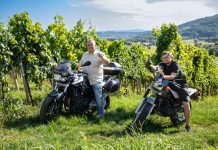
For years, he imagined owning a Harley-Davidson, although he had never ridden one. Then a friend invited him for coffee. Five or six Harleys were parked outside the café, beside a van bearing the company’s logo. Around the motorcycles stood men in leather, with tattoos and beards.

“I was convinced it was a hidden-camera prank.”
They sat down and talked. One of the men handed him a key.
“Want to try it?”
Gordan climbed onto a Harley for the first time, took it for a ride, returned the key and asked just one question:
“Is it for sale?”
It was.
Nothing moved quite so quickly with the Church of St Rudolf, thirty metres from the winery. The lease has been signed and the plans exist, but the walls are still waiting to be restored.
After all the businesses, plans and projects, I ask him what he does for a living.
His answer could not be simpler:
“Winemaker.”