The most expensive way to learn, says Miroslav Kovačević, is from your own mistakes. It is much cheaper to listen to people who know more than you, even when you do not like what they are saying. It took him years to understand that, even longer to admit it, and longest of all to put it into practice.
The land is a particularly unforgiving teacher. It remembers every foolish thing you do to it. You can smother it in artificial fertilisers, push it to produce more and faster, treat it like a factory floor, but sooner or later the bill will arrive. The land has more time than a person does, and it is in no hurry.
It sounds like the wisdom of a man who grew up in love with vineyards. But Miroslav Kovačević was not that sort of boy.
He hated the vineyard.
He hated dirty hands, soil beneath his fingernails and days spent among the vines while his friends had better things to do. In his childhood, the vineyard did not smell of tradition, family heritage or a romantic return to nature. It smelled of obligation. Of work that had to be done. Of a punishment he intended to escape as soon as he was old enough.
“I grew up in a vineyard, but that certainly doesn’t mean I loved it. In fact, I came to hate it. I grew up in Irig and wanted to be anywhere else.”
And he escaped. First into hospitality, then into trading, into a world of customers, waiters, suppliers and invoices. A café was his first university, the Gradska Kavana his second, and a restaurant his third. There, he maintains, he learned far more about people than any business manual could have taught him.
“When you work in a café, you see everything. Who lies, who puts on an act, who can take a defeat, who has courage and who hasn’t a clue. And you learn never to react on your first impulse.”
Business was good. He was making serious money, meeting people and living well enough that returning to a hoe could hardly have crossed his mind. He thought he was finished with vineyards.
Then, in October 1999, he listened to a speech by Zoran Đinđić. Of everything said, one thought stayed with him: everyone must do something for the country they belong to.
“I don’t know what happened in my head that day, but that sentence kept echoing. I thought: if someone needs to do something, then that someone is me. And the one thing I know how to do, however much I hate it, is work a vineyard.”
His father looked at him in disbelief. The son whose childhood nightmares had been vineyards was now saying he wanted to make wine. Only when he realised that Miroslav had not arrived with another passing notion did he offer him all the land the family owned.
That was how Kovačević Winery began, without a centuries-old wine dynasty, a romantic family legend or a market waiting for its first bottle. It would soon become clear that absolutely nobody was waiting for that bottle.
Miroslav entered the business with the confidence of a man who had already succeeded in hospitality and trading and saw no reason why wine should be any different. He would make good wine, put it in a bottle and people would buy it. Restaurants would call, merchants would compete for it, and the Kovačević label would appear on tables as soon as the market understood what it was being offered.
The market, however, understood nothing.
“I couldn’t move the wine even if I gave it away. The telephone didn’t ring once.”
He had ten thousand litres of wine in the cellar and, for two years, almost no customers. Medals and awards arrived, but the bottles did not leave. Even in Irig, where people had known him all his life, nobody felt obliged to change their habits because a neighbour had decided to become a winemaker. Belgrade was harder still. Restaurants served wines from the large state-owned cellars, private producers were an unknown quantity, and owners and waiters felt no need to experiment.
Miroslav went from restaurant to restaurant, carrying bottles, organising tastings, making calls and persuading people to try the wines, at least. Some turned him away, others ignored him, and others listened politely before continuing to serve what they had served for years.
“I was young and full of myself. I thought the fact that I had made the wine was enough. Well, it wasn’t.”
He calls that period his “season zero”. Investment without returns, work without validation, and wine that was much easier to produce than to sell. He could have given up, concluded that he had been right to hate vineyards and returned to a business in which he already knew how to make money. But retreat was not in his nature. He had invested too much money, even more stubbornness, and above all his conviction that a private winery in Serbia could be a serious business.
There were not many people who shared that conviction at the time. Kovačević from Irig, Boža Aleksandrović from Vinča near Topola and Mija Radovanović from Krnjevo belonged to a small group who believed that an independent producer could make wine that went beyond a cottage industry or a sideline on the family farm and became a product for a serious market.
“We were kids who thought we could build something big, even though a private winery barely existed as a concept. We drew a line and said: an independent producer can make serious wine.”
They had to create customers as well as wine: explain the difference between an industrial litre and a bottle bearing a producer’s name, persuade restaurants to make room on their wine lists, and teach drinkers that privately produced wine did not necessarily mean something drawn from someone’s cellar into an unlabelled bottle.
His first real breakthrough came with Chardonnay, made on the advice of winemaker Jovica Popov. But good wine alone was still not enough. He also had to change the way it appeared before the customer. He sourced Italian bottles unlike those then seen on the Serbian market and completely redesigned the winery’s visual identity.
The labels featured Aurelius, Rosetto and Bermet, the Latin saying Vina dant animos-“Wine gives courage”-and the year 1895 on the crest. This was not the winery’s founding date, as many later assumed, but the year Kovačević chose to mark the re-establishment of vineyards after phylloxera. He liked the symbolism of a fresh beginning. After the disease had devastated the vineyards, vines returned to Fruška Gora, just as, almost a century later, the boy who had fled them returned to the vineyard.
The new appearance began attracting attention. People first remembered the bottle, then the label and, finally, the wine. Miroslav learned his first serious lesson in a business he had thought he understood: taste determines whether a customer orders a wine a second time, but first there must be a reason to order it once.
Then the telephone rang.
“Young man, where have you been?”
“Who’s this?”
“Dule from Madera. Why haven’t you come to offer us your wines?”
Madera was one of Belgrade’s important restaurants, precisely the sort of establishment a small independent winemaker approached with considerably less confidence than he would have later.
“Are people asking for them?”
“They are. And it’s a good thing they are. Come tomorrow.”
After two years spent knocking unsuccessfully on other people’s doors, the market had finally knocked on his. People had begun asking for Kovačević Chardonnay. And demand was considerable. Production soon rose from thirty or forty thousand bottles to a quarter of a million.
Season zero was finally over. Kovačević would very soon discover that success does not make problems disappear: they grow along with the business.
At first, success brought everything he had hoped for: restaurants, customers, increased production and confirmation that returning to the vineyard had been the right decision. Kovačević wines reached official state tables and were served at lunches and dinners for foreign guests. The once unknown private producer from Irig became one of the recognisable names of Serbia’s new wine industry. Kovačević was named Serbia’s best winery for 2024, Sauvignon S Edicija 2021 headed the ranking of white wines from international varieties, and Brut 2011 led the sparkling wine category.
“I’d be lying if I said I didn’t enjoy it. But above all, it was proof to me that quality gets noticed sooner or later.”
Before long, however, the other side of success arrived. More customers required more grapes, more wine, larger cellars, more advanced technology and an increasingly complex organisation. What had begun as a family winery could no longer be managed as a small business in which the owner checked a few tanks every morning, got into his car and visited restaurants until evening.
“When you’re small, people see you as someone who needs help. When you become big, they look for ways to take advantage of you.”
Kovačević was growing faster than he had planned. The existing cellar could no longer keep pace with production, and he found the solution somewhere he had never expected: Iriški Podrum, the former wine giant that had been deteriorating for years.
It was a remnant of another era. Vast halls, long rows of tanks, abandoned production lines and facilities that had once produced around six million litres of wine a year. The premises were neglected, oversized and sufficiently intimidating to make a sensible person say thank you after the first visit and walk away.
Miroslav bought them.
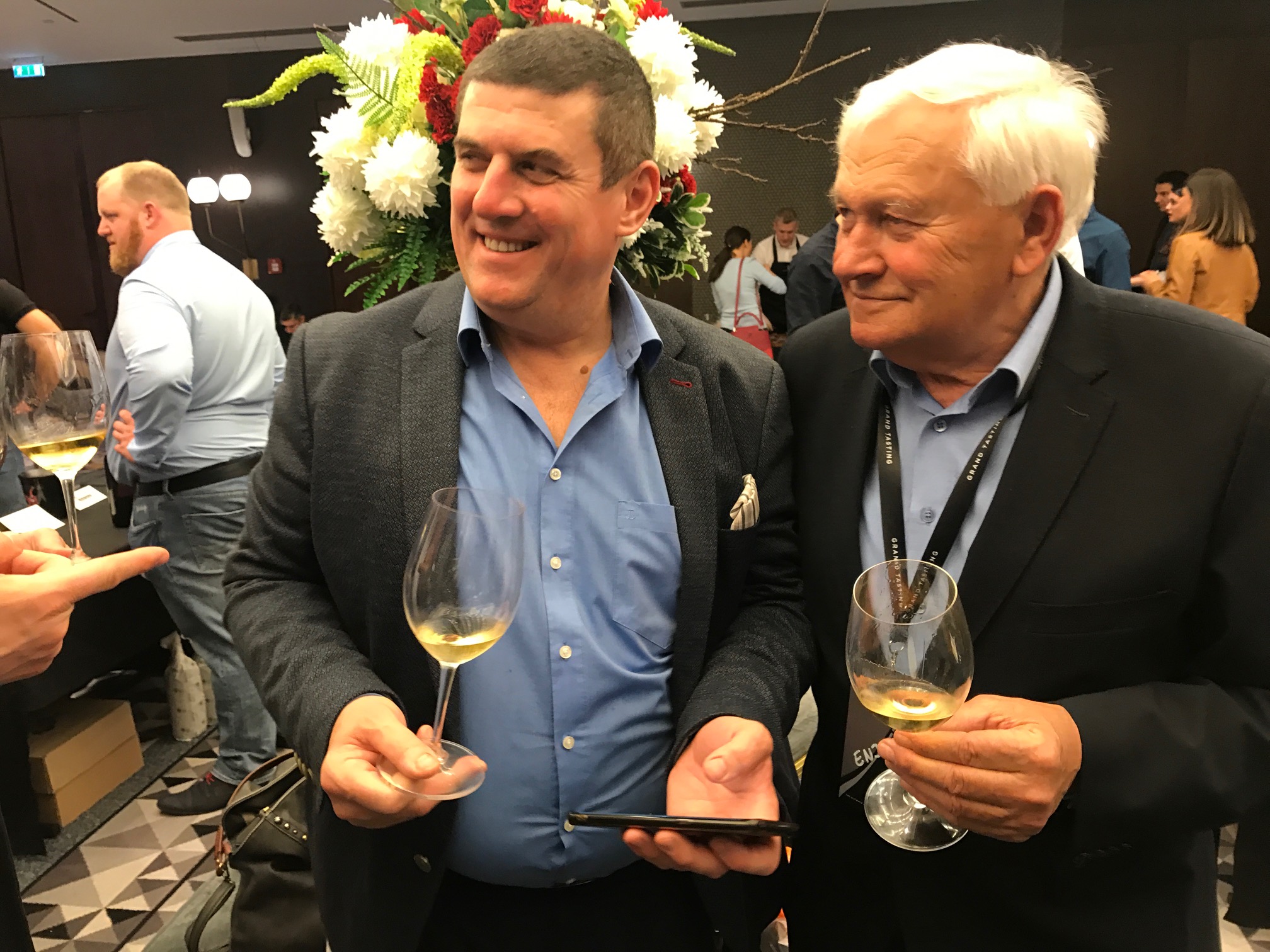
“I never imagined I would be the person who bought Iriški Podrum. It was enormous, far beyond my ambitions at the time. But the company was growing and I had to keep up with it. Once you start climbing, you can’t suddenly stop.”
He was not entirely sure that the people calling him mad were wrong. Restoring such a complex involved much more than replacing a few tanks and painting the walls. Production had to be redesigned, lines separated and facilities renovated, transforming an industrial inheritance into a cellar capable of controlling both large volumes and small, ambitious batches.
Buying Iriški Podrum allowed him to cross a threshold he had once considered unimaginable. Today, Kovačević Winery produces just over a million litres annually. Along the way came Orfelin, a range of more affordable wines named after Zaharije Orfelin, the author of the first winegrowing manual in Serbian. The idea was to make everyday wine while maintaining the standards on which the winery’s name had been built.
As the business grew, however, the wine scene began attaching different labels to him. When he was small, he was the brave independent producer challenging the large state combines. Once he became large himself, some newer small producers began holding him up as an example of winemaking supposedly more concerned with volume than character.
It can still make him angry.
“They arrive on the market, go into a restaurant to offer their wine, and the first thing they say is: ‘We’re small, we have tradition, unlike those big producers who are purely commercial.’ And they’ve been making wine for a year or two!”
In this division, the size of a winery often becomes a substitute for discussing quality. A small producer is automatically declared authentic and artisanal, a large one industrial, regardless of the vineyards, how the grapes are grown or what is actually in the bottle. Kovačević decided to demonstrate that volume alone does not determine a wine’s character.
“Wine is made in the vineyard, not in the winery. You can make bad wine from good grapes, but no technology in the world can make good wine from bad grapes.”
For years, Kovačević worked with winegrowing families on Fruška Gora, overseeing grape production on approximately two hundred hectares of leased and contracted vineyards. As the winery grew, he became increasingly interested in whether herbicides and artificial fertilisers could be abandoned on a large scale, life restored to the soil and interventions reduced. At that scale, a mistake means much more than losing a few rows: it becomes a serious business risk. Conviction, curiosity and sheer stubbornness drew him towards it.
His shift towards a different kind of production began in the glass rather than the vineyard. On trips to Goriška Brda, Kovačević met Slovenian winemakers who left white grapes on their skins for long periods, fermented spontaneously and made wine with minimal intervention. He returned every year, tasting more of these wines and discovering a style markedly different from the clean, technically precise wines on which he had built his own market.
He liked long-macerated wines because he wanted to drink them.
“As far as I’m concerned, I’d sooner say I’ve set trends than followed them. But only if I like what I’m doing. I won’t make something just because it’s fashionable.”
Amphorae arrived from Georgia in 2016. He had not bought them as scenery for visitors or as a marketing statement about returning to his roots. He was drawn to the thought of making wine in a vessel like those in which its history probably began, using a method that might give a modern winemaker at least some idea of what people drank thousands of years ago.
“History wasn’t my main motivation. I simply love the character of amphora wines. I know they aren’t wines for a broad audience, but there are people who enjoy exploring. I like making wines for those people.”
Riesling and Chardonnay went into the amphorae. Long-macerated wines followed, then an orange sparkling wine. Kovačević could simultaneously produce Serbia’s bestselling Chardonnay, a million litres of wine for the wider market and small batches that only some of his customers would appreciate. He saw no contradiction in that.
A large winery, he believed, did not have to make only safe bets. Its size allowed him to devote part of his cellar and his time to wines whose reception on the market was uncertain.
“Part of me went into it out of sheer stubbornness. I wanted to show that natural, orange or organic wines don’t have to come only from cellars producing a few thousand bottles.”
The amphorae changed his view of wine, but an organic transformation also required a different way of looking at the vineyard. Ivan Enjingi played an important role in that: a man in whose presence Kovačević, despite his own experience and the size of his business, felt like a beginner again.
When they met, Miroslav saw before him someone who had begun doing, decades earlier, what the wine world would only much later start discussing as its future. Enjingi was a pioneer of organic viticulture in Croatia, a winemaker who believed in compost, healthy soil and patience long before “organic” and “natural” became appealing words on labels.
“The man is an encyclopaedia. He’s been through everything and experienced everything. He’s over eighty and works harder than all of us put together. He still digs, drives a tractor and works in the cellar. I said to myself: if he can work like that at his age, and I’m almost half his age, what’s my excuse?”
Their conversations revolved around soil, compost, biodiversity, contact treatments, sulphur and wines stabilised by the natural passage of the seasons. Kovačević did not try to copy everything Enjingi did. Some methods remained puzzling until he tasted the results.
“When you taste his wines, you realise there’s a logic behind it all.”
Enjingi’s most important lesson concerned the soil. A vineyard can be depleted for years before the consequences become visible, and by the time they appear, it is often too late for simple remedies.
Kovačević began with a few Chardonnay plots. For two years, he tested what happened when he eliminated herbicides, artificial fertilisers and systemic treatments, relying instead on contact protection and natural compost. His interest went beyond maintaining a showcase vineyard beside the winery. He wanted to know whether it could work at scale.
“If the Austrians, Slovenians and Italians can do it, so can we.”
He brought Simmental cattle, Angus cattle, Mangalica pigs and sheep into the operation. The animals were part of a closed cycle: their manure became compost, and the compost returned to the vineyard what production took away. He also considered using horses to work one plot without tractors.
“People think organic farming is a trend. To me, it’s a necessity. We have to protect both our health and nature. If you keep pushing the soil, it will take its revenge. If you bring it back to life, it will give life back to you.”
His biggest step came at Grabovo, above Beočin. The plot had been left to nature for decades, overgrown and untouched by intensive agriculture. When he first saw it, he felt as though he had arrived in Dalmatia: stone, sunshine and terrain where almost everything had to begin from scratch.
That was precisely its advantage. He did not have to heal soil exhausted by years of conventional farming or wait for residues of herbicides and other treatments to disappear. He had a clean starting point and enough space to test organic production on a scale that left little room for romantic notions.
A friend from Sweden, a wine distributor supplying Michelin-starred restaurants, first noticed the scent of mint in the vineyard.
“He told me: ‘Mire, I’ve never smelled mint like this in any vineyard in Europe.’”
And when thousands of morel mushrooms emerged from the ground in early spring, Kovačević took them as another sign that he was heading in the right direction.
“Morels don’t grow just anywhere. To me, that was the best proof that the soil was clean.”
At the beginning of 2025, Kovačević Winery had 120 hectares of vineyards under organic management. Sixty-six hectares were certified, while the rest were still in conversion. Miroslav believed at the time that this was the largest organic vineyard in southeastern Europe.
The extensive acreage did not yet mean that most of the bottled wine was organic. Those wines accounted for approximately ten per cent of annual production exceeding a million litres. His goal is to increase that share to forty or fifty per cent, particularly in the premium segment, where he wants to make wines from certified grapes using traditional methods and spontaneous fermentation.
Kovačević’s standard range has long had its audience. He does not intend to replace overnight the wines that made the winery famous. Instead, he wants gradually to change what customers will recognise it for in the future.
“The point is whether the wine is good or it isn’t. Nobody can reliably tell you from aroma and taste alone whether it’s organic or conventional. Organic production is more responsible towards health and nature, but a certificate won’t fix a bad wine.”
In the organic vineyards, he has also planted varieties with which he had not previously been particularly associated. Morava accounts for the largest share, and he sees an interesting opportunity in it: disease-resistant, suited to organic growing and aromatically distinctive enough that it might one day mean to Fruška Gora what Tamjanika means to southern Serbia. He also has Neoplanta, Grašac, Probus, Furmint, White Tamjanika and Prokupac, but he is not sentimental about grape varieties.
For now, he has no intention of bottling Tamjanika or Prokupac as single-variety wines, because he does not consider them typical of Fruška Gora. He is even less inclined to join the general enthusiasm for Grašac.
“I don’t want to sound like a hater, but for now I’m not planning to make it as a separate wine. It goes into a blend with Riesling.”
“Why?”
“Because I think Riesling makes greater wines.”
Over the years, Riesling has also become a personal favourite, ahead of Chardonnay, although Chardonnay remains the winery’s bestselling wine.
“The older I get, the more I like wines with higher acidity. These days, Sauvignon and Riesling are probably closer to my heart than Chardonnay. It seems the more of an alcoholic you become, the more you like acidity.”
“When someone asks me how to learn to recognise wines, I tell them they first have to become an alcoholic! I’m partly joking, but you can’t understand wine if you don’t drink it.”
The man who had once needed to teach the market that an independent producer could make a serious Chardonnay was now established enough to feel no obligation to court either trends or majority taste. He could openly say that he did not see in Grašac what others saw, invest a decade in organic production whose costs would not be recovered overnight, and admit at the same time that sheer stubbornness had helped propel him into it.
The same stubbornness with which he fought for a place for private wineries two decades earlier now prevents him from keeping quiet about what he sees as the weaknesses of Serbia’s wine industry. He does not believe it is enough to count new cellars, point to a few impressive buildings and conclude that the scene is moving in the right direction.
There are more wineries, new generations are arriving, styles are changing and substantial capital is being invested. Among the new producers are people with ideas, knowledge and clear goals, but also those whom Kovačević describes with the proverb about the frog that saw a horse being shod and lifted its own foot. He considers the greater problem to be how little winemakers know about one another, and how little they cooperate. Instead of working together on the identity of Fruška Gora and other wine regions, there are too many personal interests, divisions and egos.
“Everyone has an opinion about everyone else. We aren’t in the habit of helping one another. I’m afraid we won’t be following Istria’s path any time soon.”
He does not dispute the value of Grašac as a variety around which Fruška Gora is trying to unite, but believes that a few joint tastings and labels are insufficient to build a regional identity. Strategies are adopted and targets written down, yet afterwards there is rarely any assessment of what has actually been achieved.
“I’d like someone from the winegrowers’ and winemakers’ association to present the figures and tell us how much of the Development Strategy has been accomplished. If we drew it up simply to have it on paper, that was money wasted. The goal isn’t just to get a score and build the prettiest possible winery.”
Kovačević makes no secret of his belief that large, successful producers must play an important role in developing the industry. He objects to the idea that a region can move forward by belittling those who have already built its market.
“We’ve got things the wrong way round in Serbian wine. The locomotive pulls the carriages, not the other way round.”
Such a statement will not win him universal affection among his colleagues, but he is no longer seeking it. His wines sell, the winery is growing, and he still sees no shared objective capable of overcoming individual interests.
“Where do we go from here? Apparently, everyone towards their own goal, because we don’t all have the same one.”
He expanded his own ambitions beyond wine production long ago. Vinska Kuća Kovačević, between Irig and Iriški Venac, brought together a cellar and a restaurant and became one of Fruška Gora’s best-known wine tourism destinations. There, wine is conceived as part of the food, the landscape and the stay, extending the experience beyond a bottle bought after a tasting and taken home.
He began expanding the restaurant, building an events hall, new kitchens, facilities for more ambitious gastronomy and a cigar lounge. Beside Vinska Kuća, he is also building a hotel with twenty rooms, eight suites, a conference hall and a wine spa.
“If we’re expanding, we have to take everything to a higher level. We’re creating an experience.”
As he speaks, he lists building sites, deadlines and new ideas like a man who would like to give the impression that everything is under control. Then he shrugs and admits that sometimes even he does not know why he needed all of it.
“Well, a man has to enjoy himself somewhere.”
The only problem is that Miroslav Kovačević enjoys working. As soon as he finishes one project, another appears. The winery needed a larger cellar, the larger cellar new wine ranges, the vineyards organic production, Vinska Kuća a hotel, and the hotel attractions that would make guests want to stay longer.
“A fool always finds more work for himself.”
In one vineyard, he imagines a traditional farmstead with houses for the people who will run the estate, space for children and a plot worked by horses. In another, he plans a campsite with cabins reached by horse-drawn carriage. Guests would stay for several days, ride horses and bicycles, drink wine and visit the monasteries surrounding his vineyards: Staro Hopovo, Novo Hopovo, Grgeteg, Velika Remeta and Krušedol.
“It’s our Mount Athos.”
He believes Fruška Gora already has everything needed to become a major wine and tourism destination: vineyards, history, gastronomy, monasteries and landscape. What it lacks is the connectedness that would encourage visitors to experience the whole region rather than a series of individual places.
“I want children to see nature and people to get away from concrete. I want someone to come to my vineyard for two days and return feeling as though they’ve been away for a month.”
He pauses, as though only then hearing how much more work he has just assigned himself.
“I know, I’m too ambitious. But what can I do? I was born this way.”
Ambition has brought him everything he lacked in those early years. His wines no longer sit unsold in the cellar, restaurants no longer turn him away, and he has long since stopped waiting for a telephone call from Madera. Production has passed a million litres.
Yet when he compares his life then and now, Kovačević does not automatically choose what he has today.
“Life was better when I was small.”
He does not mean his age, although he likes to say that time has already taken its toll. He means the winery. When he did not have much money, he could get into the car, drive to Belgrade, visit restaurants and spend the day with friends.
“I used to be able to spend all day with people. Now I don’t have time for anything.”
Success has given him more places where he has to work, and no less work to do.
He says that, if he could choose again, he would start listening sooner to people who knew more than he did. And when asked when he will slow down, he replies:
“Only the sky’s the limit. But perhaps one day I’ll sit down and enjoy a glass of wine in peace.”
Perhaps he will.
As soon as he finishes whatever he is working on now.