For almost twenty years, Mladen Dragojlović made wines whose labels did not bear his name. Some won major international awards, others became benchmarks for their varieties and winegrowing districts, and those in the know recognised the hand behind them. In March 2026, he finally presented three wines under his own surname.
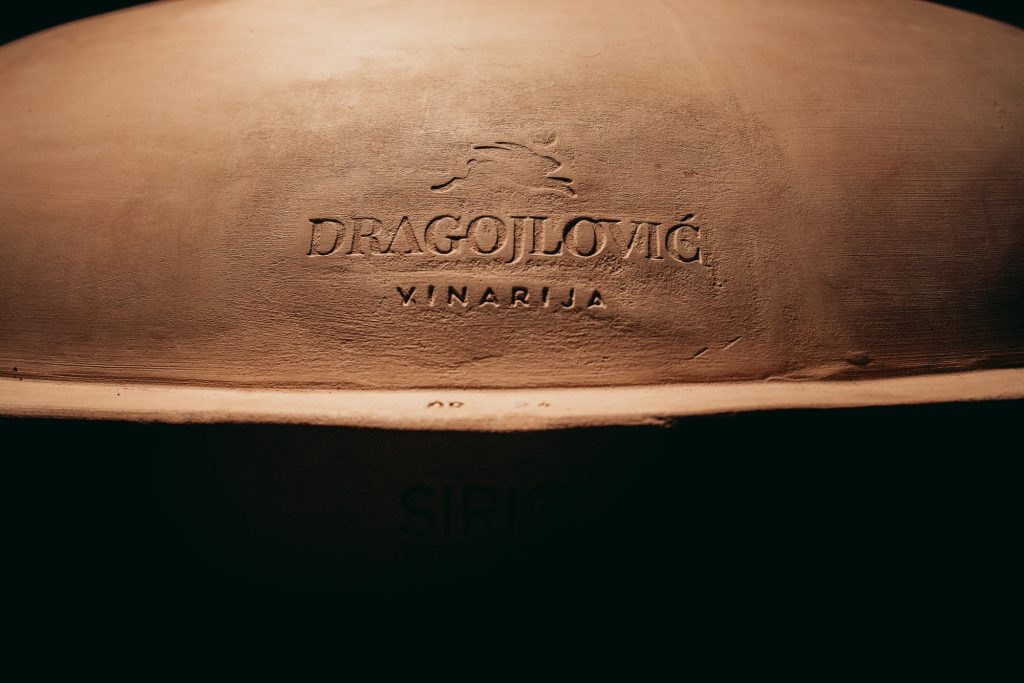
Yet the Dragojlović winery’s logo featured a hare running towards the sun.
It came from a family story dating to the early eighteenth century. The last boy in their line to bear the surname Zec-meaning “hare”-lost his parents young and was adopted by an aunt who had no heirs. He took the surname Dragojlović, but the old name never disappeared from family memory. It survived in the story of ancestors who travelled from Herzegovina through Lika, Slavonia and Banat before reaching Bačka, and three centuries later it returned on the labels.
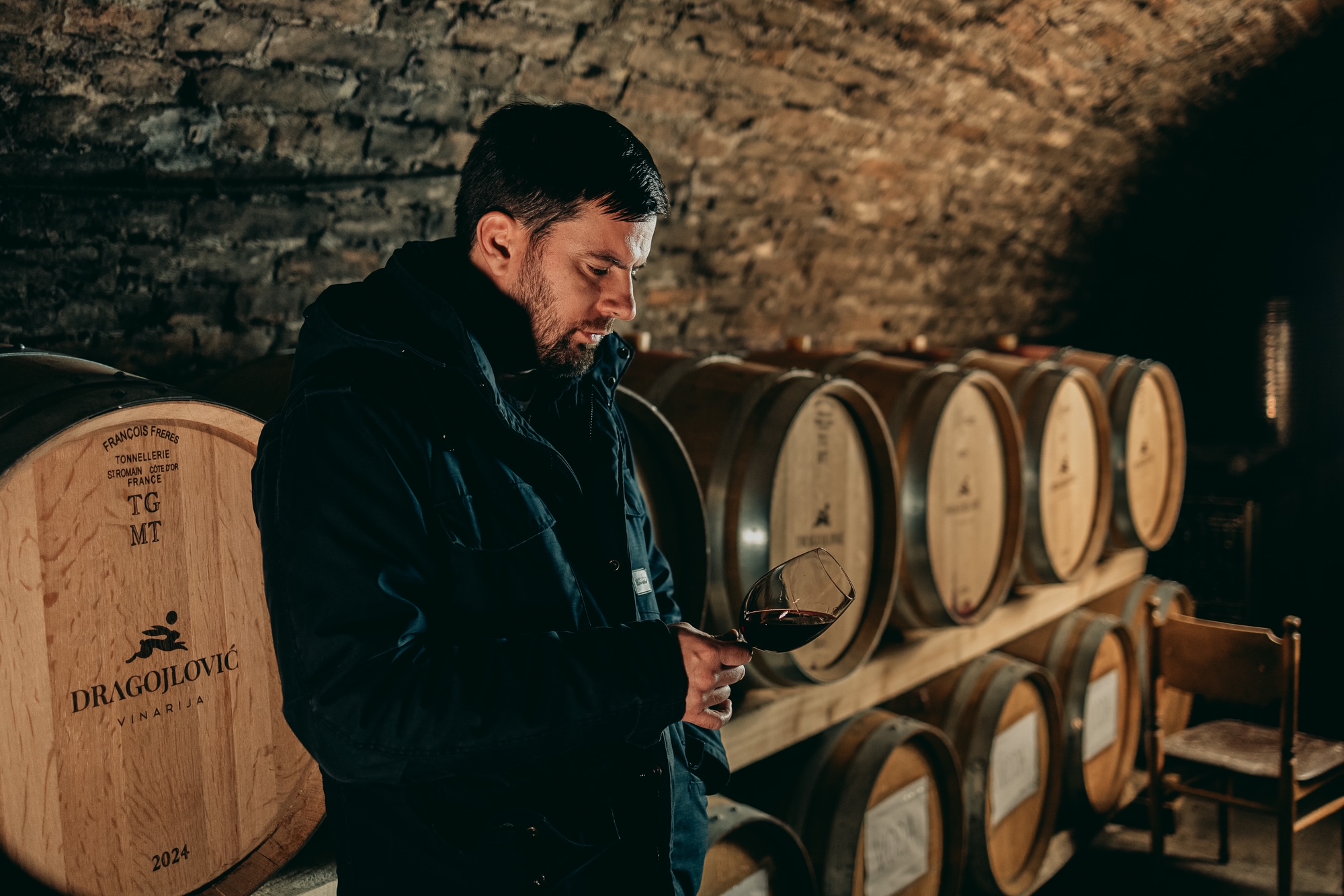
In the packed room of Belgrade’s Balkan Wine Center wine school on 25 March 2026, Mladen was on familiar ground. Over his career, he had presented many wines and spoken about soils, varieties, acidity, tannins and oak. This time, Rogoz 2025, Husar 2024 and Kolodar 2024 stood before him, each bearing his surname. Standing behind someone else’s wine, it turned out, was not quite the same as presenting his own.
His initial nerves quickly gave way to a flood of information, but he was not presenting alone. Beside him was his wife Danka, a research associate with a doctorate at the Institute of Food Technology. She had helped find the site, develop the winery’s identity and, for the first time, participated directly in making the wines. Mladen admitted that no bottle would reach the market without her sign-off. They share responsibility, and praise, equally. The winery grew from a combination of science, nature and family memory. Mladen spoke about the loess at Mihaljevac; Danka about the Battle of Slankamen, the family surname Zec and the sun towards which the hare runs. Their three wines took their names from the landscape, history and natural cycles: Rogoz Grašac, Husar Chardonnay and Kolodar Syrah.
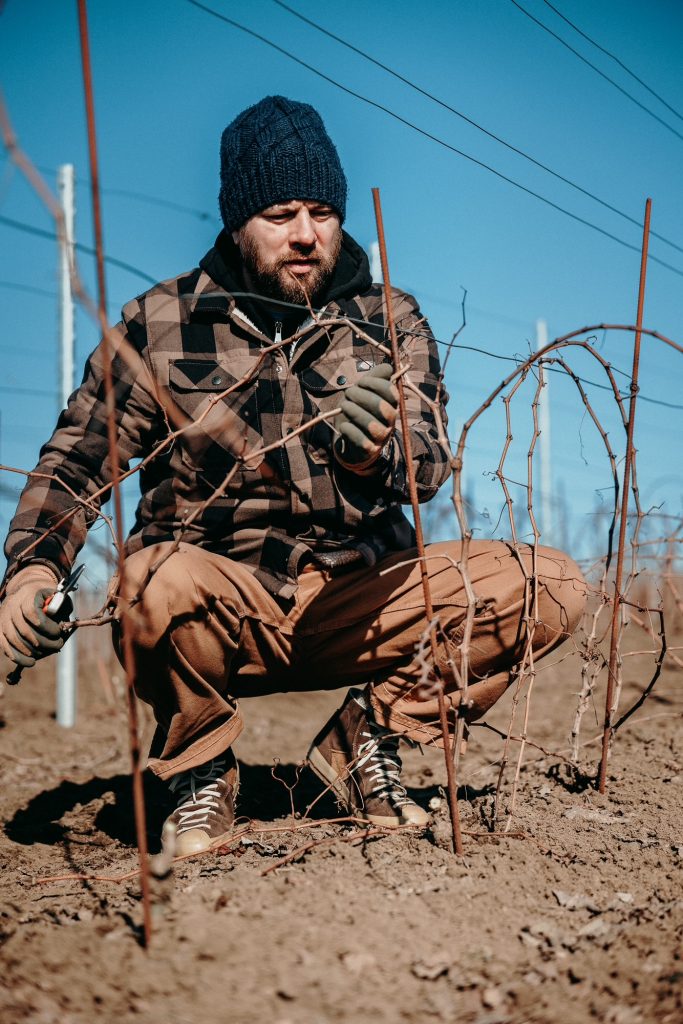
The vineyards lie at 218 metres above sea level, beside the monument commemorating the Battle of Slankamen in 1691. They own three hectares of young vines and have taken a further hectare and a half of older vineyards under a full lease. The south-facing site rests on deep, carbonate-rich loess, which Mladen compares with soils found in some of the world’s great vineyards. Syrah occupies forty per cent of the plantings, with Chardonnay and Grašac sharing the remainder equally.
The first vintages yielded around 7,500 bottles, and the premium range is not intended to exceed 12,000 even in the future. Some Chardonnay has already become the base for their first sparkling wine, a blanc de blancs they will make only in years without drought. Their cellar is a leased underground cellar in Sremski Karlovci. For a man who spent years working in other people’s cellars, what matters more is that the decisions are finally his.
Or, more precisely, theirs.
Those first three bottles offered more than a chance to show what he could do when nobody else set the boundaries. They tested everything he had spent twenty years telling others: that wine needs a plan, that technique must not obscure the variety, and that a great wine cannot be made unless the right vineyard site has been found before the grapes reach the cellar.
And the road to Mihaljevac began long before Slankamen.
While his friends spent their earnings from waiting tables on summer holidays, Mladen Dragojlović bought technical books about wine. At first, he was drawn to its mystique, to the idea of winemakers as people set apart from everyday life. He had loved chemistry at secondary school, so romance soon led him to reactions, processes and figures.
“I was a very good chemist-until I realised you could make good wine from grapes too!”
In time, his belief that winemakers were a special breed disappeared as well.
“I thought winemakers belonged to some strange world, people detached from reality. Eventually, I saw they were perfectly ordinary people, with their faults and virtues. Mystique brought me into wine, but technique kept me there.”
The first wine he worked on, in 2006, was not made from a variety on which he would later build his reputation. It was Muscat Croquant from the sandy soils of Biserno Ostrvo near Novi Bečej, a grape whose survival is tied almost entirely to that part of the Tisza region. It had rarity on its side, along with the story that Josip Broz Tito particularly enjoyed it. Neither prevented Mladen from assessing it without sentimentality.
“I found Muscat Croquant very strange, somewhere between a wine grape and a table grape. It accumulates little sugar and little acidity, and good wine needs both. The story that Tito adored it did more for its reputation than the quality itself.”
He made a few hundred litres. The wine expressed the variety, people liked it, and it was soon drunk. It brought him no trophies, but allowed him to test what he had learned from books on grapes that offered no easy solutions.
He then tested his knowledge outside Serbia. He interned at Masciarelli in Italy’s Abruzzo region before going to Chile, where he worked at RR Wine and Viña Carmen. There, he encountered a different scale of production and an approach that saw no contradiction between tradition and modern technology.
From those experiences, he developed what he calls postmodern winemaking. Old knowledge is not valuable simply because it is old, just as new technology is not good merely because it is new. He takes from both whatever helps him make the wine he envisages. He dislikes chance elevated into a philosophy, a fault sold as authenticity, or technology that speaks louder than the variety and vineyard.
“A person without a philosophy is nothing. It took me time to understand what I wanted. Today, I know much more clearly where I’m going, and I make far fewer mistakes.”
He did not reach that clarity without mistakes.
“Until you succeed, everyone tells you you’re a fool. Once you succeed, you’re a genius.”
On returning to Serbia, he did not find a single cellar in which to demonstrate his knowledge at leisure. He found the road. He worked with Podrum Janko in Smederevo, Matalj in Negotinska Krajina, Milanović in Surduk, Eden, Lastar, Despotika, Šapat, Matijašević and, later, Đoković. They formed the professional map that earned him the nickname “the flying winemaker”.
The nickname mattered less to him than his simple answer when asked where he lived:
“I only sleep in Novi Sad.”
During the months when the vintage was being decided in vineyards and cellars, scarcely a day passed without travel. From Novi Sad, he drove towards Smederevo, Surduk, Slankamen, Šumadija or Negotinska Krajina, then returned and set out again. The Black Keys, Kings of Leon and The White Stripes took turns on the car stereo while he mentally rearranged grape ripeness, acidity, tannins and possible blends.
The number of wineries and kilometres travelled confirmed that he was in demand, but such a life came at a cost.
“I’m tired, and I realise I have to take this work to another level because I physically can’t get everywhere. I want a serious laboratory, my own team of young people, people who aren’t afraid of competition. I don’t want to do everything myself.”
He envisaged the laboratory as a place for more precise work, and younger colleagues as people to whom he could pass on some of his knowledge. He saw little sense in keeping everything locked inside one head, especially on the day his car failed to reach the next cellar.
Of all the wines he made over those years, one stands out as the most important. Not because it was the only one to win major awards, but because its vintages reveal the continuity of his work.
It is Matalj’s Kremen Kamen.
The grapes come from Kremenjača above the Timok River, from loose, well-drained soil full of stones and limestone. The site receives enough sunshine to ripen Cabernet Sauvignon, while cooler nights preserve freshness. Mladen insists that the boundary of the section yielding the best grapes can be recognised without a map.
“You walk through the vineyard tasting grapes, then suddenly enter an area where the bunches and berries are completely different. Smaller, more concentrated. That’s Kremen Kamen.”
Stylistically, he places it between Bordeaux and California. From Bordeaux, he seeks structure and elegance, but without excessive green, pyrazine notes; from California, breadth and power, but without overripeness or cooked fruit.
“I haven’t said it’s better than every wine costing 250 dollars, but it has everything I love and none of the things that sometimes bother me in them.”
He believes every vintage of Kremen Kamen can age for at least twenty years. More important to him is that it was no isolated success. Its quality has been repeated, and repeatability is Mladen’s proof that a wine is no accident.
Perhaps the almost forgotten Bagrina, which Mladen and Matalj brought back into bottle, describes him even better. Professor Avramov once spoke of it as a variety with a great future, but Mladen does not claim the task is complete: Bagrina still awaits a great wine that will vindicate everything attributed to it for decades.
Such varieties attracted him precisely because no ready-made model existed. With Cabernet and Chardonnay, he could measure himself against the world. With Bagrina, Grašac, Morava, Sila or Probus, he first had to discover what their world might be.
Yet the most important lesson about the limits of his knowledge came from a variety he initially wanted to grub up in Slankamen: Teroldego.
When he began working at Atelje Vina Šapat, he found a grape in the vineyard whose existence he had barely been aware of. Originally from Italy’s Trentino region, Teroldego had neither a recognisable name in Serbia nor a market waiting for it.
“Teroldego? Who’s going to understand that, and who are we going to sell it to? I’d heard of the variety once in my life. I was certain we’d pull it out.”
There was enough work in the vineyards even without Teroldego. Trellises needed repairing, the consequences of poor pruning correcting, and crop protection putting in order. They grubbed up plantings with no future, let the soil rest and only then planted new vineyards. From an initial six hectares, they gradually reached around twelve.
Before passing final judgement, however, he gave Teroldego another chance. He pruned more severely, drastically reduced yields, vinified the grapes conventionally and put the wine into barriques. Three months later, he tasted it with the winery team.
“I jumped out of my chair: ‘People, this is phenomenal!’ It has everything: high acidity, reactive tannins, depth, dark colour, the aroma of fresh meat… It’s related to Syrah and really does resemble it. I invited a few more people, and everyone was delighted. That’s how we went from ‘we’re pulling it out’ to ‘we’re expanding the planting’.”
Teroldego forced him to reconsider his first assessment. He could have stuck to it and found enough reasons to grub up the vines. Instead, he accepted that the problem lay in their failure to give the variety a chance to reveal its character.
Teroldego later became one of the flagships of Šapat’s premium Atila range. The same range also produced a Chardonnay that again demonstrated how well Mladen understood the variety. Atila Chardonnay 2022 won gold at the Decanter World Wine Awards, while the 2023 vintage took the trophy for best white wine at the 2024 Balkans International Wine Competition.
Mladen made no pretence of indifference to awards.
“I don’t want to hide my satisfaction. The terroir of Slankamen Hill is fantastic. I knew an award would come, perhaps not that particular one, but somewhere, somehow. This is a wine with character, a classic Old World wine, closest to Burgundy, but with our own loess-derived minerality and phenolic character.”
At Šapat, he also began working with Italian Sirio amphorae of 600 and 900 litres, equipped with valves, cooling and controlled oxygen input. He was not attracted to the romance of a vessel in which wine was left to time and chance.
“We didn’t want qvevri because you can control almost nothing in them. They’re coated inside with supposedly neutral beeswax, but I don’t want wax in my wine.”
He regarded amphorae as tools for the future. They allowed texture to develop without the aromas imparted by oak. An old idea had acquired technological control and a place in the wine he envisioned.
The most ambitious result of Šapat’s experiments with amphorae was Trofej, a traditional-method sparkling wine whose base wine matured mainly in amphora, with thirty per cent in used barrique. Only 1,100 bottles were made. It also hinted at a direction Mladen would take into his own winery.
When deciding how to make the first Grašac from Mihaljevac to bear the Dragojlović name, he chose amphora.
He could have begun his own wine story with Cabernet Sauvignon or Chardonnay, varieties long associated with his name. Instead, the first bottle he presented to the public was Grašac.
He believes the variety has every prerequisite to become Serbia’s most important white wine. It produces good wines in different parts of the country, but he sees Fruška Gora as its natural centre, where it can achieve sufficient extract and retain its character without support from oak aromas. Restoring the name Grašac in place of Welschriesling is, for him, more than a change of terminology: it signals that Serbian winemakers are shedding their inferiority complex about their own heritage.
“Istria has raised Malvazija to the heavens. We should look to that model, but I believe Grašac has even greater potential.”
He named his answer to the question of what Grašac could be Rogoz. It takes its name from the reedmace growing in the Danube’s side channels around Slankamen, bending in the wind while remaining firmly rooted in its surroundings. To the Dragojlovićs, it suited a wine that need not resemble an international variety to be taken seriously.
“Grašac must have something authentic. It shouldn’t resemble a Chardonnay pushed into oak, and the last thing I want is to turn it into Sauvignon Blanc.”
That is why Rogoz will see no oak. Following a particular maceration regime, the 2025 vintage fermented in amphorae and remained there for approximately six months. The winery hardly uses stainless steel except when assembling final blends.
If Rogoz was a statement about a variety whose greatness still needed establishing, Husar was a fresh test of Mladen’s work with Chardonnay. Its name refers to the light cavalrymen who also fought in the Battle of Slankamen in 1691, on the hill where their vineyard now grows. A peacock feather from the hussars’ caps also appears on the label.
The grapes for Husar 2024 came from a fifteen- to seventeen-year-old vineyard, with yields reduced, as Mladen puts it, to “the absolute minimum”. Seventy per cent fermented and matured in French barrels, thirty per cent in amphorae. He selected barrels for how well the wood would integrate with the wine, rather than how strongly it would announce itself. He was equally cautious with malolactic fermentation.
“I don’t want to make a Chardonnay that ends up as nothing but butter. A creamy touch can be the icing on the cake, but it mustn’t become the whole cake.”
The third wine, Kolodar 2024, was Syrah, and Mladen insisted on that name rather than Shiraz. For him, the distinction was stylistic rather than linguistic. He wanted a more elegant, medium-bodied expression of fresh dark fruit and spice, rather than a dense, overripe, heavily oaked New World style.
A large proportion of the berries remained uncrushed, and approximately twenty per cent whole bunches went into fermentation. Partial carbonic maceration was intended to preserve fruit, while a year in first- and second-fill barrels provided structure without allowing oak to dominate. The Dragojlovićs linked the name Kolodar with the turning seasons, nature’s rhythm and the moment when the vineyard yields ripe fruit: kolo is the cycle, and dar the gift nature gives to people.
These three wines were not versions of what Mladen made in other cellars. Rogoz was not Grašac made to a Sauvignon Blanc recipe, Husar did not repeat his Chardonnay from Šapat, and Kolodar had no wish to become another Syrah from one of the wineries he advised.
For the first time, he did not have to seek a compromise between his own vision and someone else’s project. Yet even now, the final word was not his alone. Before reaching the public, every bottle also needed Danka’s approval.
Danka and Mladen brought scientific precision to their winery, but do not regard wine as a laboratory product. Numbers can explain what is happening and help avoid mistakes, but cannot replace the senses. Mladen therefore insists that a first-rate oenologist must be an excellent taster and remain immune to passing trends.
He is equally wary of labels that proclaim wines natural, organic or healthier in advance. He does not reject their aims, but the marketing that implies one word on a label guarantees responsibility in the vineyard and quality in the bottle.
“Almost all my wines fall within organic limits for sulphur. But I don’t want to put that on the label, because the point is the quality of the wine, not a slogan.”
He prefers to describe his approach as sustainable viticulture: cultivating the soil mechanically whenever possible, using protective treatments only when necessary and avoiding the most aggressive herbicides. Organic production, he warns, is not without problems when excessive copper use hides behind the designation.
“It’s six of one and half a dozen of the other. Both pollute. It’s hard to say which is worse.”
His resistance to simple answers explains his work. An amphora is not better because it is ancient, and a barrique is not bad because it can overwhelm a wine. Grašac is not great merely because it is local, just as Chardonnay is not characterless because it is planted everywhere. Every variety, vessel and technique must justify its place in the wine.
He applies the same standard when discussing Serbia’s wine industry. Awards please him, and he considers them necessary for a country without France’s or Italy’s historical reputation in established markets.
“If we don’t have both quality and recognition, we have nowhere to go. Awards are our argument for saying: look, we can compete with you as equals.”
Yet medals at the top cannot conceal problems at the base of the wine pyramid.
“You can’t buy a three-euro wine, take it home and say, ‘This is excellent, fresh, fruity and fault-free.’ Something that doesn’t scrape your throat, that isn’t oxidative or reductive. There’s almost none of that in Serbia, and it’s the foundation of the industry.”
He is equally concerned by the shortage of people capable of looking after vineyards. Serbia, he believes, needs skilled agronomists even more than oenologists. Phytoplasma diseases are spreading, protective treatments are often applied without sufficient knowledge, viruses receive too little attention, and the consequences will become visible only when they are no longer easy to contain.
Nevertheless, he sees the future as more than a matter of correcting weaknesses. He believes in Prokupac and Tamjanika, newly developed varieties such as Morava, Sila and Probus, Bagrina still awaiting its great wine, and above all Grašac. He does not expect Serbian winemakers to abandon international varieties, but wants them to stop treating their own as consolation prizes.
In ten years, he sees Serbia as a regional wine power alongside Hungary and Slovenia. For a long time, he imagined himself on a small Fruška Gora estate, with a few hectares of vines, a laboratory and a winery serious enough to be a business but small enough to leave room for friends.
“Definitely with a view of the Danube.”
Of everyone connected with wine, Mladen most envies those who know less about it than he does. Those who can open a bottle, pour a glass and surrender to it without needing to determine fermentation temperature, barrel type, sulphur levels, tannin ripeness or a cellar mistake that could have been avoided.
“It’s incredible how rarely I can approach wine in a relaxed way, without analysing it, looking for faults or thinking about how it could have been better. That’s my curse.”
When he wants to step away from wine, he listens closely to music, another subject he does not approach superficially. He calls himself an “all-round winemaker”: interested in different varieties and winegrowing districts, rather than a single technique or recognisable recipe. He tries to find an individual path for every wine.
His own winery was not conceived as another consultancy project. It was an attempt to gather in one place everything he had learned over years travelling between other people’s cellars.
At the presentation of his first wines, the nerves disappeared as soon as he began talking about Grašac, amphorae, acidity and loess. On that ground, he was sure of himself again. Speaking about the surname on the label, Danka’s approval and a hare carrying a three-hundred-year-old family story towards the sun was different.
His ancestor Đuro Zec could not have known that his lost surname would one day become the emblem of a family winery. Mladen, on the other hand, had long known what he was looking for: a few hectares on Fruška Gora, a small cellar, a laboratory and fewer roads to drive.
Whether his own winery will finally help him sometimes see nothing more than wine in a glass, he does not yet know. The first three bottles suggest he has scarcely stopped analysing or controlling anything.
The one question he no longer has to ask is whose name, after all his decisions, will appear on the label.