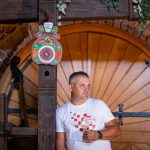
The plough had already bitten deep into the ground when something blue flew out of the furrow. Branko Mlađenović stood beside the tractor, watching the field in Krčedin being deep-ploughed for a future vineyard. Almost a metre down, he might have expected a stone, a root, perhaps a piece of an old bottle-but certainly not a rubber Donald Duck.
In the middle of a field, two and a half kilometres from the village.
Branko picked it up and looked at Mirjana Đurđević.
“Helloooo? Donald Duck? In the middle of a field?”
Mirjana did not need long to think.
“There it is!”
And so a vineyard that did not yet contain a single vine finally acquired its name.
Mirjana and Branko had already rejected several possibilities. Below their land ran a stream called Patka-Duck-but Patkov Podrum, Duck’s Cellar, reminded them too much of Mačkov Podrum, Cat’s Cellar, in Irig. They wanted no name that sounded like a copy, a wine joke or a tourist attraction conceived in advance. The grass was growing, planting was approaching, and the name would not come.
Then the vineyard threw it out of the ground.
“Seriously, how else do you explain it? A metre down, in the middle of a field, a rubber duck appears. I mean, excuse me-wasn’t that a sign?” Branko laughed.
Mirjana explained it more briefly:
“We wanted a name. The vineyard gave us one.”
Patkov Vinograd-Duck’s Vineyard-was therefore not named after ducks. They had none in Krčedin, only Donald, who had waited underground for who knew how many years until a plough unearthed him just as Mirjana and Branko were trying to name their future winery.
That part of Srem was not short of other animals, especially at weekends. Before going into the vineyard, Mirjana and Branko put on fluorescent vests and brightly coloured raincoats so hunters on the surrounding hills would not mistake them for game.
“They shoot in every direction, so we have to make sure they see us before they fire.”
Krčedin already offered plenty of material for literature: the Patka stream, Zekin Salaš-Hare’s Farmstead-and a field that produced rubber toys before it began producing grapes. Had it not existed, someone would probably have had to invent it.
Mirjana Đurđević, who had already experienced things she wrote in novels later appearing in reality, perhaps ought to have been less surprised. Branko believed it had all begun long before Donald Duck anyway: with a few hundred kilograms of vineyard peaches, a twenty-litre still and a brandy they would call Poljubac Nindže-Ninja’s Kiss.
Mirjana’s husband brought the peaches, and Branko, who already had distilling experience, decided to make brandy from them. Mirjana wanted to learn, so she acquired a twenty-litre still.
“A lady’s still,” she called it.
Branko distilled while Mirjana watched and learned, and the peach brandy proved good enough to encourage them towards something they had never seriously considered. Ninja’s Kiss thus, at least indirectly, opened the way to Patkov Vinograd.
Branko already owned land near Zaječar, where he intended to plant Tamjanika and eventually retire to the country, but it was too far from Belgrade. Krčedin was about forty minutes from Vračar. He found land there, and Mirjana saw an opportunity to join his venture. They became partners in a business about which neither knew enough to be frightened in time.
In 2012, they also took over a roughly hundred-year-old Vojvodina house. In the kitchen, Mirjana recalls, an elderly woman sat on a sofa watching television, while the rest of the property looked as though nobody had asked for decades whether anything needed repairing. Beside the house stood an old stable that would later become a small, single-storey winery.
“Everything you see today looked almost the same, only much more dilapidated.”
They had no winemaking experience. Mirjana described their knowledge as domestic and wine-drinking rather than technical, while Branko knew how to distil brandy and had worked the land enough to distrust the idea that anything grew from a good idea alone.
In 2013, they planted two hectares: approximately eight thousand Grašac vines and a thousand Riesling, along with around fifty vines each of white and black Tamjanika, more out of curiosity than a clear production plan. That same year, they published their jointly written novel Bunker Swing. It is therefore difficult to say whether the vineyard continued the book or the book foreshadowed the vineyard. Either way, writing a novel and planting nine thousand vines in a single year was enough creative madness for two beginners.
Mirjana also had a job that was difficult to connect with fictional characters, wine labels and a rubber duck in a furrow. She taught hydraulic engineering, ecology and municipal infrastructure at Belgrade’s College of Civil Engineering and Geodesy. That job, she said, would provide her pension; literature and vineyards used considerably less reliable accounting methods.
Alongside brandy, land and the winemaking he was only beginning to learn, Branko was a guitarist at heart. Mirjana later summed up their arrangement as a mutual deception:
“Bane tricked me into making wine, and then I talked him into writing books.”
While waiting for the vineyard to bear fruit, both discovered how different real land was from its literary counterpart. In a novel, a badly conceived scene can be rewritten. In a vineyard, a wrongly planted vine cannot be returned to the previous page. And when hunters start shooting on the surrounding hills on a Saturday, the author cannot change genres and pretend it is all fiction.
The first substantial bunches arrived in 2015, in what they later called their “zero vintage”. Mirjana and Branko made the wine themselves, relying on what they had managed to read, ask and work out. Friends praised it, but friendship is not an oenological category, so the following summer they decided to find someone who would tell them whether the whole venture made sense, without sparing their feelings.
Their agronomist recommended Tatjana Đuričić.
The first meeting did not promise a long collaboration. Tatjana first inspected the poorer section of the vineyard, then entered the still-unfinished winery in the old stable and said very little. To Mirjana, she looked appalled by what she had found and interested only in leaving as soon as possible.
“I asked whether she would try the wine we’d made the previous year.”
“I can’t, I’m driving,” Tatjana replied.
A winemaker refusing to taste wine at a winery because she was driving hardly needed to explain her confidence in what the two beginners had produced.
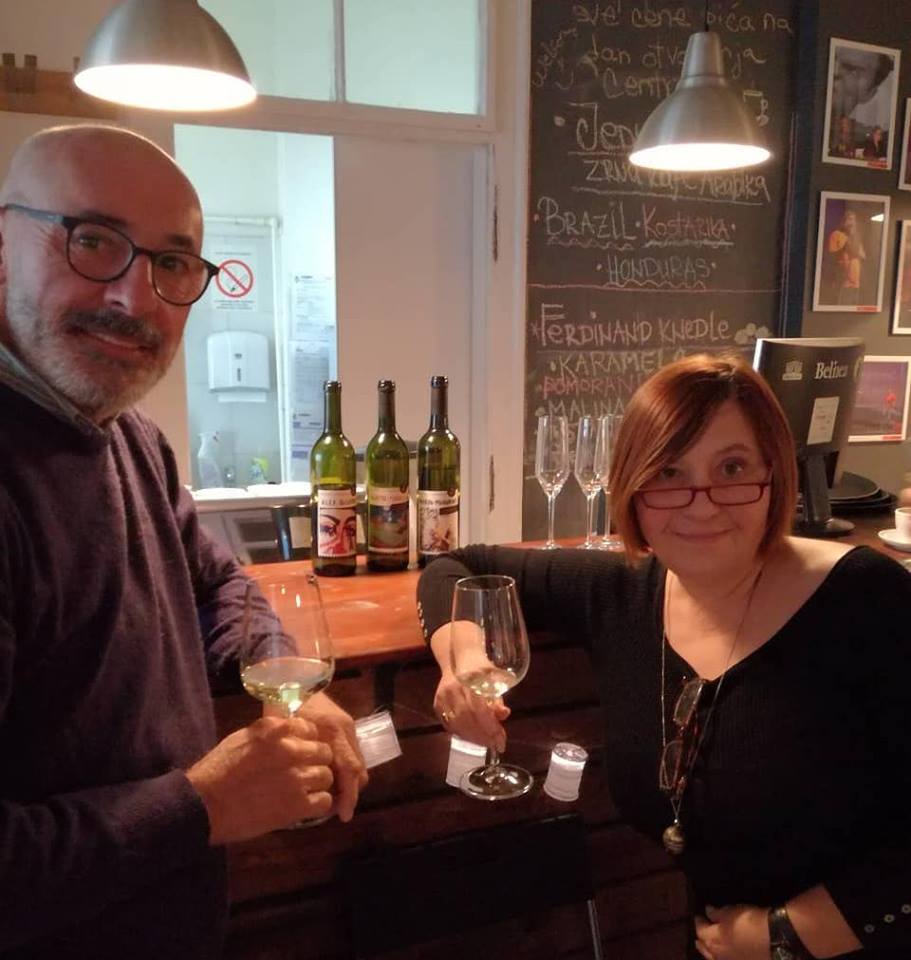
Mirjana persisted.
“Come on, at least smell it.”
She brought a bottle. Tatjana smelled the wine once, then again. She paused, tasted it after all, and said:
“I want to work with you. You’re serious!”
Mirjana and Branko thus gained confirmation that their zero vintage had been more than beginner’s luck, while Tatjana acquired two collaborators who would soon draw her into experiments of uncertain outcome.
The first wine they released with Tatjana’s professional guidance came from the 2016 harvest. It was delicate and fresh, with barely eleven per cent alcohol, comprising approximately ninety per cent Grašac and ten per cent Riesling-the proportions in which the varieties grew in their vineyard.
All it needed was a name.
From the outset, Mirjana and Branko knew their labels would carry more than a variety, plot number or word harmless enough to appeal to every buyer. Each wine would bear the name of a literary character, and Branko’s first suggestion was Prince Lev Nikolayevich Myshkin, the protagonist of Fyodor Dostoevsky’s The Idiot.
Branko described him in words that suited the wine too: innocent, pure, free of malice or hidden calculation. Mirjana immediately agreed. They called it Knjaz Miškin-Prince Myshkin-wrote the name in Cyrillic and intended to put the character and a quotation from Dostoevsky’s novel on the label.
Then came a letter: no Russian script, no literary character, nothing that might lead buyers to a mistaken interpretation.
Mirjana’s reply was brief:
“Prince Myshkin doesn’t exist.”
That did not help either. A more experienced winemaker advised them to “interpret” the label in a way that satisfied the regulations. Biljana Pešić, the artist designing their wines’ visual identity from the United States, created a slightly smudged label unlike anything on the Serbian wine scene at the time.
On the first bottle, which they kept in their living room, they wrote the date in pencil: 16 June 2017.
The day, as Mirjana put it, when an inveterate teetotaller ended up on a wine label.
The literary hero was no marketing embellishment added afterwards. Mirjana had spent years living among characters with the inconvenient habit of escaping her novels and appearing in reality. After submitting her doctoral thesis in 2000, she published seventeen novels in seventeen years, some of whose plots later overlapped strangely with real events. One crime novel so closely resembled the circumstances surrounding Radovan Karadžić’s arrest that even newspapers in Bangladesh developed a theory that he had found the idea for his disguise in her book.
People therefore began calling her a witch, half in jest.
Mirjana was not particularly troubled:
“You can’t invent anything these days without reality coming up with something worse.”
After all that, it would have been strange for her first wine to have an ordinary label.

Knjaz Miškin was gentle and naive, ill-suited to a world that generally rewards force more readily than innocence. That was precisely why Mirjana and Branko linked it with Dostoevsky’s hero. After a few harvests, however, they admitted that the name also described them.
“Myshkin, or The Idiot, also refers to our beginnings, when we were naive and idiots for starting to make wine at all,” Branko said. “And now, after the fifth harvest, we’re almost certain that’s what we are!”
Some welcomed the first wine as a refreshing change; others found it too light and understated. Mirjana and Branko did not try to change their minds. They had made a wine they wanted to drink themselves and left it to find its audience.
Time was on its side. When they reopened the 2016 vintage three years later, sommelier Marko Marjanović declared it ten times better than at his first tasting, with several more years of life ahead.
Suddenly, Myshkin was anything but an idiot.
The following year produced a wine with the same varietal composition but a completely different character. Drought gave the grapes more alcohol, body and complexity, teaching Mirjana and Branko a serious lesson about vintages: the same vineyard, varieties and method do not guarantee the same wine.
They named it Majstor i Margarita-The Master and Margarita.
Branko suggested the name, but Mikhail Bulgakov’s novel was a shared love. After Dostoevsky’s innocent, their wine shelf acquired a novel in which the devil appears in Moscow, manuscripts do not burn and reality is less dependable than fiction.
For Patkov Vinograd, it was almost documentary literature.
The 2017 harvest showed how seriously Mirjana and Branko took wine, but also how little they feared methods that might make other winemakers nervous. They crushed their surplus grapes, put them into a thousand-litre plastic container and-forgot about them.
Fermented with wild yeasts, the wine turned out much better than its origins promised. They named it Alex DeLarge, after the violent, unpredictable antihero of Anthony Burgess’s A Clockwork Orange, and sold it out very quickly.
“It’s fun to play around with wine and experiment,” Branko explained. “And since we’re young winemakers of advanced years, we have to hurry and try everything.”
After their own harvest was over, Branko appeared with a tonne of Pinot Noir from Irig. The grapes looked picture-perfect, but Mirjana regarded them with considerably less enthusiasm.
“Are you out of your mind? What are we going to do with that?”
Branko shrugged.
“You’re the winemaker, Mirjana. How should I know?”
Translated from Branko into plain language, that meant: ask Tanja. Mirjana called Tatjana Đuričić and presented her with the fait accompli.
“Of all things, where did you find Pinot Noir for your first red wine?”
Meanwhile, Mirjana had read somewhere that the Spanish made rosé and lighter reds using a technique called doble pasta. She did not entirely understand what it involved, but asked Tatjana whether they could try it.
“Now you’ve started inventing things too,” the winemaker replied. “But yes, we can.”
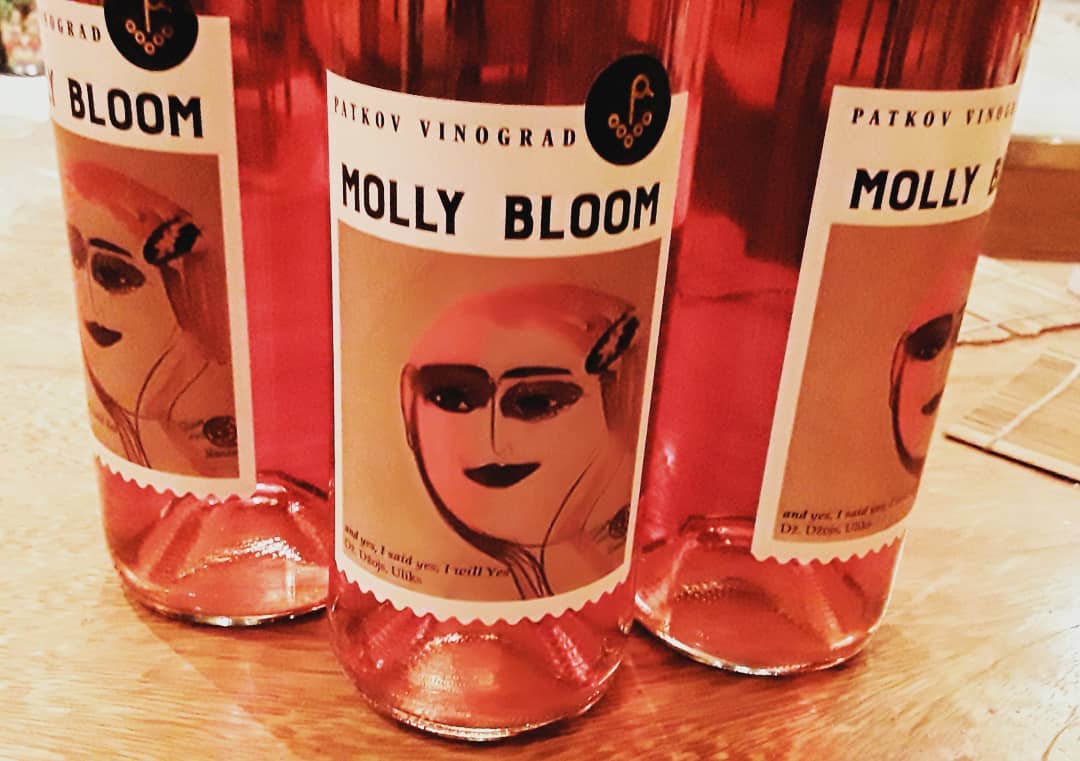
Two wines emerged from the same tonne of Pinot Noir. In a hundred-litre vessel, they made the pink Molly Bloom, named after the character in Joyce’s Ulysses. On the label, they placed her final affirmation of life from the novel:
“Yes, I said yes, I will Yes.”
Mirjana immediately claimed Molly as her wine, describing her as a red-haired hussy. Branko did not object. He had enough to do with the remaining Pinot Noir, which became a wine with fourteen per cent alcohol that stubbornly resisted a final name.
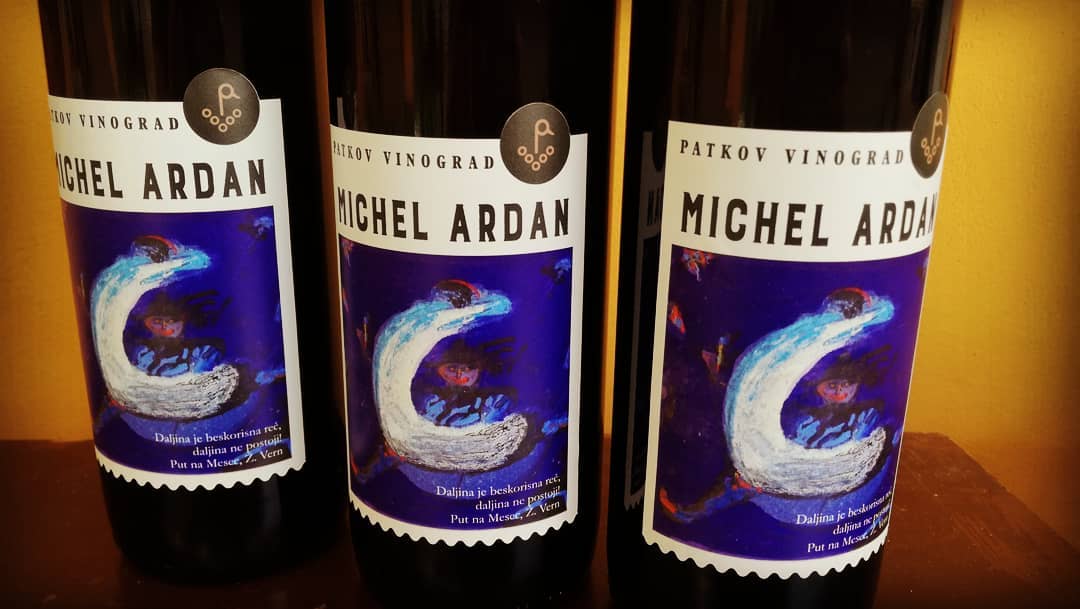
First, they called it Aureliano Buendía, then Michel Ardan, briefly Mephisto, then Crnjanski. Eventually, they abandoned a single literary hero and summoned the entire apocalyptic cavalry.
The wine became Četiri jahača Apokalipse-The Four Horsemen of the Apocalypse-with a label based on a painting by Petar Sibinović. Buyers looked at it and regularly asked the same question:
“But where are the four horsemen?”
Mirjana assured them they were perfectly visible.
Thus, one unplanned tonne of Pinot Noir, brought by Branko after harvest had already ended, produced two wines, at least six names, one red-haired Joycean heroine and four horsemen almost nobody could find on the label.
After their very first wine, Tatjana Đuričić had concluded that they were serious. By the end of the 2017 harvest, she had probably also realised that being serious would never be enough for them.
After a wine that changed identities more often than the average fictional swindler, the 2018 harvest brought a simpler connection between what was in the bottle and the name on the label.
Geppetto was their first Grašac to encounter wood: ninety per cent Grašac, ten per cent Riesling and three months in barrel. The name of the woodcarver who made Pinocchio suggested itself, and across the label Mirjana wrote:
“And all the boys turned into donkeys!”
The oak did not obscure the variety, and Geppetto 2018 won gold at a major Grašac competition in 2021.
During the 2019 harvest, Mirjana and Branko ran out of vessels and did not make their usual Grašac at all. Instead, they produced Patkov Vinograd’s first single-variety Riesling.
They called it Švabica-The German Girl.
The name required little interpretation: pure Riesling fermented with German yeasts. On its label, Mirjana added a quotation from Laza Lazarević’s short story Švabica:
“Proud as D minor, she rubs her knees with kerosene.”
She supplied the translation into wine language herself:
“Švabica is ready for ageing.”
Tatjana Đuričić was even more direct. She maintained that it was the first Serbian Riesling in ten or fifteen years to smell exactly as the variety should.
Švabica became Mirjana’s favourite wine. Branko’s relationship with Riesling was more complicated. The variety proved sensitive and capricious in the vineyard, and occasionally he lost patience among the rows.
“If you don’t give me proper grapes this year, I’ll pull the lot of you out!” he threatened the vines.
Whether the variety understood the warning is unknown, but it remained in the vineyard.
That same year, they also made around a hundred bottles of pure Grašac, with five weeks of maceration and wild-yeast fermentation. The wine then continued resting on its lees, unlabelled and with almost no intervention. There were many such small experiments, mostly in quantities they could drink themselves with their collaborators.
Plans had limited authority at Patkov Vinograd anyway. Alex DeLarge came from surplus grapes, Molly Bloom and The Four Horsemen of the Apocalypse from an unplanned tonne of Pinot Noir, and Švabica from a shortage of vessels for Grašac. Like Mirjana’s novels, the wines often began with a plot twist nobody had requested.
By 2020, an entire literary wine family had gathered in the old Krčedin house. Seeing the bottles lined up on a table, Branko exclaimed, almost alarmed:
“How much do we actually have?”
Then he poured everyone Ninja’s Kiss, the brandy that had started it all, to remind them how they had travelled from a lady’s still to wines that could no longer be counted without a literary catalogue.
The literary names were not equally clear to everyone. Those who recognised Myshkin, Bulgakov, Joyce or Burgess would smile; those who did not might reach for a book after the wine. Mirjana and Branko wanted the label to prompt a question, but the answer should never be more interesting than the wine.
As early as 2017, Patkov Vinograd was named Serbia’s best winery you had probably never heard of. The title described their position precisely: memorable wines and labels, but little desire to turn themselves into a major market presence. Knjaz Miškin found its audience mainly through people who tasted it, remembered it and recommended it to others.
Awards nevertheless arrived. After Geppetto 2018 won gold in 2021, Knjaz Miškin 2016 and Majstor i Margarita 2017 took bronze medals at the international Grow du Monde competition in 2022. Several years after harvest, their first two wines thus demonstrated precisely what Mirjana, Branko and Tatjana had sensed in them: Grašac need not be drunk before it has had time to remember its own name.
Patkov Vinograd never grew into a large winery, nor did it try. It remained a small operation in a former stable beside an old Vojvodina house, with a vineyard where every new harvest could change the plan. Mirjana and Branko did not strive to repeat the same catalogue each year: when vessels were short, they simply did not make a particular wine; when surplus grapes became something interesting, they gave it a name.
The characters on their labels were summoned only when a wine revealed its personality. At first, books determined the wines; then the wines began determining the books too.
Six years after Bunker Swing, they jointly published another novel, but its title could no longer escape what had happened to them in the meantime.
They called it Bunker Patka.
The duck had thus returned from the soil and cellar to the covers of a book. Wine had not replaced writing, nor had literature become merely a means of selling bottles: each kept passing the other new characters, plots and titles.
Mirjana maintained that Bane had tricked her into becoming a winemaker, and she had repaid him by persuading him to become a writer. That mutual deception produced two joint novels, a vineyard, a winery and an entire shelf of wines named after characters who had never existed.
Except Donald Duck. Neither Mirjana nor Branko invented him. A metre beneath the surface, the earth had written him into their story.