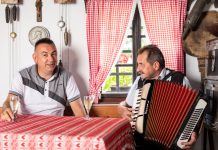
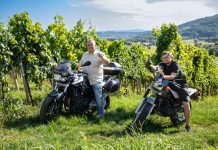
At first glance, Tihomir Kota seems like a man who values simplicity and peace. Yet behind that calm demeanour lies a tireless curiosity and a deep commitment to the vineyard. His sparkling wines are more than a drink: they tell a story of breathing soil, grapes ripening in the sun and a man who has chosen to turn nature into bubbles of life, seeking perfect balance in a bottle. His bubbles are more than a fleeting sparkle on the tongue; they leave a lasting memory of nature meeting passion.
Some would say that Tihomir’s personal touch is also evident in the brand’s identity: “Vina Kota – heights where the senses come together.” His sparkling wines bear numbers that identify the precise vineyard sites from which the grapes originate. This is no gimmick, but a map of terroir translated into bubbles – something journalists can work with and wine lovers can readily understand.
– Since I wasn’t making my living from wine, I had enough time to devote to all the details, which I believe have ultimately turned out very well. My wife Irena came up with the idea of calling the winery Kota. She suggested linking our surname to the individual vineyard sites, with the numbers used as the wines’ names representing the elevations of those sites, says Tihomir Kota, the man behind Zagorje’s latest wine sensation, Vina Kota.
If the story of Tihomir “giving in” to his wife really holds water, then Irena Kota deserves recognition as a first-rate marketing mind, skilfully turning the family surname into a wonderful interplay of words and numbers. In Croatian, kota also means a spot elevation on a map. Those in Gornja Batina, near Zlatar, may have no mythical significance, but in the context of Vina Kota and its sparkling wines, they evoke old, dusty maps on which numbers marked specific points. They make it clear that at elevations of 213, 255, 260, 267, 325 and 375 metres, people are harnessing nature to satisfy their need for wine. And they point towards those “heights where the senses come together”.
Tihomir Kota, a qualified mechanical engineer whose main business is facility management – managing and maintaining premises for major corporations – is reluctant to claim any ancestral wine heritage that naturally led him to establish his own winery.
– Or perhaps there is something there after all. It’s hard to explain. I’m originally from Markuševec, where my parents had a few hundred vines to make wine for their own consumption. Whether that influenced my decision to start a winery… The simplest explanation would be that my wine story grew out of my love of food and wine. And there you have it: one day, out of curiosity and as a hobby, I embarked on my own wine adventure.

Initially, Tihomir explains, his principal business, which had proved highly lucrative, financed this “release valve”. And a wine venture really does require substantial investment, contributing to the “release” of considerable sums from its owner’s pocket.
– I felt the need for a release valve about fifteen years ago, when I was forty. I told myself I needed to find something to do beyond my main line of work. One day, I literally took a van, drove to Kaptol in Slavonia, bought a few hundred kilos of Graševina and made my first wine in the garage of our family home in Markuševec. And it didn’t turn out badly at all!
Tihomir repeated the exercise the following year, and again the year after that. Given his enormous love of sparkling wines, it was only a matter of time before he moved from still wines to bubbles.
– For my sparkling wine grapes, I went to Zagorje, to the very area where my winery stands today. I bought a few hundred kilos of Chardonnay, made a base wine first, then turned it into sparkling wine.
– Both experiments were driven by curiosity, by wanting to see where this venture might lead. Growing grapes and making wine is a fairly slow process. It isn’t a case of “buy today, sell tomorrow”. It took a few years to get to grips with everything, although you could also say that things moved quite quickly.
– On the other hand, you could say I made that first wine relatively quickly, too. That was in 2010, and in 2013 I bought my first hectare of land on the site where the winery now stands. In May that year, I planted my first vineyard.
Why the commitment to sparkling wines?
– First of all, I love them. And Hrvatsko Zagorje is the most natural choice and the best region in Croatia for sparkling wine. Some things are simply the way they are; there’s no need to reinvent them.
– As I said, it all began in the garage of our family home in Markuševec. The Faculty of Agriculture is nearby, so I took my wines there for analysis. And, of course, I read up on the subject.
Before buying the grapes for his first sparkling wine, Tihomir had no idea where Gornja Batina was. In fact, he did not even know that this village near Zlatar existed.

– That’s true! When I was working for another company, I had a colleague from that area. As I became increasingly interested in all this, I started looking for a reasonably sized piece of land to get things going – although in my case we really are talking about small plots and small quantities. Since he was from there, we explored the area together until we came across the vineyard site where I later planted my first vines. There was nothing there at the time, just meadow.
To be fair, even Zlatar was unfamiliar territory to Tihomir back then.
– I was somehow more drawn to Marija Bistrica, where I would visit the shrine at least once a year. It seems a twist of fate brought me to Zlatar.
– I was also drawn to wine because I wanted to understand how to create something that tastes good in the glass.
– And it certainly helps that the winery is only forty-five minutes from Zagreb. When I leave Zagreb and arrive at my own elevation of 267 metres, where the winery stands, I stop focusing on everyday business life. My mind moves away from work and its challenges. Besides, once I enter the cellar, there’s no mobile signal! Into the wild! When I’m at the winery, my focus is entirely on wine. I try to achieve the very best I can.
After initially buying and planting two vineyards with Chardonnay and Sauvignon Blanc, Tihomir rolled up his sleeves and began expanding. In a very short time, he brought together all the available plots around the winery, accumulating 6.5 hectares of land. Nor is he stopping there: more vineyards are planned.
– I can already say with pride that the winery is gradually becoming a self-sustaining business, Tihomir says.

I began selling wine in 2019, before the coronavirus pandemic. Despite the doubts surrounding me, even among very close friends – because I’m not from the countryside and have no winemaking tradition or experience – I managed to get my wines into a great many Croatian restaurants. That was more than enough to make me realise I was beginning to live my wine dream.
Yet although he takes part in every stage of production, from pruning and harvesting to working very actively in the cellar, Tihomir is reluctant to call himself a winemaker.
– To me, winemakers are people whose families have been doing this for generations. I suppose I could call myself an entrepreneur and winemaker.
His winery on the hilltop, at 267 metres above sea level, is something of a tribute to his stubborn determination to be different and more innovative.
– I didn’t do that by chance. My thinking was that I’m not from this area and haven’t inherited a winemaking tradition, so I didn’t automatically want to build a rustic winery in the local style. I have nothing against that – quite the opposite. I took a step towards modernism, although I think it all fits beautifully into this particular site and, more broadly, into Hrvatsko Zagorje.
For his packaging, he commissioned the celebrated designer Vanja Cuculić, who has repeatedly demonstrated his talent through theatre posters and wine labels.
Following Irena’s idea of using elevations as wine names, Vanja made Kota the constant element on every label, referring both to the family surname and to the winery. Each wine received its own “number”: the elevation of the vineyard supplying its grapes. The label also carries the vineyard plot’s ARKOD identification number from Croatia’s agricultural land register.
How did you come across Vanja Cuculić?
– I hadn’t even heard of him before. I found him through an internet search. It was as simple as that…
While Vanja Cuculić may have been the result of a Google search, all Tihomir’s subsequent efforts to position Vina Kota as a kind of “Zagorje temple of wine and culture” have been carefully planned and arranged.
Tihomir, where did the idea of bringing art to the hilltop come from?
– I think people get bored if all they do is drink wine. There has to be something more: a story, an event, something happening… I decided that was precisely how I needed to broaden what we offer. Art and wine are closely connected, so I see no reason not to bring them together at the winery.
And so, at the winery, Dimitrije Popović spoke about the connections between the role of women, the Holy Grail, eroticism and religion.
– Over these past few years, I’ve seen only positive things come out of my wine venture. First of all, it helps me unwind. Then there are all the people you meet – positive people. Of everyone who has come to the winery, I can’t recall anyone arriving in a bad mood or bringing bad energy.
– In wineries like mine, beyond the figures, which at some point have to turn positive, there is emotion. In some other businesses, however much people love their work, that emotion simply isn’t there.
Under the title “Opera in the Vineyard”, he also hosted young musicians who gave guests a wonderful evening featuring operetta arias from Countess Maritza, The Merry Widow and Die Fledermaus, along with several opera arias, popular standards and traditional urban songs. The high point was a performance of “Neka cijeli ovaj svijet” from the musical Jalta, Jalta.
Vina Kota is thus more than a place of production. It is a meeting point for vineyard and sky, work and inspiration, wine and culture. Here, one learns that sparkling wines are more than a drink for celebrations: they are a bridge between everyday life and art. On the hilltop, “where the senses come together”, culture and nature speak a shared language. And once we hear that language in a glass, it stays with us far longer than the sip itself.
You could say that, thanks to Vina Kota, opera arias now echo through Hrvatsko Zagorje in place of its traditional folk songs!

– Mingling over music and sparkling wine, Tihomir comments with a smile.
And he celebrates. He enjoys the acclaim, too. In a short time, Tihomir has succeeded in making his sparkling wines one of Zagorje’s most recognisable signatures. Twice he has entered them in the international judging at the Salon of Sparkling Wines in Ljubljana, and both times he could proudly say that his wines finished at the very top – competing against 76 sparkling wines from Slovenia and Croatia.