Serbia was living for basketball in those days, and Dragan Stevanović was a little late for our meeting because he had been held up at the barber’s. His wife Kristina, an assistant professor of world and comparative literature at the Faculty of Philosophy in Novi Sad, joked that perhaps he was already getting ready for a trip to the final stages of EuroBasket. The national team kept winning, Nikola Jokić carried the country’s expectations, and Dragan found a connection to basketball in everything.
Yet that day, his eyes were on the hill rather than the court.
On Vestegov Breg above Krčedin, approximately 250 metres above sea level, stood the winery that Dragan Stevanović, Miloš Uzelac and Boris Kovač had officially opened on 17 May 2025. Behind it stretched 28 hectares of young vineyards, including Sila, the grape intended for the leading role, while a little farther away on Fruška Gora, olive trees were settling into their new surroundings. The road to the estate was called Put za Slankamen Planinu-the road to Slankamen Mountain-and Dragan made no secret of where he wanted it to lead.
“Our Breg will become a wine mountain! If I don’t believe that, I’d be better off doing nothing.”
He made no attempt to temper his ambitions with the sort of modesty that sounds good in newspaper interviews.
“Our goal is to become one of Serbia’s top ten wine estates very soon.”
“By force, if necessary?”
“Nothing can be forced.”
“But you’re positioning yourselves as the House of Sila?”
“Then let’s say we’ll achieve our goal with Sila. And with style.”
In Serbian, sila means “force” or “strength”. In that sentence, it was both wordplay and a business plan. The domestic white grape, developed at the Institute of Viticulture in Sremski Karlovci, was meant to give Breg its identity and Dragan a market position others had yet to occupy. He had spent forty years in private business and did not pretend that customers interested him any less than vineyards and wine.
“I’m a merchant. I asked myself what we could sell that wasn’t already on the market. That’s how we arrived at Sila. We decided to take it to the skies, together with other producers.”
But wine had not entered his life through a spreadsheet.
“My grandfather’s legacy!”
That was his answer when asked whether anything in his family background pointed towards wine. Born in Sombor, he had roots in Sivac, where his maternal ancestors worked with horses and owned vineyards. His father came from Toljevac near Varvarin, between Drenova and Trstenik, a region where vineyards had belonged to family life long before becoming a business opportunity. When Sivac came up, I tried to surprise him by asking whether he knew which famous people had come from there. Unsuccessfully: Dragan naturally knew everything about Nikola Jokić. Wine writer Pero Samardžija added that more than three hundred wine cellars still existed in Sivac’s old “German” houses.
Dragan was the youngest, so everyone knew who would be sent whenever his grandfather needed wine.
“It was always: ‘Go on, Dragan, fetch some for Grandpa!’ Dragan would go and take a swig. And he’s still taking swigs today!”
He first tried to begin his own wine venture in 2000. He quickly discovered that a romantic return to the land ended where abandoned plots, unresolved ownership and dozens of people each owning a fragment of the future vineyard began. He gave up, but clearly did not forget.
Twenty years later, he was looking for something entirely different: land for a weekend house.
They were celebrating his wife’s birthday on Fruška Gora, and Dragan asked a friend to find out whether a suitable plot was available nearby. It was May 2020, during the pandemic, so wanting somewhere outside the city sounded entirely understandable. The reply came quickly.
“I’ve got something. It isn’t small, and it isn’t exactly for a weekend house. When can you come?”
They arrived the following morning. The land was neglected and overgrown with black locust trees, but Dragan saw beyond what stood before him. He immediately told his son Nemanja and his partner Miloš what he would build there.
Nobody asked about a weekend house again.
What Dragan envisaged first had to be assembled from land records, inheritances and neglected scraps of ground. The future estate consisted of more than two hundred plots belonging to approximately 170 people. Most measured only three or four tenths of a hectare.
Twenty years earlier, precisely that kind of undertaking had driven him to abandon winemaking. This time, he was evidently in no mood to heed his own experience.
He consolidated the plots, cleared the black locust trees and planted the first vineyards in 2022. They included five Chardonnay clones and two Grašac clones, among them SK-54, but he knew a winery seeking recognition could not live solely on varieties everyone already had. Alongside Grašac and Tamjanika, he planted Sila, with Probus, Pinot Noir and Syrah among the reds.
By summer 2024, 22 hectares were under vine; by the winery’s opening the following May, the area had grown to 28 hectares. A Harley-Davidson stood beside the veranda, seemingly ready for the road, but Dragan no longer had time for it. The man who once covered miles on a motorcycle now accumulated them daily between the vines.
“If you don’t commit yourself completely, nothing will come of winemaking. That’s why the Harley stays parked. I now have eighty kilometres of vineyard rows. I’ve got somewhere to go.”
The Stevanović family’s ambitions did not end between those rows. His son Nemanja had graduated in history and joined the Institute for the Protection of Cultural Monuments in Novi Sad, but neither the job nor the salary made him particularly happy. When his father asked what he really wanted to do, he said he wanted to work on something with him.
The olives were Nemanja’s idea.
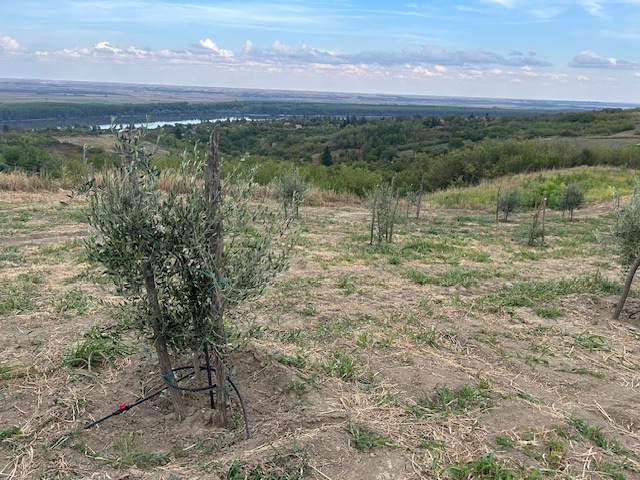
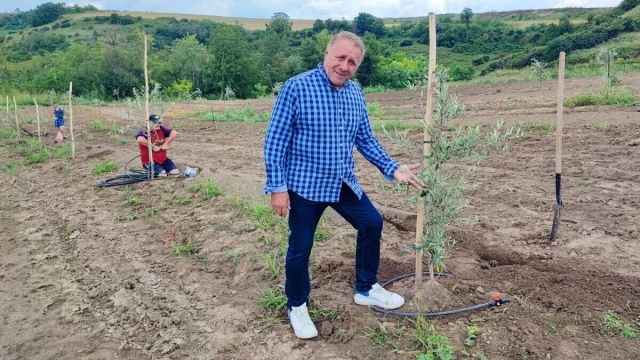
At Lake Balaton, he heard about a man who had planted olives around ten years earlier and was already producing oil. If they could thrive there, he thought, why not on a sheltered southern slope of Fruška Gora? They also considered figs, then began investigating varieties capable of withstanding lower temperatures.
“In the last five years, we haven’t had two consecutive days below minus fifteen. The lowest temperature we recorded was minus nine. The climate has changed dramatically.”
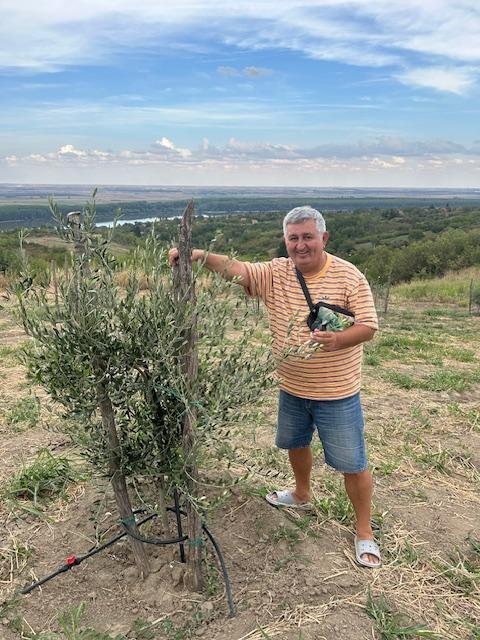
They planted the first hundred trees on 0.65 hectares. They chose the subalpine varieties Casaliva and Leccino, with Pendolino as a polliniser. The young olives bore their first fruit in the very first year, and the planting soon expanded to 150 trees. Dragan’s friend Smiljan Đaleta, from near Drniš, who grew olives in Dalmatia, was astonished by their development.
“He says the trees are stronger than his in Dalmatia.”
Eventually, the olive grove should cover approximately four hectares, with full production expected in the fifth year. The oil will not be seeking supermarket shelves. Dragan intends to offer it at the estate alongside the wines once the accommodation and visitor facilities are complete.
“The buildings should be ready just as the olive oil arrives.”
On an estate assembled from more than two hundred plots, where olives grew in a place almost nobody would recently have expected them, nothing suggested a man cautiously testing ideas. Dragan invested as though he already knew the outcome.
“Everyone says it takes three generations to get things properly established. I don’t think that’s true.”
One person without whom Dragan had no intention of building Breg was Miloš Uzelac. Miloš pursued his corporate career from Belgrade, Dragan lived in Novi Sad, and the winery stood approximately halfway between them. Its winemaking direction, however, depended on someone living much farther away.
When Boris Kovač first came to Breg, he quickly identified what was missing.
“He said only one thing was lacking: a bed. There was no leaving this place!” Miloš recalled.
Initially, they considered employing a cellar master who would follow Boris’s instructions while he continued living and working in France. The idea did not last long.
“We quickly realised he couldn’t do without us, and we couldn’t do without him.”
For Sila, that was particularly important. Boris Kovač was more than a winemaker returning to Fruška Gora after decades in France. His father Vladimir had helped create the grape on which Dragan had chosen to build the winery’s identity.
“When it comes to Sila, blood is thicker than water for Boris.”
Boris Kovač had lived and worked in France since 1991. After studying agriculture in Novi Sad, where he graduated under Professor Pero Cindrić, he went to Montpellier. His Novi Sad degree was not recognised there, so he studied again, this time oenology at the Faculty of Pharmacy.
He worked at the French research institute INRAE, studying polyphenols, a field his father had also worked in. Meeting Australian winemakers took him to Australia, where he completed two harvests in one year. In 2003, he and a friend took over vineyards in the foothills of the Pyrenees, near the village of Latour-de-France.
That became Domaine de l’Agly, whose youngest parcels were planted in 2004 and oldest in 1900.
“Those old plots barely yield three hundred litres per hectare, but we preserve them as living heritage. It’s Carignan on dry-stone terraces. When Americans or Chinese visitors arrive, that’s the first place I take them.”
As a young man, Boris had wanted to study painting, but his father guided him towards a profession he believed would provide a more reliable living.
“He told me: ‘Get a practical qualification, then paint when you have time!’ So I chose viticulture.”
As a child, he had never quite understood why people spoke to his father about wine.
“When I was a kid, I found it fascinating that someone would come along and start talking to him about wine. How dare they? My dad invented the vine and wine! At least, that’s what I thought.”
The childhood assessment was not entirely objective, but it had a basis. Vladimir Kovač was a corresponding member of the French Academy of Sciences and a major figure in viticulture. He helped create Neoplanta, Panonija and Probus, and, with Pero Cindrić, completed the work on Sila begun by their colleague Sima Lazić. The crossing of Chardonnay and Kövidinka took its name from the opening syllables of Lazić’s first name and surname.
For Boris, Sila therefore meant far more than another entry in Breg’s collection of varieties. His family had once grown it in their own vineyard, and now it was returning through a friend’s project that placed it centre stage.
“And not only because my father worked on it. Sila makes a delicate, fine, easy-drinking wine. It’s kind to us in the vineyard: it crops well, it’s resilient and has lovely bunches.”
When Dragan invited him to Breg, Boris already had vineyards, a winery and a life in France. But the invitation came from a friend rather than an unknown investor. Dragan and Miloš offered him co-ownership as well as a winemaking role.
“My heart is full! For my father, and for Fruška Gora. What Dragan is doing is one of the most beautiful ways of promoting this grape.”
They did not agree on everything. Dragan thought like a merchant searching for an opening in the market, while Boris brought experience from a country whose vineyards were older than many Serbian wineries. He considered five hectares of Probus excessive, given declining demand for reds even in France, Italy and Spain. He therefore insisted on Pinot Noir and Syrah, varieties he personally loved, while Chardonnay seemed a logical choice for the site.
He was equally firm about oak.
“In France, I buy barrels that have been used for six to eight months. A barrel should only round out the wine. It must never dominate.”
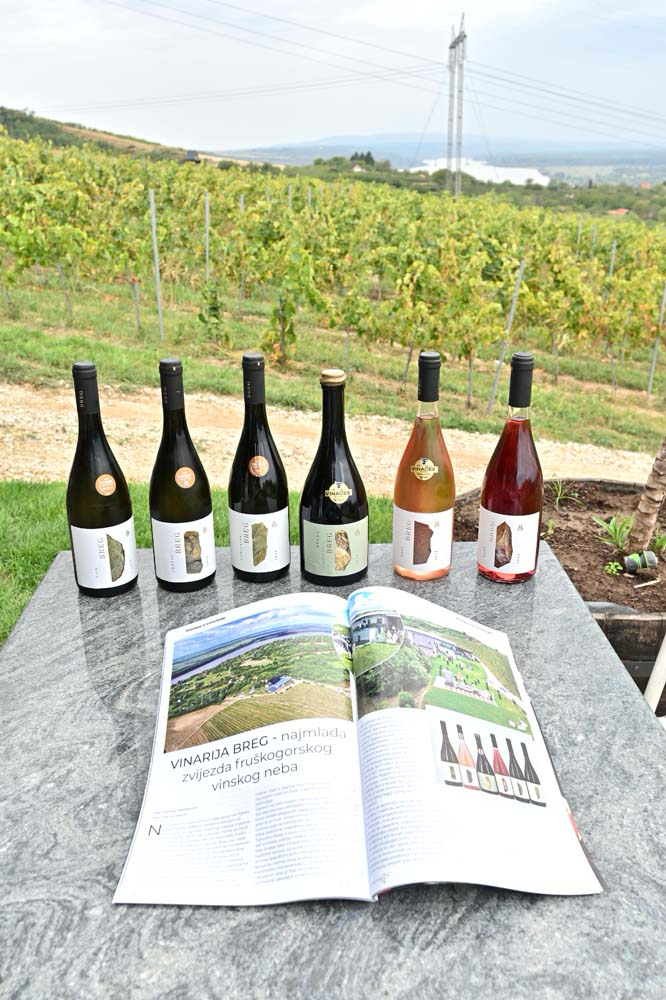
Breg’s first harvest came in 2024, only two years after planting. They entered the market with six labels. Chardonnay 2024, the only wine in the range to spend time in barrel, and Rosé 2024 won gold medals at France’s Vinalies Internationales competition.
Dragan accepted the awards as confirmation that the enormous investment had not begun in the wrong direction, but more important evidence came at the table: guests who tasted Sila began asking for it.
Pero simply smiled. His son Splićo had been the first restaurateur in Vojvodina to put Sila on his list, after which demand rose sharply. Nobody had spent a dinar promoting it: the entire campaign rested on drinking it.
Dragan translated that into a merchant’s language:
“Once guests try Sila, they don’t want Grašac any more.”
He did not mean Grašac should disappear from vineyards or that he had found a grape capable of changing Serbia’s wine map overnight. He had found what a merchant always seeks: a product people do not know before tasting, but want to order again afterwards.
Sila was becoming more than a grape. It was becoming a reason to remember Breg.
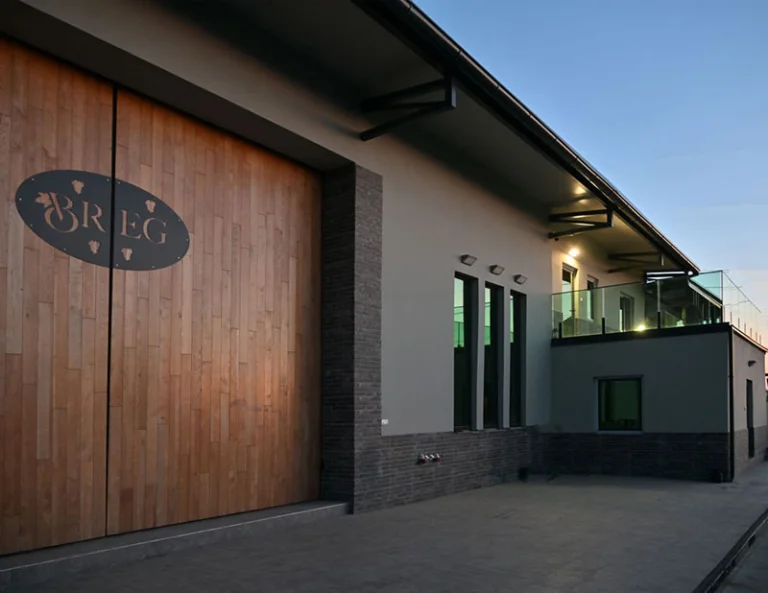
When Breg officially opened on 17 May 2025, it did not look like a winery just entering the market. At the top of the estate, visitors found parking, landscaped paths, vineyards, an olive grove, horses and carriages for scenic rides. The tasting room and wine shop occupied a restored brickworks, while a modern building with large wooden doors showed that production was not concealed behind the tourist scenery.
Wind from the Danube disrupted the organisers’ plans, but not the guests’ mood. Tables held Srem dry-cured ham, Iberian pata negra, poppy-seed and walnut rolls, while young wines chilled in vessels that doubled as decorations. Some desserts were adorned with gold, as though someone wanted to make clear that nobody on this hill intended to play in a lower league.
Among the guests, Dragan was host, merchant, owner and a man who, after five years of consolidating plots, clearing land, planting and building, could finally look at what had grown from that message: “I’ve got something. It isn’t small, and it isn’t exactly for a weekend house.”
It certainly was not for a weekend house.
Yet behind everything that looked glamorous at the opening lay a very down-to-earth calculation. Dragan did not believe quality and business belonged to separate worlds.
“Is Breg about Excel or quality for you?”
“Quality, above all. But Excel has to fit into the business too.”
He felt no need to play the winemaker for whom sales and money were embarrassing words. He knew what it cost to assemble more than two hundred plots, plant dozens of hectares and build a winery. He knew equally well that friends’ compliments and medals could not cover those expenses.
Sila was therefore the choice of a man combining family ties to vineyards with experience gained in trade. Domestic varieties interested him as a competitive advantage for local producers as well as heritage worth preserving.
“They allow us to compete with importers and take part of their market. I’m thinking of Malvasias from Istria and Tamjanikas from Macedonia.”
His reasoning was simple: a Serbian winery need not imitate what already arrives from abroad if it has its own grape through which to distinguish itself. Sila had a memorable name, a story worth telling and a wine that made guests want another glass.
But the House of Sila was not intended to become a house of only one wine. Five Chardonnay clones and two Grašac clones gave Boris plenty of possibilities, while Probus, Pinot Noir and Syrah awaited the time red wines required. Dragan wanted to enter Serbia’s top ten wine estates quickly, but did not expect every vine to repay its investment immediately.
“My ambitions are big. Initially, it all came down to wanting to establish a company that would earn an outstanding position on Serbia’s wine map. And we’re well on our way.”
He was not speaking only for himself. Miloš Uzelac had committed to the investment while pursuing a corporate career; Boris Kovač divided his life between France and Fruška Gora; his son Nemanja found the work he wanted in the project; and Dragan’s wife Kristina watched the idea of a little land outside the city become an estate spanning dozens of hectares.
According to Dragan, Breg had even persuaded Boris to get up earlier.
“He wouldn’t be here if I weren’t beside him from morning till night. I think he gets up earlier than usual because of me!”
Breg grew from different kinds of trust. Dragan believed it did not take three generations to build a great winery. Miloš believed in the man who, after his failed attempt in 2000, had begun consolidating land again. Boris believed the grape associated with his father could return to the spotlight. Nemanja believed olives could grow where almost nobody had planted them before.
What they shared was that most of those beliefs had not yet had enough years to become proven facts. The vineyards were young, the winery newly opened, the olive grove producing its first fruit, and accommodation remained on the drawing board. Even the two French gold medals belonged to the first harvest.
Breg had neither decades of old bottles nor three generations showing yellowed harvest photographs.
It had something else: a man behaving as though he had to recover twenty lost years in a single surge of investment.
Meanwhile, the basketball euphoria that opened our conversation faded faster than Serbia expected. The national team lost in the round of sixteen to Finland, led by Lauri Markkanen, making a trip to the final stages pointless. Dragan did not need to pack his bags. He probably would not have packed them even if Serbia had kept winning.
At Breg, 28 hectares of vineyards awaited him, eighty kilometres of rows, a winery newly on the market, olives bearing earlier than expected and a grape for which he envisaged a much greater future than it had enjoyed so far.
For decades, Sila had existed as a successful result of grape breeding, but without a winery building its identity around it. Dragan saw precisely what he had sought throughout his business life: a good product the market had not yet had time to exhaust, overlook or turn into a passing fashion.
That was why he wanted Breg to become the House of Sila.
Nothing in wine could be achieved through coercion. A vine could not be forced to grow up faster, a young wine to acquire age, or an olive tree to forget it was not in the Mediterranean. Dragan could bring 170 owners together, clear black locust trees, plant vineyards, find people who believed in the same idea and return each morning to where the previous day had ended.
Everything else had to come in its own time.
While the Harley rested beside the veranda, Dragan already had enough roads ahead: eighty kilometres between the vines, several hectares of future olive groves and the road to Slankamen Mountain, along which guests had yet to arrive.
It was worth returning to the sentence from the beginning of our conversation:
“Nothing can be forced.”
Except, perhaps, the decision to build a house around Sila.