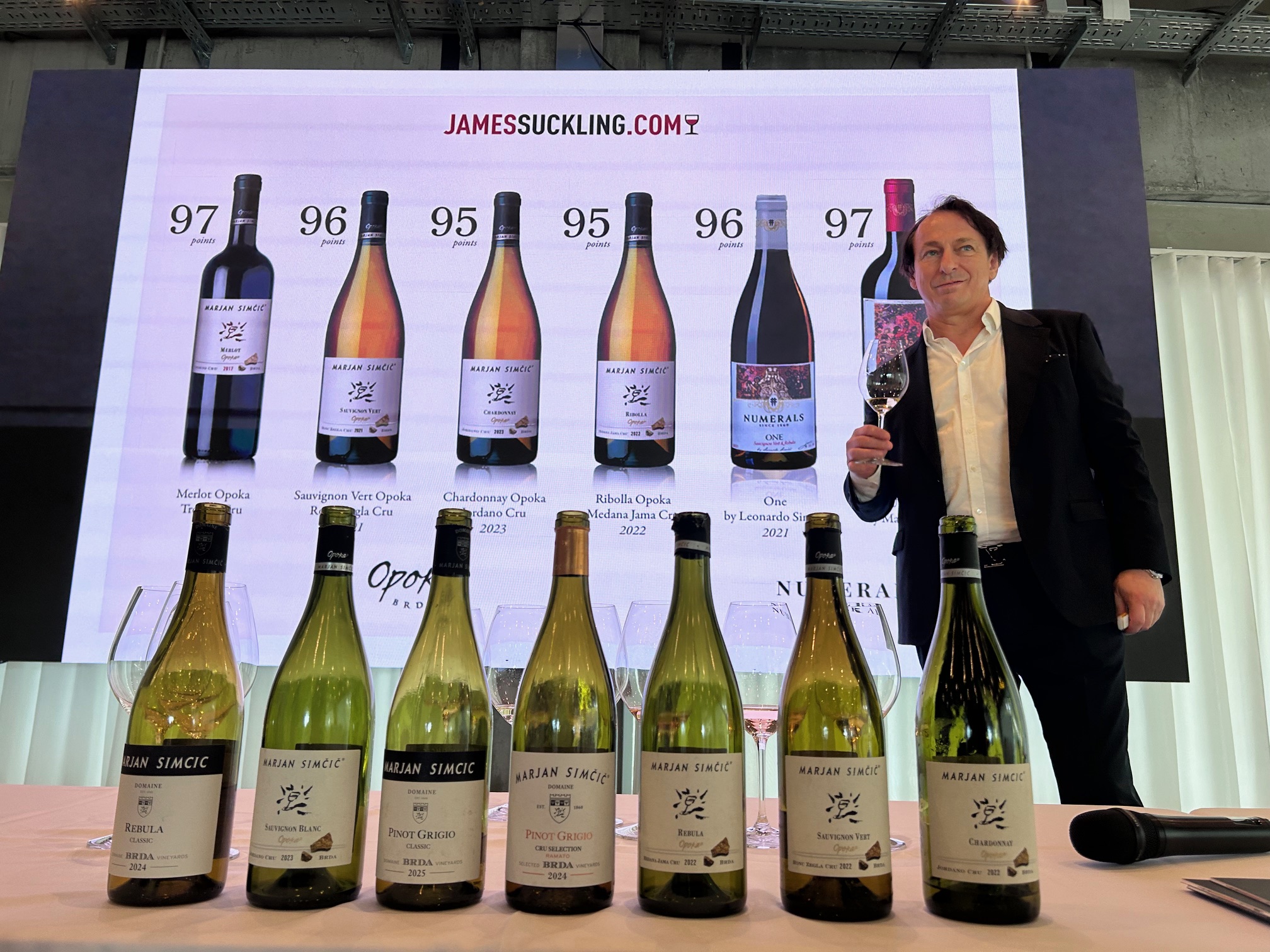
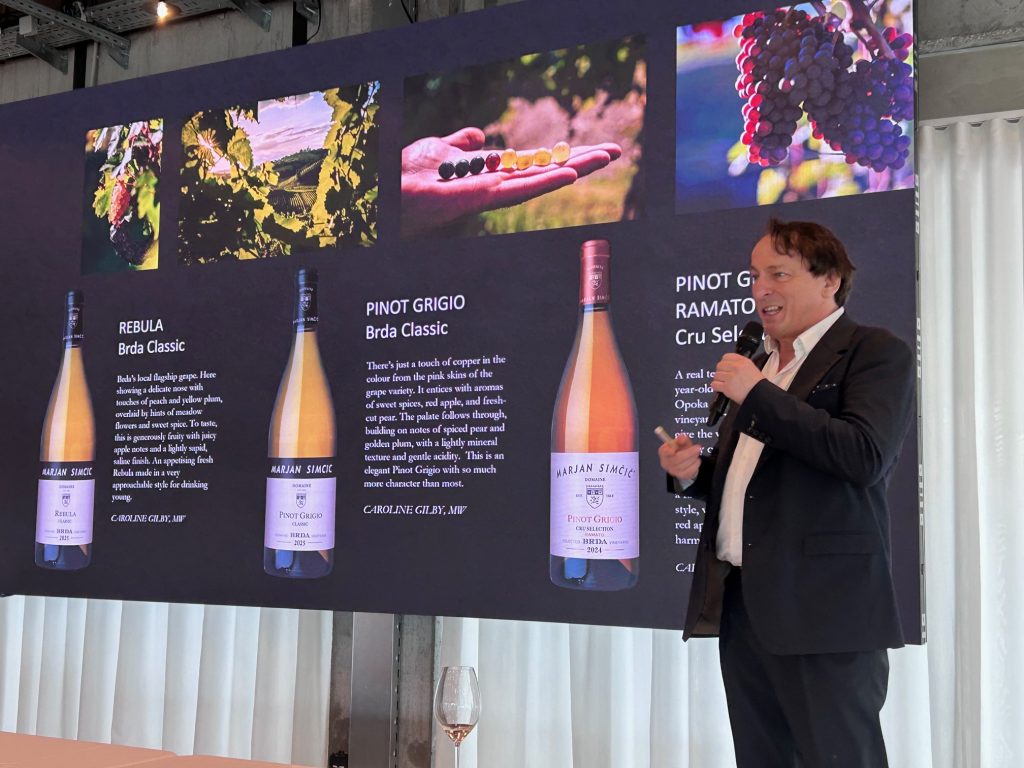
I had waited a long time for the chance to listen to Marjan Simčič in person.
When I heard he was coming to the Outstanding Wine Show at Belgrade’s Ložionica, there was no hesitation. I got into the car, drove there, took my seat in the hall and listened.
It was not a presentation memorable for lines you want to copy down, but for the way he spoke about the things he does every day, without trying to make them seem greater than they are.
He spoke about vineyards, mistakes and decisions you cannot see from the outside.
I took it all in.
Afterwards, I got into the car and returned to Osijek.
Then I began writing, and writing, and writing, late into the night.
– On my first visit to leading winemakers in France, I looked at a map of the world and marvelled at how widely their wines were distributed. That was when I wanted to make wines that would be my own, but at a level of quality that would earn them a reputation and recognition around the world. Today, I have achieved that.
Marjan Simčič said this fifteen years ago. Not yesterday, not after his latest accolade, not at the moment of some new breakthrough, but back then, when he already had enough reason to pause and look back. In that same statement, he also said:
– Most of my dreams have come true, and the others are within reach. I am convinced that, through persistence, honesty and love for this work, I will achieve even my highest goals.
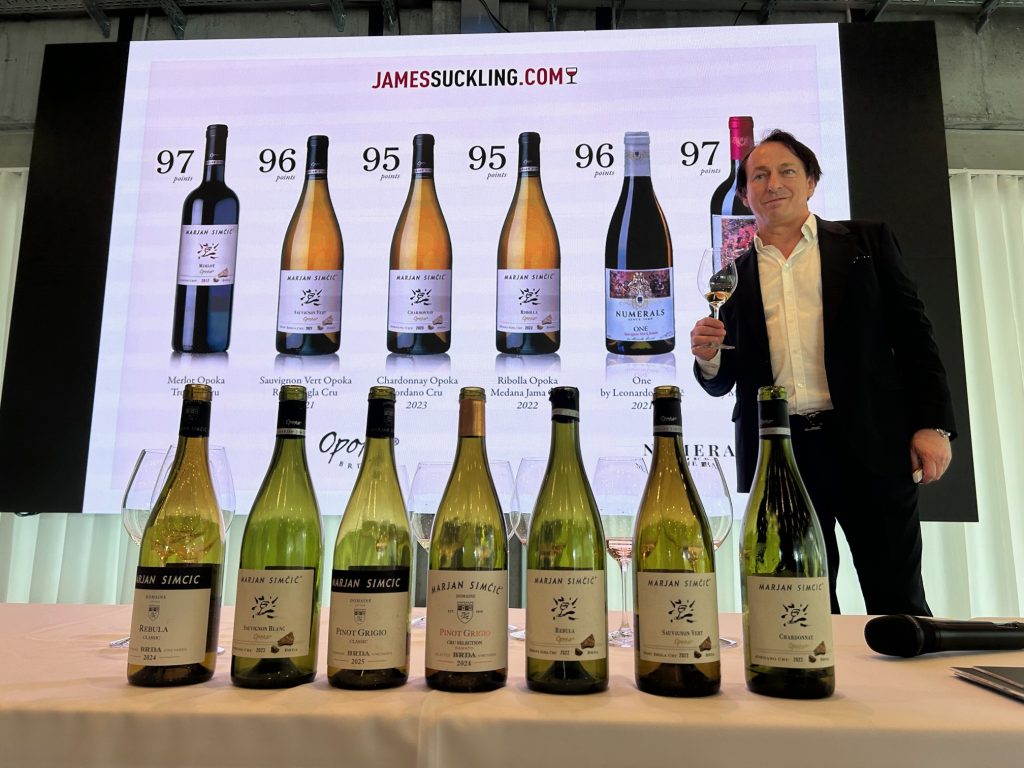
Those few sentences reveal everything: ambition, confidence, work, but also a quality that perhaps still describes him best today. With him, there is no phase of settling down. No moment when a man says he has done enough, that it is time to enjoy what he has achieved, time to repeat what has already proved successful. With Simčič, nothing seems finished. Not when he talks about his wines at the world’s most prestigious venues, nor about vineyards he has known all his life, nor about his own journey.
– You have to grow with wine. Like a child growing up and beginning to understand himself.
With him, that is no pose. It really is how he speaks and how he works. Even today, after decades in the same vineyards, he speaks like a man still searching for something, still making corrections, still pushing his own limits.
– I haven’t lost any of that enthusiasm or creativity. Even when you’ve been working for twenty years, you could say you’re only on the right path, at the beginning of the middle.
Simčič has long been operating at a level where mediocrity is no longer forgiven. His wines are drunk in markets that have no patience for provincialism, amateurism or local folklore packaged in expensive bottles. They occupy places reserved for wines that can withstand comparison. Yet precisely because of that, he now works with greater rigour, rather than greater ease. As though all his success so far has added to his obligations rather than lightened them.
In Brda, this is clearest early in the morning, before the day acquires its heat and sounds. The hills slowly reveal themselves, rows of vines emerge from the shadows, and the soil still holds the night’s moisture. For Simčič, even this scene is no postcard. There is nothing decorative about it. Everything is practical, tangible, serving what is still to come.
– You need brains and hardworking hands.
With him, that is not a platitude about honest work, but a literal description of the job. A vineyard is not managed from a distance, from a spreadsheet, or in the belief that anything neglected can later be made up for in the cellar. You look at the leaf, the bunch, the soil. You walk between the rows and know where the ground is harder, where it cracks more easily, where it holds moisture longer, where the vines start too early and where they lag behind. This is work in which decisions are made not once, but every week, sometimes every day.
That is why the spaces between his rows of vines are not bare.
– We have three different mixtures of plants, depending on the composition of the soil and what it needs.
They are sown in autumn, grow in spring, and are then dealt with in a way that differs from ordinary mowing.
– We don’t mulch in the conventional way. We have a roller that lays it all down and makes a carpet.
Underfoot there is neither bare earth nor closely cut grass, but a flattened mass of vegetation that retains moisture, stabilises the soil and protects it from the summer’s onslaught. Like a thick carpet you do not tread on unnecessarily. There are many such details. Each says the same thing: nothing is done because it looks attractive, but because there is a reason for it.
Everything he does comes back to the soil. Literally, rather than rhetorically. For him, the soil is where things begin and where they return. That is why Brda is the main character in this story, rather than a backdrop. Not the tidy, photogenic Brda of tourism, terraces and views, but the working Brda, full of abrupt changes, differences and small complications no outsider sees.
– We’re lucky that the winery is in the middle, with those nine small vineyard sites around it. No vineyard is more than two kilometres away, so everything is five minutes by tractor.
On paper, that is an advantage. In practice, it means no two vineyards are alike and each must be read separately. Slope, aspect, soil depth, water retention and airflow all change over short distances. What gives tension and freshness on one site can give softness, warmth or excess on another. That is why Simčič never speaks of the vineyard as a single whole. He speaks of sites. Of individual places. Of what each can withstand, and what it cannot.
– Terroir isn’t just soil and climate. Terroir is also the way you work.
For Simčič, terroir means nothing without the work behind it. That is why, some twenty years ago, he went so far as to open up his vineyards, quite literally.
– I carried out a thousand analyses. We drilled down to ten metres, at different elevations. I wanted to know what I had beneath my vineyards.
It was not curiosity, but a need to understand what he was working with. Once you know that, you stop speaking in generalities and begin speaking in specifics. About where the vines can be allowed to yield more and where they must be held back. About where you can wait and where you cannot. About when to let something develop and when to cut it back without mercy.
– If the grapes weren’t phenomenally ripe, I didn’t go in for long macerations.
Simčič is not a man enslaved to an idea. He does not do something because it is modern, daring or desirable within a particular wine fashion. He does only what makes sense at that moment, for that vineyard and those grapes.
– If you have a vineyard that produces a lot, it’s weaker. The skins are thinner and the vines are more sensitive. Quality comes when the vines have to struggle.
Less fruit. More concentration. More selection. And, ultimately, more decisions that are unpleasant but necessary.
– You can have one great vintage, but that means nothing. Quality is measurable. And if it isn’t up to standard, the wine is declassified.
With him, that is no pose. It is discipline. A wine that fails to meet the standard does not enter the top range merely because it is “supposed” to be there. It is downgraded. Or it is not made. That kind of discipline may be the truest form of respect for the place a wine comes from. If you keep saying that wine must speak of its soil, you cannot allow compromise to silence it.
In Simčič’s world, time is no decorative notion.
– Great wine takes time. You can’t make it quickly, regardless of money and technology.
– To change the soil, to develop that character, takes time. It isn’t something you do quickly.
Today, that sounds stubborn. His style has followed the same path: from a period when long maceration, oak and technique were legitimate tools to his present desire for wines that are more focused, tauter and more precise.
– We had the fashion for barrique ageing, excessive lees ageing, long macerations of white wines… but each of those techniques has to be used wisely.
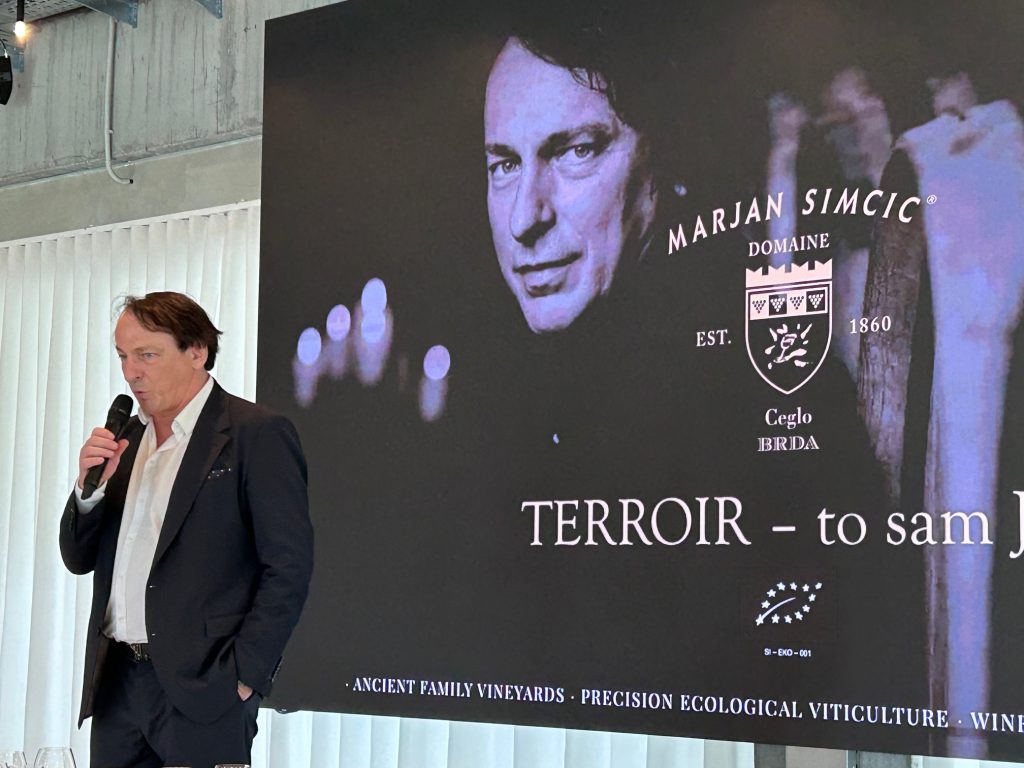
– Today, there is increasing demand for wines with body and character that remain fresh and vibrant, without 14 or 15 per cent alcohol.
– Wine has to be alive, dynamic and clear. Focused, vibrant, electric, keeping you on edge.
There is little to add to that sentence. It contains his style, his taste and his direction. There is no desire for bombast, or for a “greatness” measured in power. Quite the opposite. It is about tension, control and the sense that a wine endures rather than falling apart after the first impression.
– I wouldn’t start drinking that wine until it was four, five or six years old.
– Trends are information.
– A trend can be a stimulus, but it mustn’t be the reason.
– Technology can help you, but it can’t make a great wine.
– If you blend and lose that, the wine may be good, but it no longer has its distinctive character or uniqueness.
Simčič is no romantic who disdains selling wine. On the contrary, he knows very well where his wines are, who drinks them and why. But he does not accept a logic in which the market dictates the wine.
– I can’t increase production just because there’s demand.
– This isn’t a wine you can always get.
– These days, those wines are allocated more than they are sold.
Nor does he want to depend on a single market, country, distributor or wave of interest.
– Diversification means security.
– I have to know where my wine is going.
This is not control for its own sake. It is a way of ensuring that the wine does not lose its context. That it does not end up somewhere it does not belong. That it does not become merely a commodity.
Somewhere in all this, there is football too. Not as a charming addition to his biography, but as another arena in which the same character emerges.
– I got involved more or less by chance… I started coming to matches when my son began training, and then they persuaded me.
– It’s important not to promise too much, but to deliver on what we do promise.
The same logic applies here: sustained work, maintaining standards, no grand gestures or empty promises.
– When you’re in the first division, doors open to the best.
Very early on, he realised he had to look abroad.
– I realised very early that I had to go abroad.
– Once you go abroad, there’s nowhere left to hide.
At that level, there are no local mitigating circumstances. The wine must stand on its own. Neither the region, the story nor charm can help you. Only quality can. And to endure, that quality must remain faithful to the place it came from.
– I don’t want to depend on a single market.
– A variety without terroir can quickly become banal, very international.
– You can sell wine anywhere… but the question is what you’re selling.
Everything returns to where it begins. A small patch of land. Brda. Opoka, the local marl. To the decision not to rush what needs time. To a man who said fifteen years ago that he had succeeded, yet works today as though he is only now entering the most important phase of his work.
– It’s a process that takes years… and there’s always something more you can build on.
For him, succession is not an ending. His son is there, but without pressure.
– I don’t want to burden him. He’s following what we do, but let him decide for himself.
At the same time, it is clear that Simčič is no longer building only his own winery and label. His gaze has long extended to the wider region to which he belongs.
– I want to show that this can be one of the best regions in the world.
– I make wines that will be able to measure up to the best in the world.
That is no pose. It is a longstanding ambition and an awareness of what such a goal costs. That is why it is worth returning to the beginning. To that old statement, to the man who said then that he had succeeded, without suspecting that fifteen years later he would sound even hungrier than he did at the time.
– Most of my dreams have come true, and the others are within reach.
– I am convinced that, through persistence, honesty and love for this work, I will achieve even my highest goals.
There is the whole of Marjan Simčič. In the way he still works as though the most important things are yet to come, rather than in what he has already achieved.