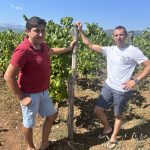
– What is it like to make a wine for a winery you do not own, dedicated to your late father? And to do so at the winery where you now hold his old position?
Matej Jovanov pauses briefly.
– It is certainly a great honour. But it was not easy to make a wine that has to achieve that level of quality and live up to everything the label represents. Especially because it is a new wine, and both the public and our colleagues expect something different from it.
The wine is called Memoire. It is dedicated to Janko Jovanov, the long-serving manager of the Čara Agricultural Cooperative and a man who devoted almost his entire working life to Pošip. After his death in January 2024, Matej took over his role as the cooperative’s chief oenologist.
– At first, I was not sure I had made the right decision, he admits. – But now I know my father would have been pleased. I think it is what he would have wanted too.

Today, at the Čara cooperative, he is responsible for more than two hundred thousand bottles a year and the grapes of around a hundred Korčula growers. Yet the hardest part of that responsibility cannot be expressed in numbers. He works among people who spent years working with Janko and who, whether they mean to or not, will compare every Pošip he makes with his father’s wines.
– What does it feel like to take his place?
– Good. Of course, there is a certain amount of pressure, but I think we work very well as a team at the winery today, and I believe my father would be proud of us.
Memoire is no attempt to reproduce Janko’s wines. Matej has taken over his father’s job, but he is not trying to become Janko in it. He still has to prove that he deserves the position he has inherited precisely as Matej.
The story of the man whose place he took, however, did not begin on Korčula.
The surname Jovanov does not sound native to Korčula. Matej’s family comes from Macedonia, from the area around Strumica, from where his grandfather moved to the Zadar area. Janko completed primary and secondary school there, then enrolled at the Faculty of Agriculture in Zagreb. During his studies, he met Marija, a woman from Zagreb with roots in Blato, with whom he would later come to Korčula and stay.
– Before coming to Korčula, did your father have any connection with wine beyond his university studies?
– No. When he arrived, he spent several years without a permanent job. He worked in the agricultural advisory service, more with olives and fruit, then joined the Čara cooperative and began learning about and working with wine there.
Although a trained agronomist, Janko had to educate himself further for the work that would define his life. He learned by working, reading and talking to older colleagues, testing what he discovered in the cellar.
– I would say he learned most of it through experience, books and conversations with people who had worked with wine before him, Matej says. – He did not talk much about himself or boast, but he was certainly proud of making Pošip a recognised wine and raising the whole cooperative to a higher level. I think he devoted his life to the Čara cooperative.
The cooperative was founded in 1984, when much of Korčula’s wine was still sold in bulk. Over the following decades, Janko helped turn it into one of Dalmatia’s most recognisable Pošip producers. Marko Polo became its most ambitious label, and both Vrhunski Pošip and Marko Polo later won medals at the International Wine Challenge in London.
Yet the scale of Janko’s influence is perhaps better conveyed by a story still told among people in Čara than by the medals.
– They told me that they used to cover the tanks with sheets and blankets and warm them up to get fermentation going, Matej recalls. – Then one day my father came in and said, “Stop. Now we are going to cool them.”

For people who had spent years trying to warm the must, it was almost unimaginable that someone would suddenly demand the opposite.
– They looked at him as if they were asking: how can we cool it now when we have always warmed it? Before he arrived, they did not have that knowledge or the facilities for controlled cool fermentation. He changed a great many things here.
He nevertheless made no attempt to designate his own son as his successor in advance.
It is hard to imagine Janko Jovanov’s son growing up on Korčula and remaining almost indifferent to wine for so long. Matej saw it on the family table and heard conversations about cellars, harvests and Pošip, but recognised no future of his own in any of it.
– When did you first take wine seriously? I imagine that, as a child, you were constantly hearing about it and seeing what your father did.
– I became interested in wine quite late.
– Wait, you enrolled at the Faculty of Agriculture, and you still weren’t interested?
– No.
– How is that possible?
– My father never forced anything on me. He did not put pressure on me or tell me I had to follow his path.
Even Korčula, an island where a vineyard, cellar or story about a grape variety seems to appear around almost every bend, was not enough to tempt him. In his younger years, he was much more drawn to football, water polo and swimming. He was so good at swimming that, for a while, a coach on Korčula tried to persuade the family that he should pursue it more seriously.
– Did you drink wine at all back then?
– I did, but I did not enjoy it or understand it as I would later. I only became seriously interested during my studies.
Enrolling at the Faculty of Agriculture in Zagreb was therefore no culmination of a path his father had mapped out for him, but the beginning of a search for his own. There, he shared a room with Lukša Hropić, who would later become a winemaker on Lastovo. The two roommates were connected by more than their studies: there was also a man whose contribution Matej still insists on acknowledging.

– That is something that must always be mentioned, he says. – My father was my greatest support, but alongside him, Frano Milina Bire was there all the time too. Without Frano, I probably would not have gone to university. Actually, not probably – definitely.
Bire did not help only him.
– He helped both Lukša and me. He followed our progress and supported us throughout. I think we have to be grateful to him for the rest of our lives.
At university, Janko’s previously uninterested son began making up for lost time. Lectures were not enough, so from his first year he sought out cellars where he could work, observe and ask questions. Once wine finally drew him in, he approached it as someone aware that he had to learn quickly everything he had spent years walking past without a second glance.
His first work placement was at Château Kamnik in Macedonia. Afterwards, he went to Plantaže “13. jul” in Montenegro, worked at the Čara cooperative and with Frano Milina Bire, then gained experience at the New Zealand wineries Oyster Bay and Villa Maria.
– What did each of those placements give you?
– A great deal, because I really soaked everything up. I was persistent, and everything interested me. I knew I did not have much time to learn, so I behaved like a sponge.
– Like SpongeBob?
– Exactly. Like SpongeBob.
In New Zealand, he saw what work looked like in large, meticulously organised wineries. Some of his colleagues did only what they were assigned, but that was not enough for Matej. He wanted to understand the whole process, rather than a single operation.

– We were not allowed to use mobile phones at work, but I always carried paper and a notebook. I wrote things down, followed what was happening and tried to understand everything.
Only when he worked far from home did he begin to understand how unusual the place he had left really was. Macedonia and Montenegro showed him regions where red wines were more convincing than whites, while in New Zealand, at least in the part of the wine industry he came to know, the emphasis was on white wines. Suddenly, Korčula revealed itself to him as much more complete.
– I do not think a climate like ours exists anywhere else. In such a small area, we can produce sparkling wines, light entry-level wines, serious whites and reds, and even dessert wines. We have many varieties that thrive here and can deliver high quality.
Somewhere between the Macedonian cellars and his New Zealand notebook, the idea of his own winery first appeared. Janko had not planted that idea in him, but he was the first person Matej confided in on returning home. Once again, his father did not tell him what he had to do; he helped him find a way to realise his own idea.
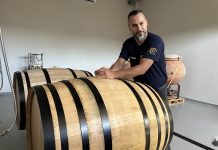
The space for a winery already existed: an old family house on the edge of the Blato plain, beside the vineyards at Krtinja.
– What was here before the winery?
– A stable.
While Matej was still studying, he and Janko discussed how they might restore it and turn it into a small cellar. This was to be Matej’s winery, rather than a scaled-down Čara cooperative: a place where he would decide for himself what to make from the family’s grapes and the knowledge he had gathered on his travels.
The first Jovanov Winery wines came from the 2019 harvest, and restoration of the old house was completed the following year. Since he did not yet have all the facilities he needed at the outset, Matej vinified them at Frano Milina Bire’s winery. Their collaboration continued after his own cellar was ready.
Janko did not interfere in his son’s winery as though he had a claim on it, but Matej did not pretend he had no need of his father’s experience.
– Did you let him mentor you, or did you want to do everything without his influence?
– Of course I did. I always listened to him. Sometimes what he said did not sit particularly well with me, but it all made sense.
Matej began making his own wines with an education, international experience and an idea of the wines he wanted to produce. That is why Jovanov Winery’s Pošip is no copy of his father’s Pošips from the Čara cooperative. It bears the signature of a man who respects what he has inherited but has no intention of repeating what has already been done.
Father and son did not have much time left to exchange experience and new ideas.
– How many harvests did you manage to work together?
– Three.
– Only three?
– Yes. Sadly, we had very little time.

While helping Matej establish his small winery in Blato, Janko continued managing the Čara cooperative and advising other Korčula winemakers. He died on 18 January 2024, aged fifty-nine.
Matej was left with the experience of just three harvests during which he could finally talk to his father as one winemaker to another. Soon he had to decide whether, besides his knowledge, he also wanted to take over the work to which Janko had devoted his life.
After Janko’s death, Matej already had his own winery, labels and enough work to devote himself entirely to what he had created. The Čara cooperative was something different: a large cooperative winery, grapes from numerous supplying growers, and decades of his father’s life built into its cellar.
– How did you come to start working at the Čara cooperative after your father died?
– I thought about what to do and eventually decided to succeed him.
– Were you sure straight away that you had made the right decision?
– No. But now I think it is the best decision I have made. The work really drew me in, and now I know my father would have been pleased.
That did not make Matej the owner of the cooperative, nor did the Čara cooperative become a second branch of his family winery. As chief oenologist, he took over a large operation and joined people who could not see him simply as a new head of production. To them, he was also Janko’s son.
He did not try to change everything simply to prove that he was different, but neither did he agree to become the custodian of a cellar where nothing could ever move again because Janko had worked there before him. His father’s legacy could not, for him, become a prohibition on the future.
That is why the first major tribute to his father was not a special edition of an existing label, an old vintage brought out of the archive or an attempt to reproduce Marko Polo. It had to be a new wine, a Pošip of a kind the Čara cooperative had never made before.
They called it Memoire.
The grapes were specially selected. The wine spent a year ageing in wood, then roughly six months in stainless steel, followed by time in bottle before release. Making it at the cooperative meant reconciling ambition with large-scale production, grapes from numerous growers and a style consumers had recognised for decades. Matej could not forget what the Čara cooperative was, but neither could he allow a tribute to the man who had continually changed the winery to remain trapped in the past.
– My father did not talk much about himself or boast, he says. – But he laid the foundations of both the winery and its Pošip. I think Memoire is the least he deserved.

Every bottle preserves Janko’s memory, but Matej signs off on the wine. If it is good, many will recognise his father’s teaching in it; if it falls short, the memory cannot bear the responsibility. That is the greatest burden of succession: he must make decisions without being able to consult the man whose name the wine commemorates.
From Čara, Matej returns to Blato, to his own small winery, where his responsibilities look quite different. It is there that one sees most clearly that Janko’s successor has no interest in living in his father’s shadow.
When he made his first wines, Blato did not have the standing on Korčula’s wine map enjoyed by Čara, Smokvica or Lumbarda. There was a long winegrowing tradition, but no variety that gave the town a clearly recognisable modern identity.
– As far as I know, at that point only Bačić was making Cetinka as a single-variety wine, Matej says. – The Blato cooperative used it in blends, but it was not recognised as a variety in its own right.
– And you had no doubts about starting with it?
– None, precisely because it had not yet been recognised.
He also knew Cetinka through his father’s work. Janko had been one of the partners in Korkyra winery, which was producing a blend of Cetinka, Rukatac and Pošip as early as 1994. In a variety used mostly as an invisible component of other wines, Matej saw the potential for a hallmark of his own winery.
– I think Cetinka is our local future. It makes a light, fresh wine of the kind people enjoy, especially in summer.
He also made a sparkling wine from it, showing that Dalmatian heat and sparkling wines could, after all, belong to the same story.
– Cetinka has really lovely acidity. It is excellent for sparkling wine, but also for a light entry-level wine. Pošip and Grk make more complex, powerful wines, that more robust side of Dalmatia, while Cetinka is something quite different.
He also planted Grk at Krtinja, where the soil is red earth rather than Lumbarda’s sand. On the Blato plain, he recognised the potential of Syrah, bottling it on its own in a limited run of six hundred bottles and also blending it with Plavac Mali.
He feels no sentimentality towards Plavac simply because it is Dalmatia’s best-known red variety.
– Why don’t you bottle it on its own?
– Because on our sites it does not deliver what it should. It does not manage to develop the quality it needs. It is quite wild and rough.
Yet the variety in which he perhaps sees the greatest potential appears neither among his labels nor in his new plantings. So far, he has made just a hundred bottles from it, while still a student. It is called Zlatarica Blatska.
– You mention Zlatarica as a variety with great potential for dessert wines.
– Not just for dessert wines, but for entry-level wines too. The flavour of the grapes themselves is reminiscent of peppermint, something incredible. I have never tasted that flavour in any other grapes.

– Do you make it?
– Unfortunately, no.
The answer is unusual, because Matej devoted his final thesis to Zlatarica, searched for its surviving vines around Blato and Smokvica, and made his own wine from the grapes he managed to collect.
– For my thesis, I picked around ten or twenty kilograms in Blato, and another twenty or thirty at a colleague’s vineyard in Smokvica. That was everything.
One of the vineyards where he found it belonged to Iko Cetinić Koća, an old grape grower from Blato who had preserved a few Zlatarica vines among his plantings. After harvest, they dried the grapes in an attic.
– We made a hundred bottles.
– Of dessert wine?
– Dessert wine. It was incredible. We tasted it with colleagues from the faculty in Zagreb and a colleague from Slovenia, but I had nothing to compare it with. It was incomparable.
– Does anyone make it today?
– Nobody. There may be only fifty to a hundred vines left on the whole island.
Later came other varieties, his return to Blato and labels that had to find a market. Zlatarica remained in his thesis, in the memory of a hundred bottles and in the occasional old vineyard.
– And that wasn’t enough for you to carry on?
– When I didn’t continue then, I never did later either. In the meantime, I already had established varieties and a production system in place. Zlatarica would be more of an experiment, something I would make for myself and my own enjoyment.
– Then make at least a hundred litres. You have a variety that you yourself say has greater potential than Pošip and Grk. You devoted your thesis to it, have already made wine from it and know where the remaining vines are. What more do you need?
Matej laughs, but no longer dismisses the possibility as firmly as he did a few minutes earlier.
– True, true.
– Arrange to buy the grapes from Iko Cetinić, collect what is available in Smokvica and make those hundred bottles again. I will call you in September to check whether you harvested the Zlatarica.
– Don’t worry.
A conversation that began as a recollection of a forgotten student experiment ended with a promise that may not yet have been entirely serious, but no longer sounded like a joke either. While in Čara he bears responsibility for the variety his father helped make great, at his own winery Matej has the opportunity to bring back a wine from a variety Blato has almost lost.
Still, the bottle that weighs most heavily remains the one on the table at the Čara cooperative.
It contains selected grapes, time spent in wood and the experience Matej gained from Macedonia to New Zealand. Its making also holds the three harvests he managed to share with his father, all Janko’s comments that did not initially sit well with him, and the decisions on which he can no longer ask his advice.
The label commemorates Janko, but responsibility for the wine belongs to Matej.
Perhaps that is the answer to how difficult it is to take the place of a man others considered irreplaceable. Matej will not replace him by trying to become another Janko. His father never taught him to do that: he did not prescribe his path, but let him leave, acquire his own knowledge and one day return of his own accord. Memoire is a wine of remembrance, but it does not live on the past. Janko laid the foundations of the winery and its Pošip, and Matej’s duty is to build something of his own upon them. He will prove worthy of his father’s position by creating wines that will one day ensure Matej’s name is remembered alongside Janko’s, rather than by repeating his father’s wines.